ScienceFreePrintable

Introduction to Electrical Circuits

A free science worksheet ready for your classroom. Open in Kuraplan to grab the print-ready PDF, customize it for your students, or generate a fresh version in seconds.
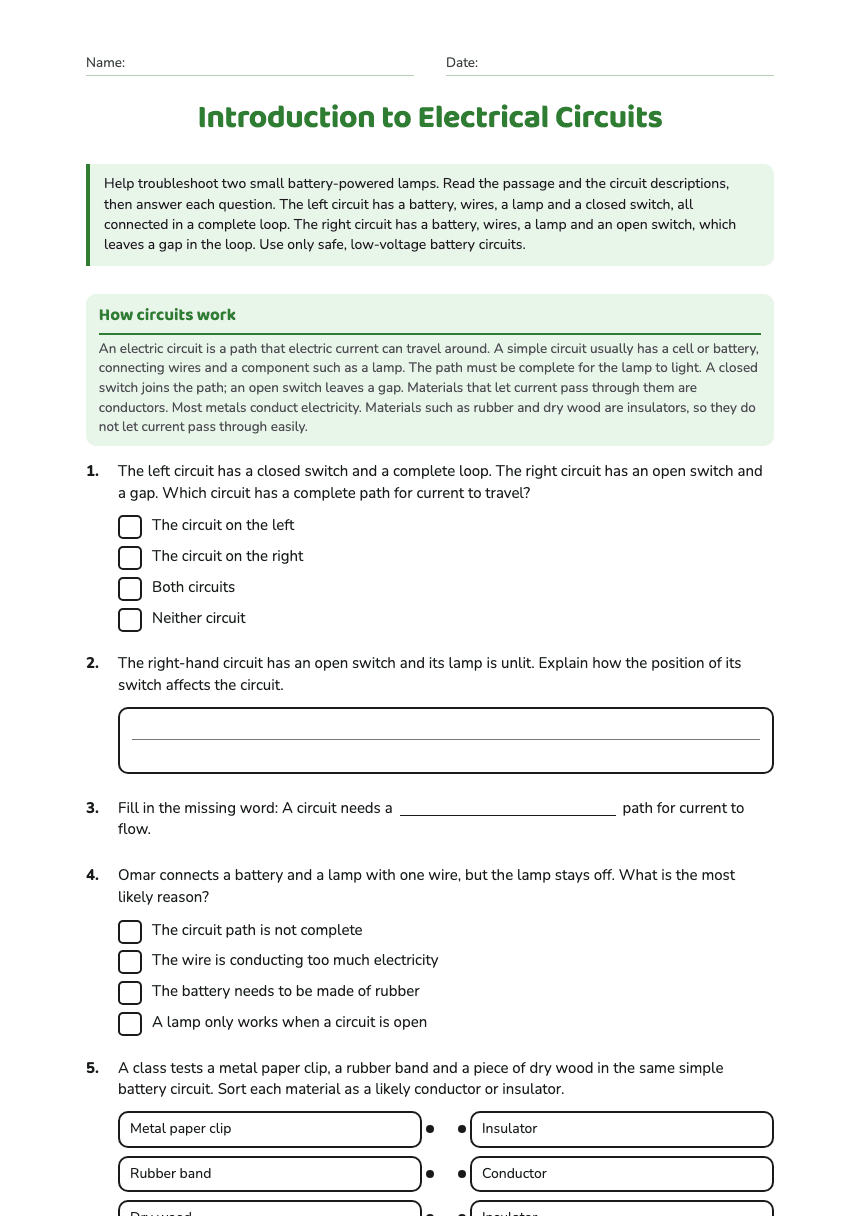
Introduction to Electrical Circuits worksheet preview
Name:Date:

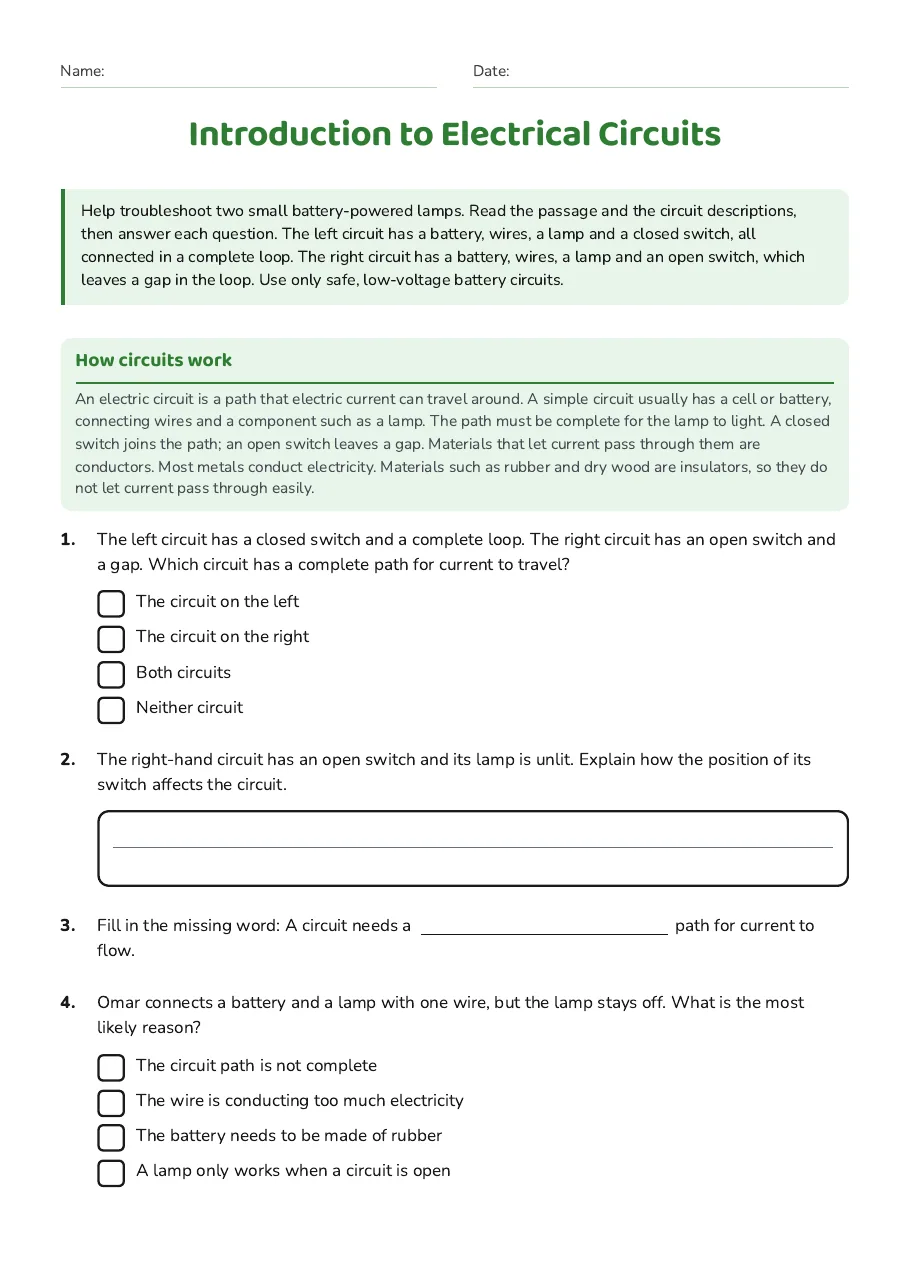
Introduction to Electrical Circuits

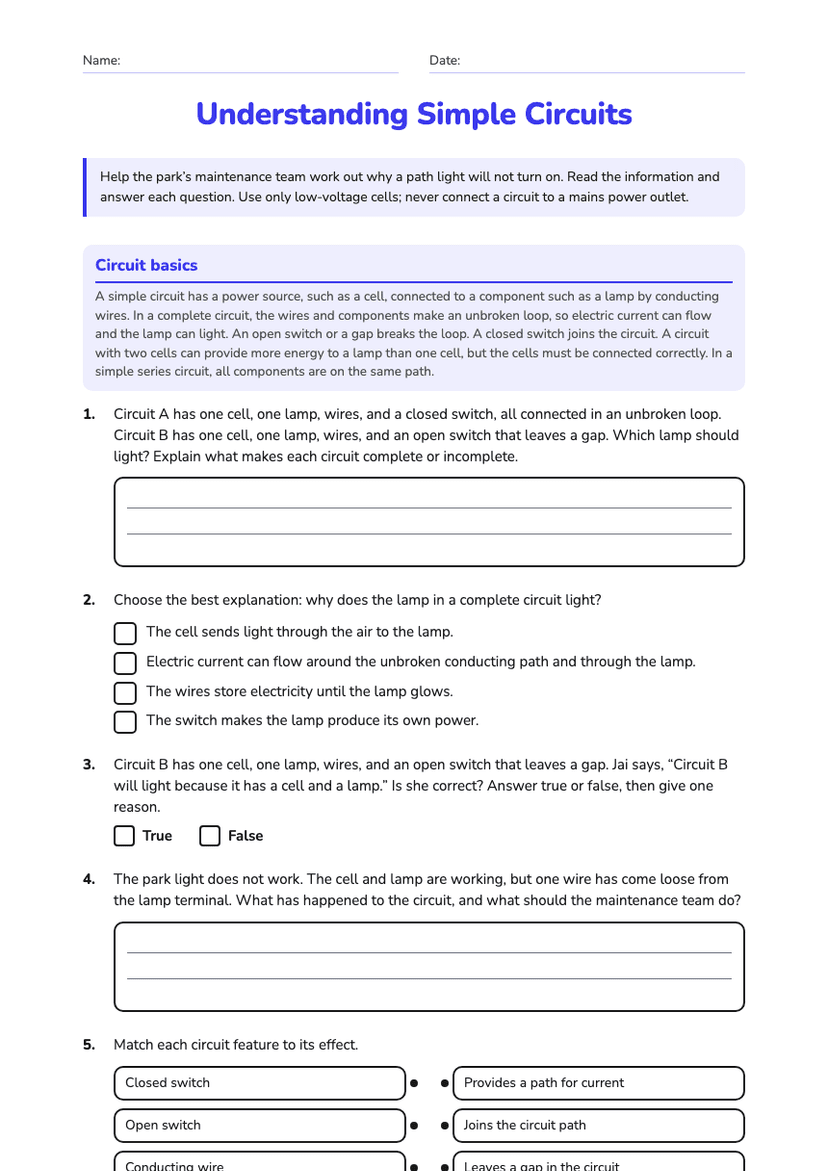
Help troubleshoot two small battery-powered lamps. Read the passage and the circuit descriptions, then answer each question. The left circuit has a battery, wires, a lamp and a closed switch, all connected in a complete loop. The right circuit has a battery, wires, a lamp and an open switch, which leaves a gap in the loop. Use only safe, low-voltage battery circuits.

How circuits work

An electric circuit is a path that electric current can travel around. A simple circuit usually has a cell or battery, connecting wires and a component such as a lamp. The path must be complete for the lamp to light. A closed switch joins the path; an open switch leaves a gap. Materials that let current pass through them are conductors. Most metals conduct electricity. Materials such as rubber and dry wood are insulators, so they do not let current pass through easily.

1.The left circuit has a closed switch and a complete loop. The right circuit has an open switch and a gap. Which circuit has a complete path for current to travel?
  • The circuit on the left
  • The circuit on the right
  • Both circuits
  • Neither circuit
2.The right-hand circuit has an open switch and its lamp is unlit. Explain how the position of its switch affects the circuit.
3.Fill in the missing word: A circuit needs a path for current to flow.
4.Omar connects a battery and a lamp with one wire, but the lamp stays off. What is the most likely reason?
  • The circuit path is not complete
  • The wire is conducting too much electricity
  • The battery needs to be made of rubber
  • A lamp only works when a circuit is open
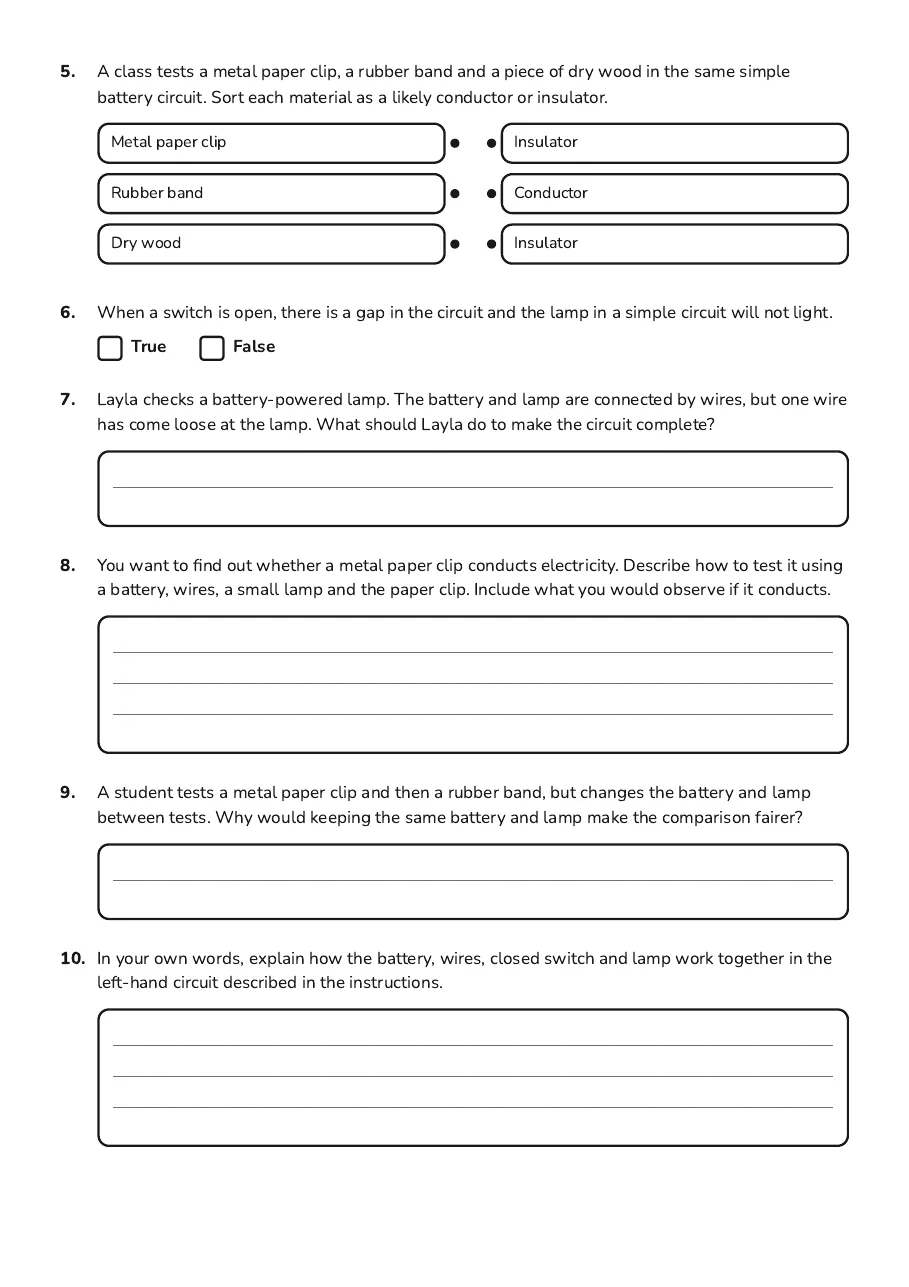
5.A class tests a metal paper clip, a rubber band and a piece of dry wood in the same simple battery circuit. Sort each material as a likely conductor or insulator.
  • Metal paper clip
  • Rubber band
  • Dry wood
  • Insulator
  • Conductor
  • Insulator
6.When a switch is open, there is a gap in the circuit and the lamp in a simple circuit will not light.
TrueFalse
7.Layla checks a battery-powered lamp. The battery and lamp are connected by wires, but one wire has come loose at the lamp. What should Layla do to make the circuit complete?
8.You want to find out whether a metal paper clip conducts electricity. Describe how to test it using a battery, wires, a small lamp and the paper clip. Include what you would observe if it conducts.
9.A student tests a metal paper clip and then a rubber band, but changes the battery and lamp between tests. Why would keeping the same battery and lamp make the comparison fairer?
10.In your own words, explain how the battery, wires, closed switch and lamp work together in the left-hand circuit described in the instructions.

2 printable pages

  • Introduction to Electrical Circuits, page 1 of 2: How circuits work

    Page 1

  • Introduction to Electrical Circuits, page 2 of 2: 5. A class tests a metal paper clip, a rubber band and a piece of dry wood in the same…

    Page 2

About This Worksheet

Free in Kuraplan

Sign up free, grab the PDF, and customize it for your class.

Print-Ready

Formatted for standard paper. Clean layout, easy to read.

AI-Generated

Created with Kuraplan's AI, designed for real classroom use.

For Teachers & Parents

Use in classrooms, for homework, tutoring, or homeschool.

Need a custom version of this worksheet?

Kuraplan's AI generates custom worksheets in seconds — differentiated for every learner, aligned to your curriculum.

Generate Custom Worksheets — Free
No credit card Curriculum-aligned Under 60 seconds