ScienceFreePrintable

Kinematic Motion Claims Testing

A free science worksheet ready for your classroom. Open in Kuraplan to grab the print-ready PDF, customize it for your students, or generate a fresh version in seconds.
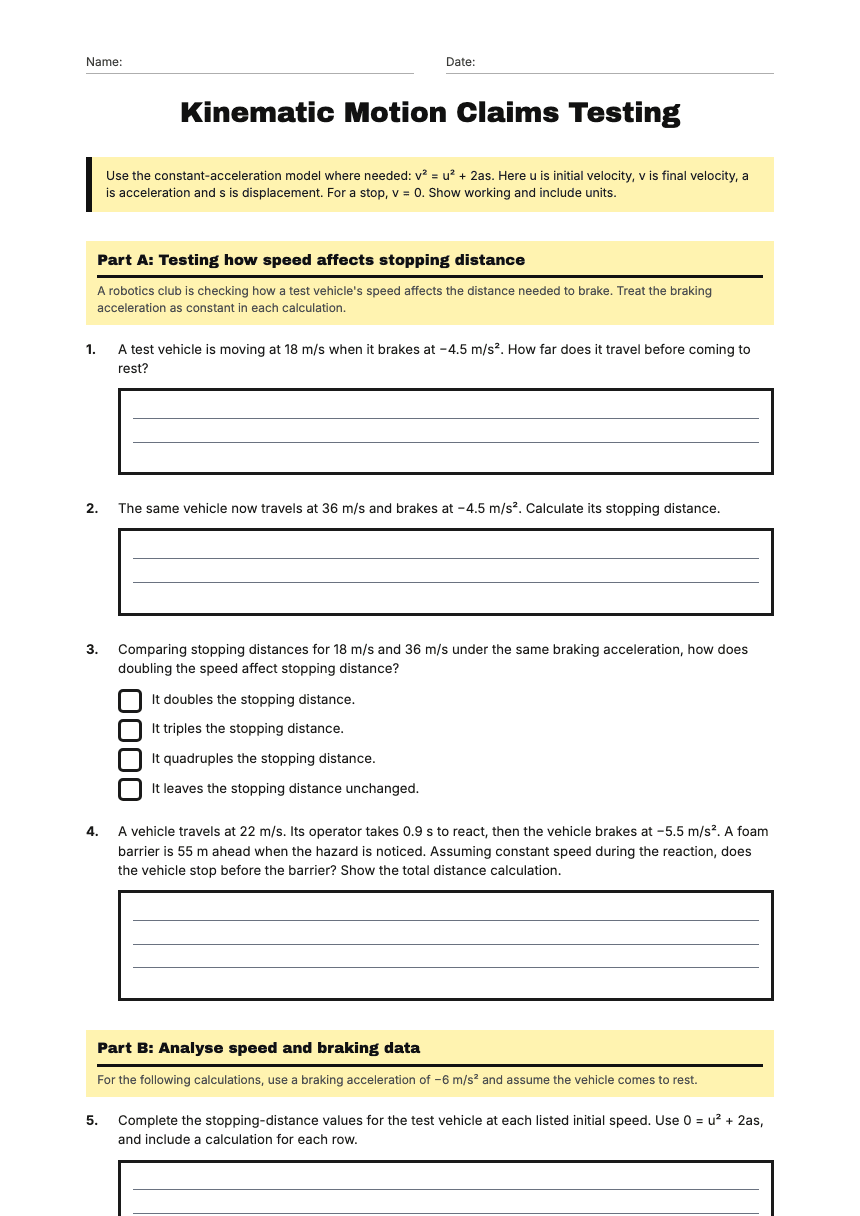
Kinematic Motion Claims Testing worksheet preview
Name:Date:

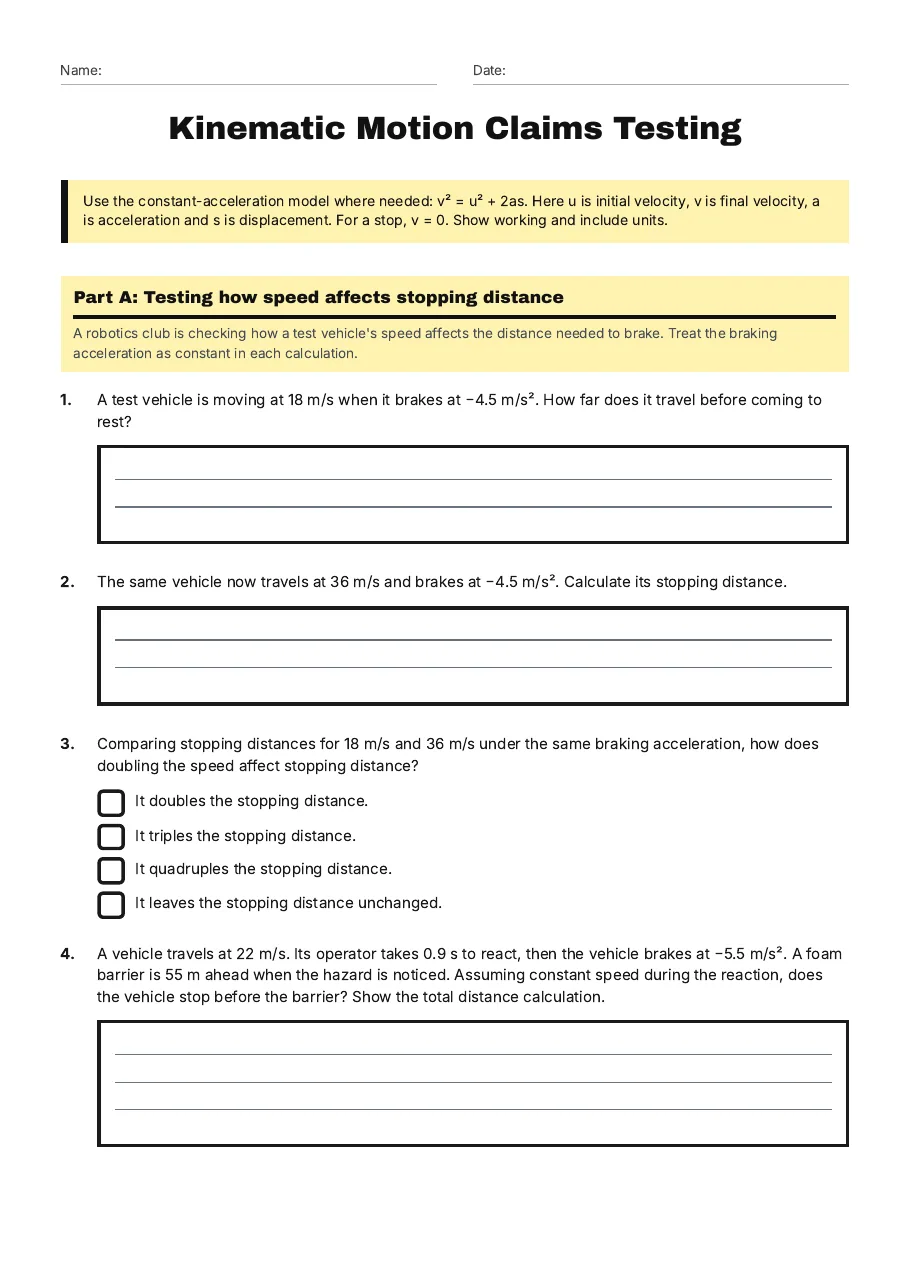
Kinematic Motion Claims Testing

Use the constant-acceleration model where needed: v² = u² + 2as. Here u is initial velocity, v is final velocity, a is acceleration and s is displacement. For a stop, v = 0. Show working and include units.

Part A: Testing how speed affects stopping distance

A robotics club is checking how a test vehicle's speed affects the distance needed to brake. Treat the braking acceleration as constant in each calculation.

1.A test vehicle is moving at 18 m/s when it brakes at −4.5 m/s². How far does it travel before coming to rest?
2.The same vehicle now travels at 36 m/s and brakes at −4.5 m/s². Calculate its stopping distance.
3.Comparing stopping distances for 18 m/s and 36 m/s under the same braking acceleration, how does doubling the speed affect stopping distance?
  • It doubles the stopping distance.
  • It triples the stopping distance.
  • It quadruples the stopping distance.
  • It leaves the stopping distance unchanged.
4.A vehicle travels at 22 m/s. Its operator takes 0.9 s to react, then the vehicle brakes at −5.5 m/s². A foam barrier is 55 m ahead when the hazard is noticed. Assuming constant speed during the reaction, does the vehicle stop before the barrier? Show the total distance calculation.

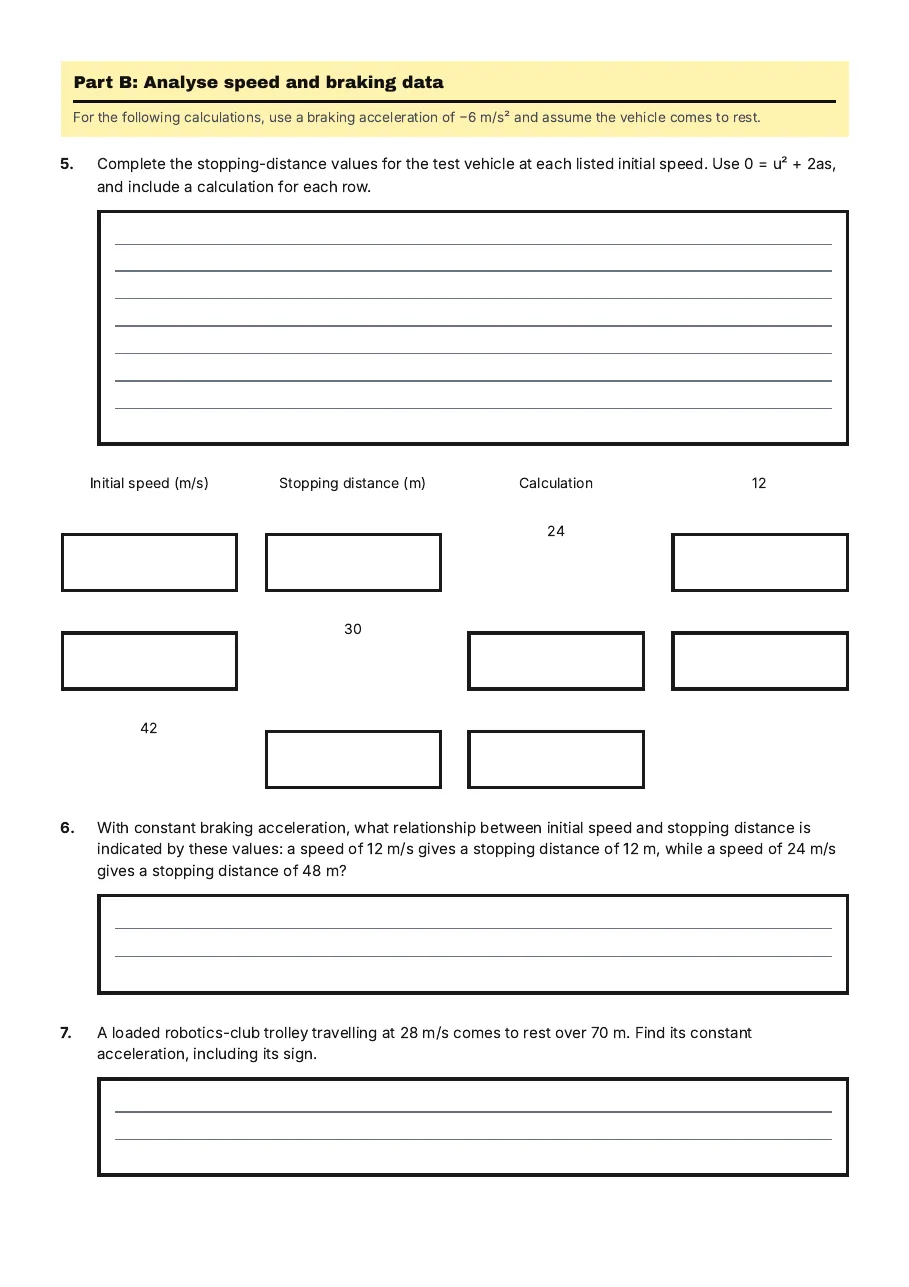
Part B: Analyse speed and braking data

For the following calculations, use a braking acceleration of −6 m/s² and assume the vehicle comes to rest.

5.Complete the stopping-distance values for the test vehicle at each listed initial speed. Use 0 = u² + 2as, and include a calculation for each row.

Initial speed (m/s)

Stopping distance (m)

Calculation

12

24

30

42

6.With constant braking acceleration, what relationship between initial speed and stopping distance is indicated by these values: a speed of 12 m/s gives a stopping distance of 12 m, while a speed of 24 m/s gives a stopping distance of 48 m?
7.A loaded robotics-club trolley travelling at 28 m/s comes to rest over 70 m. Find its constant acceleration, including its sign.

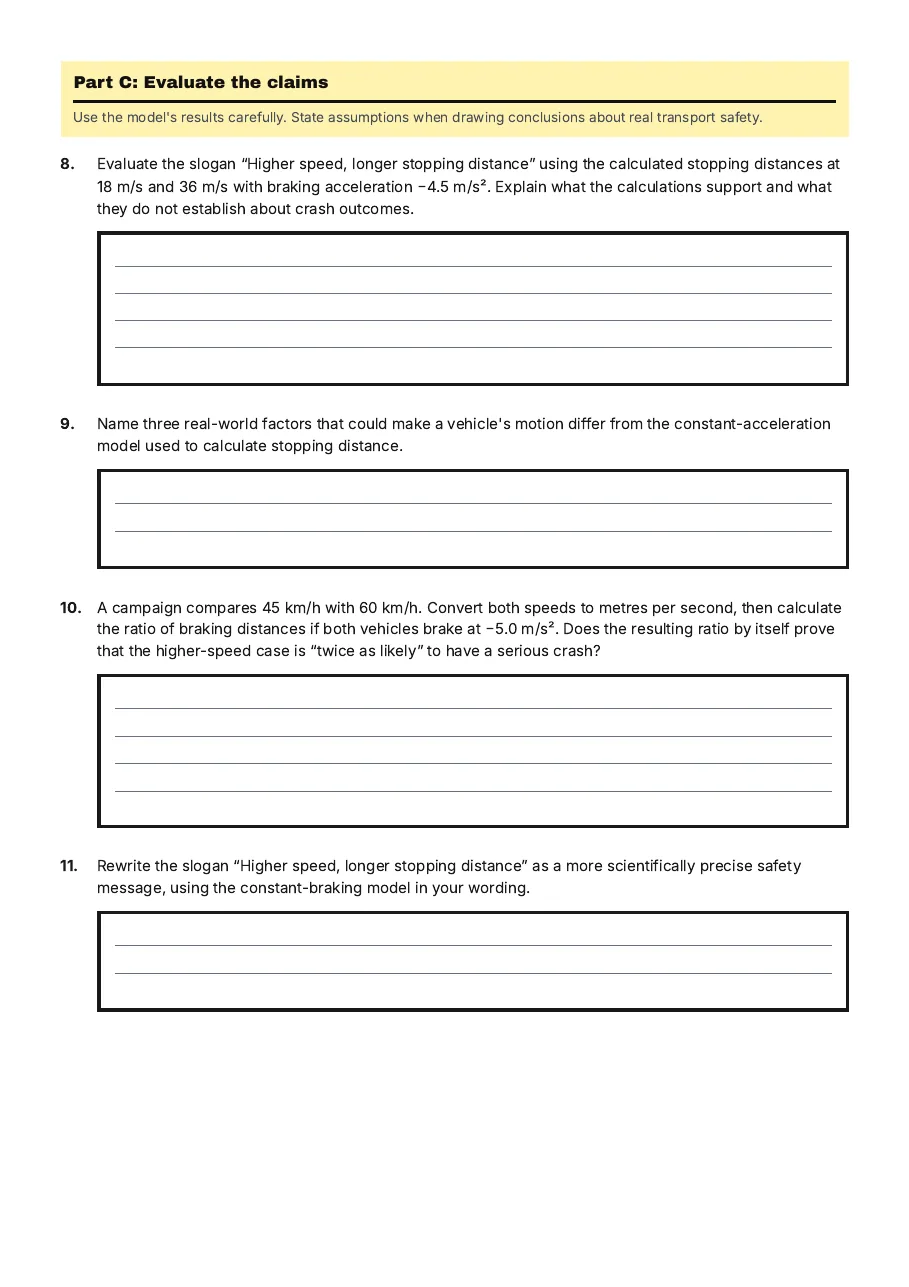
Part C: Evaluate the claims

Use the model's results carefully. State assumptions when drawing conclusions about real transport safety.

8.Evaluate the slogan “Higher speed, longer stopping distance” using the calculated stopping distances at 18 m/s and 36 m/s with braking acceleration −4.5 m/s². Explain what the calculations support and what they do not establish about crash outcomes.
9.Name three real-world factors that could make a vehicle's motion differ from the constant-acceleration model used to calculate stopping distance.
10.A campaign compares 45 km/h with 60 km/h. Convert both speeds to metres per second, then calculate the ratio of braking distances if both vehicles brake at −5.0 m/s². Does the resulting ratio by itself prove that the higher-speed case is “twice as likely” to have a serious crash?
11.Rewrite the slogan “Higher speed, longer stopping distance” as a more scientifically precise safety message, using the constant-braking model in your wording.

3 printable pages

  • Kinematic Motion Claims Testing, page 1 of 3: Part A: Testing how speed affects stopping distance

    Page 1

  • Kinematic Motion Claims Testing, page 2 of 3: Part B: Analyse speed and braking data

    Page 2

  • Kinematic Motion Claims Testing, page 3 of 3: Part C: Evaluate the claims

    Page 3

About This Worksheet

Free in Kuraplan

Sign up free, grab the PDF, and customize it for your class.

Print-Ready

Formatted for standard paper. Clean layout, easy to read.

AI-Generated

Created with Kuraplan's AI, designed for real classroom use.

For Teachers & Parents

Use in classrooms, for homework, tutoring, or homeschool.

Need a custom version of this worksheet?

Kuraplan's AI generates custom worksheets in seconds — differentiated for every learner, aligned to your curriculum.

Generate Custom Worksheets — Free
No credit card Curriculum-aligned Under 60 seconds