Te Reo MāoriFreePrintable

Marae Protocol Role-Play

A free te reo māori worksheet ready for your classroom. Open in Kuraplan to grab the print-ready PDF, customize it for your students, or generate a fresh version in seconds.
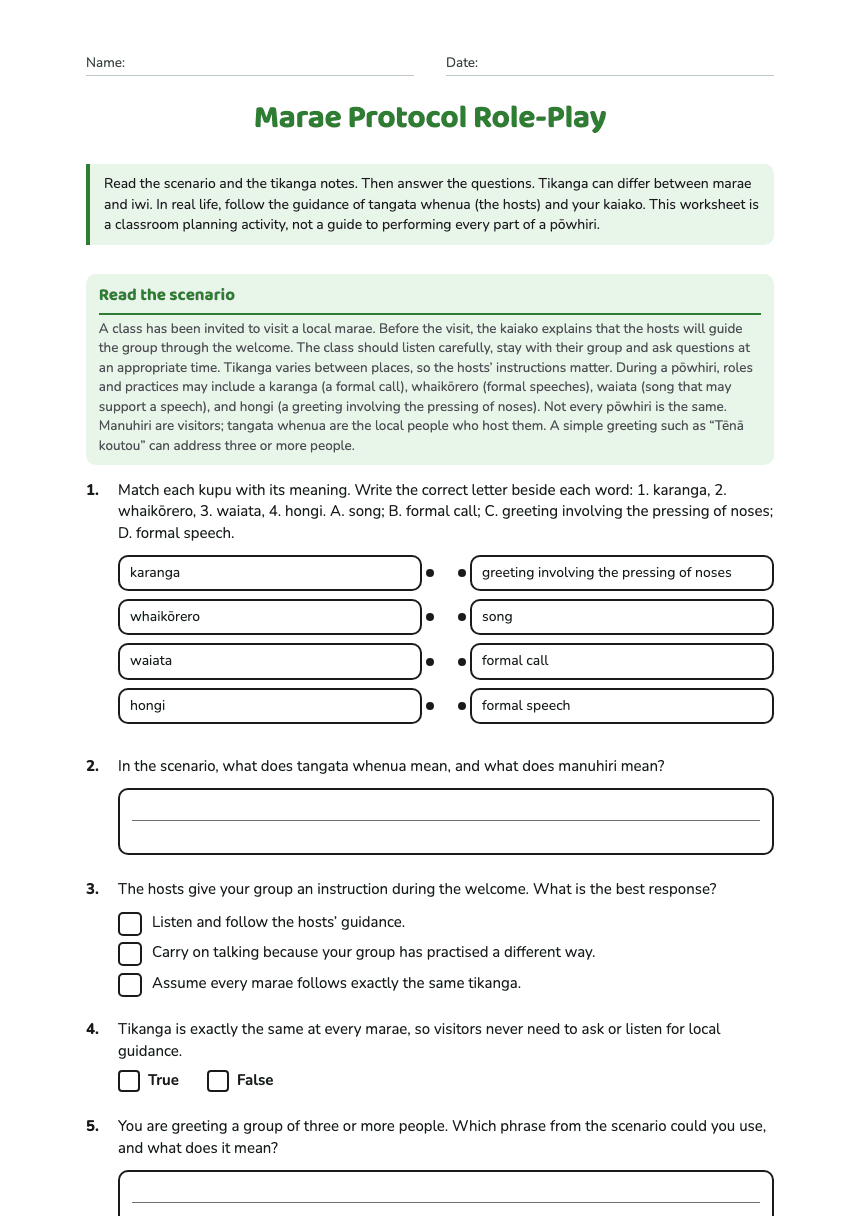
Marae Protocol Role-Play worksheet preview
Name:Date:

Marae Protocol Role-Play

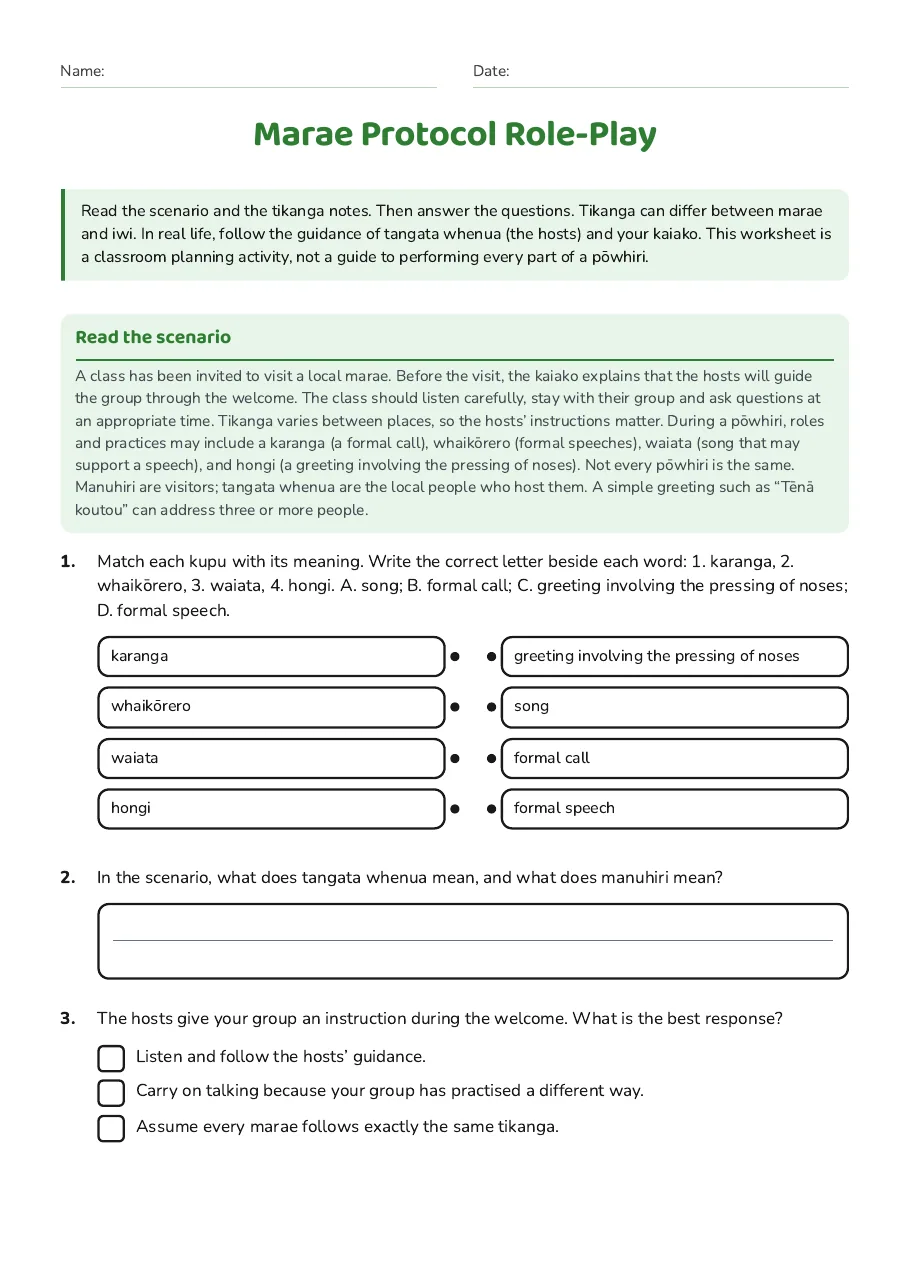
Read the scenario and the tikanga notes. Then answer the questions. Tikanga can differ between marae and iwi. In real life, follow the guidance of tangata whenua (the hosts) and your kaiako. This worksheet is a classroom planning activity, not a guide to performing every part of a pōwhiri.

Read the scenario

A class has been invited to visit a local marae. Before the visit, the kaiako explains that the hosts will guide the group through the welcome. The class should listen carefully, stay with their group and ask questions at an appropriate time. Tikanga varies between places, so the hosts’ instructions matter. During a pōwhiri, roles and practices may include a karanga (a formal call), whaikōrero (formal speeches), waiata (song that may support a speech), and hongi (a greeting involving the pressing of noses). Not every pōwhiri is the same. Manuhiri are visitors; tangata whenua are the local people who host them. A simple greeting such as “Tēnā koutou” can address three or more people.

1.Match each kupu with its meaning. Write the correct letter beside each word: 1. karanga, 2. whaikōrero, 3. waiata, 4. hongi. A. song; B. formal call; C. greeting involving the pressing of noses; D. formal speech.
  • karanga
  • whaikōrero
  • waiata
  • hongi
  • greeting involving the pressing of noses
  • song
  • formal call
  • formal speech
2.In the scenario, what does tangata whenua mean, and what does manuhiri mean?
3.The hosts give your group an instruction during the welcome. What is the best response?
  • Listen and follow the hosts’ guidance.
  • Carry on talking because your group has practised a different way.
  • Assume every marae follows exactly the same tikanga.
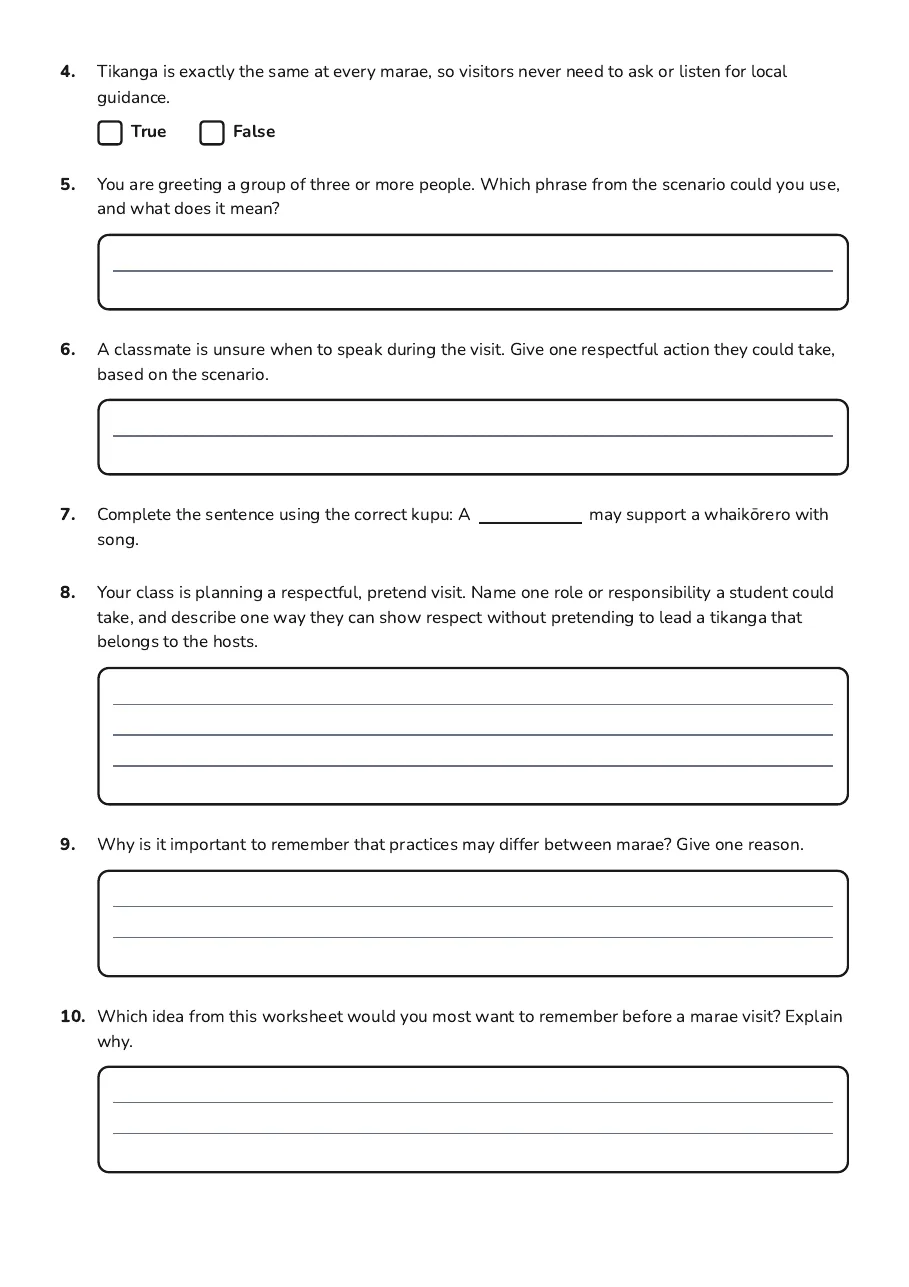
4.Tikanga is exactly the same at every marae, so visitors never need to ask or listen for local guidance.
TrueFalse
5.You are greeting a group of three or more people. Which phrase from the scenario could you use, and what does it mean?
6.A classmate is unsure when to speak during the visit. Give one respectful action they could take, based on the scenario.
7.Complete the sentence using the correct kupu: A may support a whaikōrero with song.
8.Your class is planning a respectful, pretend visit. Name one role or responsibility a student could take, and describe one way they can show respect without pretending to lead a tikanga that belongs to the hosts.
9.Why is it important to remember that practices may differ between marae? Give one reason.
10.Which idea from this worksheet would you most want to remember before a marae visit? Explain why.
Create a small reminder card for visitors. Draw or write one respectful action to remember, such as listening to the hosts’ guidance. Do not draw or invent ceremonial instructions.

3 printable pages

  • Marae Protocol Role-Play, page 1 of 3: Read the scenario

    Page 1

  • Marae Protocol Role-Play, page 2 of 3: 4. Tikanga is exactly the same at every marae, so visitors never need to ask or listen…

    Page 2

  • Marae Protocol Role-Play, page 3 of 3: Create a small reminder card for visitors. Draw or write one respectful action to…

    Page 3

About This Worksheet

Free in Kuraplan

Sign up free, grab the PDF, and customize it for your class.

Print-Ready

Formatted for standard paper. Clean layout, easy to read.

AI-Generated

Created with Kuraplan's AI, designed for real classroom use.

For Teachers & Parents

Use in classrooms, for homework, tutoring, or homeschool.

Need a custom version of this worksheet?

Kuraplan's AI generates custom worksheets in seconds — differentiated for every learner, aligned to your curriculum.

Generate Custom Worksheets — Free
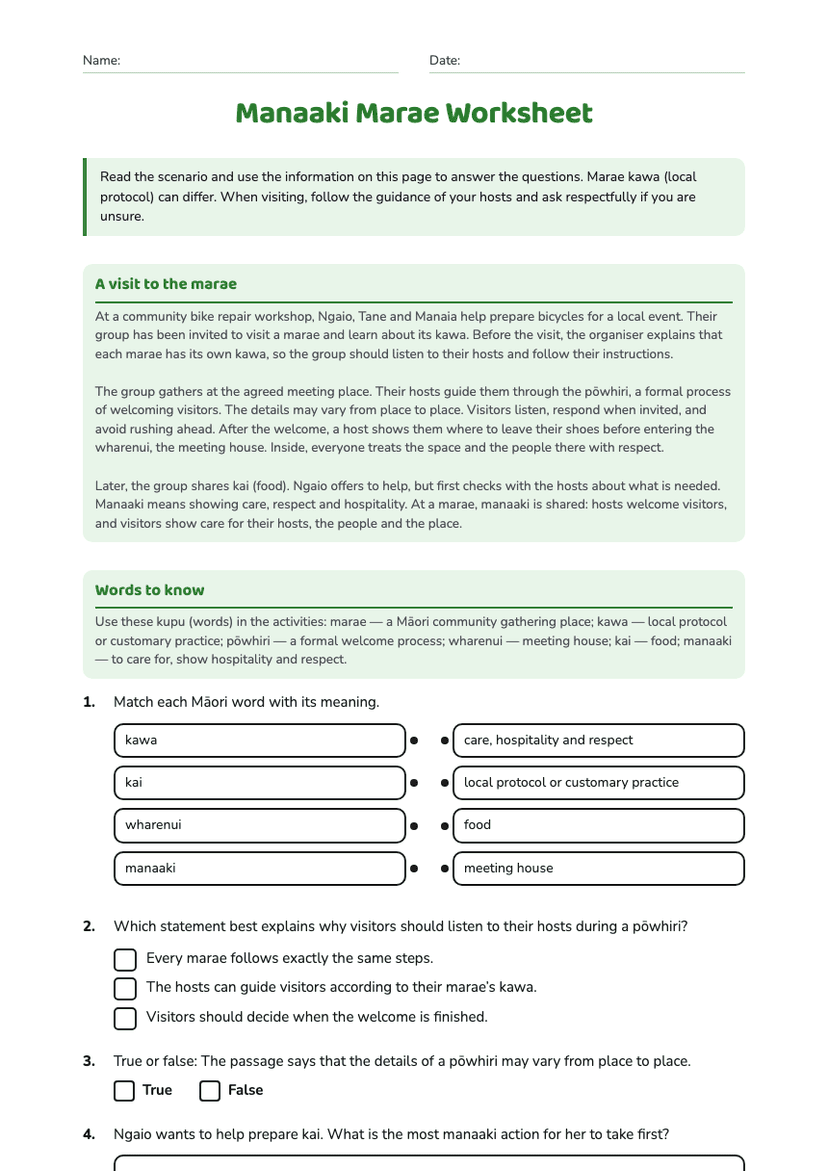
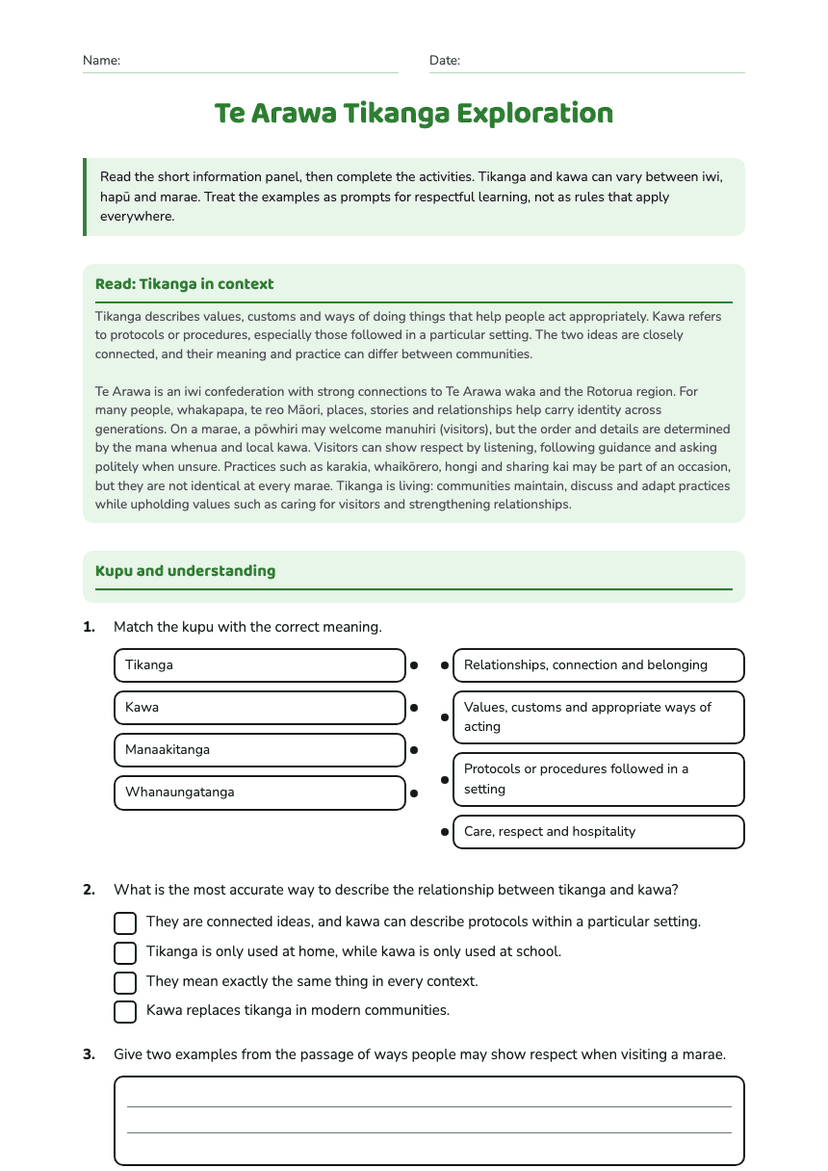
No credit card Curriculum-aligned Under 60 seconds

Explore more free resources