Modernisation and Westernisation Impacts
A free social sciences worksheet ready for your classroom. Open in Kuraplan to grab the print-ready PDF, customize it for your students, or generate a fresh version in seconds.
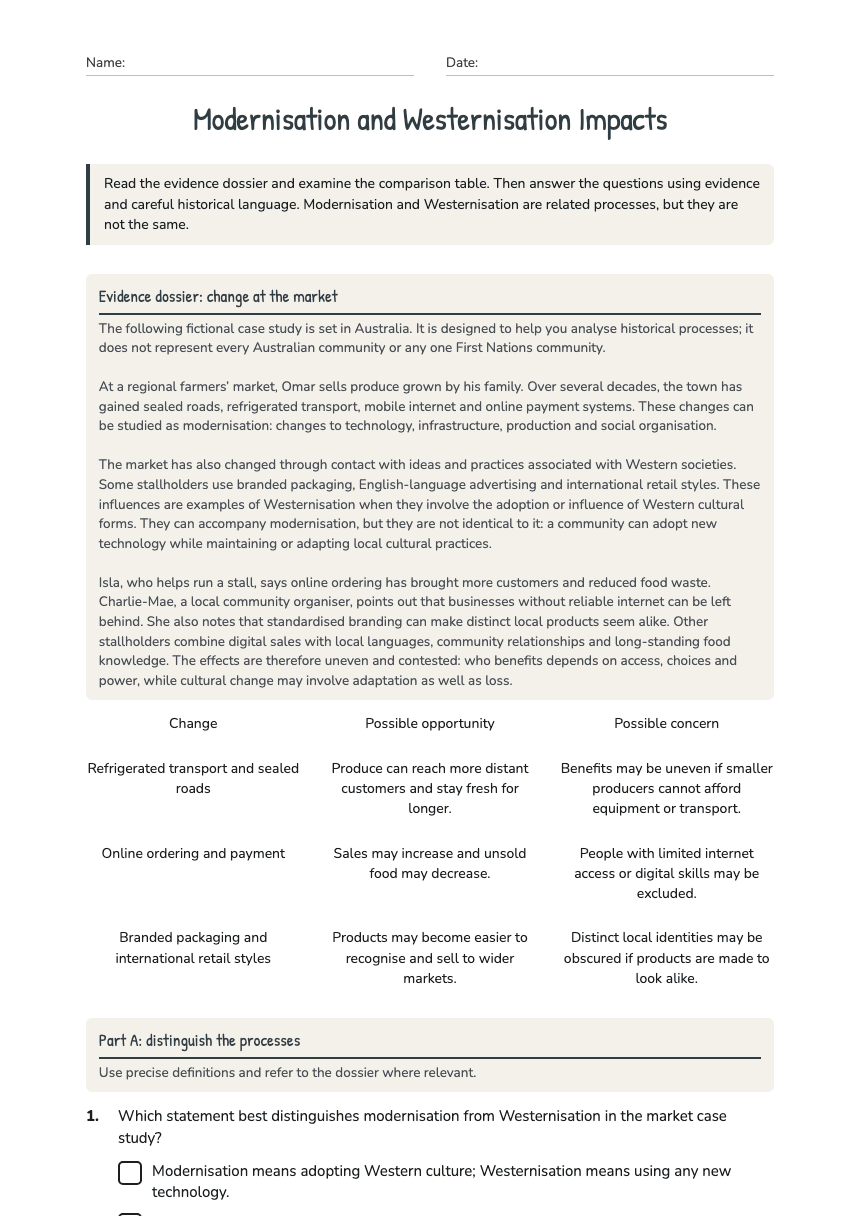
Modernisation and Westernisation Impacts
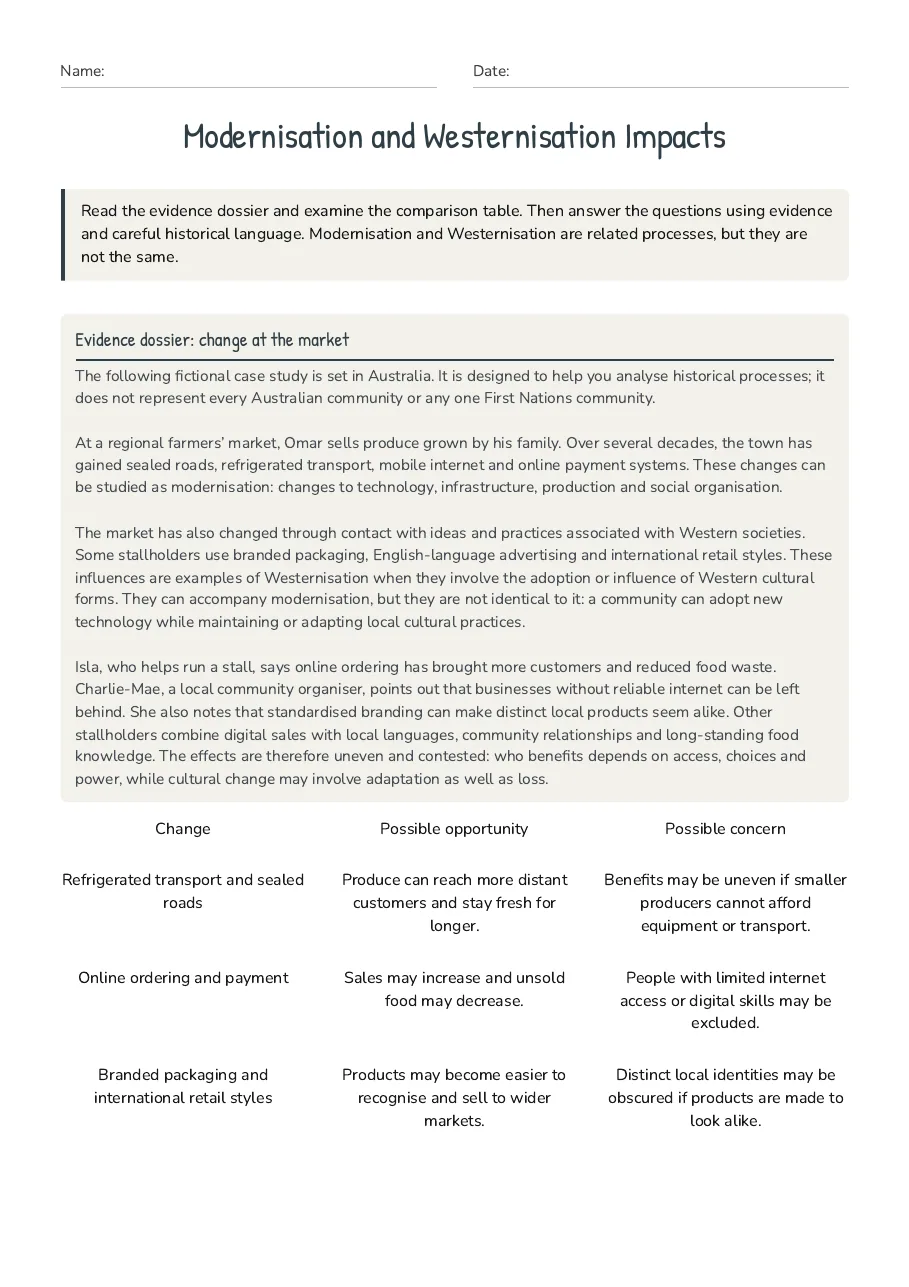
Evidence dossier: change at the market
The following fictional case study is set in Australia. It is designed to help you analyse historical processes; it does not represent every Australian community or any one First Nations community. At a regional farmers’ market, Omar sells produce grown by his family. Over several decades, the town has gained sealed roads, refrigerated transport, mobile internet and online payment systems. These changes can be studied as modernisation: changes to technology, infrastructure, production and social organisation. The market has also changed through contact with ideas and practices associated with Western societies. Some stallholders use branded packaging, English-language advertising and international retail styles. These influences are examples of Westernisation when they involve the adoption or influence of Western cultural forms. They can accompany modernisation, but they are not identical to it: a community can adopt new technology while maintaining or adapting local cultural practices. Isla, who helps run a stall, says online ordering has brought more customers and reduced food waste. Charlie-Mae, a local community organiser, points out that businesses without reliable internet can be left behind. She also notes that standardised branding can make distinct local products seem alike. Other stallholders combine digital sales with local languages, community relationships and long-standing food knowledge. The effects are therefore uneven and contested: who benefits depends on access, choices and power, while cultural change may involve adaptation as well as loss.
Change
Possible opportunity
Possible concern
Refrigerated transport and sealed roads
Produce can reach more distant customers and stay fresh for longer.
Benefits may be uneven if smaller producers cannot afford equipment or transport.
Online ordering and payment
Sales may increase and unsold food may decrease.
People with limited internet access or digital skills may be excluded.
Branded packaging and international retail styles
Products may become easier to recognise and sell to wider markets.
Distinct local identities may be obscured if products are made to look alike.
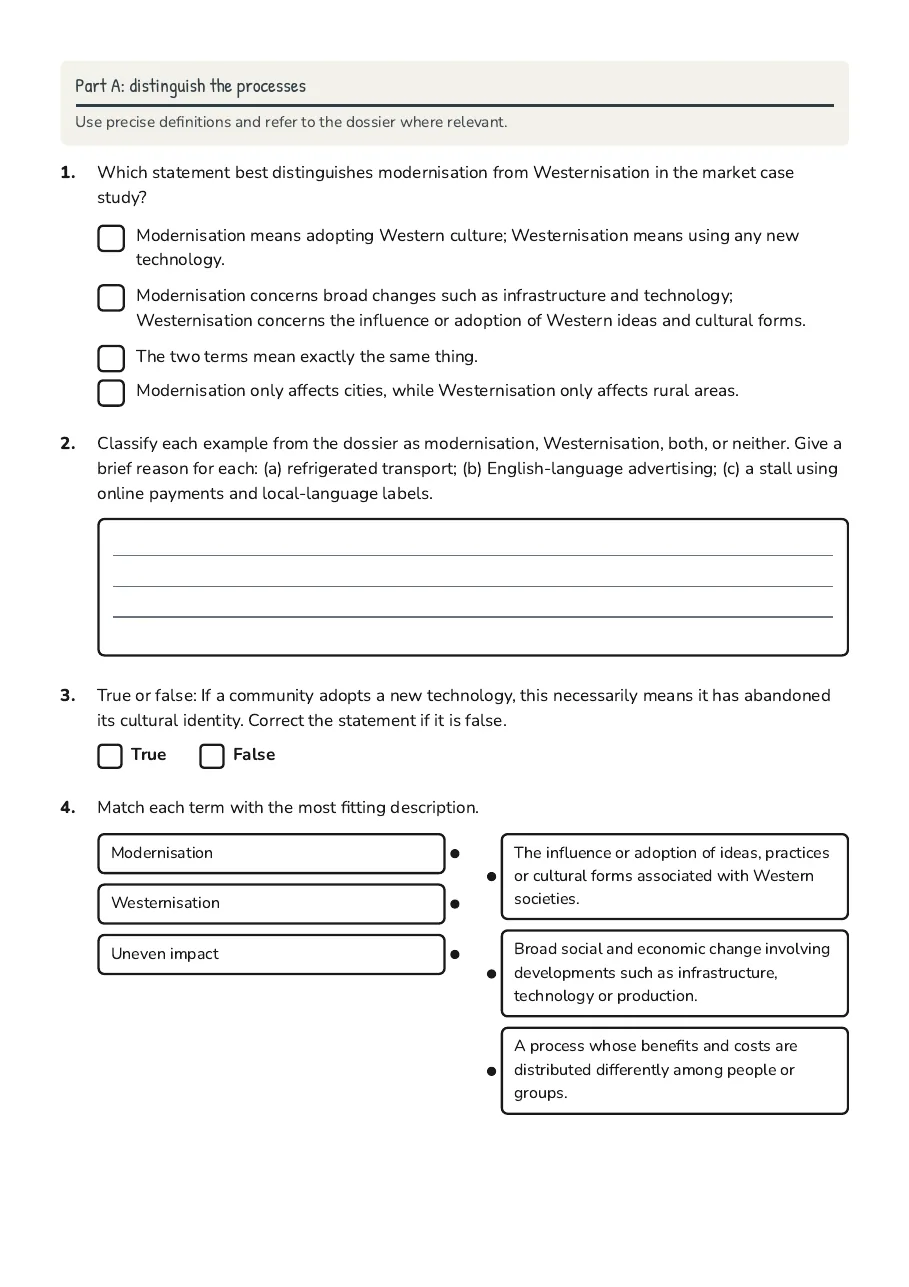
Part A: distinguish the processes
Use precise definitions and refer to the dossier where relevant.
- Modernisation means adopting Western culture; Westernisation means using any new technology.
- Modernisation concerns broad changes such as infrastructure and technology; Westernisation concerns the influence or adoption of Western ideas and cultural forms.
- The two terms mean exactly the same thing.
- Modernisation only affects cities, while Westernisation only affects rural areas.
- Modernisation
- Westernisation
- Uneven impact
- The influence or adoption of ideas, practices or cultural forms associated with Western societies.
- Broad social and economic change involving developments such as infrastructure, technology or production.
- A process whose benefits and costs are distributed differently among people or groups.
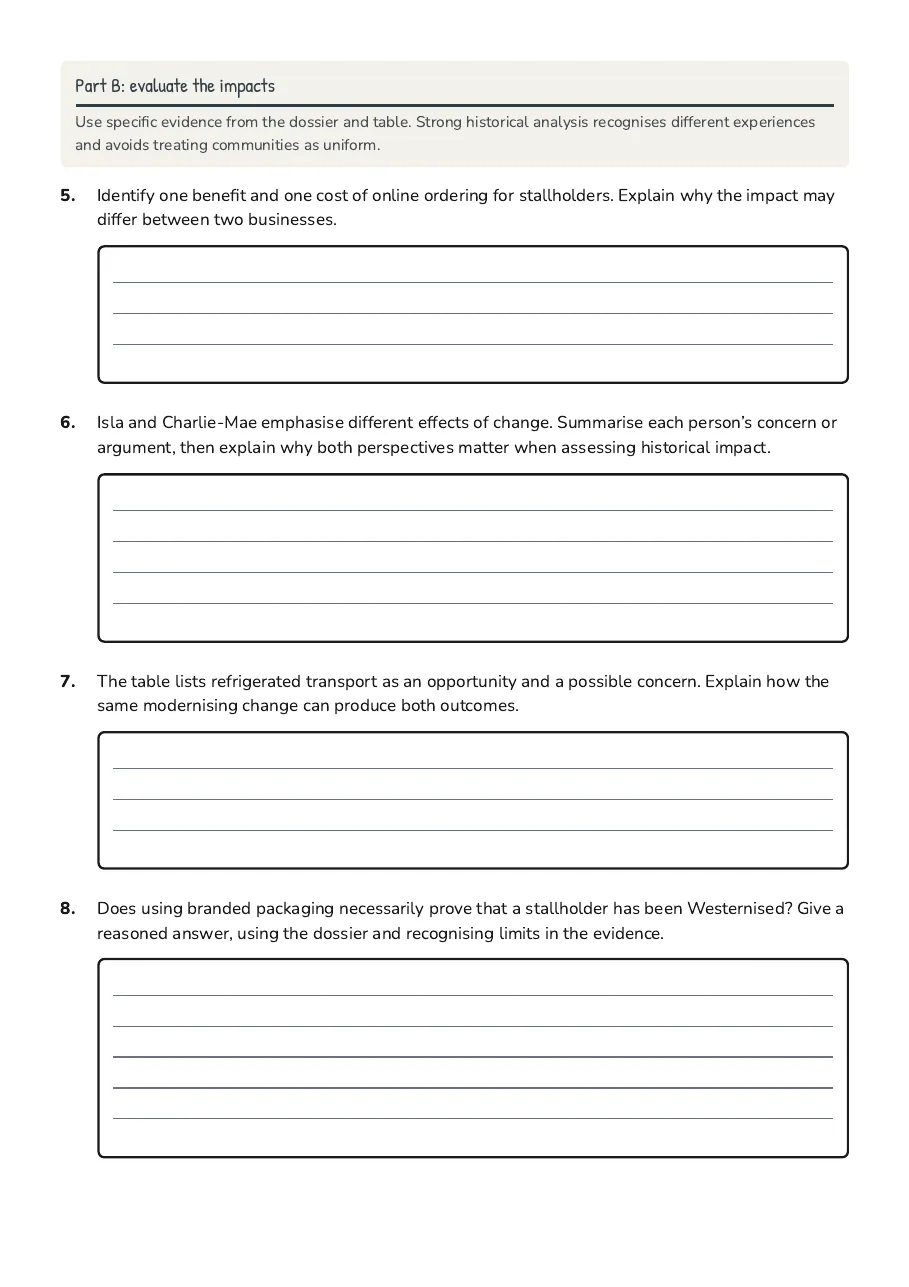
Part B: evaluate the impacts
Use specific evidence from the dossier and table. Strong historical analysis recognises different experiences and avoids treating communities as uniform.
4 printable pages
Page 1
Page 2
Page 3

Page 4
About This Worksheet
Free in Kuraplan
Sign up free, grab the PDF, and customize it for your class.
Print-Ready
Formatted for standard paper. Clean layout, easy to read.
AI-Generated
Created with Kuraplan's AI, designed for real classroom use.
For Teachers & Parents
Use in classrooms, for homework, tutoring, or homeschool.
Need a custom version of this worksheet?
Kuraplan's AI generates custom worksheets in seconds — differentiated for every learner, aligned to your curriculum.
Generate Custom Worksheets — Free