Moon Facts and Features
A free science worksheet ready for your classroom. Open in Kuraplan to grab the print-ready PDF, customize it for your students, or generate a fresh version in seconds.
Moon Facts and Features
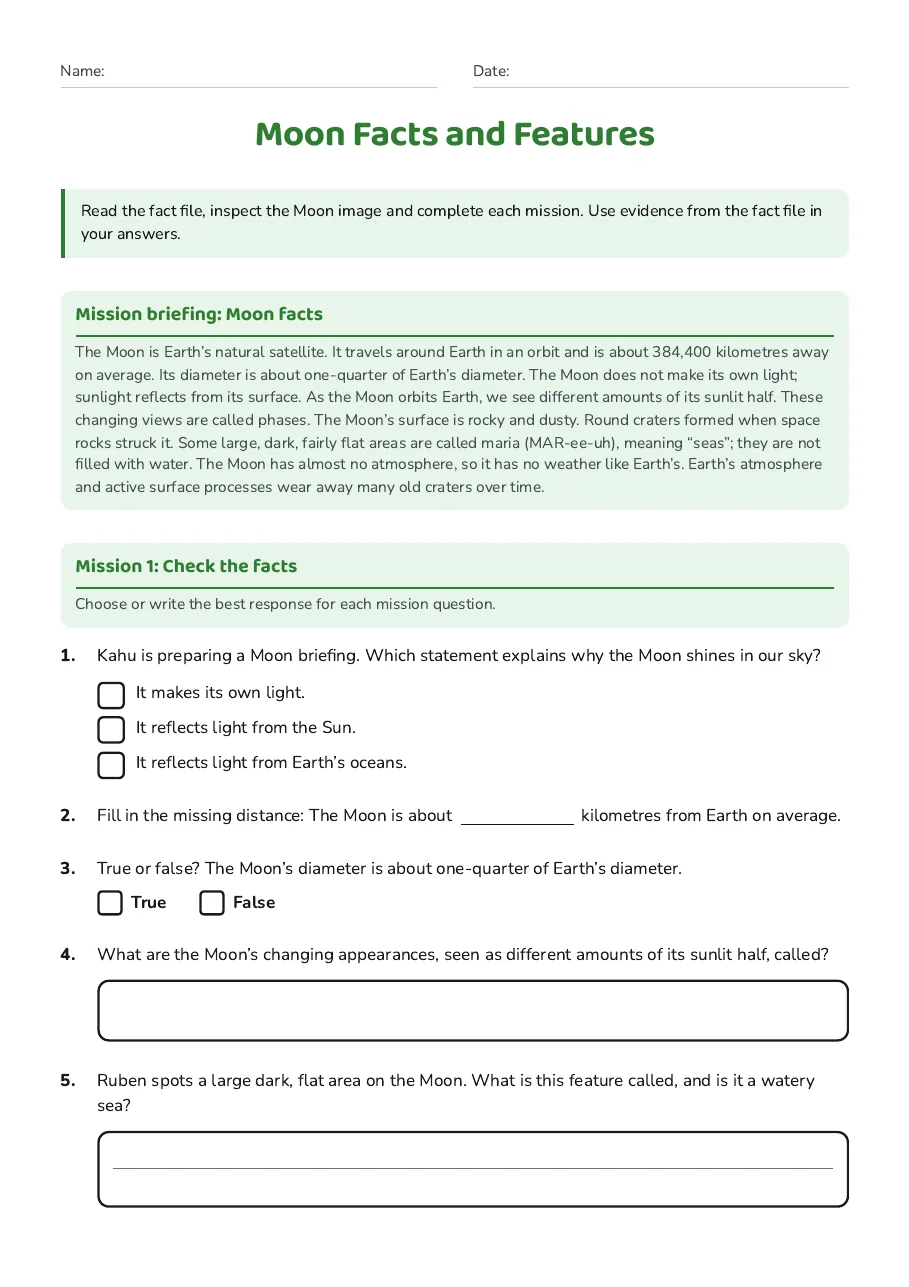
Mission briefing: Moon facts
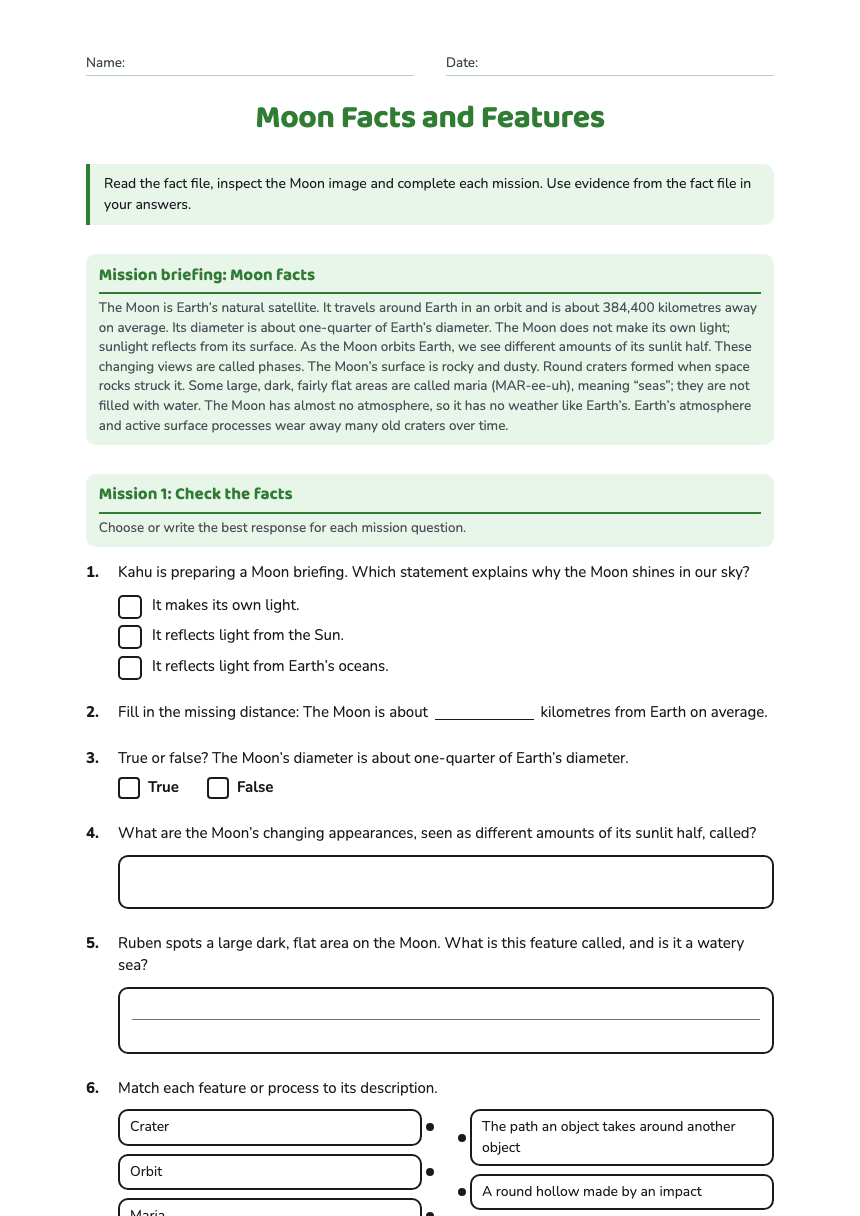
The Moon is Earth’s natural satellite. It travels around Earth in an orbit and is about 384,400 kilometres away on average. Its diameter is about one-quarter of Earth’s diameter. The Moon does not make its own light; sunlight reflects from its surface. As the Moon orbits Earth, we see different amounts of its sunlit half. These changing views are called phases. The Moon’s surface is rocky and dusty. Round craters formed when space rocks struck it. Some large, dark, fairly flat areas are called maria (MAR-ee-uh), meaning “seas”; they are not filled with water. The Moon has almost no atmosphere, so it has no weather like Earth’s. Earth’s atmosphere and active surface processes wear away many old craters over time.
Mission 1: Check the facts
Choose or write the best response for each mission question.
- It makes its own light.
- It reflects light from the Sun.
- It reflects light from Earth’s oceans.
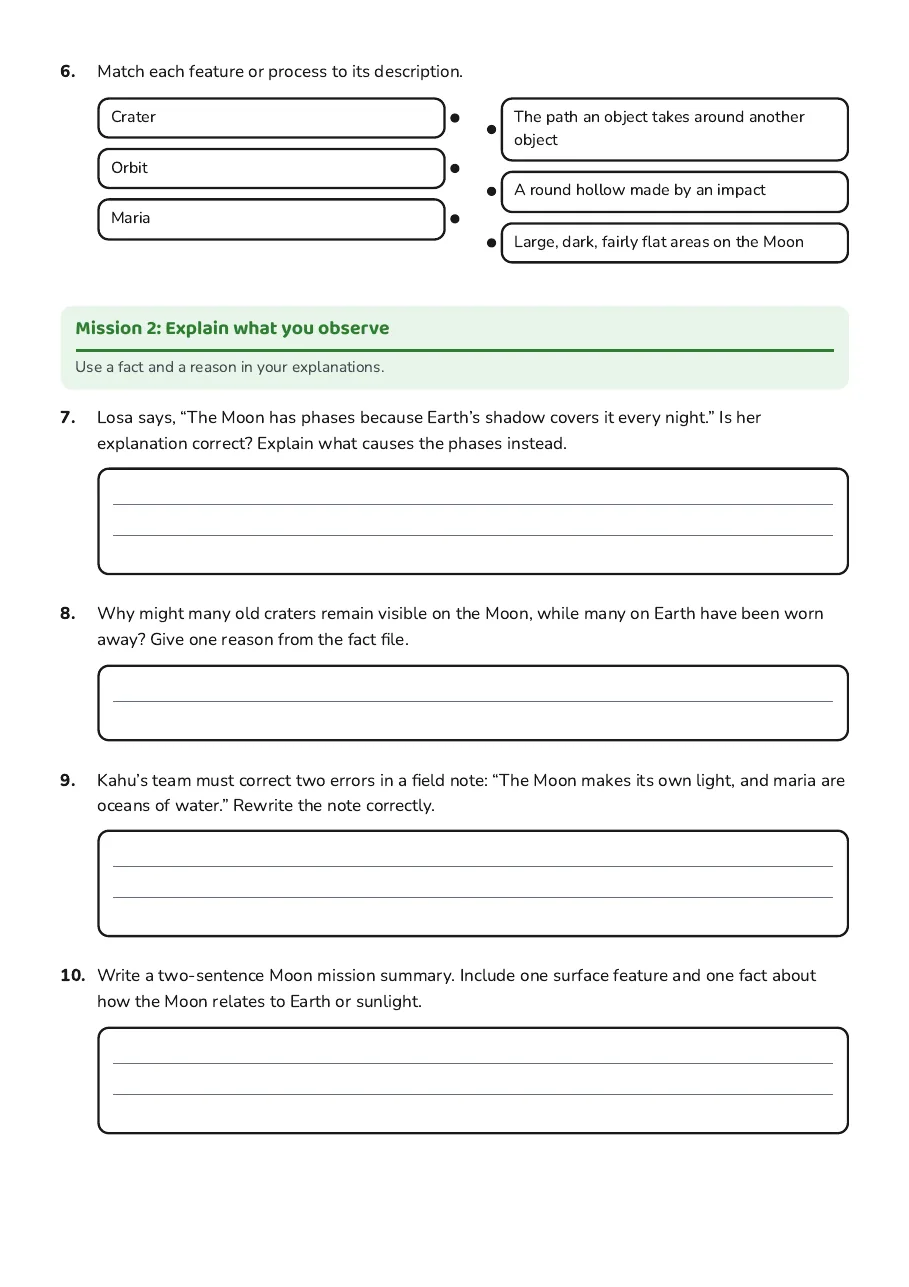
- Crater
- Orbit
- Maria
- The path an object takes around another object
- A round hollow made by an impact
- Large, dark, fairly flat areas on the Moon
Mission 2: Explain what you observe
Use a fact and a reason in your explanations.
2 printable pages
Page 1
Page 2
About This Worksheet
Free in Kuraplan
Sign up free, grab the PDF, and customize it for your class.
Print-Ready
Formatted for standard paper. Clean layout, easy to read.
AI-Generated
Created with Kuraplan's AI, designed for real classroom use.
For Teachers & Parents
Use in classrooms, for homework, tutoring, or homeschool.
Need a custom version of this worksheet?
Kuraplan's AI generates custom worksheets in seconds — differentiated for every learner, aligned to your curriculum.
Generate Custom Worksheets — Free