ScienceFreePrintable

Moon Phase Tracker

A free science worksheet ready for your classroom. Open in Kuraplan to grab the print-ready PDF, customize it for your students, or generate a fresh version in seconds.
Moon Phase Tracker worksheet preview
Name:Date:

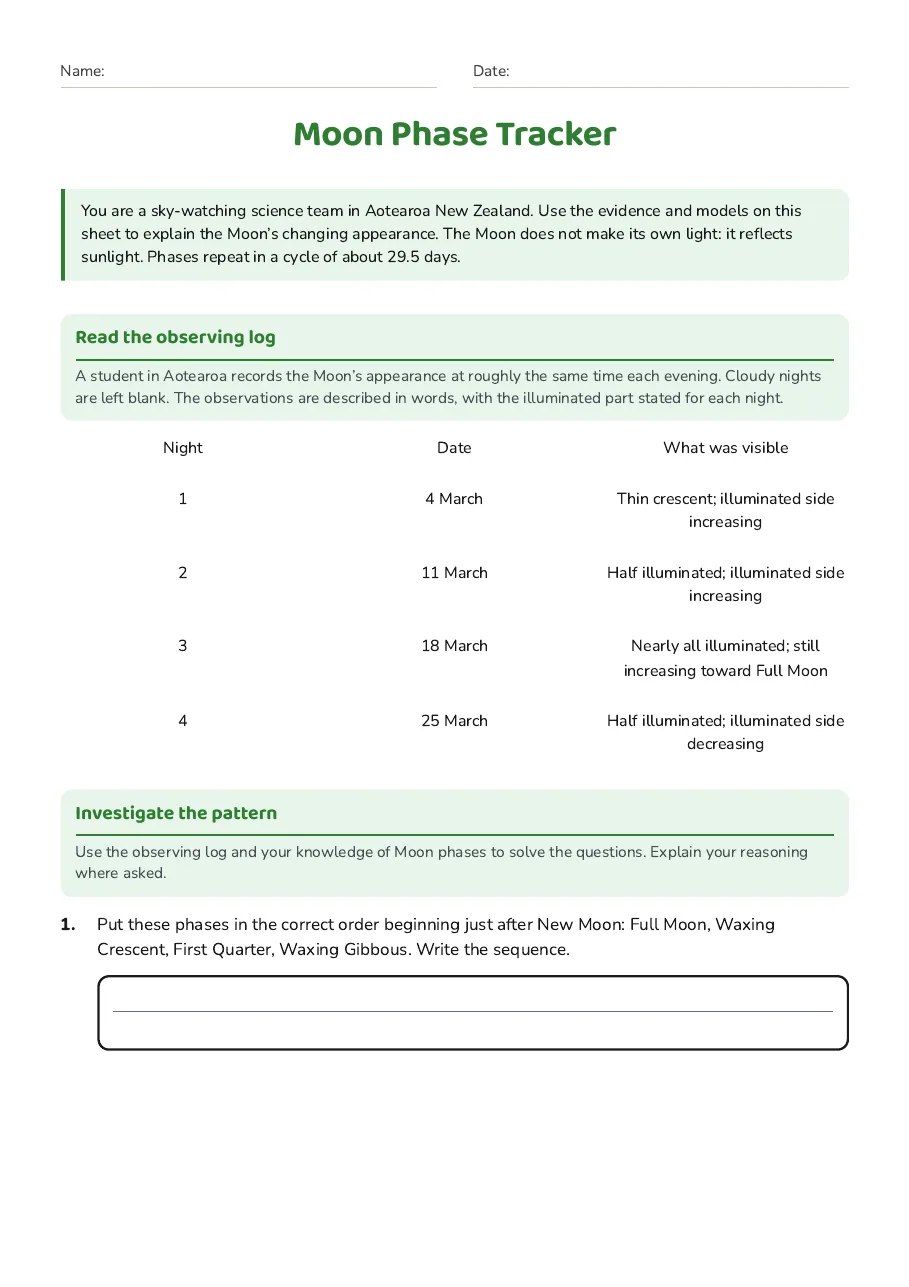
Moon Phase Tracker

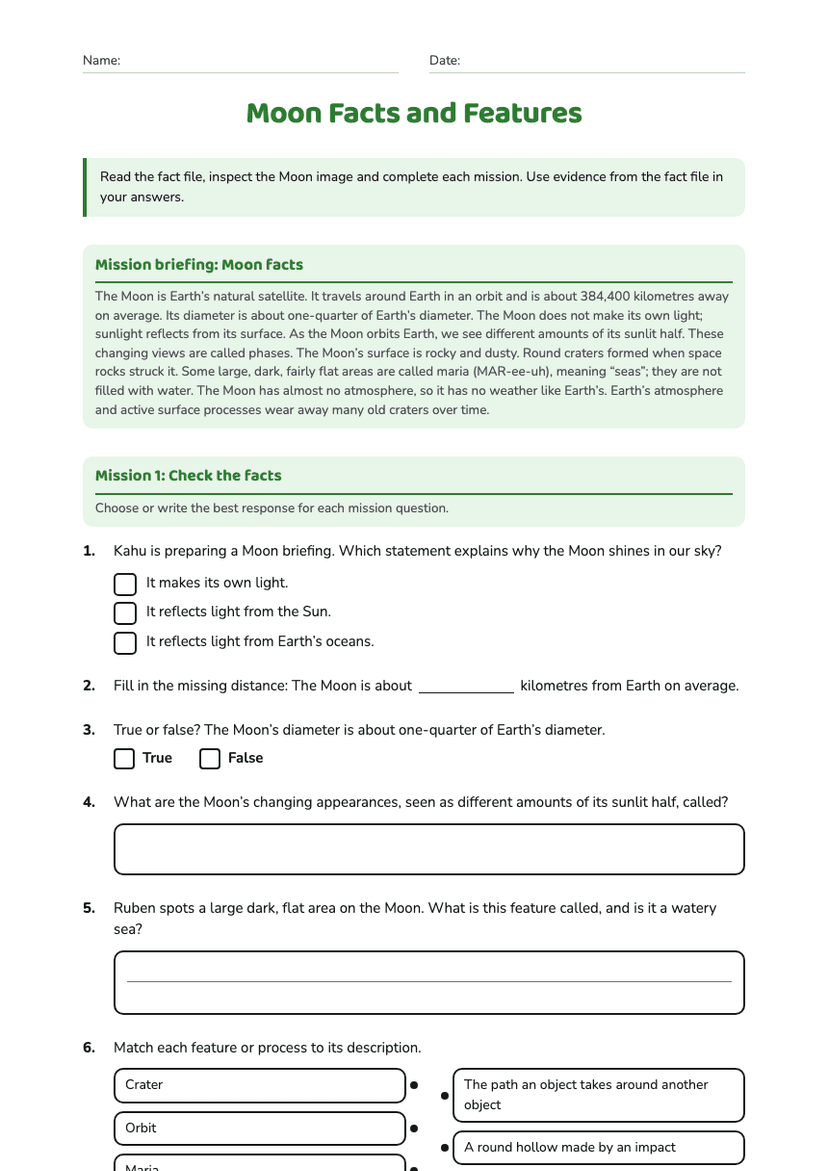
You are a sky-watching science team in Aotearoa New Zealand. Use the evidence and models on this sheet to explain the Moon’s changing appearance. The Moon does not make its own light: it reflects sunlight. Phases repeat in a cycle of about 29.5 days.

Read the observing log

A student in Aotearoa records the Moon’s appearance at roughly the same time each evening. Cloudy nights are left blank. The observations are described in words, with the illuminated part stated for each night.

Night

Date

What was visible

1

4 March

Thin crescent; illuminated side increasing

2

11 March

Half illuminated; illuminated side increasing

3

18 March

Nearly all illuminated; still increasing toward Full Moon

4

25 March

Half illuminated; illuminated side decreasing

Investigate the pattern

Use the observing log and your knowledge of Moon phases to solve the questions. Explain your reasoning where asked.

1.Put these phases in the correct order beginning just after New Moon: Full Moon, Waxing Crescent, First Quarter, Waxing Gibbous. Write the sequence.
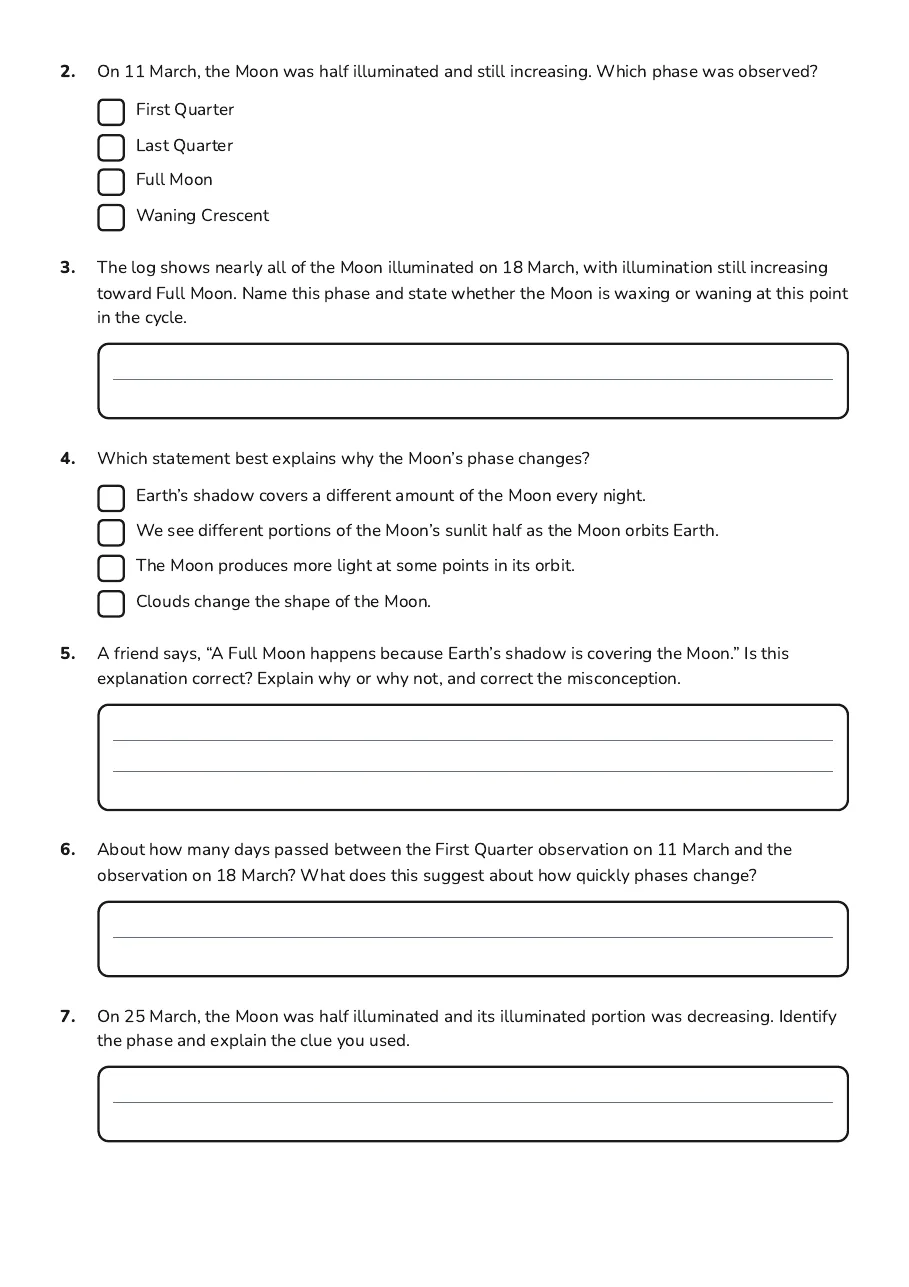
2.On 11 March, the Moon was half illuminated and still increasing. Which phase was observed?
  • First Quarter
  • Last Quarter
  • Full Moon
  • Waning Crescent
3.The log shows nearly all of the Moon illuminated on 18 March, with illumination still increasing toward Full Moon. Name this phase and state whether the Moon is waxing or waning at this point in the cycle.
4.Which statement best explains why the Moon’s phase changes?
  • Earth’s shadow covers a different amount of the Moon every night.
  • We see different portions of the Moon’s sunlit half as the Moon orbits Earth.
  • The Moon produces more light at some points in its orbit.
  • Clouds change the shape of the Moon.
5.A friend says, “A Full Moon happens because Earth’s shadow is covering the Moon.” Is this explanation correct? Explain why or why not, and correct the misconception.
6.About how many days passed between the First Quarter observation on 11 March and the observation on 18 March? What does this suggest about how quickly phases change?
7.On 25 March, the Moon was half illuminated and its illuminated portion was decreasing. Identify the phase and explain the clue you used.
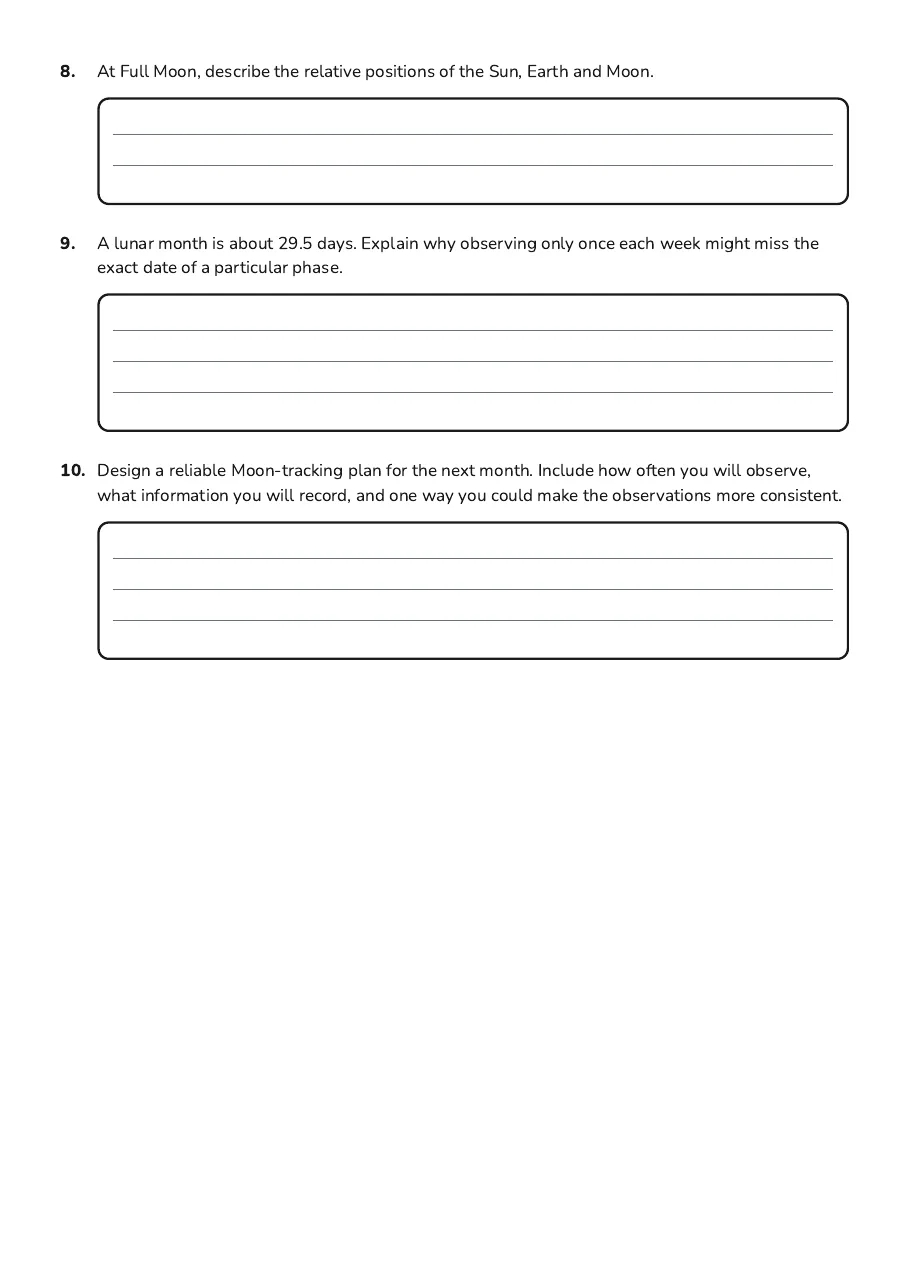
8.At Full Moon, describe the relative positions of the Sun, Earth and Moon.
9.A lunar month is about 29.5 days. Explain why observing only once each week might miss the exact date of a particular phase.
10.Design a reliable Moon-tracking plan for the next month. Include how often you will observe, what information you will record, and one way you could make the observations more consistent.

3 printable pages

  • Moon Phase Tracker, page 1 of 3: Read the observing log, Investigate the pattern

    Page 1

  • Moon Phase Tracker, page 2 of 3: 2. On 11 March, the Moon was half illuminated and still increasing. Which phase was…

    Page 2

  • Moon Phase Tracker, page 3 of 3: 8. At Full Moon, describe the relative positions of the Sun, Earth and Moon.

    Page 3

About This Worksheet

Free in Kuraplan

Sign up free, grab the PDF, and customize it for your class.

Print-Ready

Formatted for standard paper. Clean layout, easy to read.

AI-Generated

Created with Kuraplan's AI, designed for real classroom use.

For Teachers & Parents

Use in classrooms, for homework, tutoring, or homeschool.

Need a custom version of this worksheet?

Kuraplan's AI generates custom worksheets in seconds — differentiated for every learner, aligned to your curriculum.

Generate Custom Worksheets — Free
No credit card Curriculum-aligned Under 60 seconds