ScienceFreePrintable

Seed Germination Experiment

A free science worksheet ready for your classroom. Open in Kuraplan to grab the print-ready PDF, customize it for your students, or generate a fresh version in seconds.
Seed Germination Experiment worksheet preview
Name:Date:

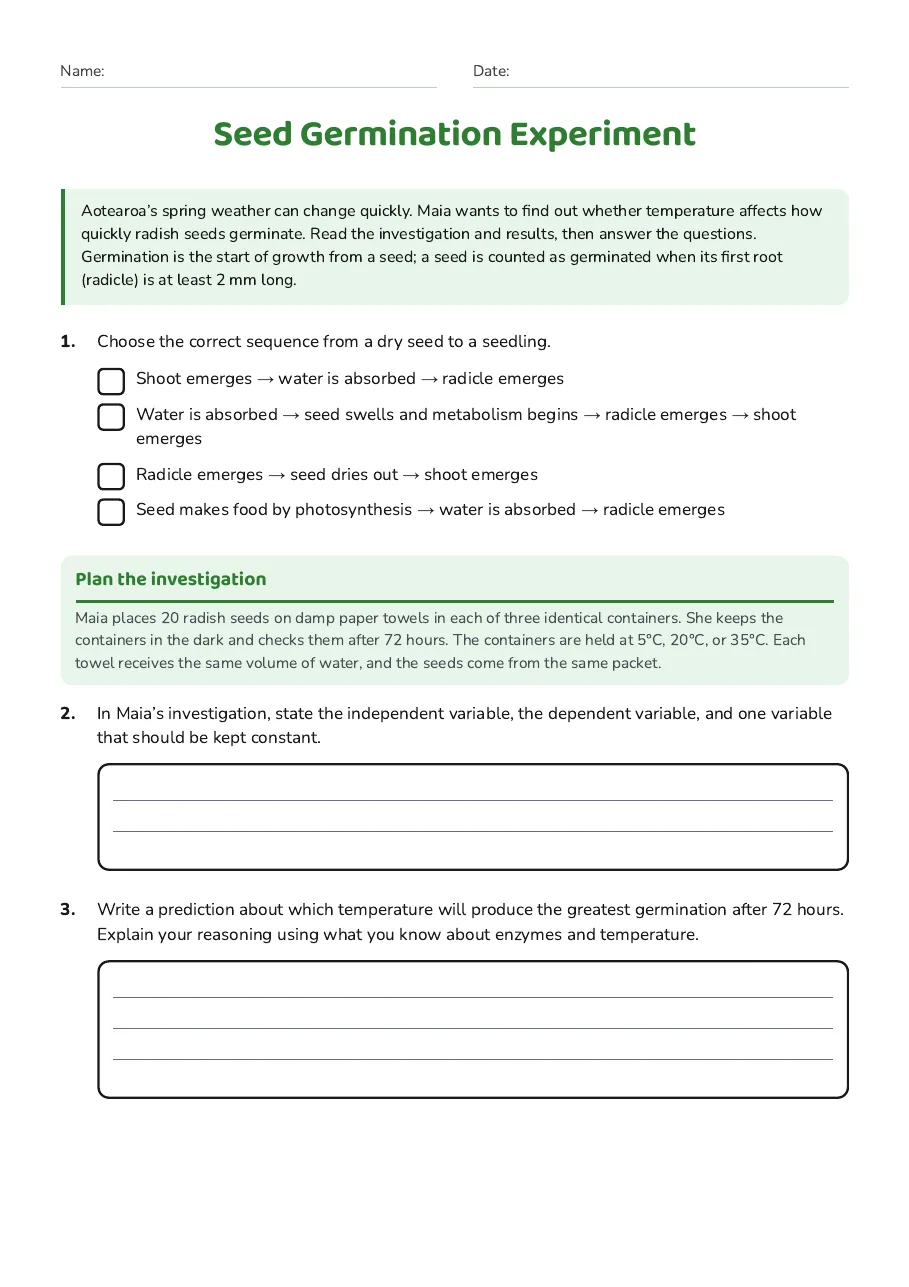
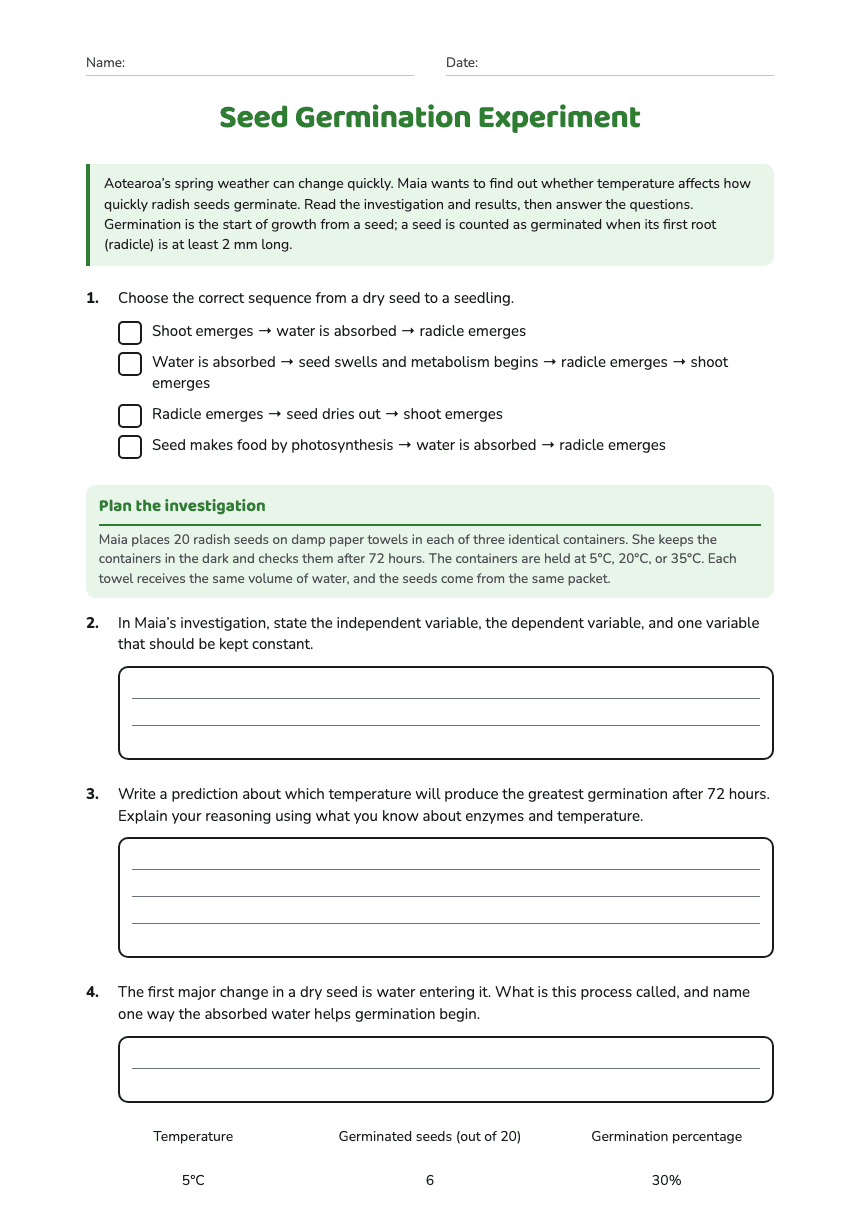
Seed Germination Experiment

Aotearoa’s spring weather can change quickly. Maia wants to find out whether temperature affects how quickly radish seeds germinate. Read the investigation and results, then answer the questions. Germination is the start of growth from a seed; a seed is counted as germinated when its first root (radicle) is at least 2 mm long.
1.Choose the correct sequence from a dry seed to a seedling.
  • Shoot emerges → water is absorbed → radicle emerges
  • Water is absorbed → seed swells and metabolism begins → radicle emerges → shoot emerges
  • Radicle emerges → seed dries out → shoot emerges
  • Seed makes food by photosynthesis → water is absorbed → radicle emerges

Plan the investigation

Maia places 20 radish seeds on damp paper towels in each of three identical containers. She keeps the containers in the dark and checks them after 72 hours. The containers are held at 5°C, 20°C, or 35°C. Each towel receives the same volume of water, and the seeds come from the same packet.

2.In Maia’s investigation, state the independent variable, the dependent variable, and one variable that should be kept constant.
3.Write a prediction about which temperature will produce the greatest germination after 72 hours. Explain your reasoning using what you know about enzymes and temperature.
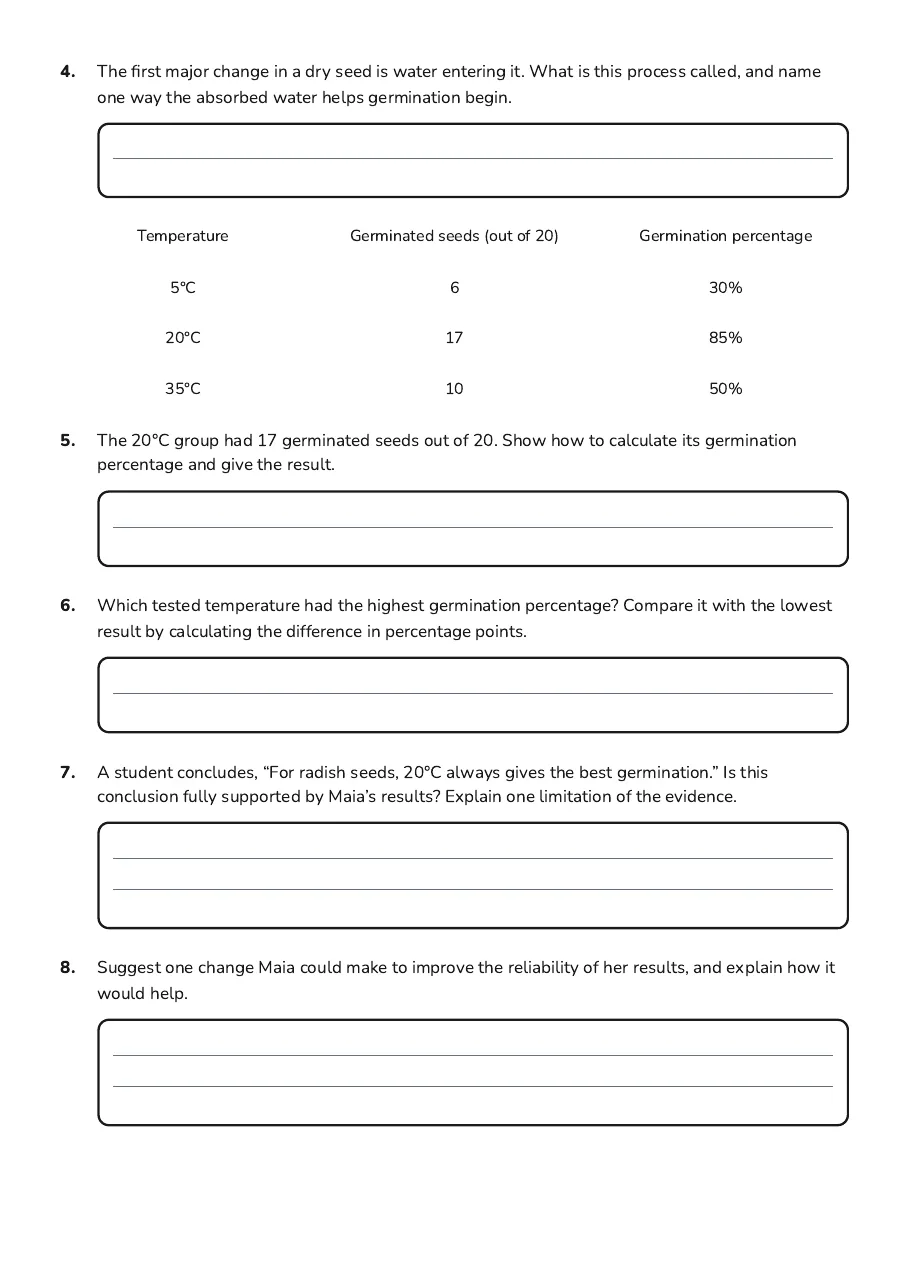
4.The first major change in a dry seed is water entering it. What is this process called, and name one way the absorbed water helps germination begin.

Temperature

Germinated seeds (out of 20)

Germination percentage

5°C

6

30%

20°C

17

85%

35°C

10

50%

5.The 20°C group had 17 germinated seeds out of 20. Show how to calculate its germination percentage and give the result.
6.Which tested temperature had the highest germination percentage? Compare it with the lowest result by calculating the difference in percentage points.
7.A student concludes, “For radish seeds, 20°C always gives the best germination.” Is this conclusion fully supported by Maia’s results? Explain one limitation of the evidence.
8.Suggest one change Maia could make to improve the reliability of her results, and explain how it would help.
9.Maia kept every container in the dark. Explain why this is a useful control when she is testing temperature, and state whether light is essential for the initial germination of most seeds.
10.Once the shoot has emerged and green leaves develop, which process allows the young plant to make glucose using light energy? Name the gas it takes in for this process.

3 printable pages

  • Seed Germination Experiment, page 1 of 3: Plan the investigation

    Page 1

  • Seed Germination Experiment, page 2 of 3: 4. The first major change in a dry seed is water entering it. What is this process…

    Page 2

  • Seed Germination Experiment, page 3 of 3: 9. Maia kept every container in the dark. Explain why this is a useful control when she…

    Page 3

About This Worksheet

Free in Kuraplan

Sign up free, grab the PDF, and customize it for your class.

Print-Ready

Formatted for standard paper. Clean layout, easy to read.

AI-Generated

Created with Kuraplan's AI, designed for real classroom use.

For Teachers & Parents

Use in classrooms, for homework, tutoring, or homeschool.

Need a custom version of this worksheet?

Kuraplan's AI generates custom worksheets in seconds — differentiated for every learner, aligned to your curriculum.

Generate Custom Worksheets — Free
No credit card Curriculum-aligned Under 60 seconds