MusicFreePrintable

Music Timing and Rhythm

A free music worksheet ready for your classroom. Open in Kuraplan to grab the print-ready PDF, customize it for your students, or generate a fresh version in seconds.
Music Timing and Rhythm worksheet preview
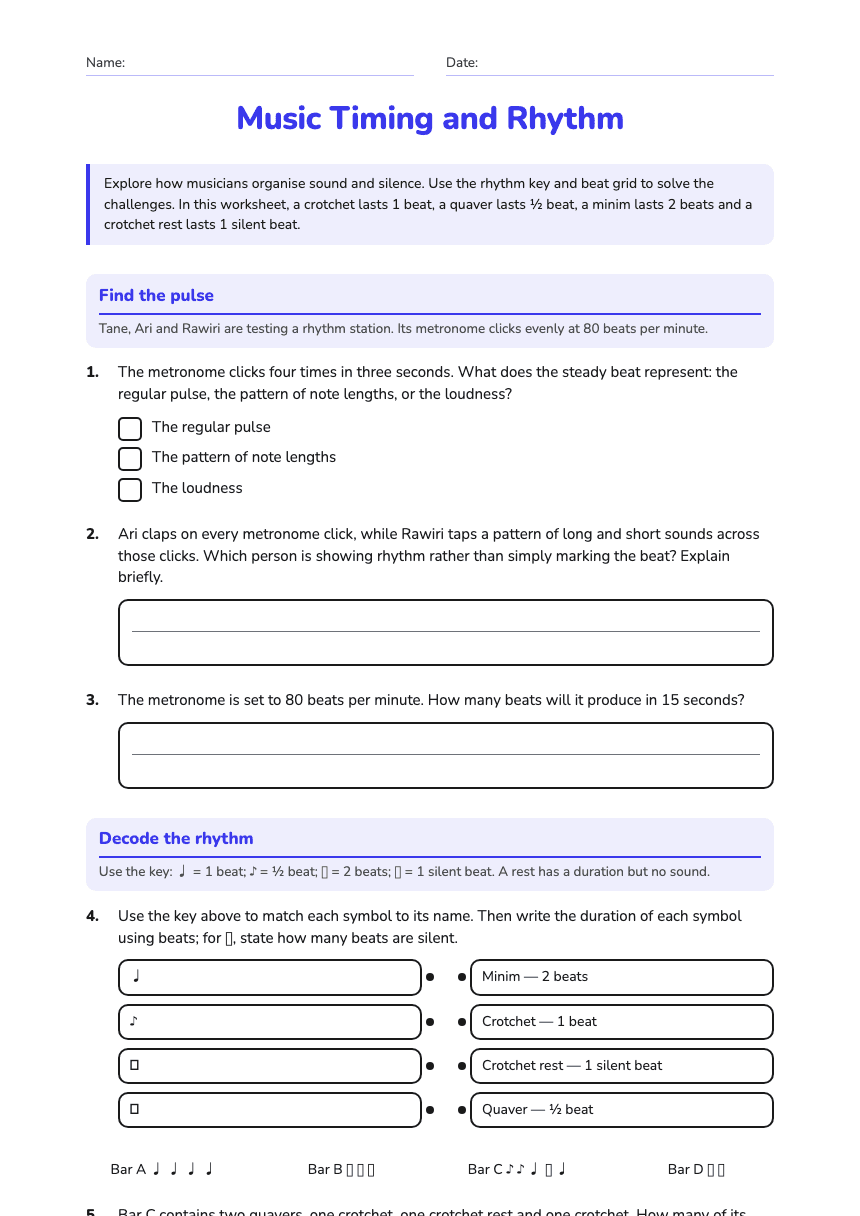
Name:Date:

Music Timing and Rhythm

Explore how musicians organise sound and silence. Use the rhythm key and beat grid to solve the challenges. In this worksheet, a crotchet lasts 1 beat, a quaver lasts ½ beat, a minim lasts 2 beats and a crotchet rest lasts 1 silent beat.

Find the pulse

Tane, Ari and Rawiri are testing a rhythm station. Its metronome clicks evenly at 80 beats per minute.

1.The metronome clicks four times in three seconds. What does the steady beat represent: the regular pulse, the pattern of note lengths, or the loudness?
  • The regular pulse
  • The pattern of note lengths
  • The loudness
2.Ari claps on every metronome click, while Rawiri taps a pattern of long and short sounds across those clicks. Which person is showing rhythm rather than simply marking the beat? Explain briefly.
3.The metronome is set to 80 beats per minute. How many beats will it produce in 15 seconds?

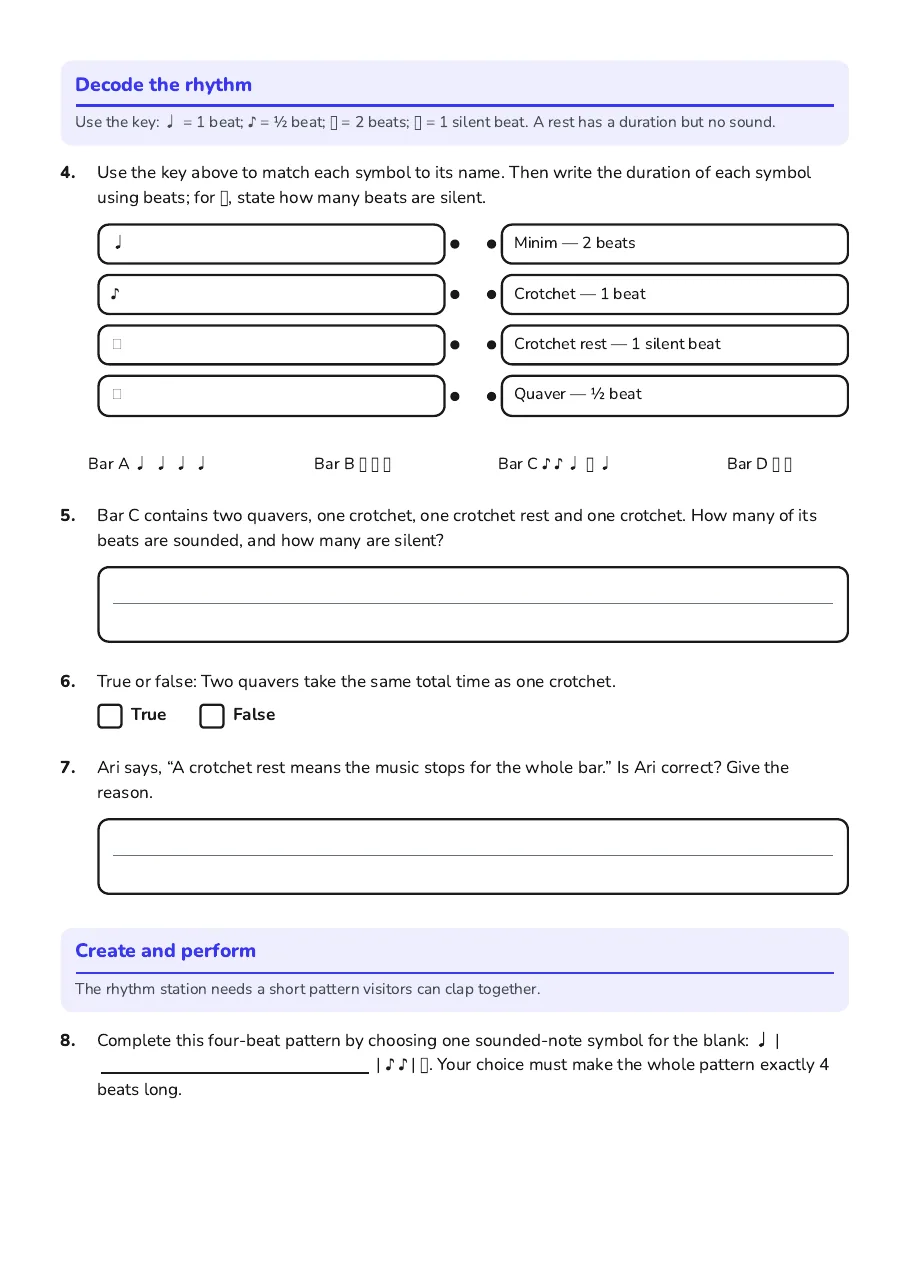
Decode the rhythm

Use the key: ♩ = 1 beat; ♪ = ½ beat; 𝅗𝅥 = 2 beats; 𝄽 = 1 silent beat. A rest has a duration but no sound.

4.Use the key above to match each symbol to its name. Then write the duration of each symbol using beats; for 𝄽, state how many beats are silent.
  • ♩
  • ♪
  • 𝅗𝅥
  • 𝄽
  • Minim — 2 beats
  • Crotchet — 1 beat
  • Crotchet rest — 1 silent beat
  • Quaver — ½ beat

Bar A ♩ ♩ ♩ ♩

Bar B 𝅗𝅥 ♩ ♩

Bar C ♪ ♪ ♩ 𝄽 ♩

Bar D 𝅗𝅥 𝅗𝅥

5.Bar C contains two quavers, one crotchet, one crotchet rest and one crotchet. How many of its beats are sounded, and how many are silent?
6.True or false: Two quavers take the same total time as one crotchet.
TrueFalse
7.Ari says, “A crotchet rest means the music stops for the whole bar.” Is Ari correct? Give the reason.

Create and perform

The rhythm station needs a short pattern visitors can clap together.

8.Complete this four-beat pattern by choosing one sounded-note symbol for the blank: ♩ | | ♪ ♪ | 𝄽. Your choice must make the whole pattern exactly 4 beats long.
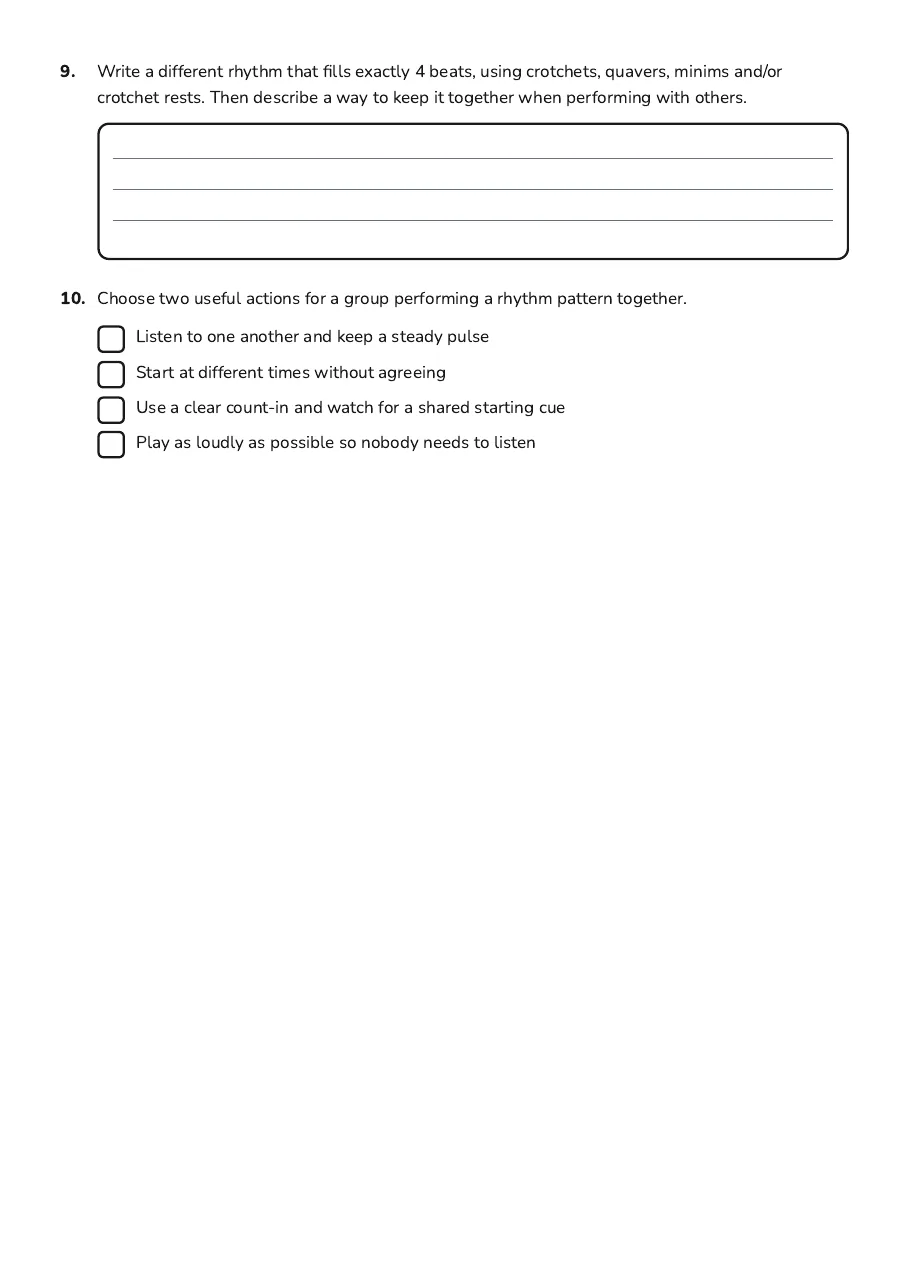
9.Write a different rhythm that fills exactly 4 beats, using crotchets, quavers, minims and/or crotchet rests. Then describe a way to keep it together when performing with others.
10.Choose two useful actions for a group performing a rhythm pattern together.
  • Listen to one another and keep a steady pulse
  • Start at different times without agreeing
  • Use a clear count-in and watch for a shared starting cue
  • Play as loudly as possible so nobody needs to listen

3 printable pages
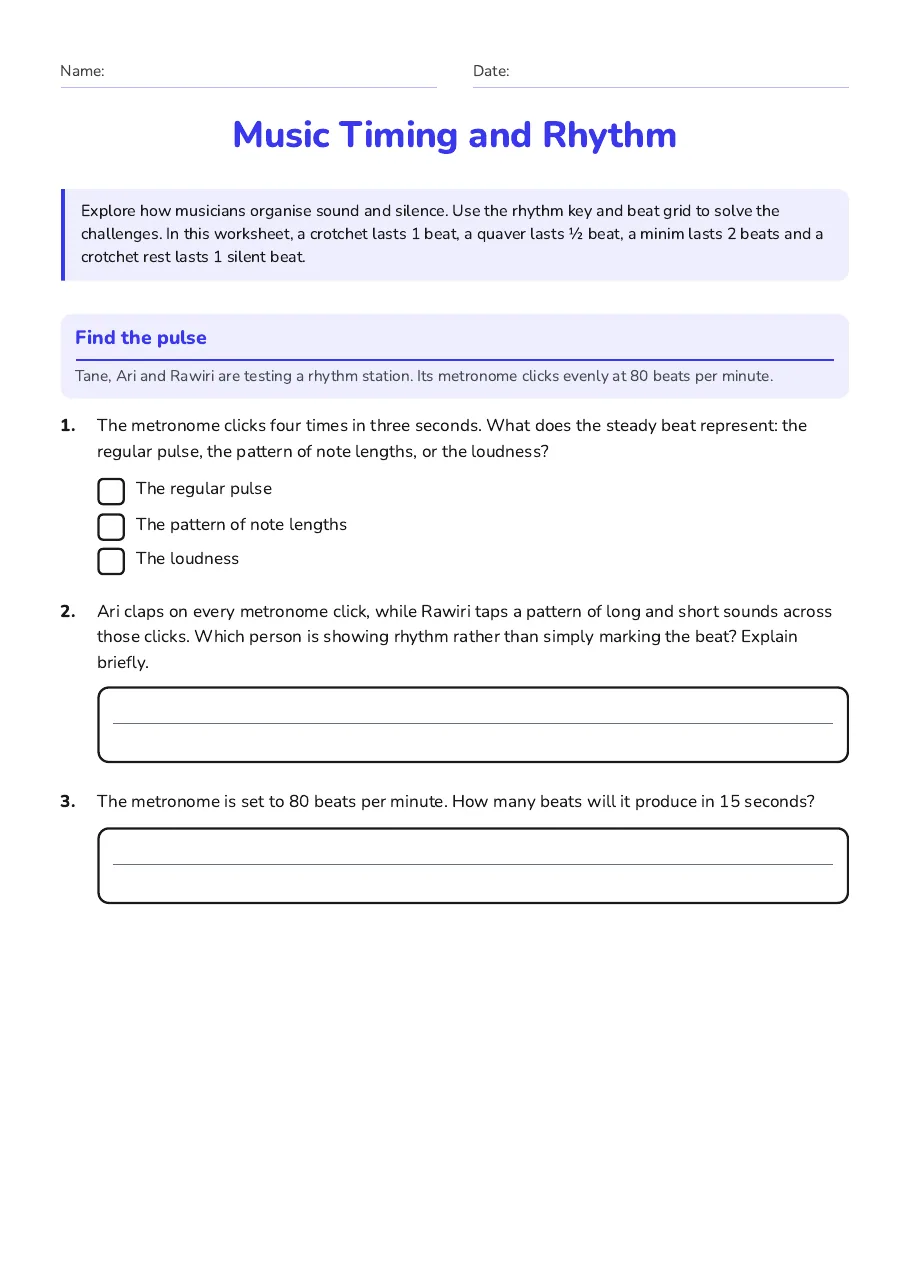
  • Music Timing and Rhythm, page 1 of 3: Find the pulse

    Page 1

  • Music Timing and Rhythm, page 2 of 3: Decode the rhythm, Create and perform

    Page 2

  • Music Timing and Rhythm, page 3 of 3: 9. Write a different rhythm that fills exactly 4 beats, using crotchets, quavers, minims…

    Page 3

About This Worksheet

Free in Kuraplan

Sign up free, grab the PDF, and customize it for your class.

Print-Ready

Formatted for standard paper. Clean layout, easy to read.

AI-Generated

Created with Kuraplan's AI, designed for real classroom use.

For Teachers & Parents

Use in classrooms, for homework, tutoring, or homeschool.

Need a custom version of this worksheet?

Kuraplan's AI generates custom worksheets in seconds — differentiated for every learner, aligned to your curriculum.

Generate Custom Worksheets — Free
No credit card Curriculum-aligned Under 60 seconds