MusicFreePrintable

Musical Story Planning

A free music worksheet ready for your classroom. Open in Kuraplan to grab the print-ready PDF, customize it for your students, or generate a fresh version in seconds.
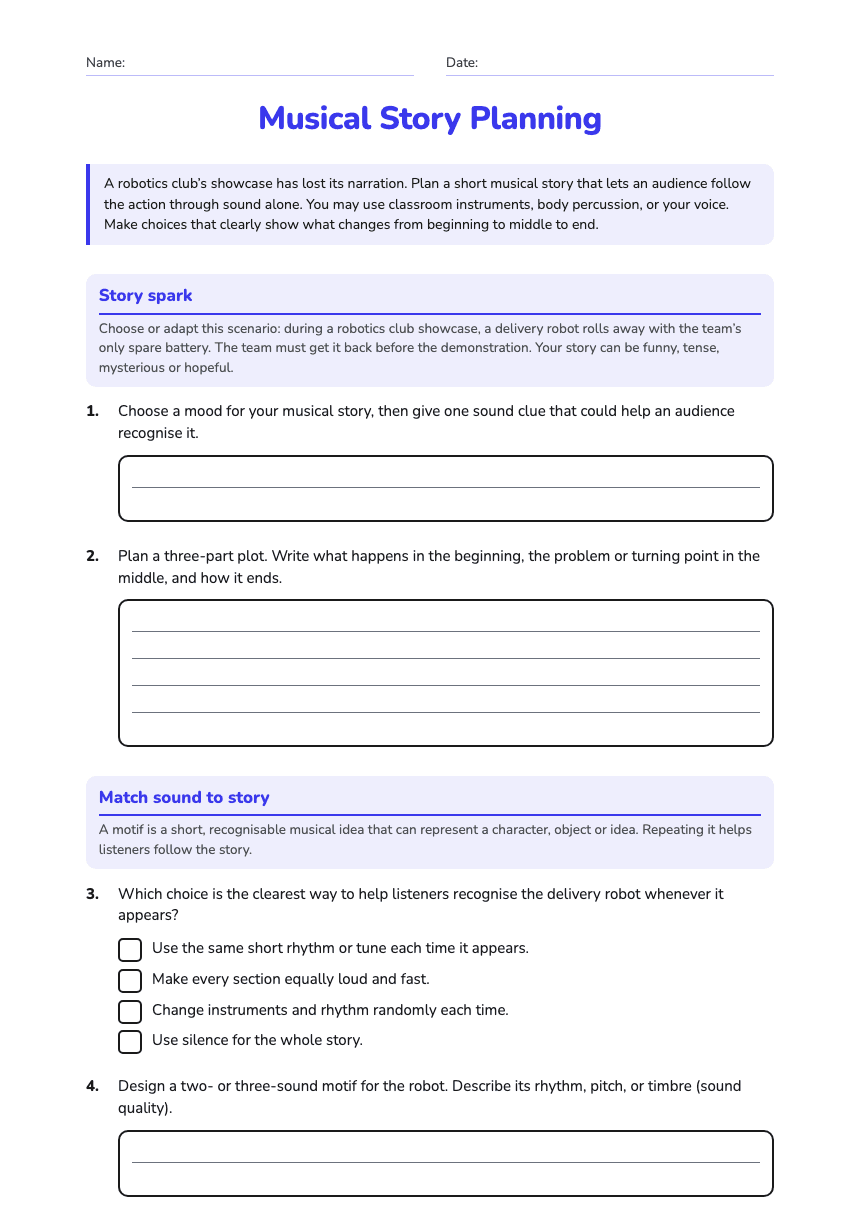
Musical Story Planning worksheet preview
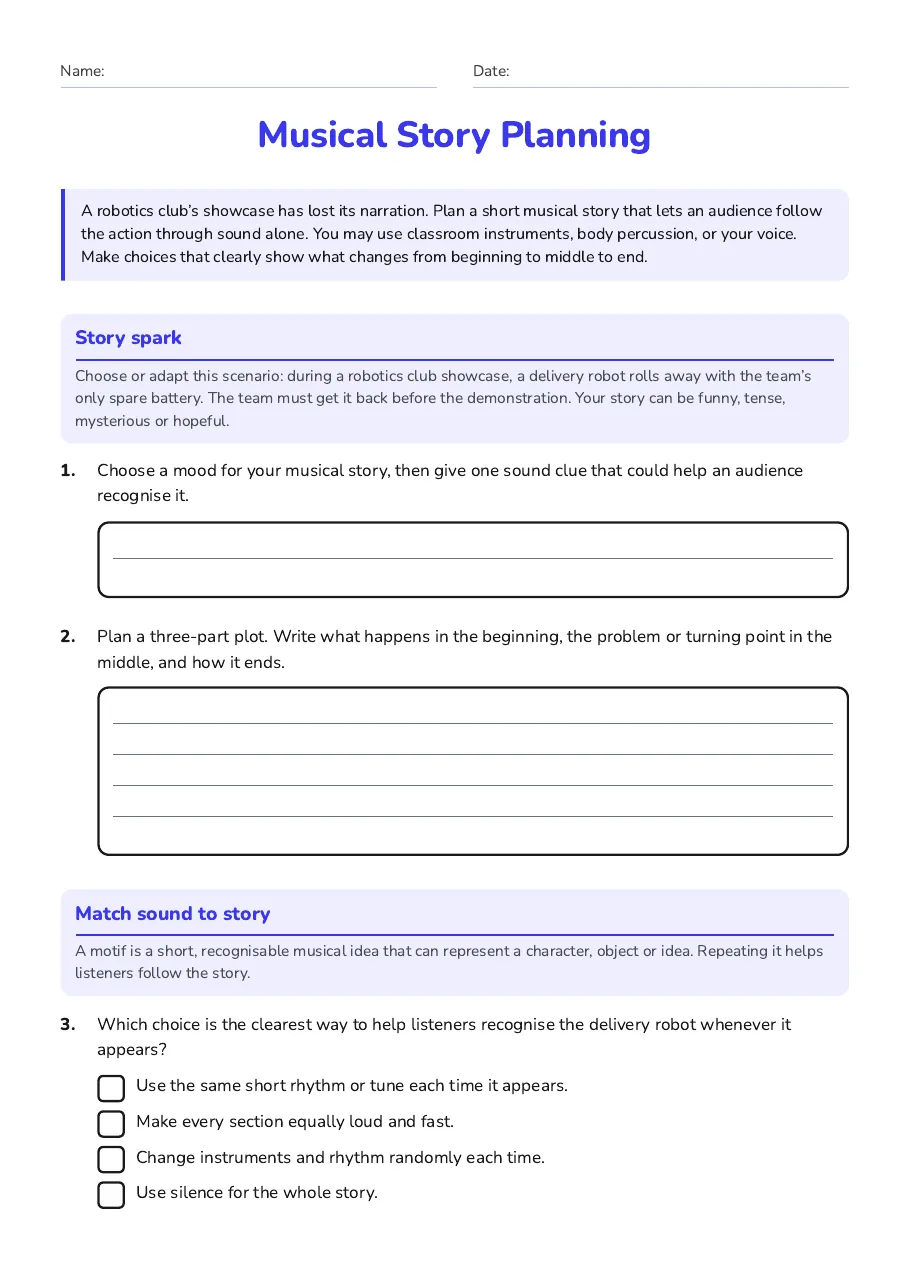
Name:Date:

Musical Story Planning

A robotics club’s showcase has lost its narration. Plan a short musical story that lets an audience follow the action through sound alone. You may use classroom instruments, body percussion, or your voice. Make choices that clearly show what changes from beginning to middle to end.

Story spark

Choose or adapt this scenario: during a robotics club showcase, a delivery robot rolls away with the team’s only spare battery. The team must get it back before the demonstration. Your story can be funny, tense, mysterious or hopeful.

1.Choose a mood for your musical story, then give one sound clue that could help an audience recognise it.
2.Plan a three-part plot. Write what happens in the beginning, the problem or turning point in the middle, and how it ends.

Match sound to story

A motif is a short, recognisable musical idea that can represent a character, object or idea. Repeating it helps listeners follow the story.

3.Which choice is the clearest way to help listeners recognise the delivery robot whenever it appears?
  • Use the same short rhythm or tune each time it appears.
  • Make every section equally loud and fast.
  • Change instruments and rhythm randomly each time.
  • Use silence for the whole story.
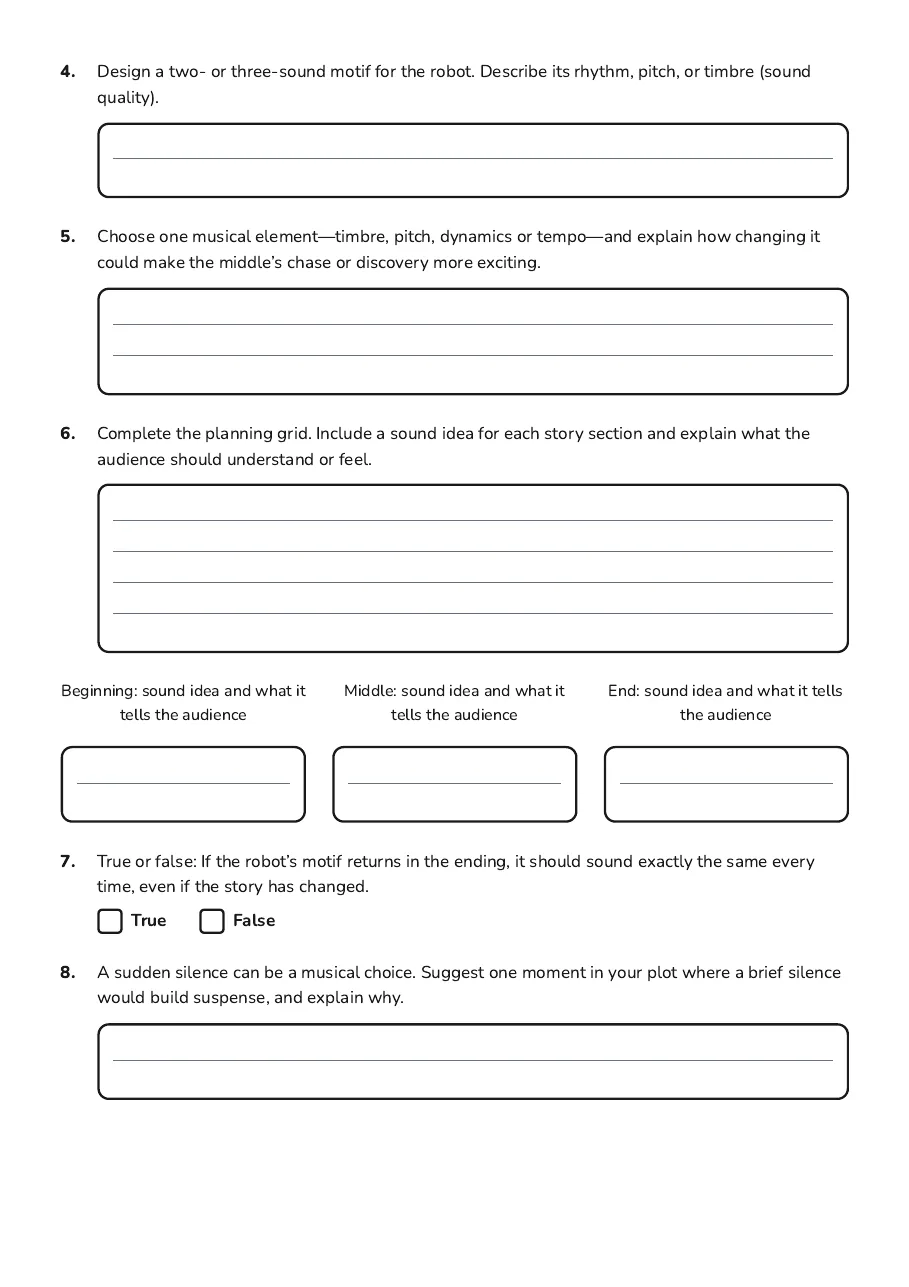
4.Design a two- or three-sound motif for the robot. Describe its rhythm, pitch, or timbre (sound quality).
5.Choose one musical element—timbre, pitch, dynamics or tempo—and explain how changing it could make the middle’s chase or discovery more exciting.
6.Complete the planning grid. Include a sound idea for each story section and explain what the audience should understand or feel.

Beginning: sound idea and what it tells the audience

Middle: sound idea and what it tells the audience

End: sound idea and what it tells the audience

7.True or false: If the robot’s motif returns in the ending, it should sound exactly the same every time, even if the story has changed.
TrueFalse
8.A sudden silence can be a musical choice. Suggest one moment in your plot where a brief silence would build suspense, and explain why.
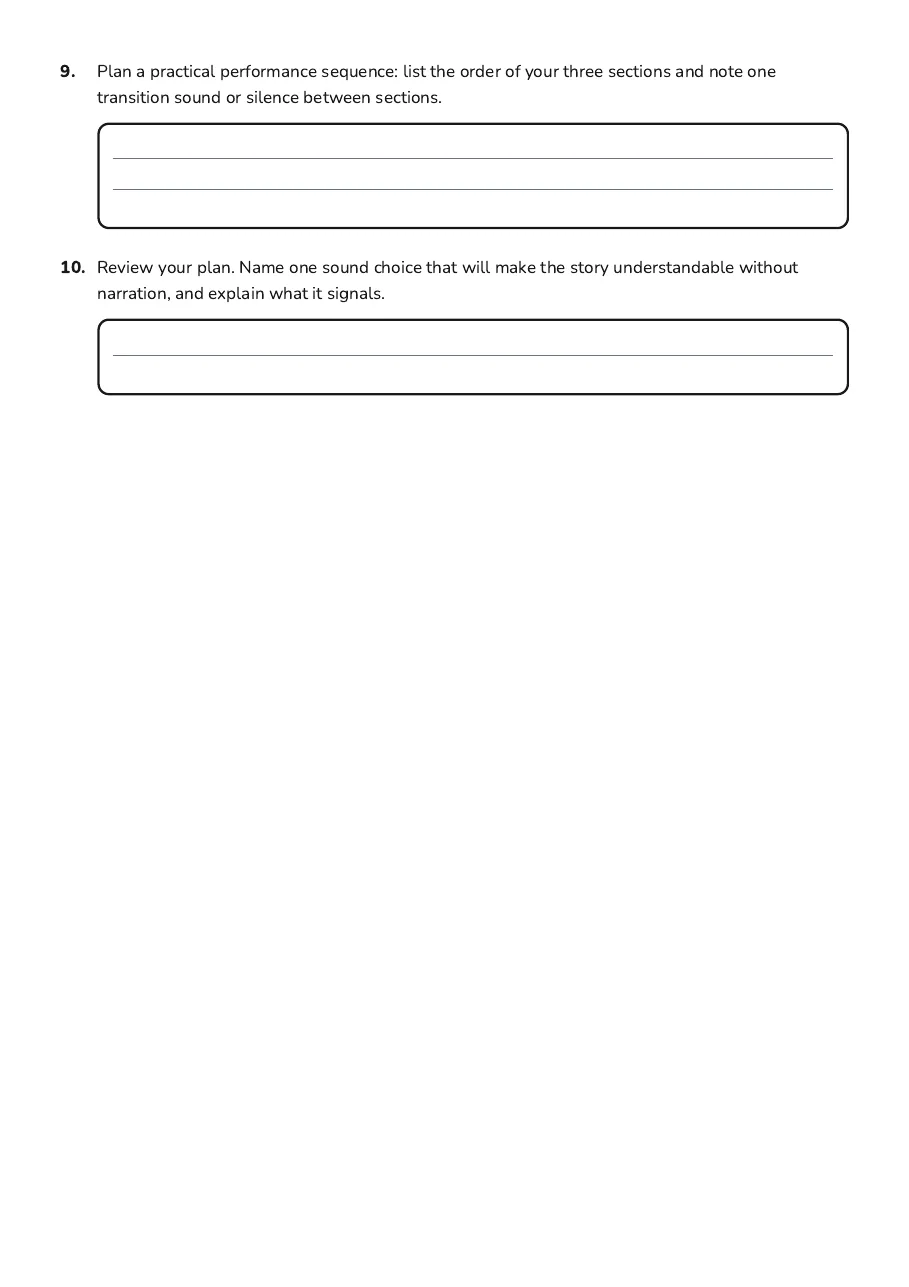
9.Plan a practical performance sequence: list the order of your three sections and note one transition sound or silence between sections.
10.Review your plan. Name one sound choice that will make the story understandable without narration, and explain what it signals.

3 printable pages

  • Musical Story Planning, page 1 of 3: Story spark, Match sound to story

    Page 1

  • Musical Story Planning, page 2 of 3: 4. Design a two- or three-sound motif for the robot. Describe its rhythm, pitch, or…

    Page 2

  • Musical Story Planning, page 3 of 3: 9. Plan a practical performance sequence: list the order of your three sections and note…

    Page 3

About This Worksheet

Free in Kuraplan

Sign up free, grab the PDF, and customize it for your class.

Print-Ready

Formatted for standard paper. Clean layout, easy to read.

AI-Generated

Created with Kuraplan's AI, designed for real classroom use.

For Teachers & Parents

Use in classrooms, for homework, tutoring, or homeschool.

Need a custom version of this worksheet?

Kuraplan's AI generates custom worksheets in seconds — differentiated for every learner, aligned to your curriculum.

Generate Custom Worksheets — Free
No credit card Curriculum-aligned Under 60 seconds