Napoleon's 1799 Coup Explained
A free social sciences worksheet ready for your classroom. Open in Kuraplan to grab the print-ready PDF, customize it for your students, or generate a fresh version in seconds.
Napoleon's 1799 Coup Explained
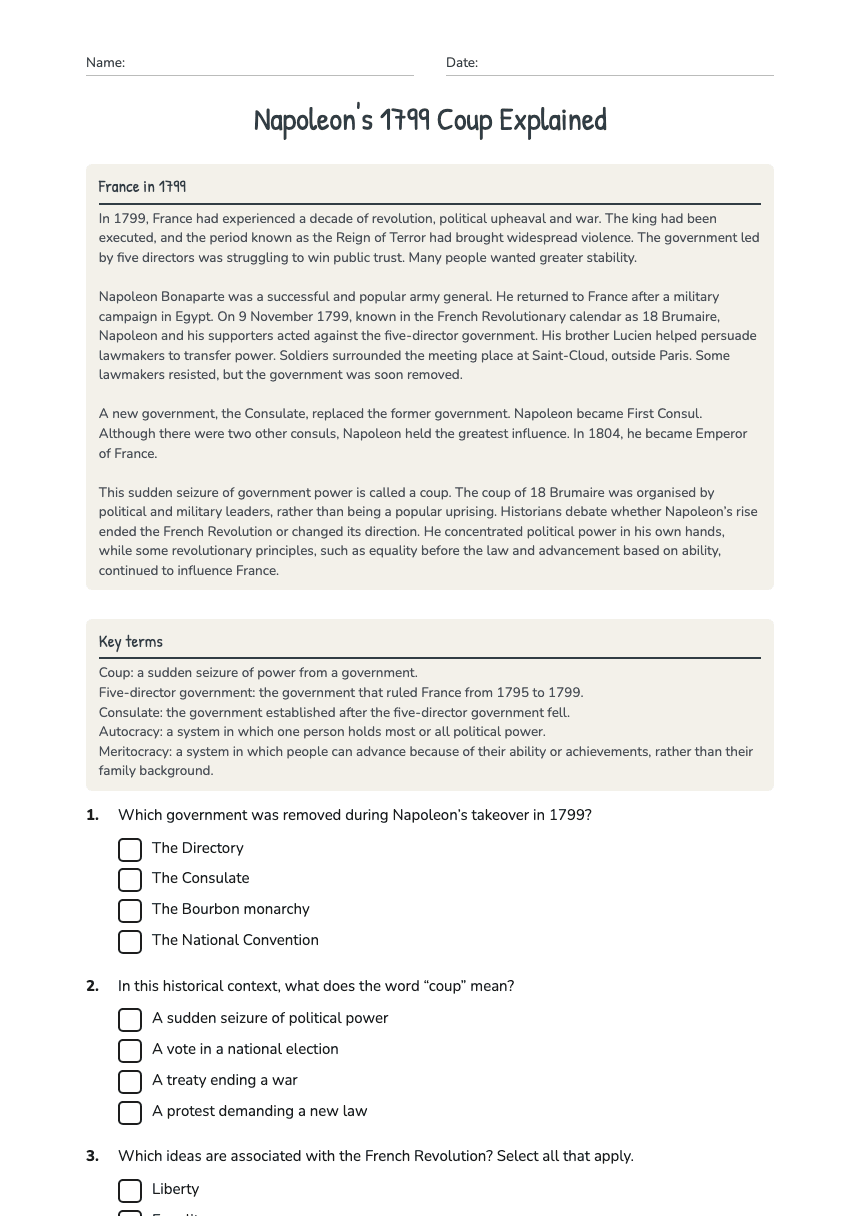
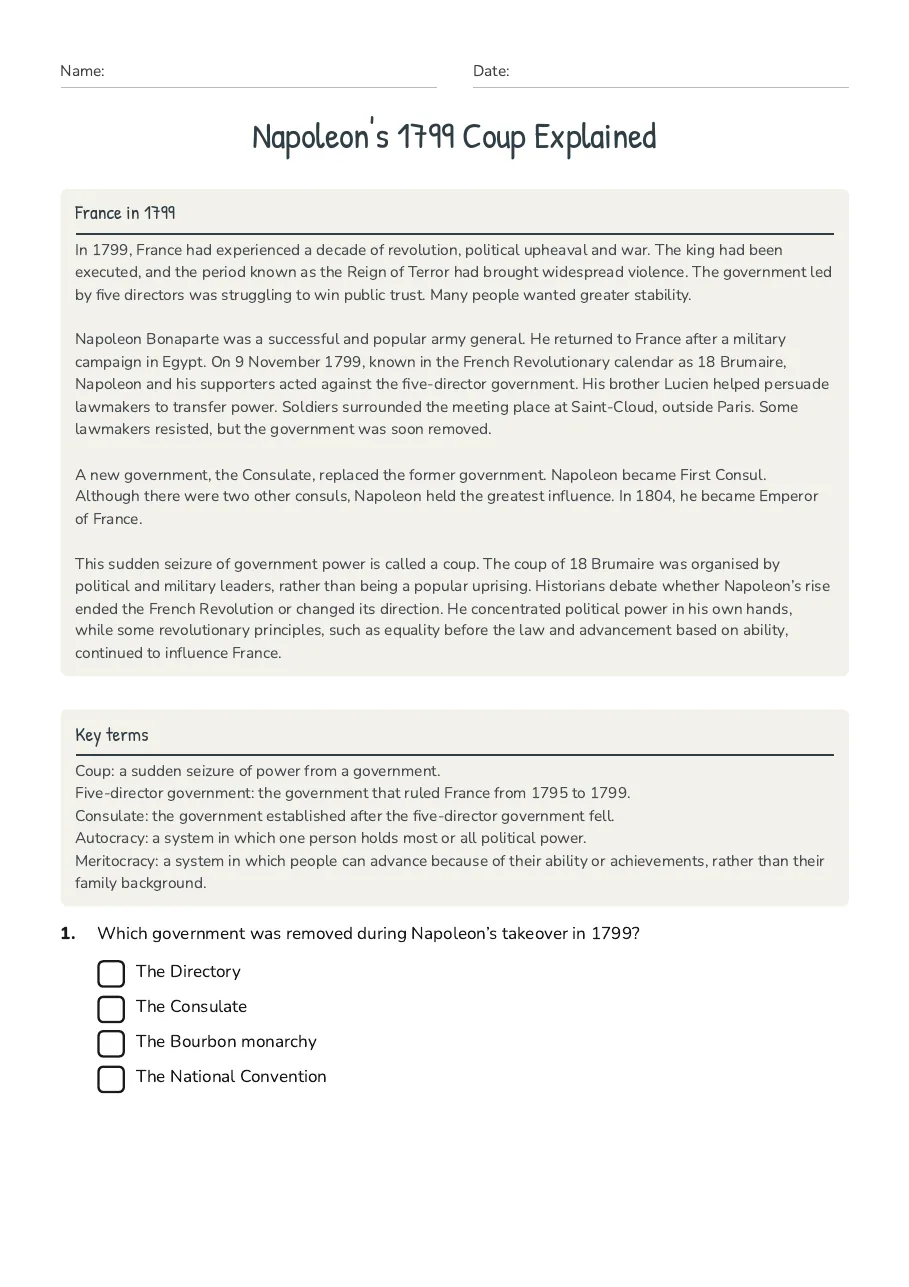
France in 1799
In 1799, France had experienced a decade of revolution, political upheaval and war. The king had been executed, and the period known as the Reign of Terror had brought widespread violence. The government led by five directors was struggling to win public trust. Many people wanted greater stability. Napoleon Bonaparte was a successful and popular army general. He returned to France after a military campaign in Egypt. On 9 November 1799, known in the French Revolutionary calendar as 18 Brumaire, Napoleon and his supporters acted against the five-director government. His brother Lucien helped persuade lawmakers to transfer power. Soldiers surrounded the meeting place at Saint-Cloud, outside Paris. Some lawmakers resisted, but the government was soon removed. A new government, the Consulate, replaced the former government. Napoleon became First Consul. Although there were two other consuls, Napoleon held the greatest influence. In 1804, he became Emperor of France. This sudden seizure of government power is called a coup. The coup of 18 Brumaire was organised by political and military leaders, rather than being a popular uprising. Historians debate whether Napoleon’s rise ended the French Revolution or changed its direction. He concentrated political power in his own hands, while some revolutionary principles, such as equality before the law and advancement based on ability, continued to influence France.
Key terms
Coup: a sudden seizure of power from a government. Five-director government: the government that ruled France from 1795 to 1799. Consulate: the government established after the five-director government fell. Autocracy: a system in which one person holds most or all political power. Meritocracy: a system in which people can advance because of their ability or achievements, rather than their family background.
- The Directory
- The Consulate
- The Bourbon monarchy
- The National Convention
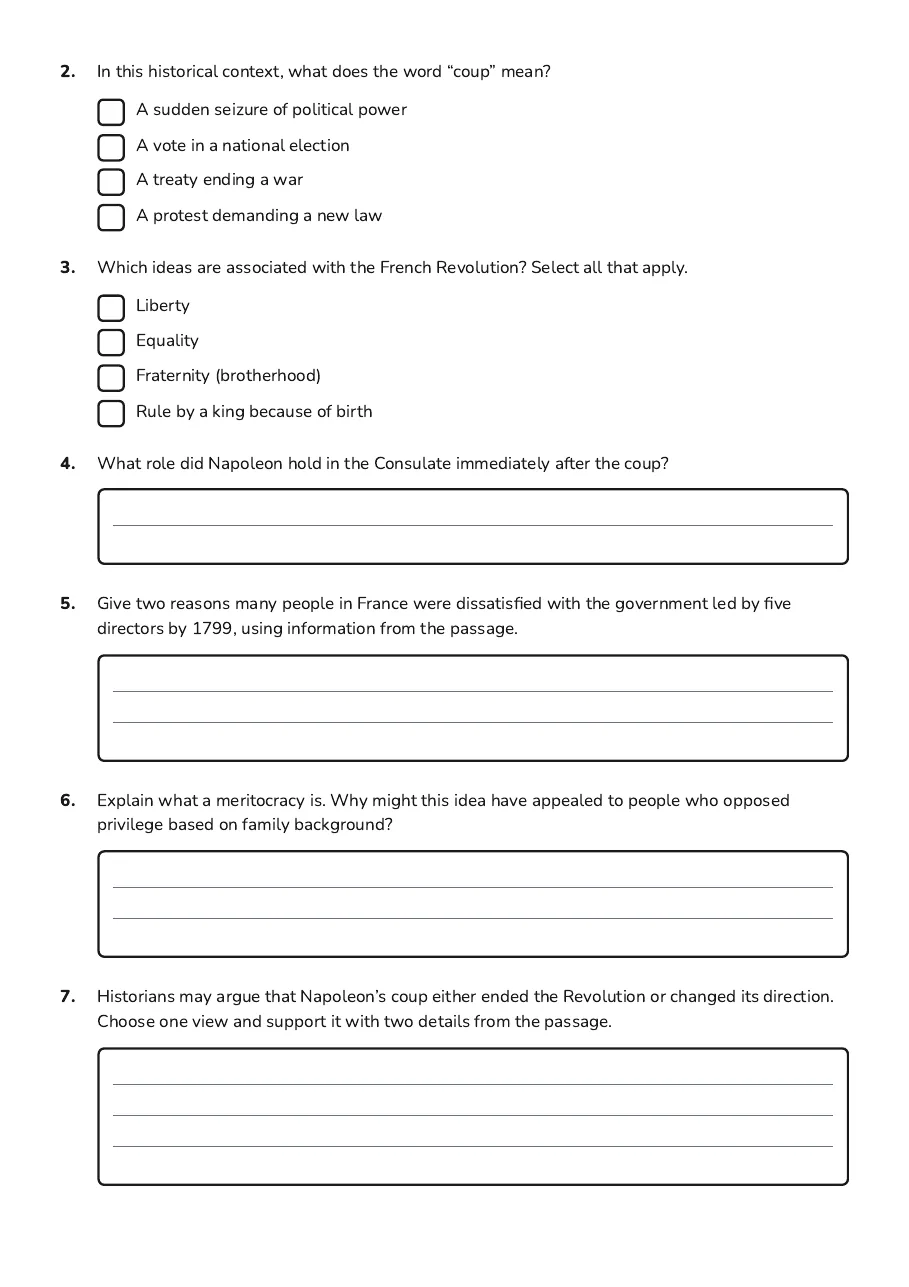
- A sudden seizure of political power
- A vote in a national election
- A treaty ending a war
- A protest demanding a new law
- Liberty
- Equality
- Fraternity (brotherhood)
- Rule by a king because of birth
3 printable pages
Page 1
Page 2

Page 3
About This Worksheet
Free in Kuraplan
Sign up free, grab the PDF, and customize it for your class.
Print-Ready
Formatted for standard paper. Clean layout, easy to read.
AI-Generated
Created with Kuraplan's AI, designed for real classroom use.
For Teachers & Parents
Use in classrooms, for homework, tutoring, or homeschool.
Need a custom version of this worksheet?
Kuraplan's AI generates custom worksheets in seconds — differentiated for every learner, aligned to your curriculum.
Generate Custom Worksheets — FreeMore Social Sciences Worksheets
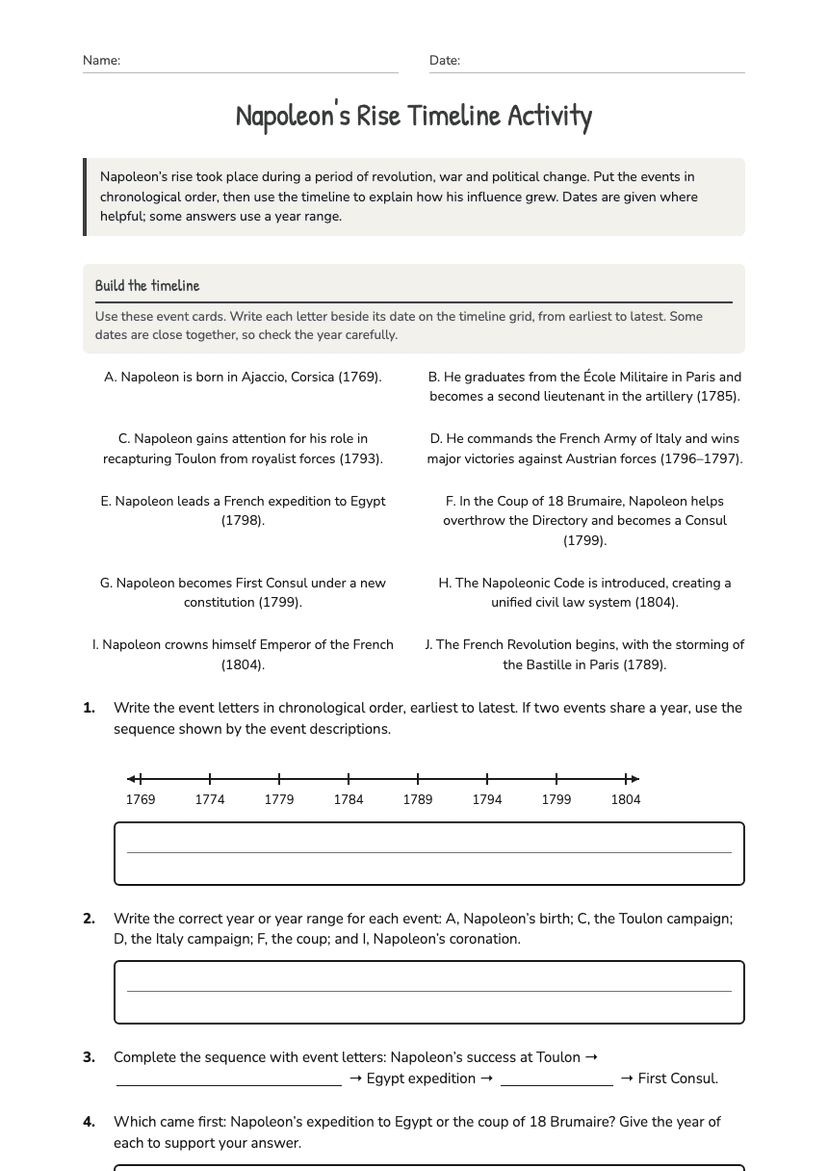
Napoleon's Rise Timeline Activity
Free
Types of Weathering Explained
Free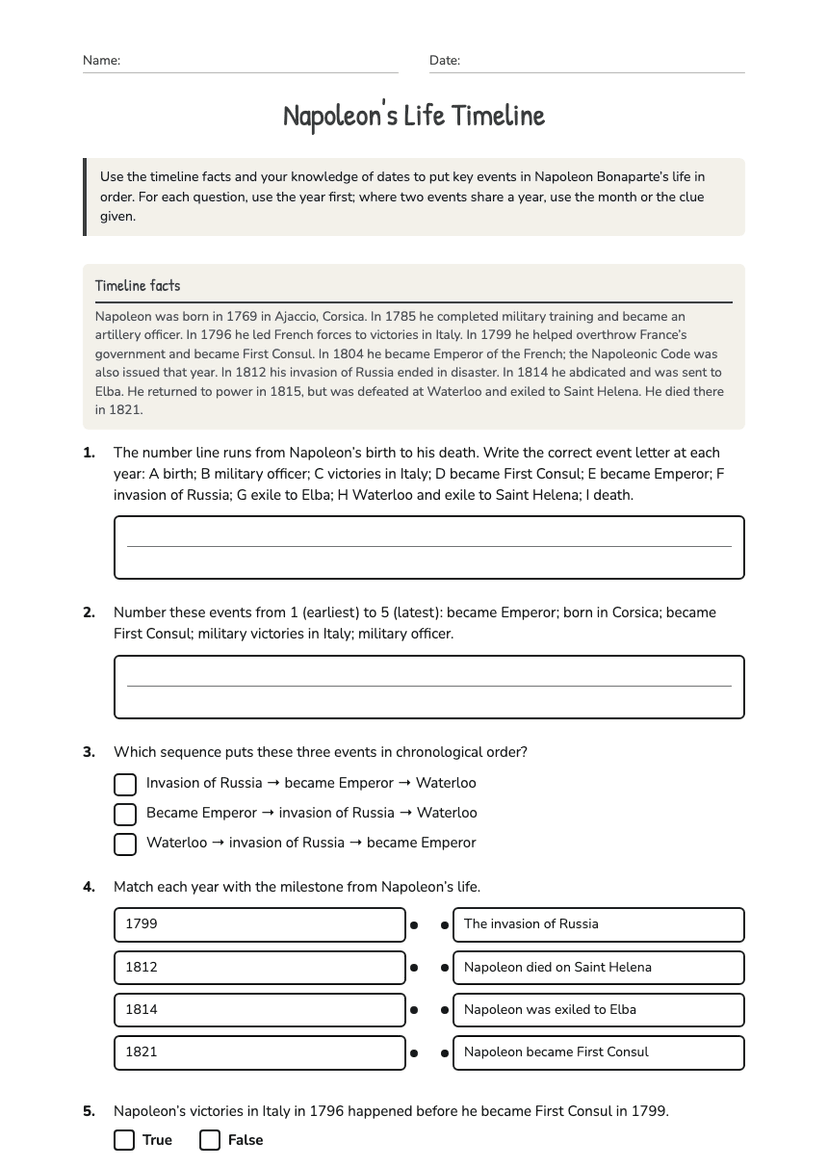
Napoleon's Life Timeline
Free
Fitness Components Explained
Free
Distance Formula Explained
Free
Greenhouse Effect Explained
Free
Year 9 Fractions Explained
Free