EnglishFreePrintable
Narrative Drafting Success Checklist
A free english worksheet ready for your classroom. Open in Kuraplan to grab the print-ready PDF, customize it for your students, or generate a fresh version in seconds.
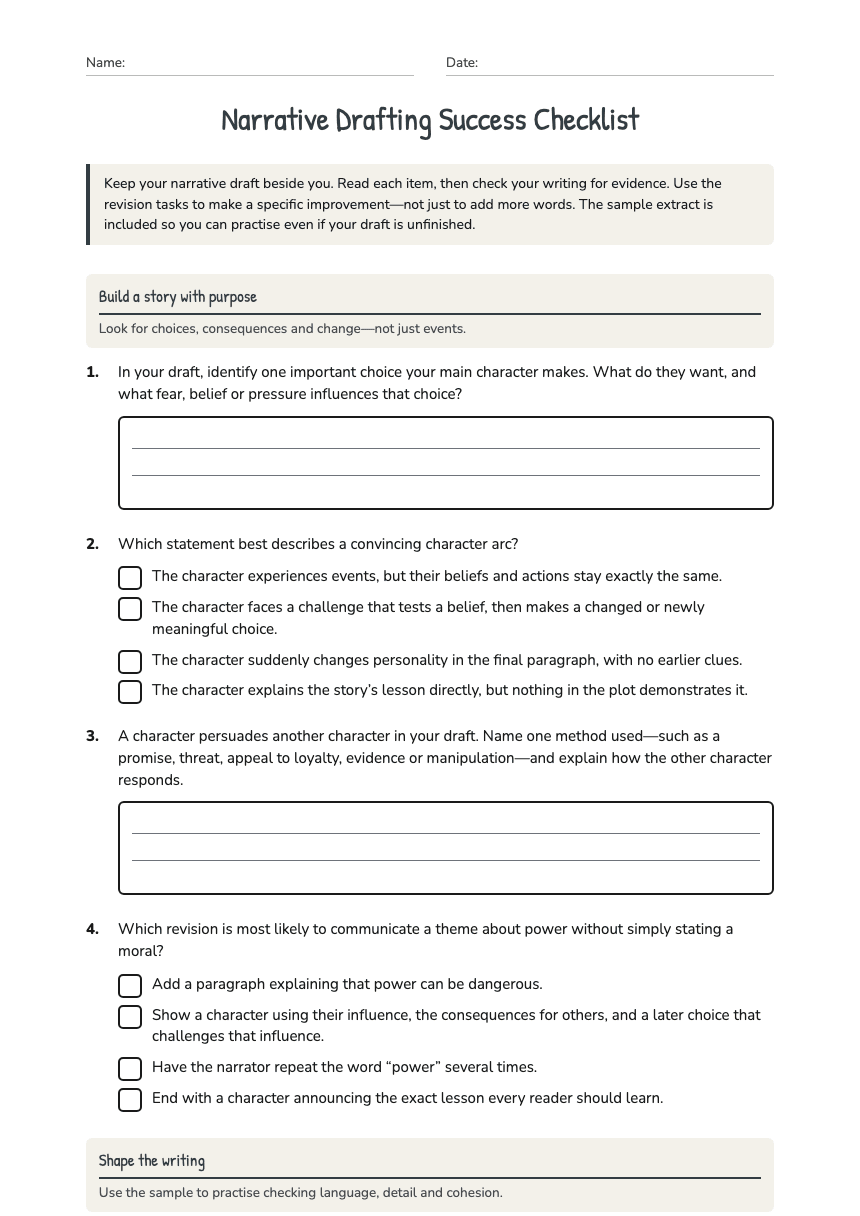
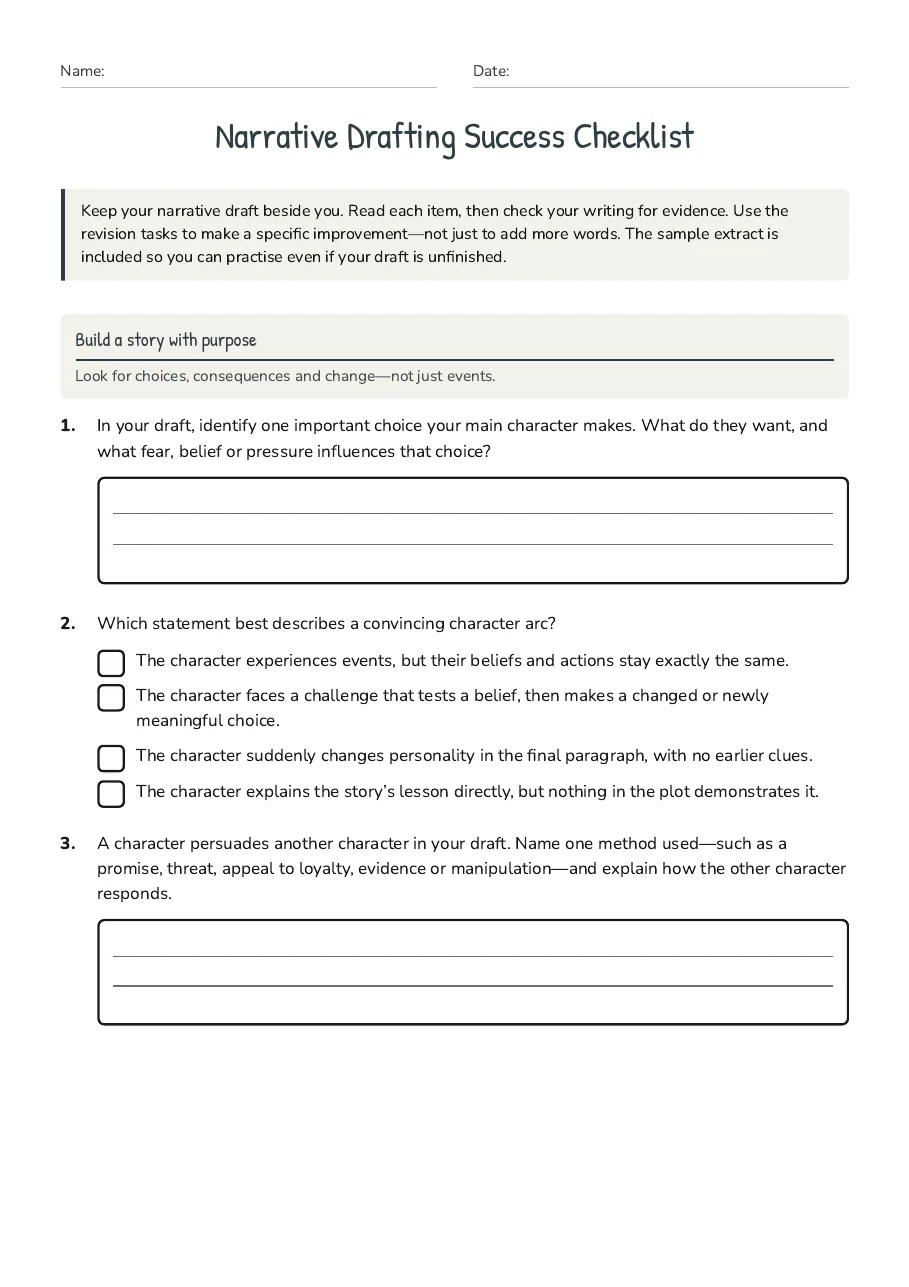
Name:Date:
Narrative Drafting Success Checklist
Keep your narrative draft beside you. Read each item, then check your writing for evidence. Use the revision tasks to make a specific improvement—not just to add more words. The sample extract is included so you can practise even if your draft is unfinished.
Build a story with purpose
Look for choices, consequences and change—not just events.
1.In your draft, identify one important choice your main character makes. What do they want, and what fear, belief or pressure influences that choice?
2.Which statement best describes a convincing character arc?
- The character experiences events, but their beliefs and actions stay exactly the same.
- The character faces a challenge that tests a belief, then makes a changed or newly meaningful choice.
- The character suddenly changes personality in the final paragraph, with no earlier clues.
- The character explains the story’s lesson directly, but nothing in the plot demonstrates it.
3.A character persuades another character in your draft. Name one method used—such as a promise, threat, appeal to loyalty, evidence or manipulation—and explain how the other character responds.
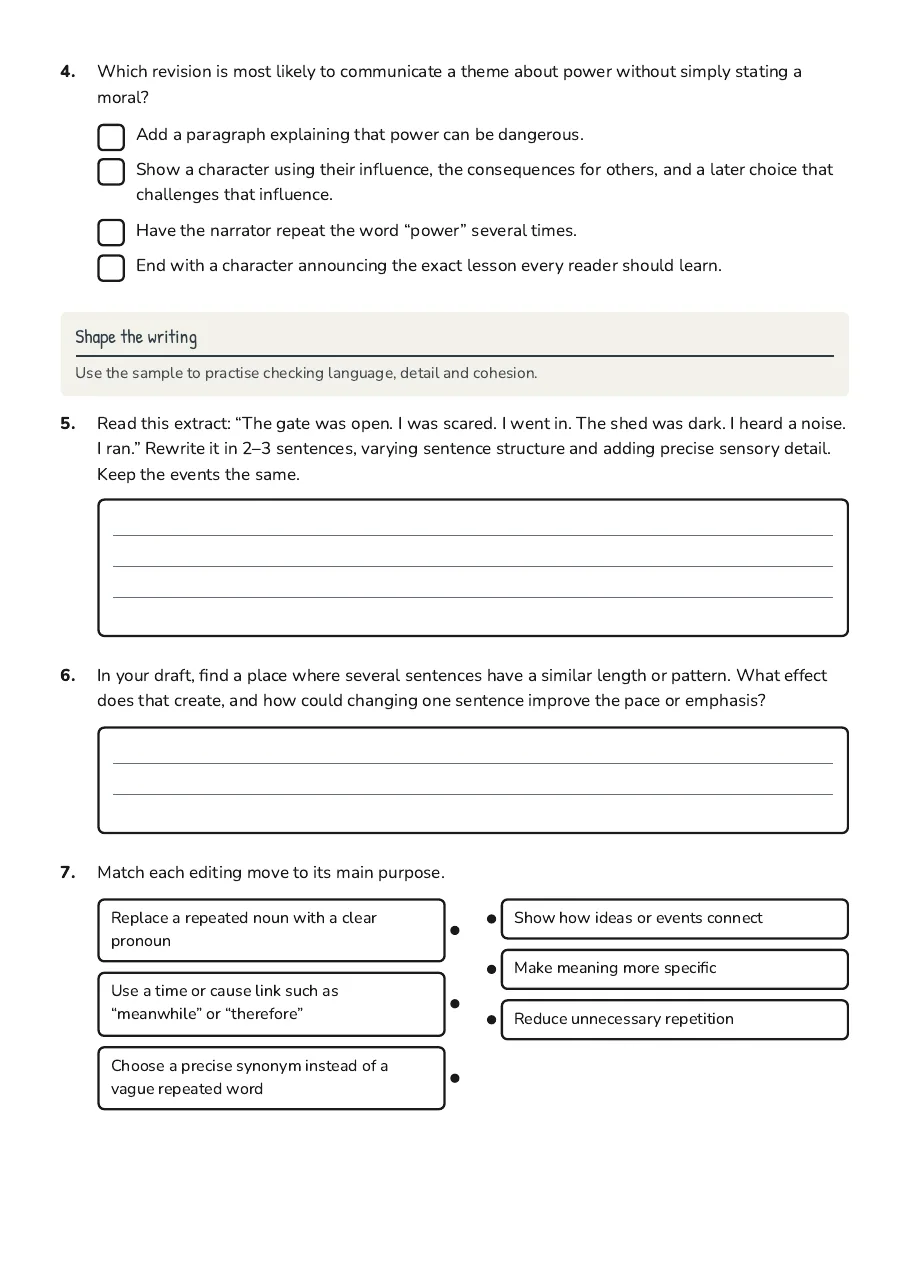
4.Which revision is most likely to communicate a theme about power without simply stating a moral?
- Add a paragraph explaining that power can be dangerous.
- Show a character using their influence, the consequences for others, and a later choice that challenges that influence.
- Have the narrator repeat the word “power” several times.
- End with a character announcing the exact lesson every reader should learn.
Shape the writing
Use the sample to practise checking language, detail and cohesion.
5.Read this extract: “The gate was open. I was scared. I went in. The shed was dark. I heard a noise. I ran.” Rewrite it in 2–3 sentences, varying sentence structure and adding precise sensory detail. Keep the events the same.
6.In your draft, find a place where several sentences have a similar length or pattern. What effect does that create, and how could changing one sentence improve the pace or emphasis?
7.Match each editing move to its main purpose.
- Replace a repeated noun with a clear pronoun
- Use a time or cause link such as “meanwhile” or “therefore”
- Choose a precise synonym instead of a vague repeated word
- Show how ideas or events connect
- Make meaning more specific
- Reduce unnecessary repetition
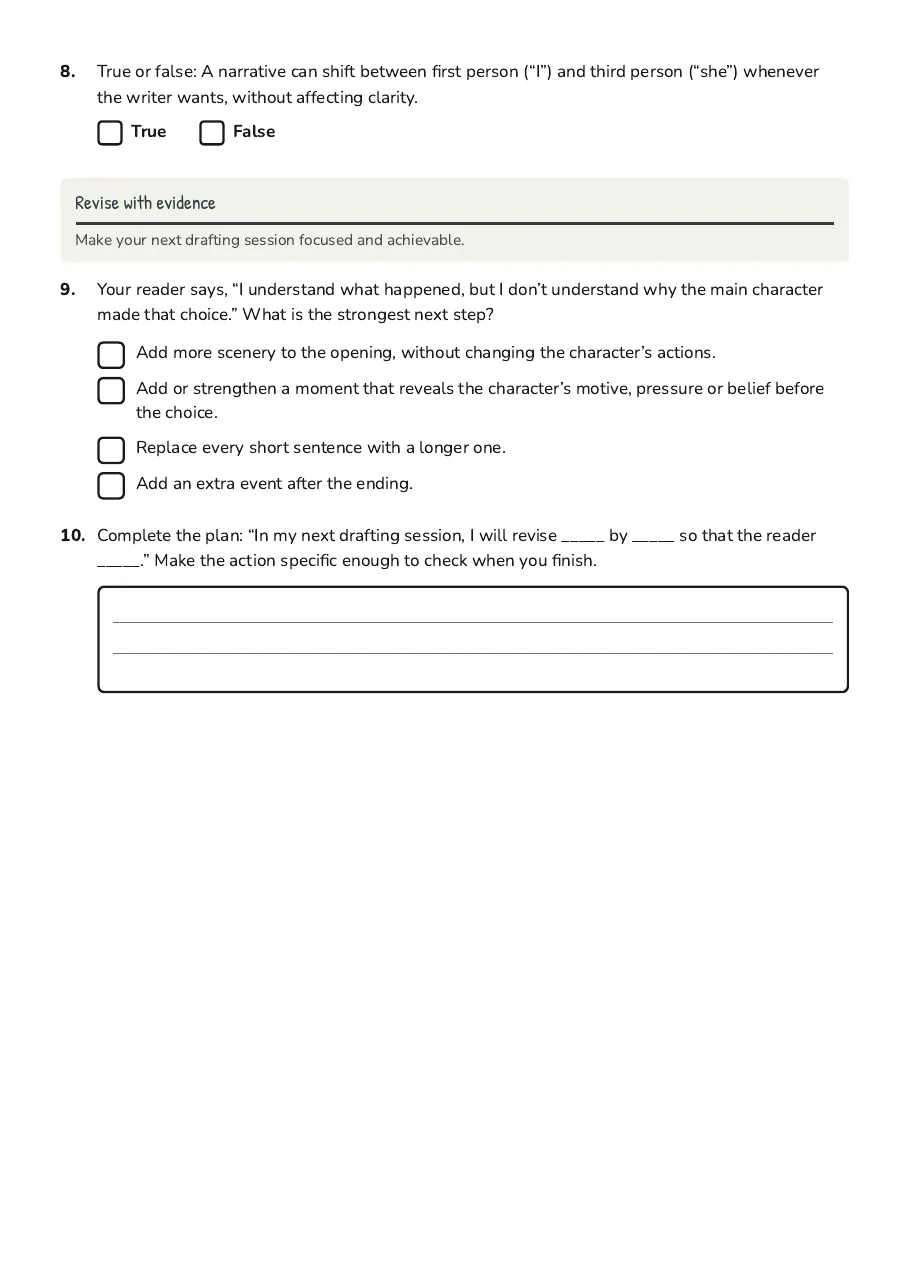
8.True or false: A narrative can shift between first person (“I”) and third person (“she”) whenever the writer wants, without affecting clarity.
TrueFalse
Revise with evidence
Make your next drafting session focused and achievable.
9.Your reader says, “I understand what happened, but I don’t understand why the main character made that choice.” What is the strongest next step?
- Add more scenery to the opening, without changing the character’s actions.
- Add or strengthen a moment that reveals the character’s motive, pressure or belief before the choice.
- Replace every short sentence with a longer one.
- Add an extra event after the ending.
10.Complete the plan: “In my next drafting session, I will revise _____ by _____ so that the reader _____.” Make the action specific enough to check when you finish.
3 printable pages
Page 1
Page 2
Page 3
About This Worksheet
Free in Kuraplan
Sign up free, grab the PDF, and customize it for your class.
Print-Ready
Formatted for standard paper. Clean layout, easy to read.
AI-Generated
Created with Kuraplan's AI, designed for real classroom use.
For Teachers & Parents
Use in classrooms, for homework, tutoring, or homeschool.
Need a custom version of this worksheet?
Kuraplan's AI generates custom worksheets in seconds — differentiated for every learner, aligned to your curriculum.
Generate Custom Worksheets — Free No credit card Curriculum-aligned Under 60 seconds