ScienceFreePrintable

Neutralisation Reactions Experiment

A free science worksheet ready for your classroom. Open in Kuraplan to grab the print-ready PDF, customize it for your students, or generate a fresh version in seconds.

Neutralisation Reactions Experiment worksheet preview
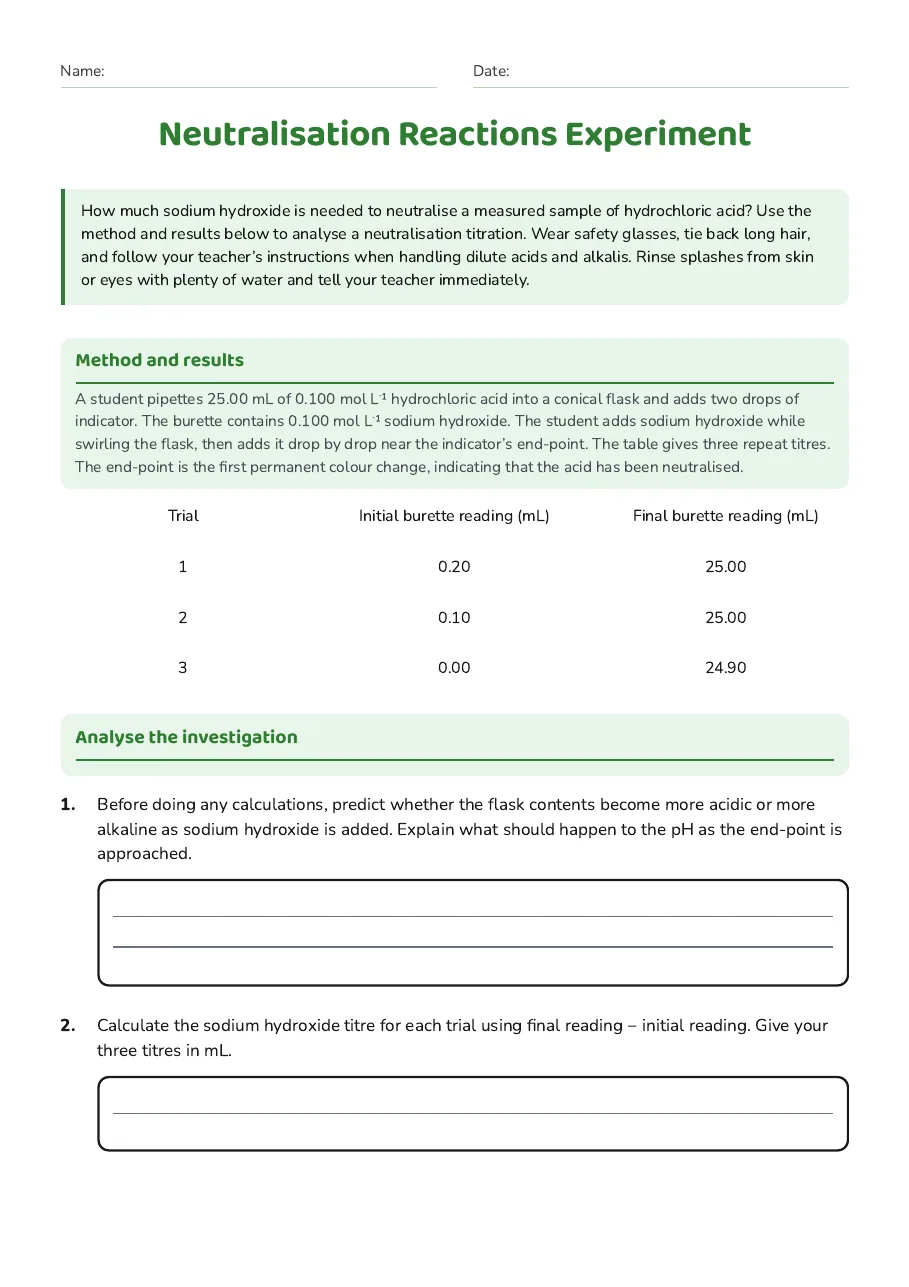
Name:Date:

Neutralisation Reactions Experiment

How much sodium hydroxide is needed to neutralise a measured sample of hydrochloric acid? Use the method and results below to analyse a neutralisation titration. Wear safety glasses, tie back long hair, and follow your teacher’s instructions when handling dilute acids and alkalis. Rinse splashes from skin or eyes with plenty of water and tell your teacher immediately.

Method and results

A student pipettes 25.00 mL of 0.100 mol L⁻¹ hydrochloric acid into a conical flask and adds two drops of indicator. The burette contains 0.100 mol L⁻¹ sodium hydroxide. The student adds sodium hydroxide while swirling the flask, then adds it drop by drop near the indicator’s end-point. The table gives three repeat titres. The end-point is the first permanent colour change, indicating that the acid has been neutralised.

Trial

Initial burette reading (mL)

Final burette reading (mL)

1

0.20

25.00

2

0.10

25.00

3

0.00

24.90

Analyse the investigation

1.Before doing any calculations, predict whether the flask contents become more acidic or more alkaline as sodium hydroxide is added. Explain what should happen to the pH as the end-point is approached.
2.Calculate the sodium hydroxide titre for each trial using final reading − initial reading. Give your three titres in mL.
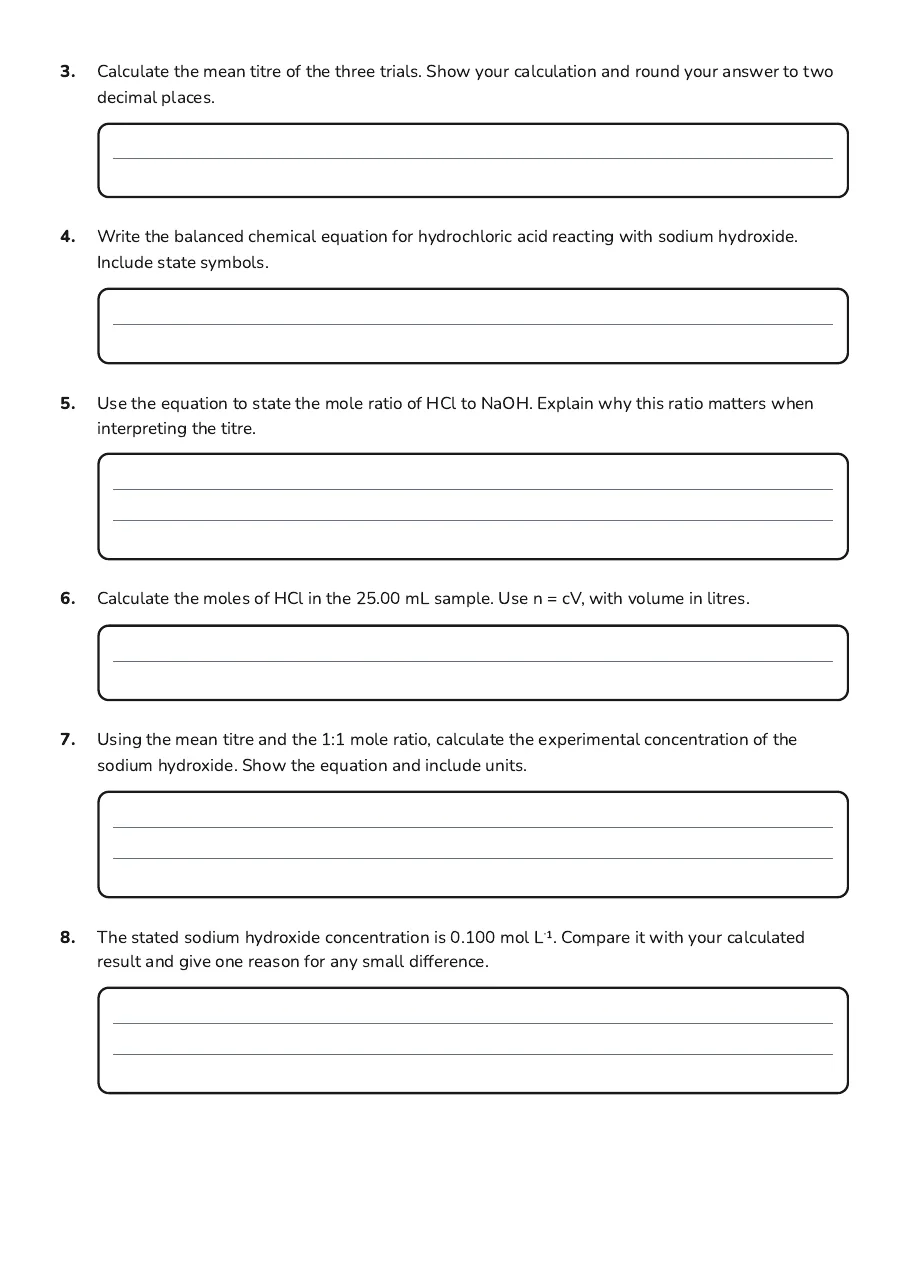
3.Calculate the mean titre of the three trials. Show your calculation and round your answer to two decimal places.
4.Write the balanced chemical equation for hydrochloric acid reacting with sodium hydroxide. Include state symbols.
5.Use the equation to state the mole ratio of HCl to NaOH. Explain why this ratio matters when interpreting the titre.
6.Calculate the moles of HCl in the 25.00 mL sample. Use n = cV, with volume in litres.
7.Using the mean titre and the 1:1 mole ratio, calculate the experimental concentration of the sodium hydroxide. Show the equation and include units.
8.The stated sodium hydroxide concentration is 0.100 mol L⁻¹. Compare it with your calculated result and give one reason for any small difference.
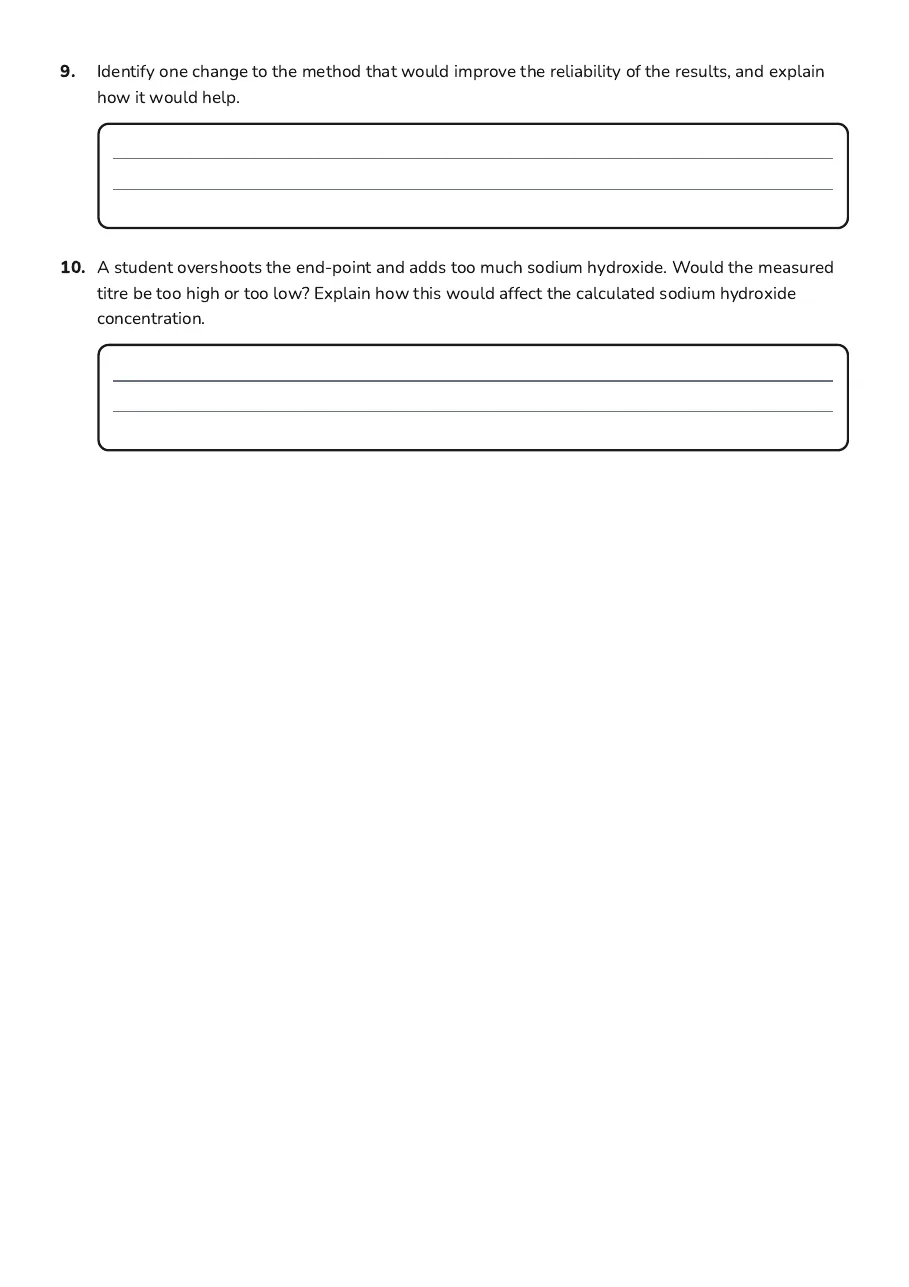
9.Identify one change to the method that would improve the reliability of the results, and explain how it would help.
10.A student overshoots the end-point and adds too much sodium hydroxide. Would the measured titre be too high or too low? Explain how this would affect the calculated sodium hydroxide concentration.

3 printable pages

  • Neutralisation Reactions Experiment, page 1 of 3: Method and results, Analyse the investigation

    Page 1

  • Neutralisation Reactions Experiment, page 2 of 3: 3. Calculate the mean titre of the three trials. Show your calculation and round your…

    Page 2

  • Neutralisation Reactions Experiment, page 3 of 3: 9. Identify one change to the method that would improve the reliability of the results,…

    Page 3

About This Worksheet

Free in Kuraplan

Sign up free, grab the PDF, and customize it for your class.

Print-Ready

Formatted for standard paper. Clean layout, easy to read.

AI-Generated

Created with Kuraplan's AI, designed for real classroom use.

For Teachers & Parents

Use in classrooms, for homework, tutoring, or homeschool.

Need a custom version of this worksheet?

Kuraplan's AI generates custom worksheets in seconds — differentiated for every learner, aligned to your curriculum.

Generate Custom Worksheets — Free
No credit card Curriculum-aligned Under 60 seconds