Never Let Me Go Ethics
A free english worksheet ready for your classroom. Open in Kuraplan to grab the print-ready PDF, customize it for your students, or generate a fresh version in seconds.
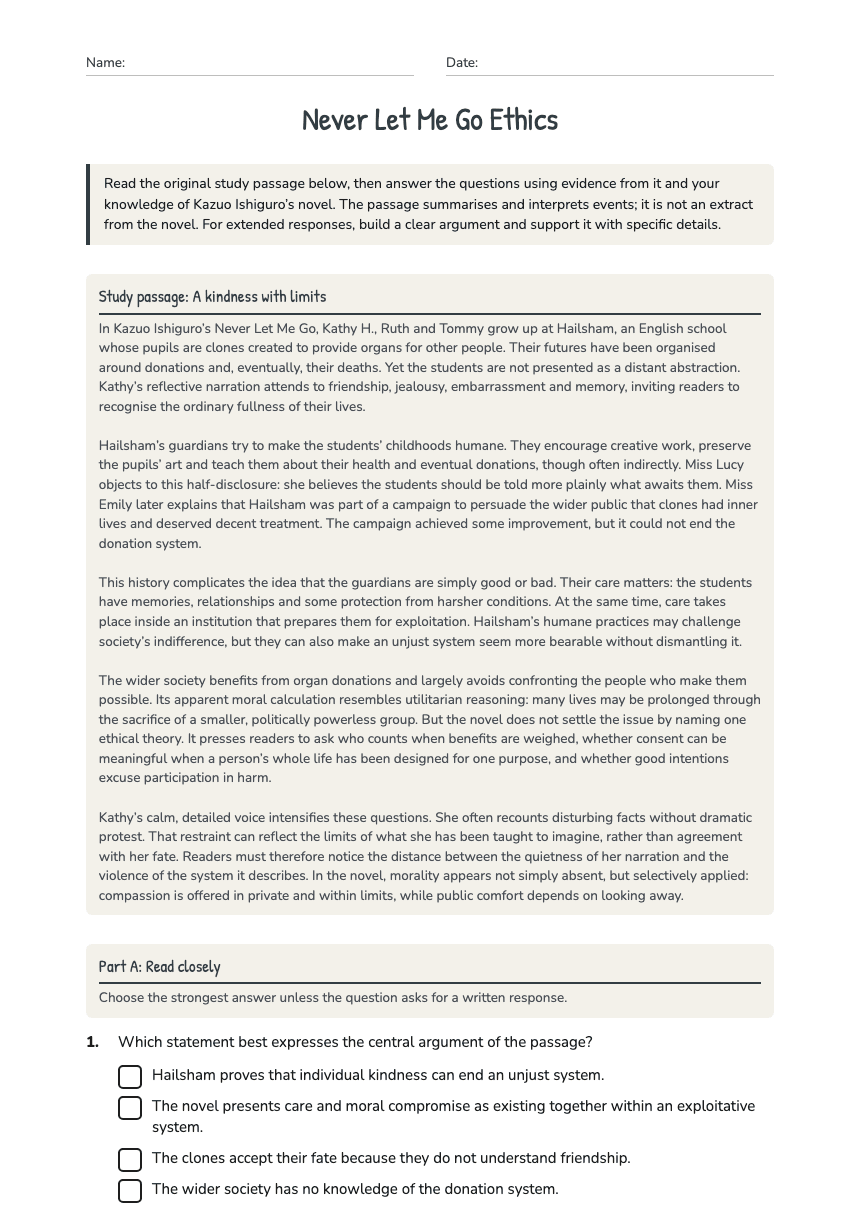
Never Let Me Go Ethics
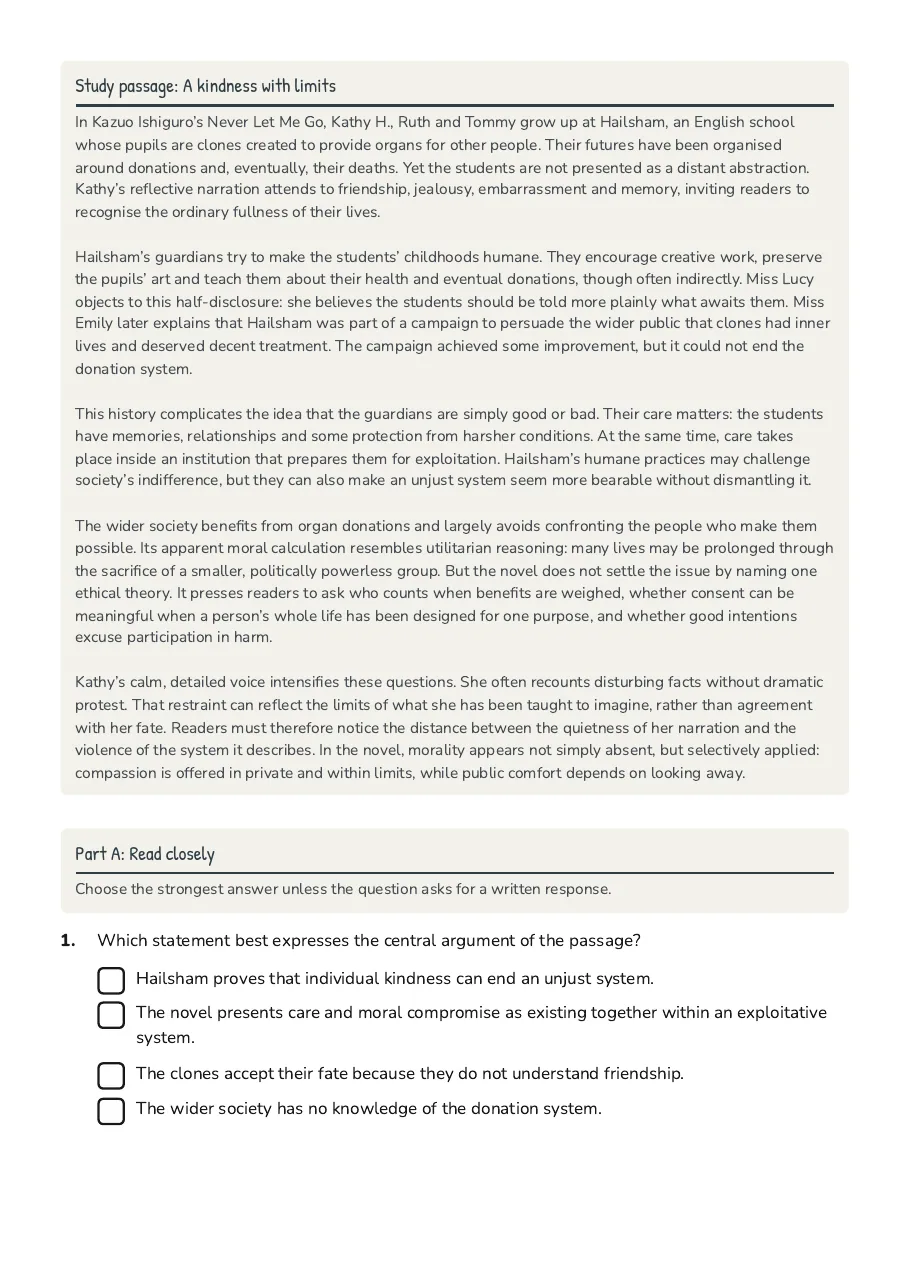
Study passage: A kindness with limits
In Kazuo Ishiguro’s Never Let Me Go, Kathy H., Ruth and Tommy grow up at Hailsham, an English school whose pupils are clones created to provide organs for other people. Their futures have been organised around donations and, eventually, their deaths. Yet the students are not presented as a distant abstraction. Kathy’s reflective narration attends to friendship, jealousy, embarrassment and memory, inviting readers to recognise the ordinary fullness of their lives. Hailsham’s guardians try to make the students’ childhoods humane. They encourage creative work, preserve the pupils’ art and teach them about their health and eventual donations, though often indirectly. Miss Lucy objects to this half-disclosure: she believes the students should be told more plainly what awaits them. Miss Emily later explains that Hailsham was part of a campaign to persuade the wider public that clones had inner lives and deserved decent treatment. The campaign achieved some improvement, but it could not end the donation system. This history complicates the idea that the guardians are simply good or bad. Their care matters: the students have memories, relationships and some protection from harsher conditions. At the same time, care takes place inside an institution that prepares them for exploitation. Hailsham’s humane practices may challenge society’s indifference, but they can also make an unjust system seem more bearable without dismantling it. The wider society benefits from organ donations and largely avoids confronting the people who make them possible. Its apparent moral calculation resembles utilitarian reasoning: many lives may be prolonged through the sacrifice of a smaller, politically powerless group. But the novel does not settle the issue by naming one ethical theory. It presses readers to ask who counts when benefits are weighed, whether consent can be meaningful when a person’s whole life has been designed for one purpose, and whether good intentions excuse participation in harm. Kathy’s calm, detailed voice intensifies these questions. She often recounts disturbing facts without dramatic protest. That restraint can reflect the limits of what she has been taught to imagine, rather than agreement with her fate. Readers must therefore notice the distance between the quietness of her narration and the violence of the system it describes. In the novel, morality appears not simply absent, but selectively applied: compassion is offered in private and within limits, while public comfort depends on looking away.
Part A: Read closely
Choose the strongest answer unless the question asks for a written response.
- Hailsham proves that individual kindness can end an unjust system.
- The novel presents care and moral compromise as existing together within an exploitative system.
- The clones accept their fate because they do not understand friendship.
- The wider society has no knowledge of the donation system.
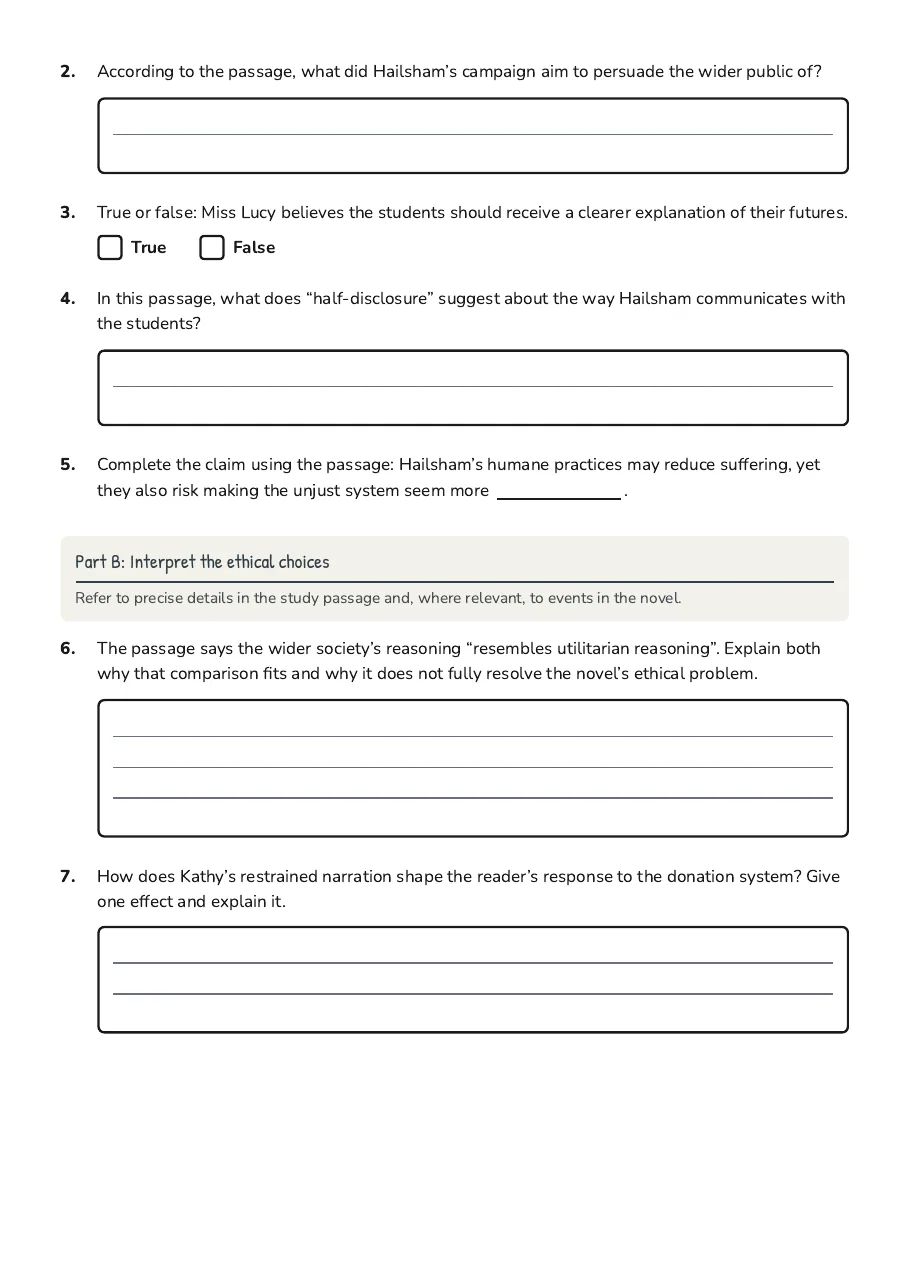
Part B: Interpret the ethical choices
Refer to precise details in the study passage and, where relevant, to events in the novel.
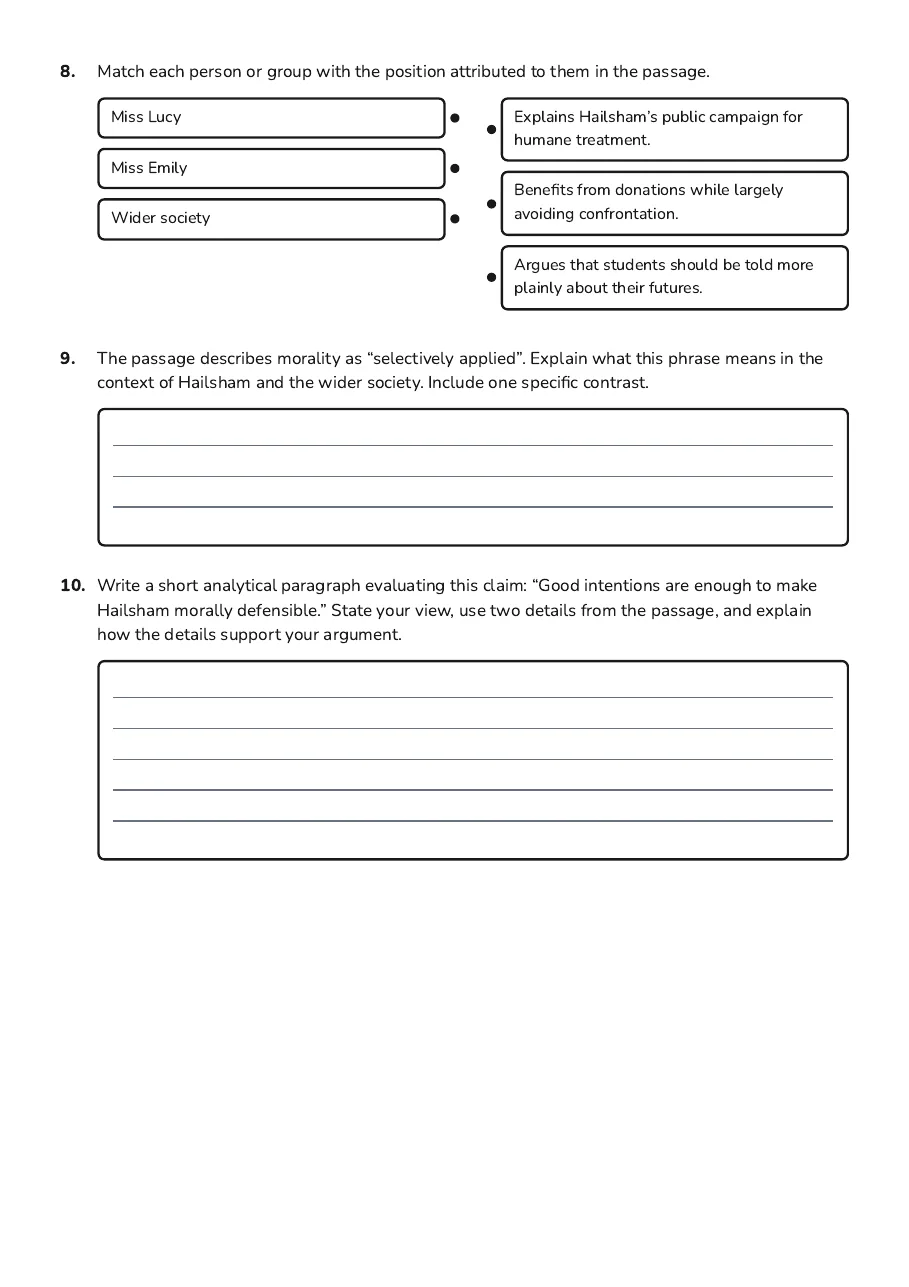
- Miss Lucy
- Miss Emily
- Wider society
- Explains Hailsham’s public campaign for humane treatment.
- Benefits from donations while largely avoiding confrontation.
- Argues that students should be told more plainly about their futures.
4 printable pages
Page 1
Page 2
Page 3
Page 4
About This Worksheet
Free in Kuraplan
Sign up free, grab the PDF, and customize it for your class.
Print-Ready
Formatted for standard paper. Clean layout, easy to read.
AI-Generated
Created with Kuraplan's AI, designed for real classroom use.
For Teachers & Parents
Use in classrooms, for homework, tutoring, or homeschool.
Need a custom version of this worksheet?
Kuraplan's AI generates custom worksheets in seconds — differentiated for every learner, aligned to your curriculum.
Generate Custom Worksheets — Free