ScienceFreePrintable

Periodic Table Applications

A free science worksheet ready for your classroom. Open in Kuraplan to grab the print-ready PDF, customize it for your students, or generate a fresh version in seconds.
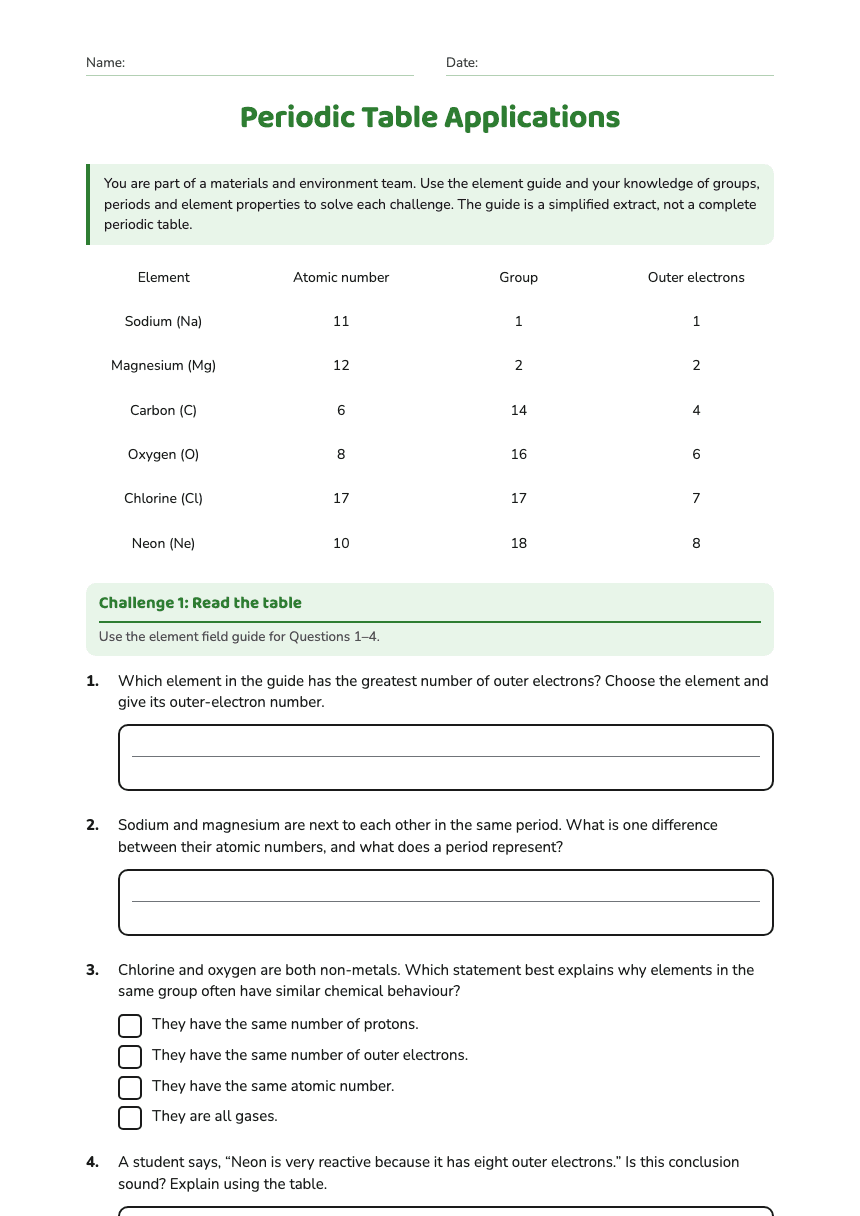
Periodic Table Applications worksheet preview
Name:Date:

Periodic Table Applications

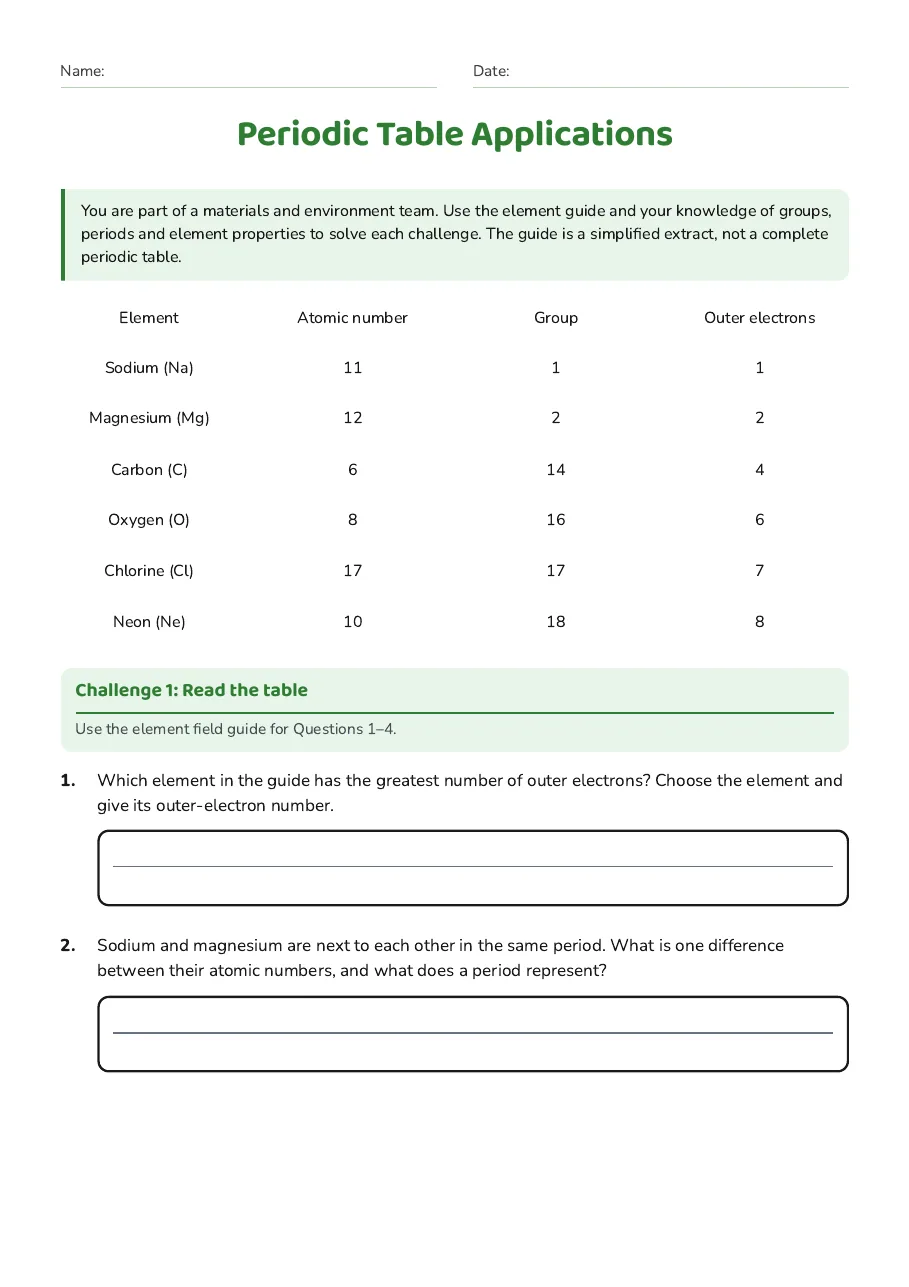
You are part of a materials and environment team. Use the element guide and your knowledge of groups, periods and element properties to solve each challenge. The guide is a simplified extract, not a complete periodic table.

Element

Atomic number

Group

Outer electrons

Sodium (Na)

11

1

1

Magnesium (Mg)

12

2

2

Carbon (C)

6

14

4

Oxygen (O)

8

16

6

Chlorine (Cl)

17

17

7

Neon (Ne)

10

18

8

Challenge 1: Read the table

Use the element field guide for Questions 1–4.

1.Which element in the guide has the greatest number of outer electrons? Choose the element and give its outer-electron number.
2.Sodium and magnesium are next to each other in the same period. What is one difference between their atomic numbers, and what does a period represent?
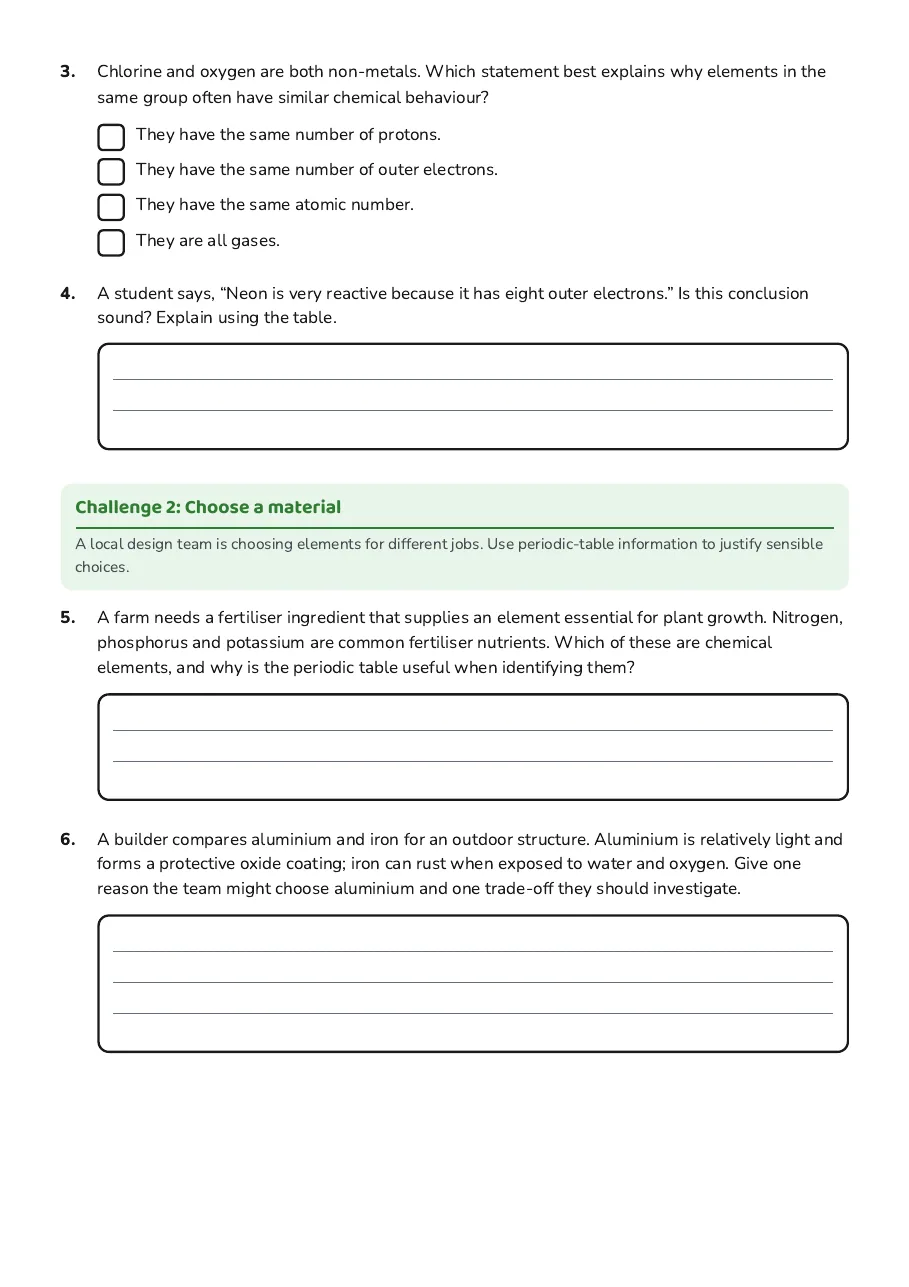
3.Chlorine and oxygen are both non-metals. Which statement best explains why elements in the same group often have similar chemical behaviour?
  • They have the same number of protons.
  • They have the same number of outer electrons.
  • They have the same atomic number.
  • They are all gases.
4.A student says, “Neon is very reactive because it has eight outer electrons.” Is this conclusion sound? Explain using the table.

Challenge 2: Choose a material

A local design team is choosing elements for different jobs. Use periodic-table information to justify sensible choices.

5.A farm needs a fertiliser ingredient that supplies an element essential for plant growth. Nitrogen, phosphorus and potassium are common fertiliser nutrients. Which of these are chemical elements, and why is the periodic table useful when identifying them?
6.A builder compares aluminium and iron for an outdoor structure. Aluminium is relatively light and forms a protective oxide coating; iron can rust when exposed to water and oxygen. Give one reason the team might choose aluminium and one trade-off they should investigate.
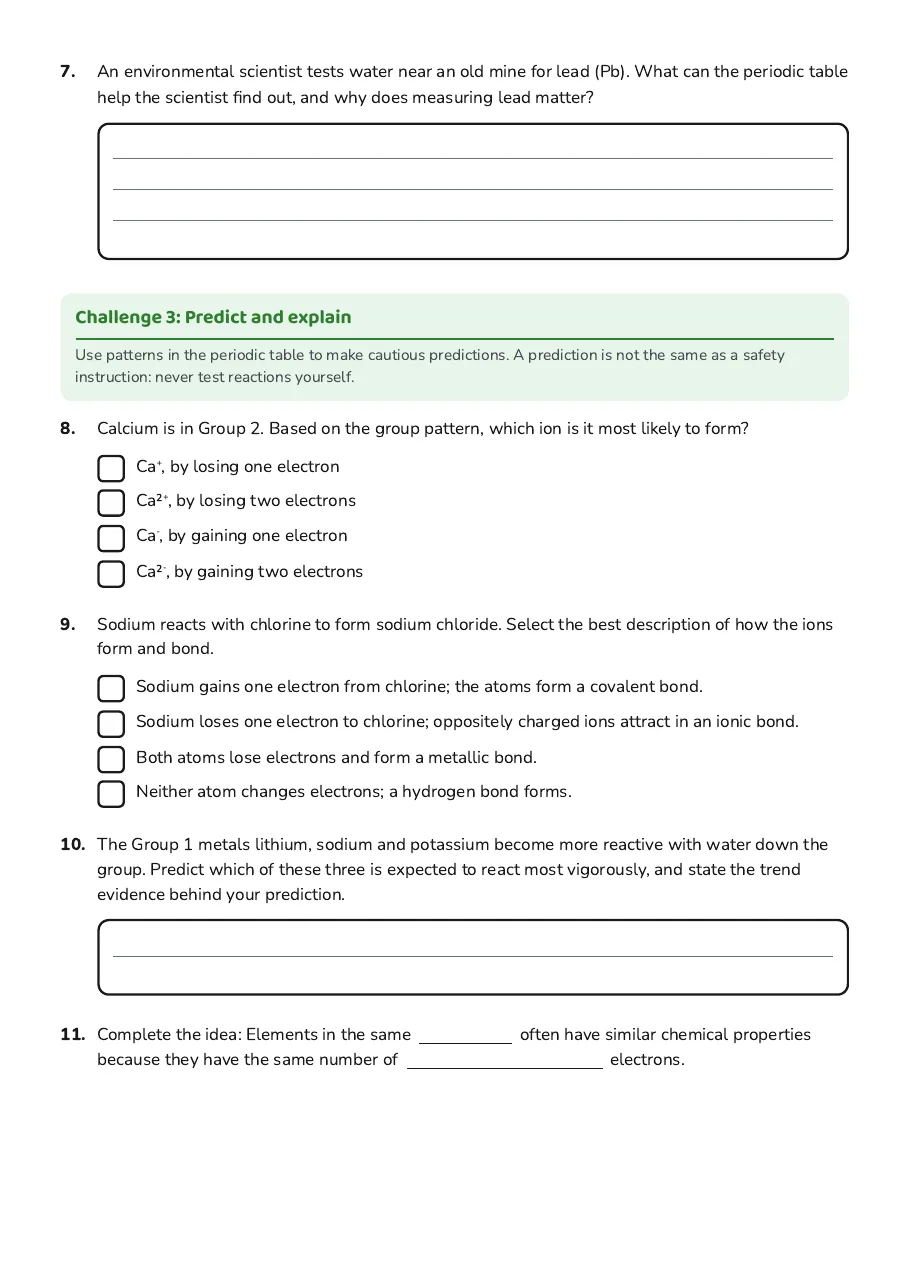
7.An environmental scientist tests water near an old mine for lead (Pb). What can the periodic table help the scientist find out, and why does measuring lead matter?

Challenge 3: Predict and explain

Use patterns in the periodic table to make cautious predictions. A prediction is not the same as a safety instruction: never test reactions yourself.

8.Calcium is in Group 2. Based on the group pattern, which ion is it most likely to form?
  • Ca⁺, by losing one electron
  • Ca²⁺, by losing two electrons
  • Ca⁻, by gaining one electron
  • Ca²⁻, by gaining two electrons
9.Sodium reacts with chlorine to form sodium chloride. Select the best description of how the ions form and bond.
  • Sodium gains one electron from chlorine; the atoms form a covalent bond.
  • Sodium loses one electron to chlorine; oppositely charged ions attract in an ionic bond.
  • Both atoms lose electrons and form a metallic bond.
  • Neither atom changes electrons; a hydrogen bond forms.
10.The Group 1 metals lithium, sodium and potassium become more reactive with water down the group. Predict which of these three is expected to react most vigorously, and state the trend evidence behind your prediction.
11.Complete the idea: Elements in the same often have similar chemical properties because they have the same number of electrons.
12.A new medication is being designed, and the team needs an element that is safe and suitable for the body. Explain why the periodic table alone cannot tell the team whether an element is a good medicine.

4 printable pages

  • Periodic Table Applications, page 1 of 4: Challenge 1: Read the table

    Page 1

  • Periodic Table Applications, page 2 of 4: Challenge 2: Choose a material

    Page 2

  • Periodic Table Applications, page 3 of 4: Challenge 3: Predict and explain

    Page 3

  • Periodic Table Applications, page 4 of 4: 12. A new medication is being designed, and the team needs an element that is safe and…

    Page 4

About This Worksheet

Free in Kuraplan

Sign up free, grab the PDF, and customize it for your class.

Print-Ready

Formatted for standard paper. Clean layout, easy to read.

AI-Generated

Created with Kuraplan's AI, designed for real classroom use.

For Teachers & Parents

Use in classrooms, for homework, tutoring, or homeschool.

Need a custom version of this worksheet?

Kuraplan's AI generates custom worksheets in seconds — differentiated for every learner, aligned to your curriculum.

Generate Custom Worksheets — Free
No credit card Curriculum-aligned Under 60 seconds