Personalized Performance Training Introduction
A free pe worksheet ready for your classroom. Open in Kuraplan to grab the print-ready PDF, customize it for your students, or generate a fresh version in seconds.

Personalized Performance Training Introduction
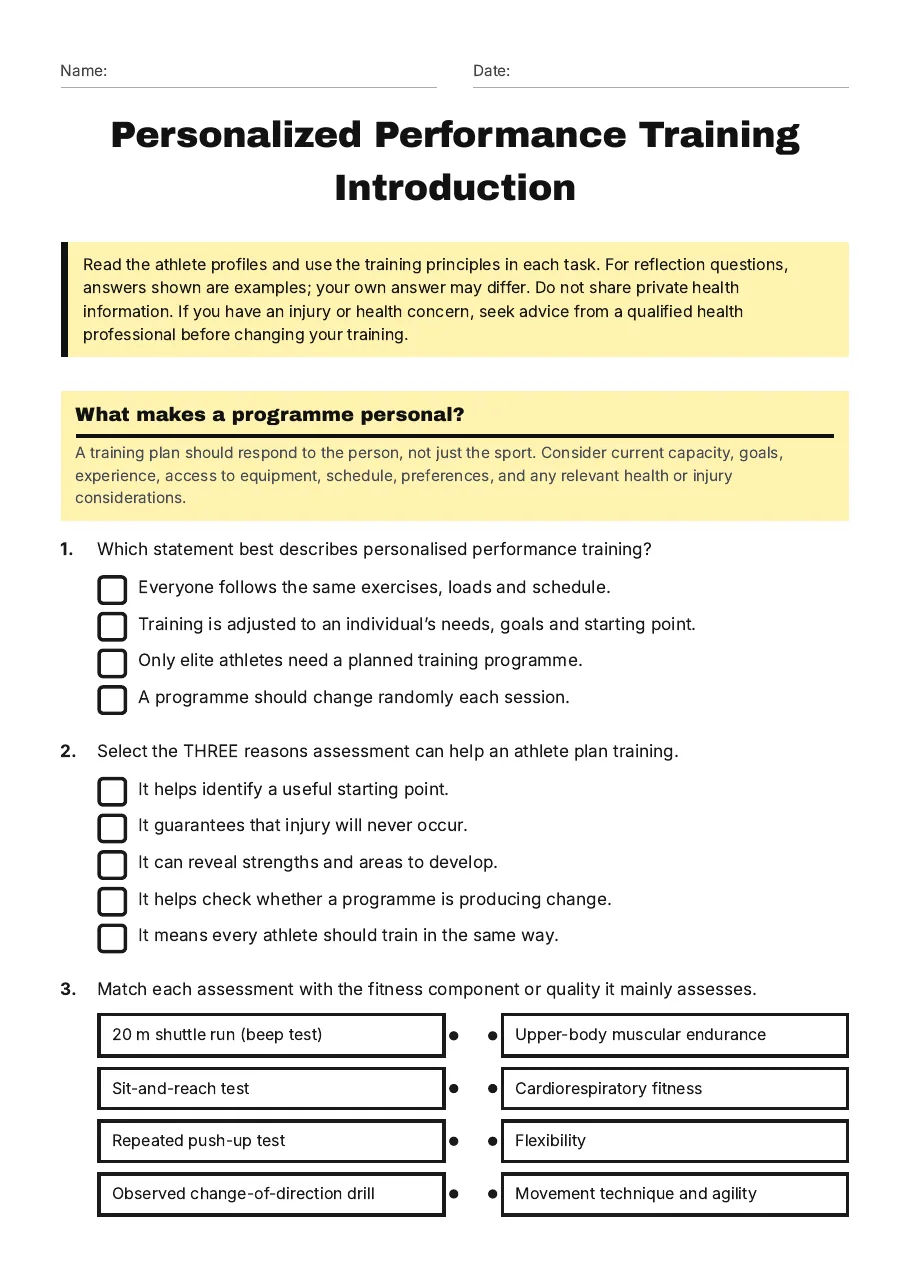
What makes a programme personal?
A training plan should respond to the person, not just the sport. Consider current capacity, goals, experience, access to equipment, schedule, preferences, and any relevant health or injury considerations.
- Everyone follows the same exercises, loads and schedule.
- Training is adjusted to an individual’s needs, goals and starting point.
- Only elite athletes need a planned training programme.
- A programme should change randomly each session.
- It helps identify a useful starting point.
- It guarantees that injury will never occur.
- It can reveal strengths and areas to develop.
- It helps check whether a programme is producing change.
- It means every athlete should train in the same way.
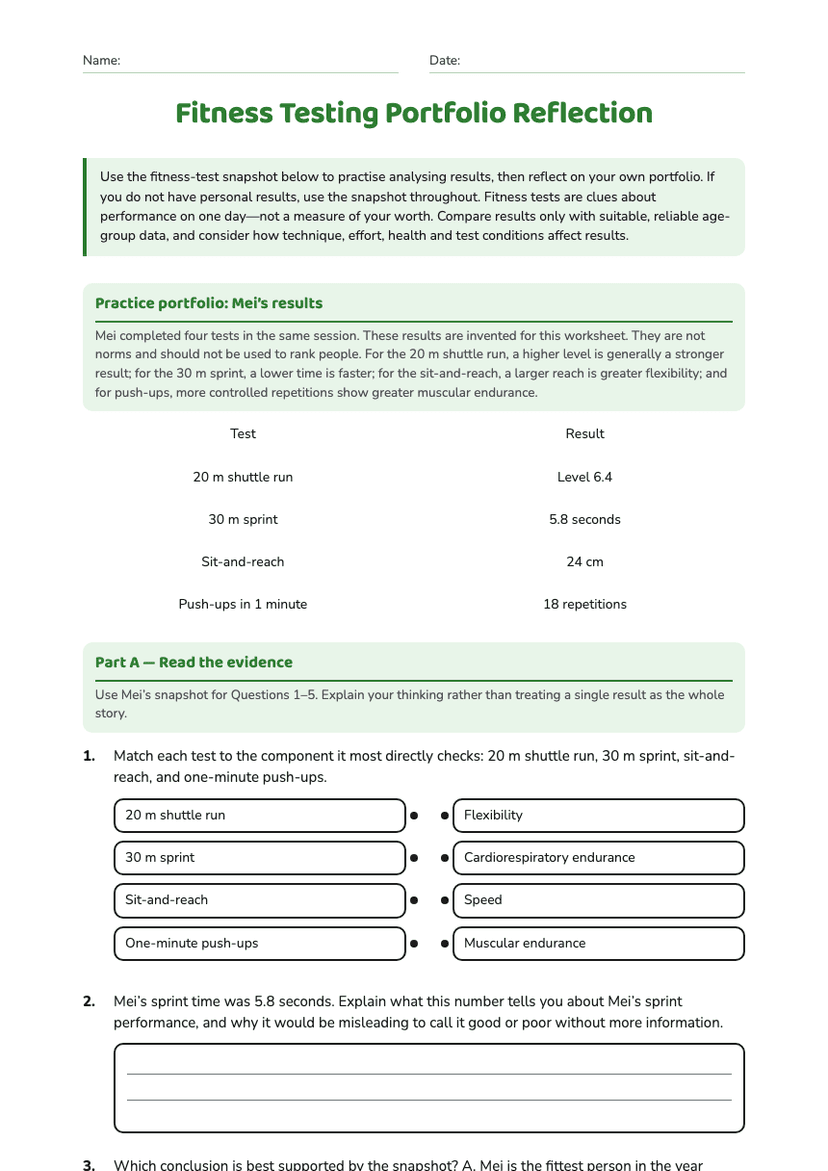
- 20 m shuttle run (beep test)
- Sit-and-reach test
- Repeated push-up test
- Observed change-of-direction drill
- Upper-body muscular endurance
- Cardiorespiratory fitness
- Flexibility
- Movement technique and agility
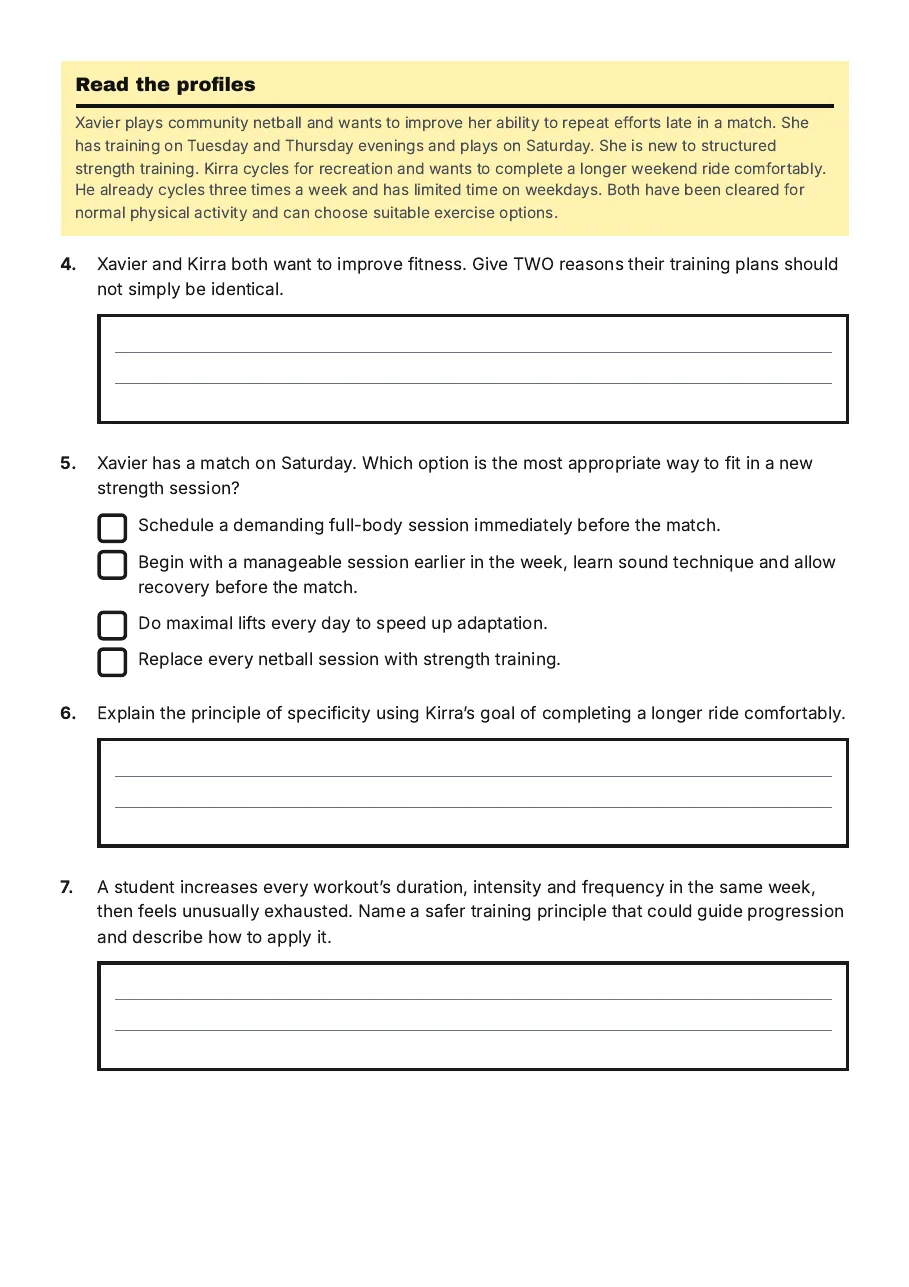
Read the profiles
Xavier plays community netball and wants to improve her ability to repeat efforts late in a match. She has training on Tuesday and Thursday evenings and plays on Saturday. She is new to structured strength training. Kirra cycles for recreation and wants to complete a longer weekend ride comfortably. He already cycles three times a week and has limited time on weekdays. Both have been cleared for normal physical activity and can choose suitable exercise options.
- Schedule a demanding full-body session immediately before the match.
- Begin with a manageable session earlier in the week, learn sound technique and allow recovery before the match.
- Do maximal lifts every day to speed up adaptation.
- Replace every netball session with strength training.
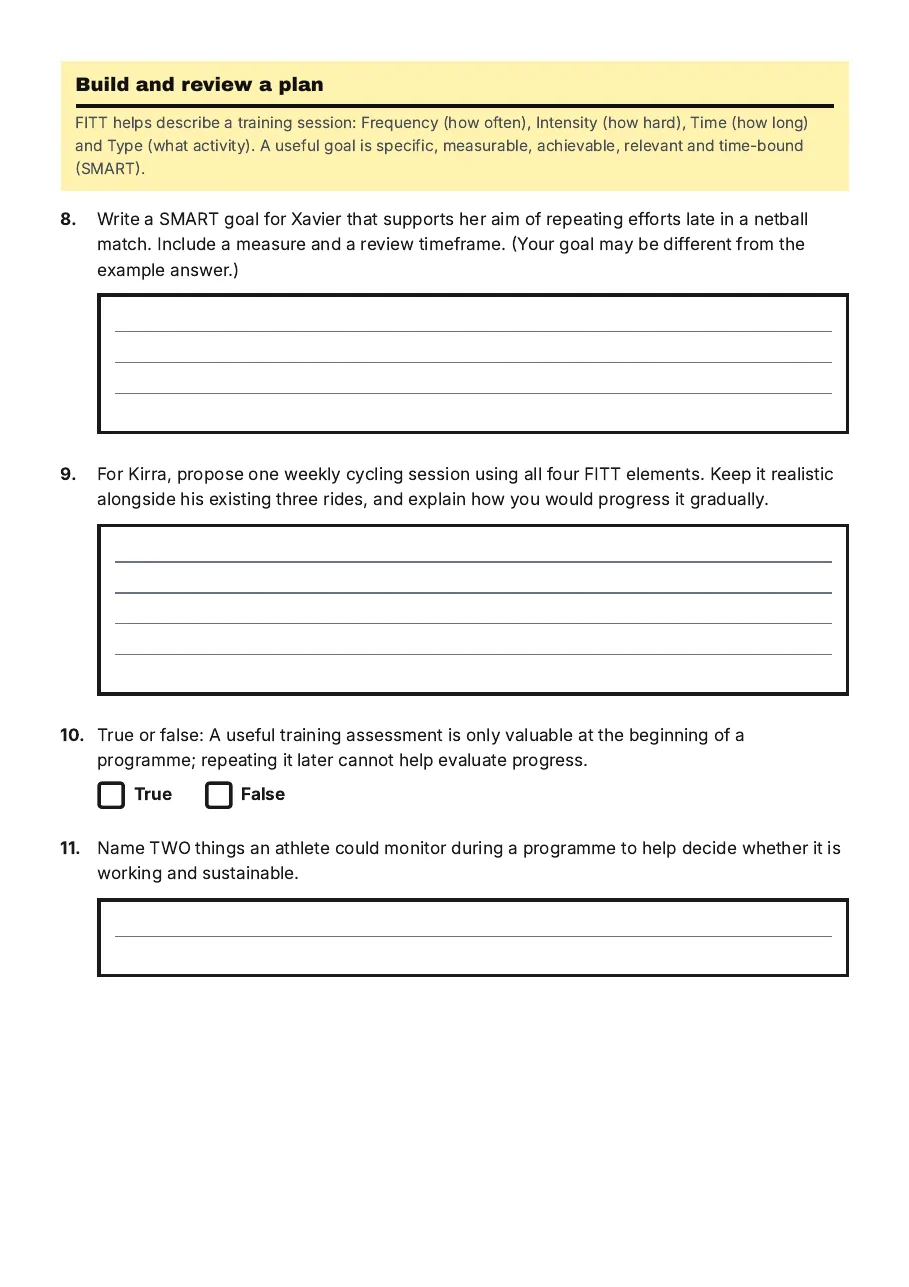
Build and review a plan
FITT helps describe a training session: Frequency (how often), Intensity (how hard), Time (how long) and Type (what activity). A useful goal is specific, measurable, achievable, relevant and time-bound (SMART).
3 printable pages
Page 1
Page 2
Page 3
About This Worksheet
Free in Kuraplan
Sign up free, grab the PDF, and customize it for your class.
Print-Ready
Formatted for standard paper. Clean layout, easy to read.
AI-Generated
Created with Kuraplan's AI, designed for real classroom use.
For Teachers & Parents
Use in classrooms, for homework, tutoring, or homeschool.
Need a custom version of this worksheet?
Kuraplan's AI generates custom worksheets in seconds — differentiated for every learner, aligned to your curriculum.
Generate Custom Worksheets — Free