ScienceFreePrintable

Pet Identification Key Worksheet

A free science worksheet ready for your classroom. Open in Kuraplan to grab the print-ready PDF, customize it for your students, or generate a fresh version in seconds.
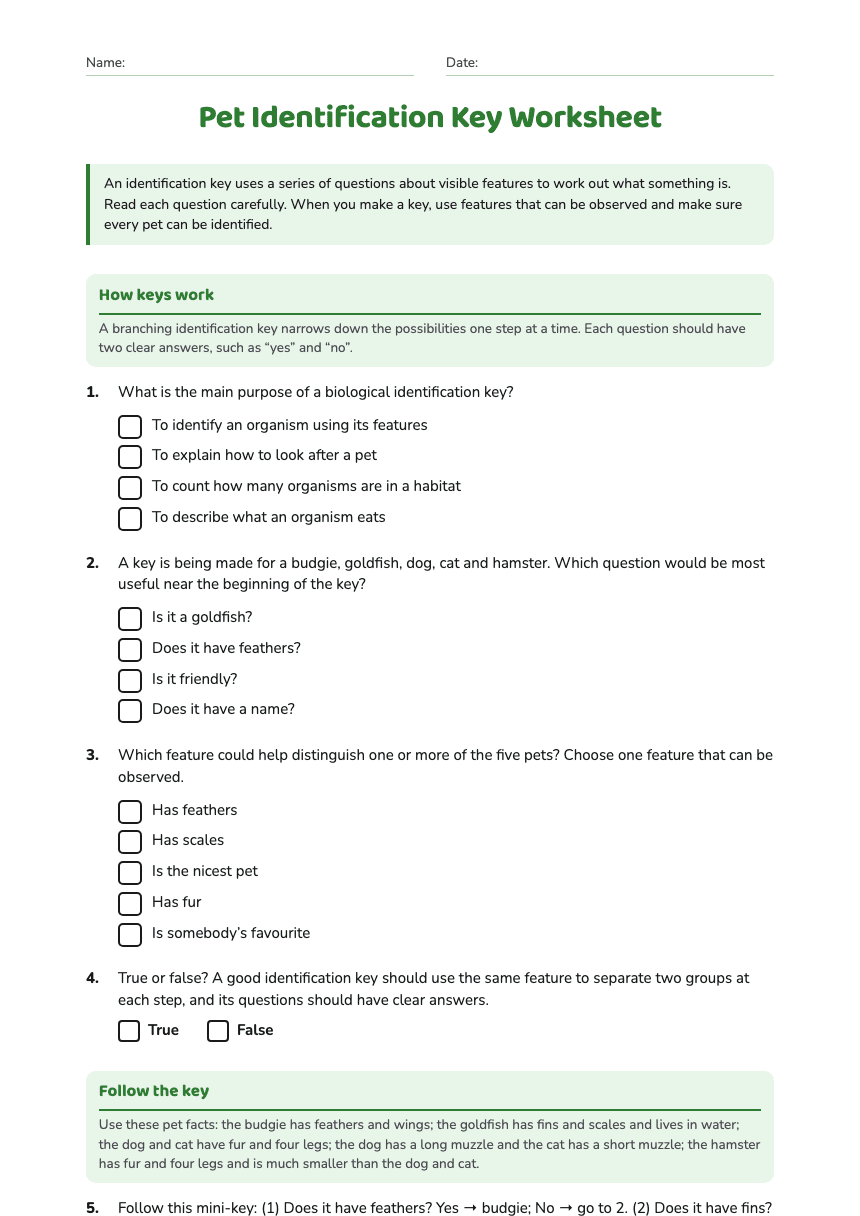
Pet Identification Key Worksheet worksheet preview
Name:Date:

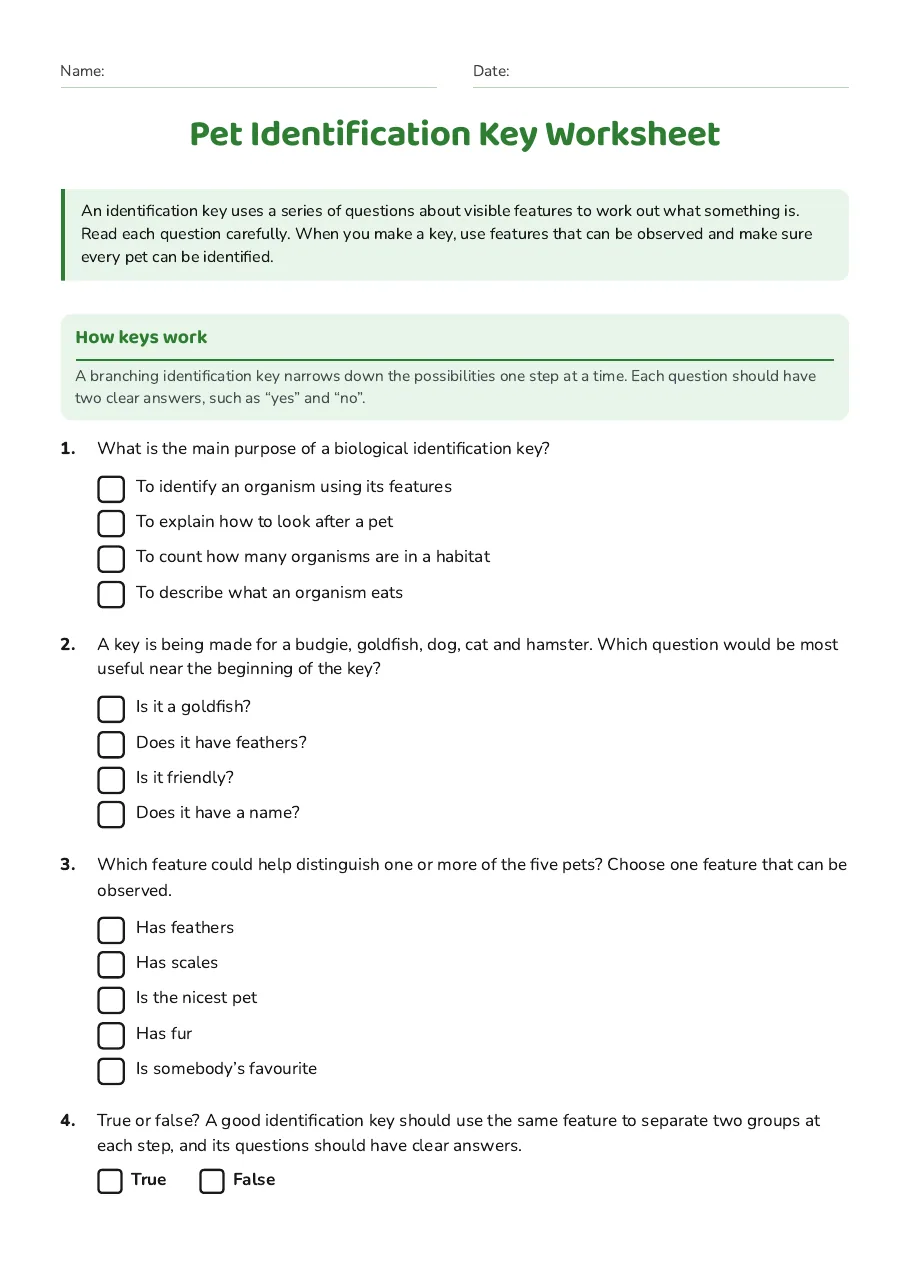
Pet Identification Key Worksheet

An identification key uses a series of questions about visible features to work out what something is. Read each question carefully. When you make a key, use features that can be observed and make sure every pet can be identified.

How keys work

A branching identification key narrows down the possibilities one step at a time. Each question should have two clear answers, such as “yes” and “no”.

1.What is the main purpose of a biological identification key?
  • To identify an organism using its features
  • To explain how to look after a pet
  • To count how many organisms are in a habitat
  • To describe what an organism eats
2.A key is being made for a budgie, goldfish, dog, cat and hamster. Which question would be most useful near the beginning of the key?
  • Is it a goldfish?
  • Does it have feathers?
  • Is it friendly?
  • Does it have a name?
3.Which feature could help distinguish one or more of the five pets? Choose one feature that can be observed.
  • Has feathers
  • Has scales
  • Is the nicest pet
  • Has fur
  • Is somebody’s favourite
4.True or false? A good identification key should use the same feature to separate two groups at each step, and its questions should have clear answers.
TrueFalse

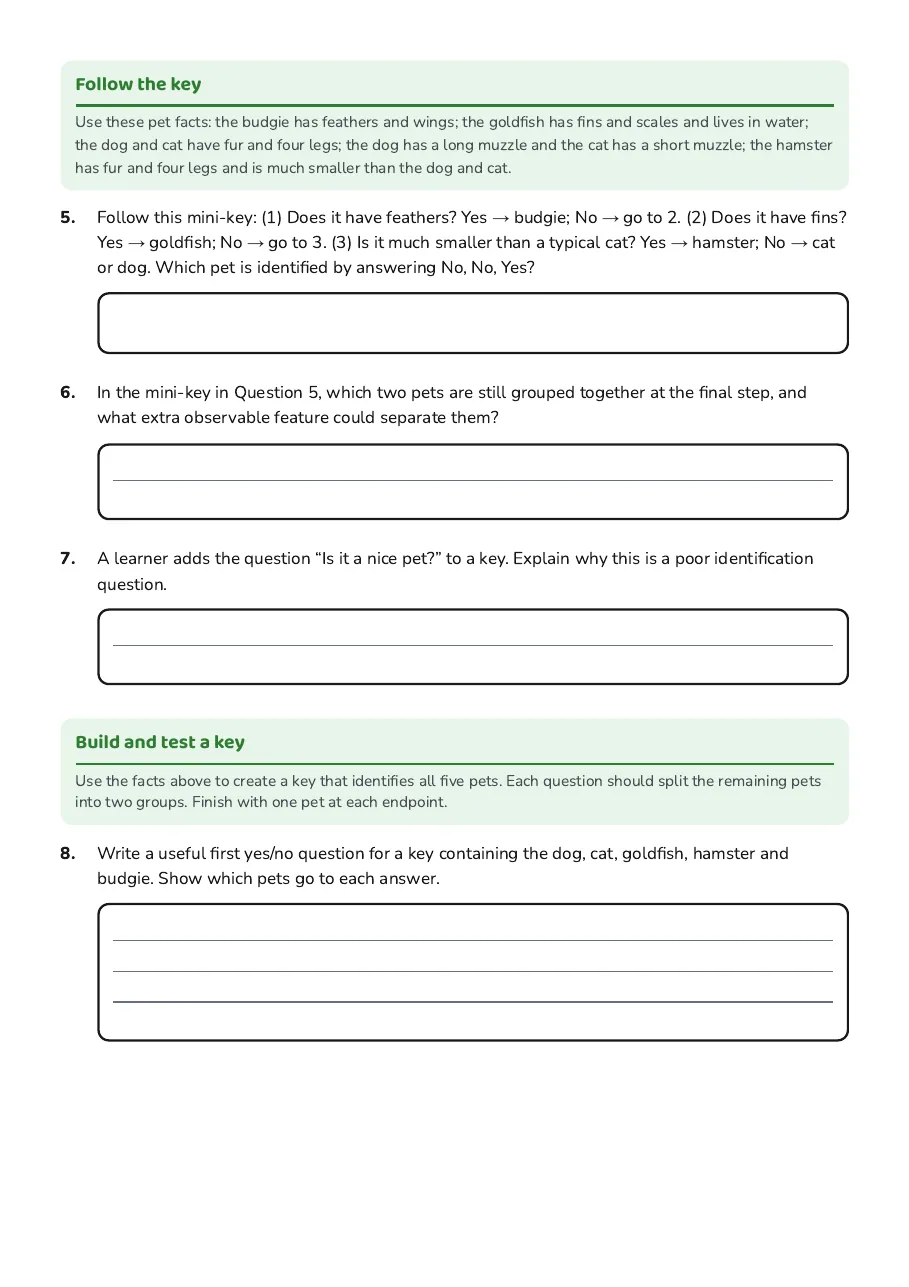
Follow the key

Use these pet facts: the budgie has feathers and wings; the goldfish has fins and scales and lives in water; the dog and cat have fur and four legs; the dog has a long muzzle and the cat has a short muzzle; the hamster has fur and four legs and is much smaller than the dog and cat.

5.Follow this mini-key: (1) Does it have feathers? Yes → budgie; No → go to 2. (2) Does it have fins? Yes → goldfish; No → go to 3. (3) Is it much smaller than a typical cat? Yes → hamster; No → cat or dog. Which pet is identified by answering No, No, Yes?
6.In the mini-key in Question 5, which two pets are still grouped together at the final step, and what extra observable feature could separate them?
7.A learner adds the question “Is it a nice pet?” to a key. Explain why this is a poor identification question.

Build and test a key

Use the facts above to create a key that identifies all five pets. Each question should split the remaining pets into two groups. Finish with one pet at each endpoint.

8.Write a useful first yes/no question for a key containing the dog, cat, goldfish, hamster and budgie. Show which pets go to each answer.
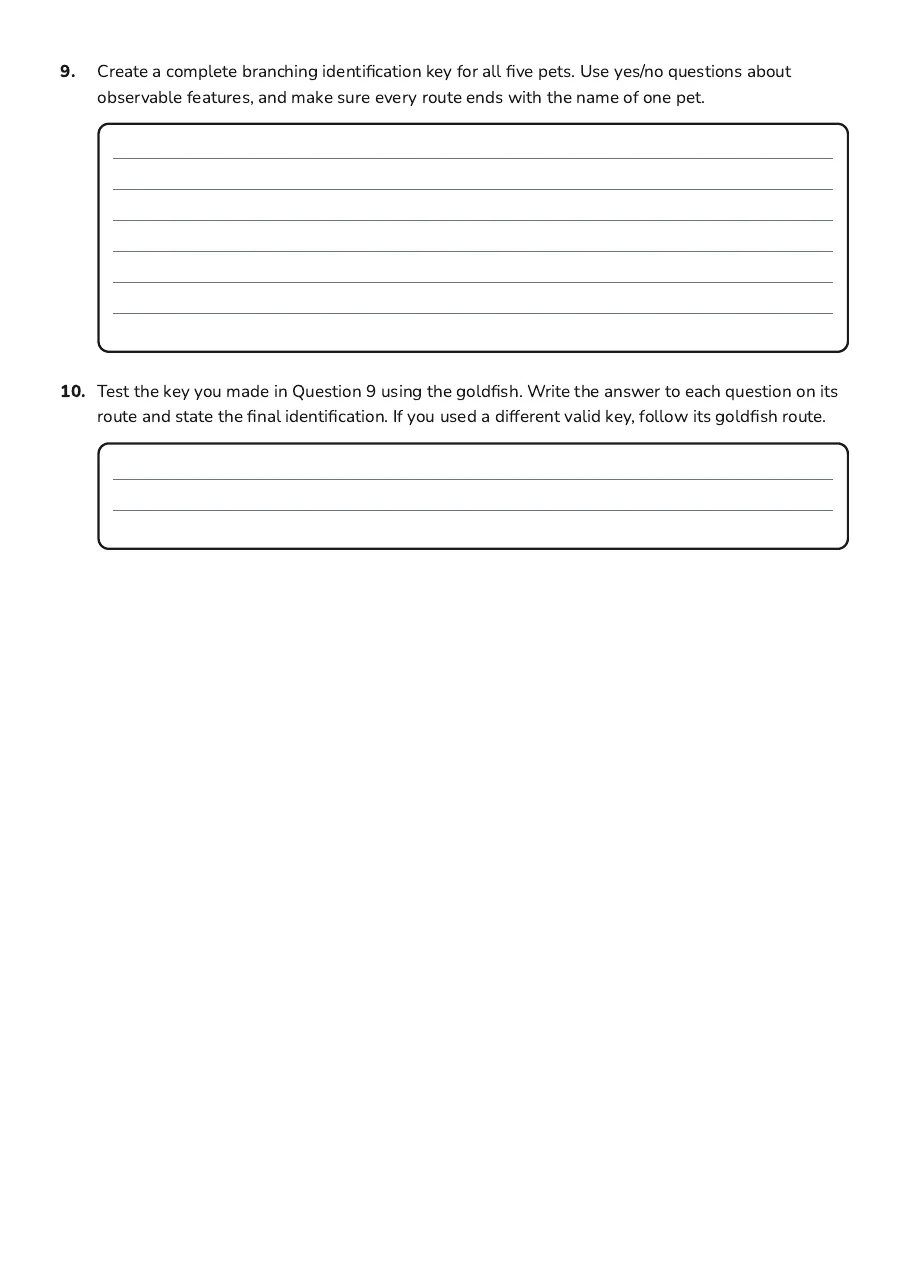
9.Create a complete branching identification key for all five pets. Use yes/no questions about observable features, and make sure every route ends with the name of one pet.
10.Test the key you made in Question 9 using the goldfish. Write the answer to each question on its route and state the final identification. If you used a different valid key, follow its goldfish route.

3 printable pages

  • Pet Identification Key Worksheet, page 1 of 3: How keys work

    Page 1

  • Pet Identification Key Worksheet, page 2 of 3: Follow the key, Build and test a key

    Page 2

  • Pet Identification Key Worksheet, page 3 of 3: 9. Create a complete branching identification key for all five pets. Use yes/no questions…

    Page 3

About This Worksheet

Free in Kuraplan

Sign up free, grab the PDF, and customize it for your class.

Print-Ready

Formatted for standard paper. Clean layout, easy to read.

AI-Generated

Created with Kuraplan's AI, designed for real classroom use.

For Teachers & Parents

Use in classrooms, for homework, tutoring, or homeschool.

Need a custom version of this worksheet?

Kuraplan's AI generates custom worksheets in seconds — differentiated for every learner, aligned to your curriculum.

Generate Custom Worksheets — Free
No credit card Curriculum-aligned Under 60 seconds