Polar vs Tropical Ecosystems
A free science worksheet ready for your classroom. Open in Kuraplan to grab the print-ready PDF, customize it for your students, or generate a fresh version in seconds.
Polar vs Tropical Ecosystems
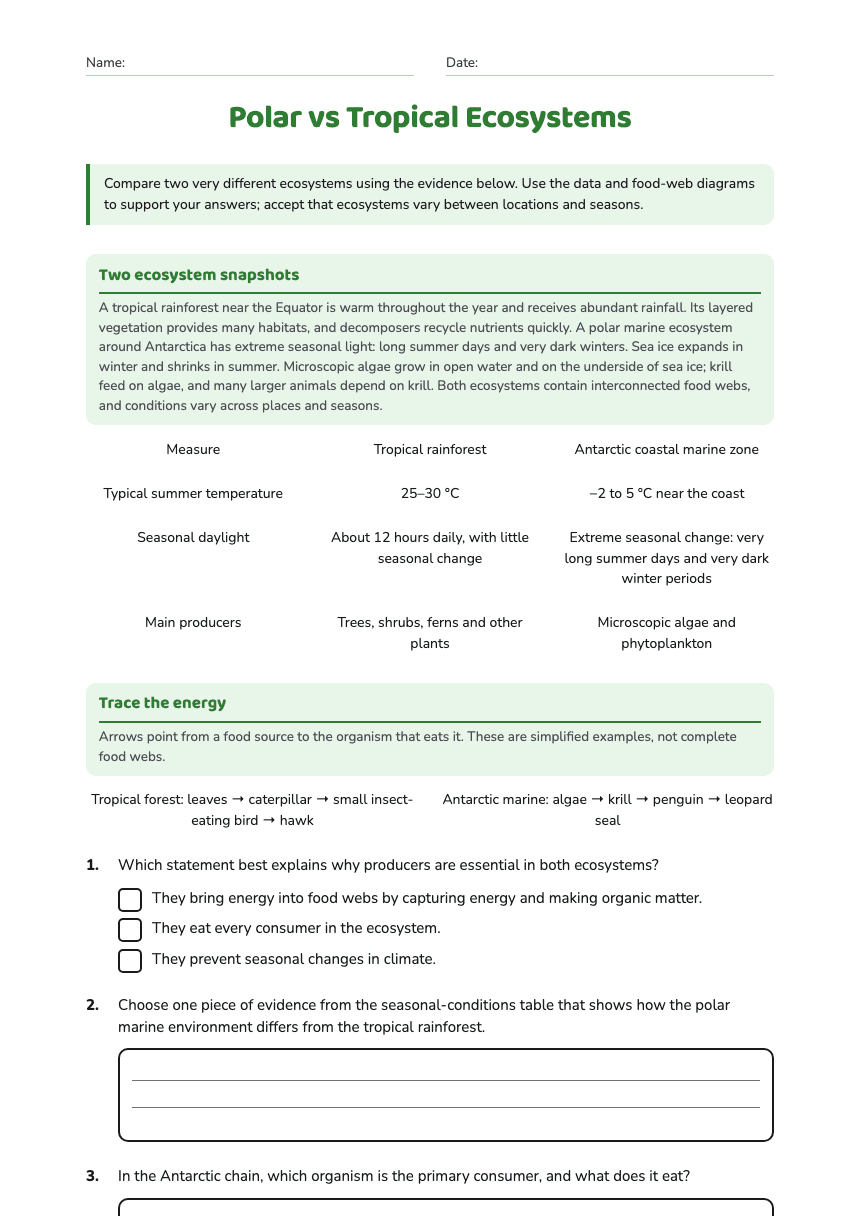
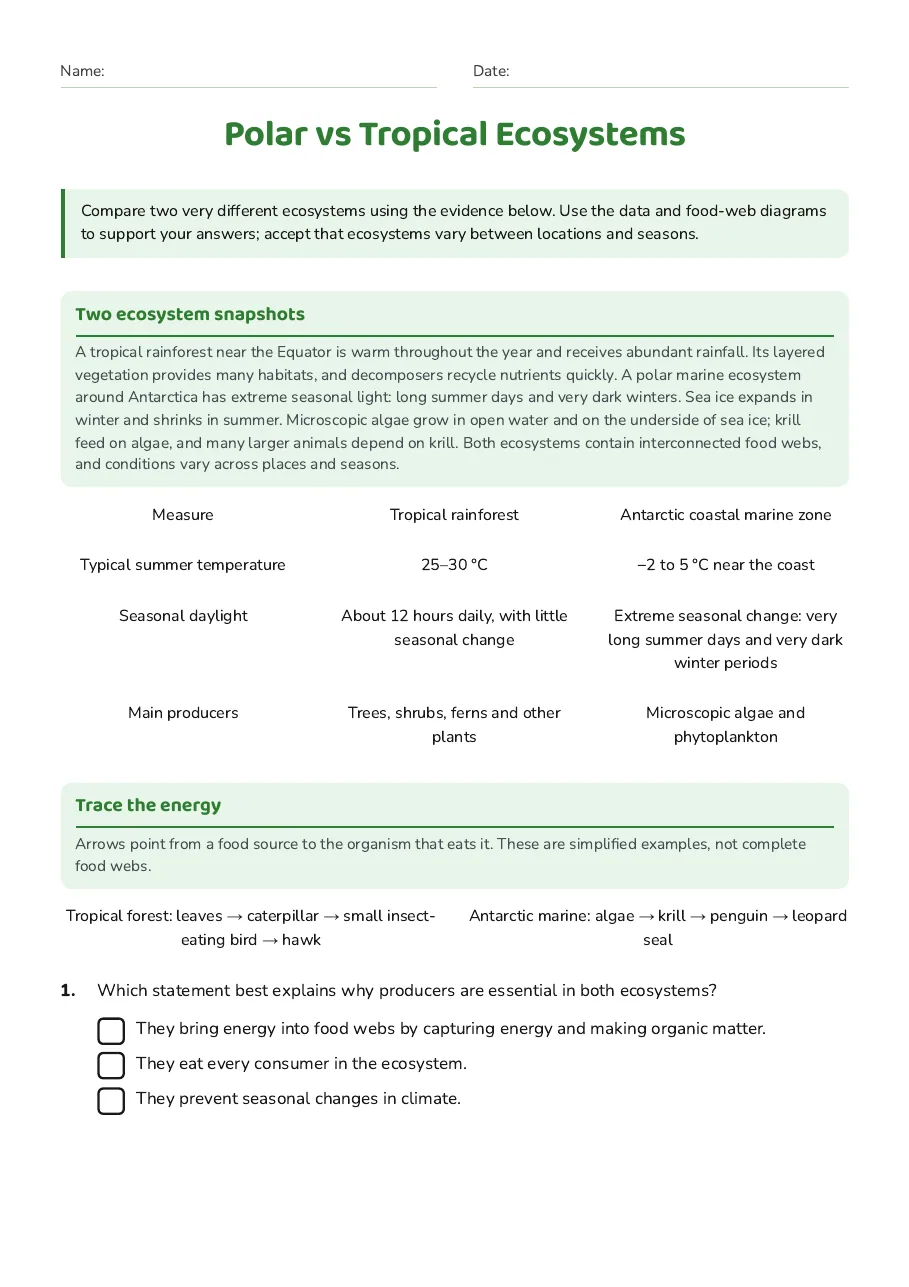
Two ecosystem snapshots
A tropical rainforest near the Equator is warm throughout the year and receives abundant rainfall. Its layered vegetation provides many habitats, and decomposers recycle nutrients quickly. A polar marine ecosystem around Antarctica has extreme seasonal light: long summer days and very dark winters. Sea ice expands in winter and shrinks in summer. Microscopic algae grow in open water and on the underside of sea ice; krill feed on algae, and many larger animals depend on krill. Both ecosystems contain interconnected food webs, and conditions vary across places and seasons.
Measure
Tropical rainforest
Antarctic coastal marine zone
Typical summer temperature
25–30 °C
−2 to 5 °C near the coast
Seasonal daylight
About 12 hours daily, with little seasonal change
Extreme seasonal change: very long summer days and very dark winter periods
Main producers
Trees, shrubs, ferns and other plants
Microscopic algae and phytoplankton
Trace the energy
Arrows point from a food source to the organism that eats it. These are simplified examples, not complete food webs.
Tropical forest: leaves → caterpillar → small insect-eating bird → hawk
Antarctic marine: algae → krill → penguin → leopard seal
- They bring energy into food webs by capturing energy and making organic matter.
- They eat every consumer in the ecosystem.
- They prevent seasonal changes in climate.
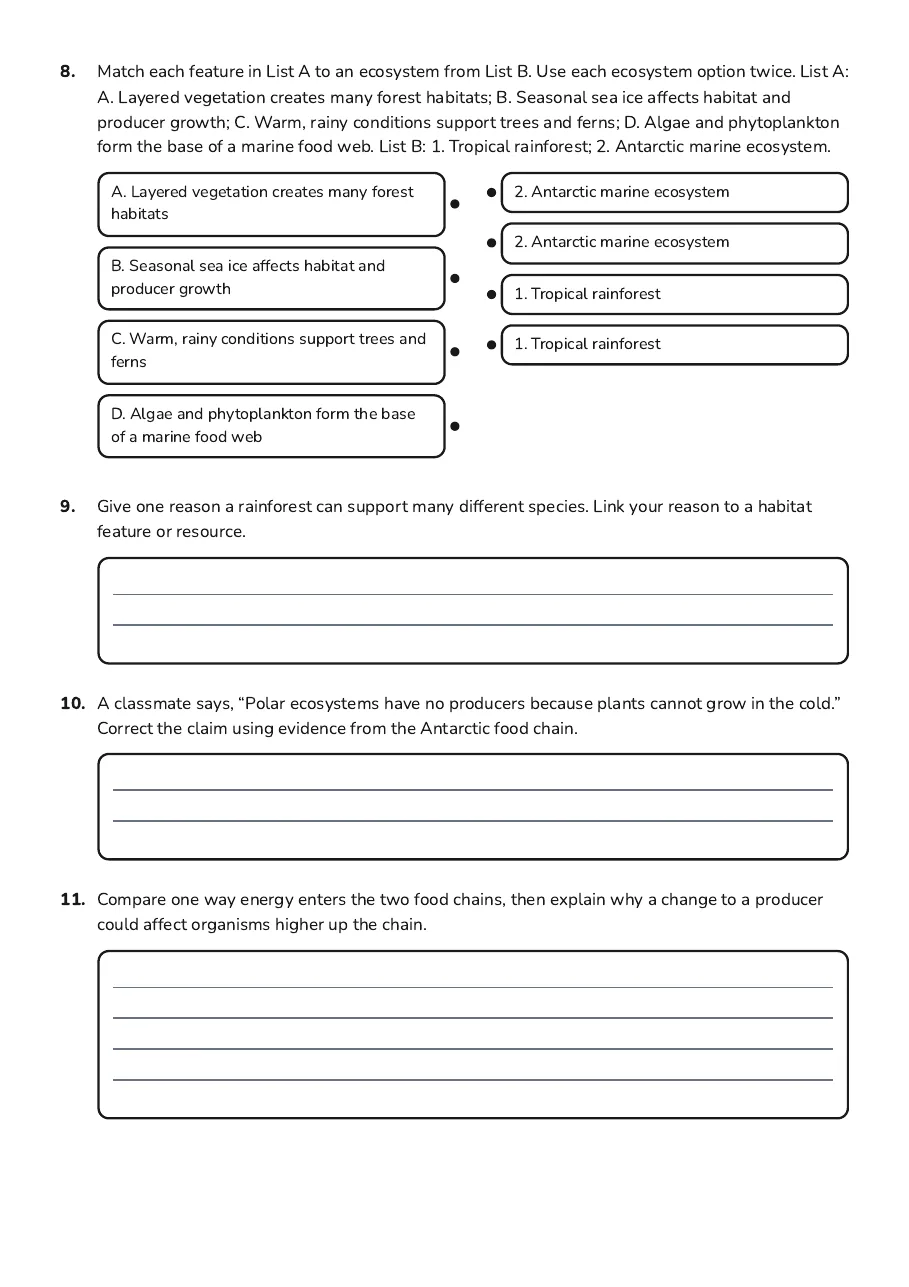
- A. Layered vegetation creates many forest habitats
- B. Seasonal sea ice affects habitat and producer growth
- C. Warm, rainy conditions support trees and ferns
- D. Algae and phytoplankton form the base of a marine food web
- 2. Antarctic marine ecosystem
- 2. Antarctic marine ecosystem
- 1. Tropical rainforest
- 1. Tropical rainforest
3 printable pages
Page 1
Page 2
Page 3
About This Worksheet
Free in Kuraplan
Sign up free, grab the PDF, and customize it for your class.
Print-Ready
Formatted for standard paper. Clean layout, easy to read.
AI-Generated
Created with Kuraplan's AI, designed for real classroom use.
For Teachers & Parents
Use in classrooms, for homework, tutoring, or homeschool.
Need a custom version of this worksheet?
Kuraplan's AI generates custom worksheets in seconds — differentiated for every learner, aligned to your curriculum.
Generate Custom Worksheets — FreeMore Science Worksheets
Kaitiaki Ecosystem Map Worksheet
Free
Climate Shapes Ecosystems
Free
Ecosystem Roles Sorting Activity
Free
Ecology Quiz Year 9–10
Free
Environmental Rights and Responsibilities
Free
Environmental Impact Analysis Worksheet
Free
Marine Environment Impacts Worksheet
Free