ScienceFreePrintable

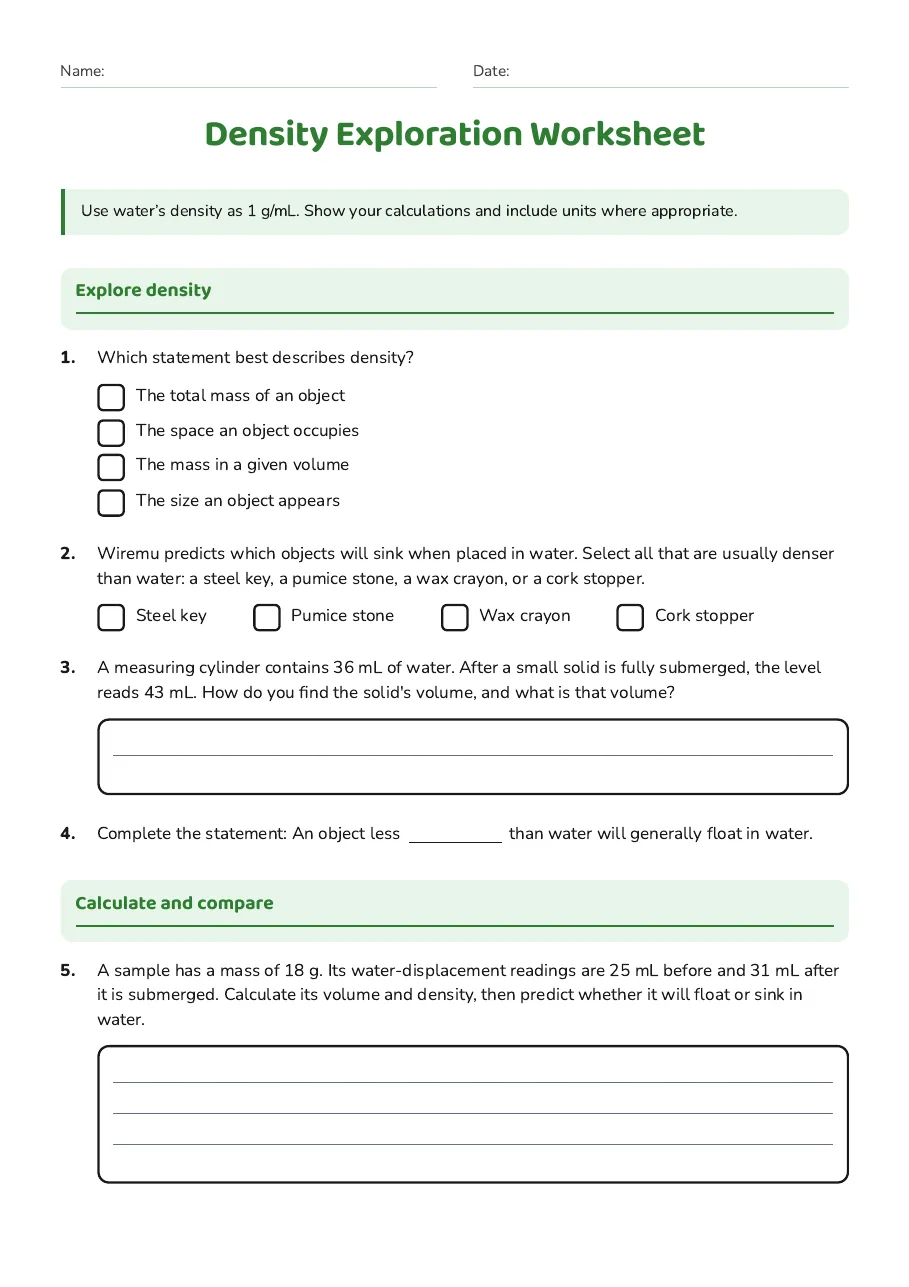
Density Exploration Worksheet

A free science worksheet ready for your classroom. Open in Kuraplan to grab the print-ready PDF, customize it for your students, or generate a fresh version in seconds.
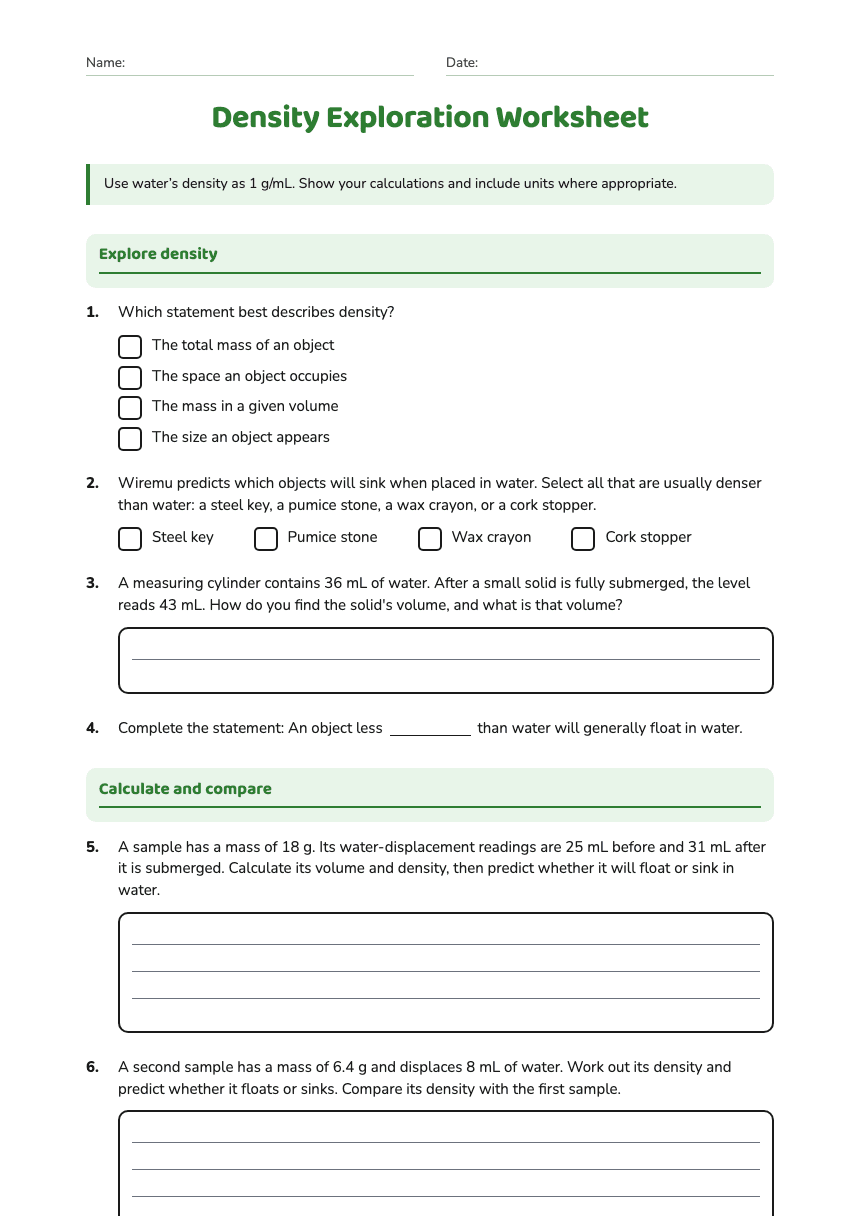
Density Exploration Worksheet worksheet preview

Density Detective Work

Objects floating and sinking in water

🔍 Part 1: Density Detective Questions

1. What is density?

How heavy an object is

How much space an object takes up

How tightly packed the mass is in a given volume

How big an object looks

2. Which objects would you expect to sink in water? (Check all that apply)

Metal spoon

Cork

Rock

Plastic bottle cap

3. To measure volume using water displacement, you need to:

Record only the final water level

Subtract the initial water level from the final water level

Add the initial and final water levels together

Only measure the mass

4. Objects that are _______ dense than water will float.

Answer: _____________

🧮 Part 2: Density Calculations

5. Complete this density investigation table:
Object Name Mass (g) Initial Water Level (mL) Final Water Level (mL) Volume (mL) Prediction (Float/Sink) Actual Result
____________ 15.2 50 52 ____ ____________ ____________
____________ 8.5 50 60 ____ ____________ ____________
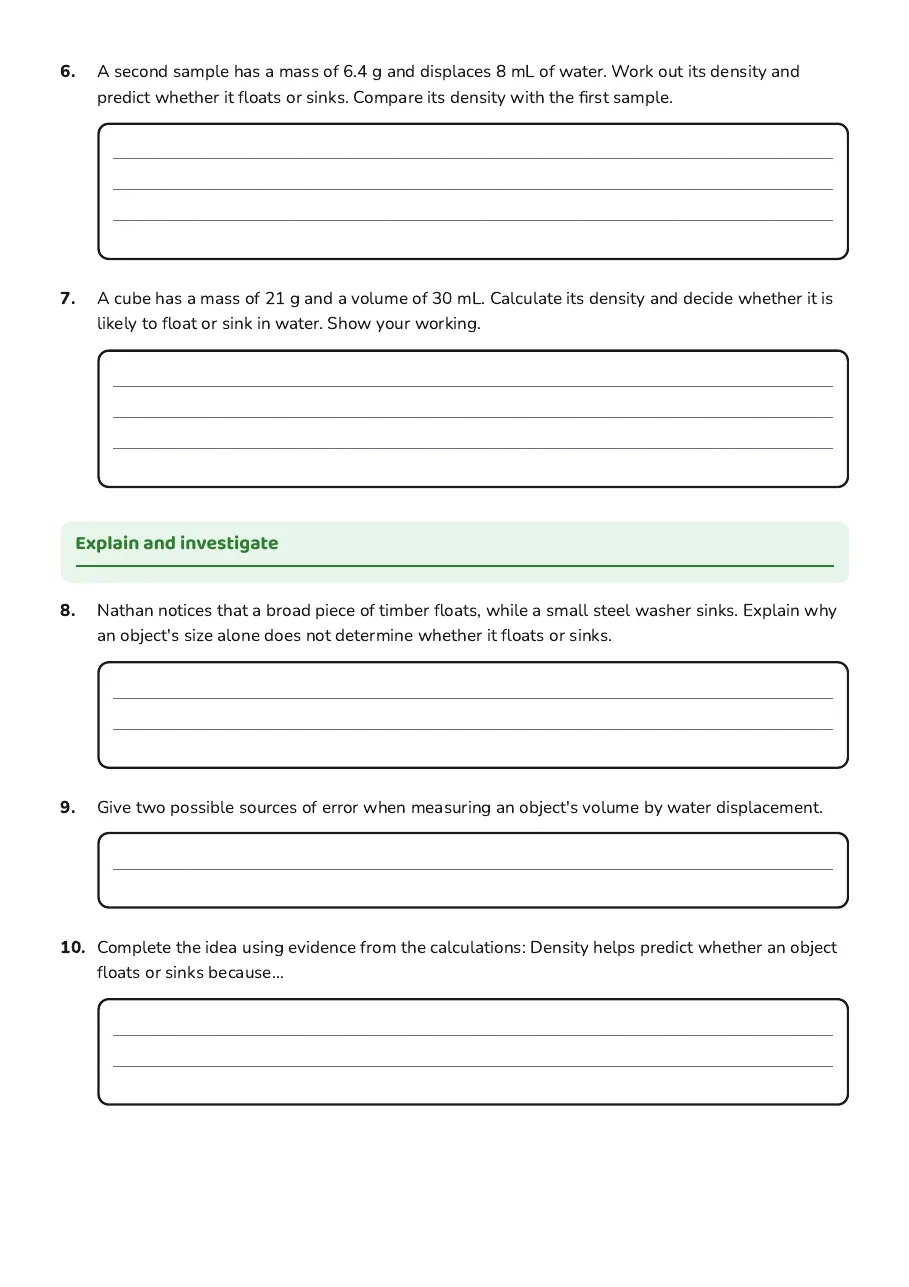
6. Which object from the table above is more dense? Explain your reasoning using the numbers.
7. A plastic cube has a mass of 12g and a volume of 15mL. Will it float or sink in water? Show your working.

📝 Part 3: Scientific Thinking

8. Explain why a large piece of wood can float while a small metal coin sinks.
9. List two things that could cause errors when measuring volume using water displacement:

a) ________________________________

b) ________________________________

10. Complete this sentence using evidence from your investigations:

"Density helps explain floating and sinking because __________________________________________

________________________________________________________________

________________________________________________________________"

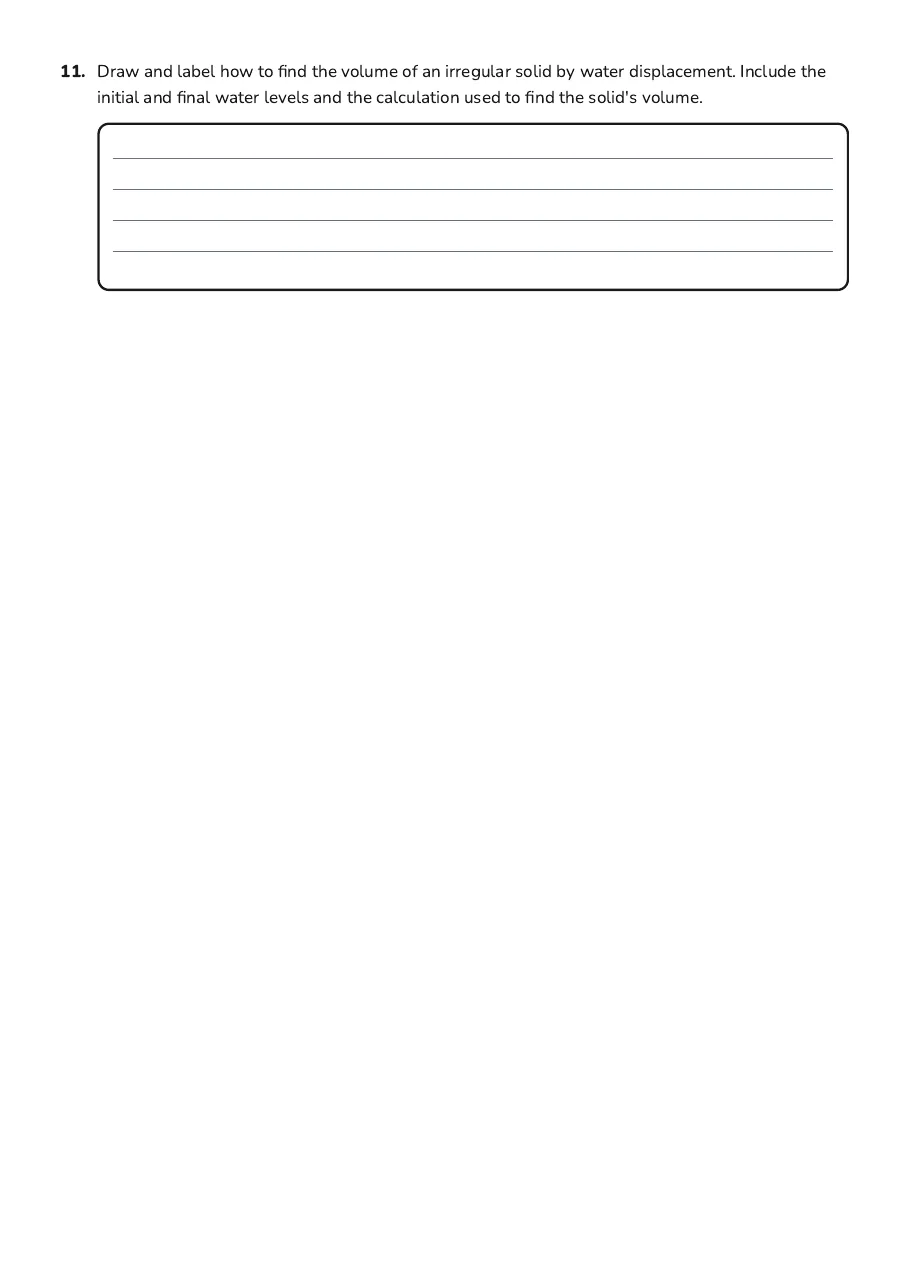
11. Draw and label a diagram showing how to measure the volume of an irregular object using water displacement.

📚 Teacher Answer Sheet

1. What is density?

Answer: How tightly packed the mass is in a given volume

Explanation: Density is defined as mass per unit volume (D = m/V). It describes how much matter is packed into a given space.

2. Which objects would you expect to sink in water?

Answer: Metal spoon ✓, Rock ✓

Explanation: Metal spoons and rocks are typically denser than water (1 g/mL). Cork and plastic bottle caps are usually less dense than water and will float.

3. To measure volume using water displacement, you need to:

Answer: Subtract the initial water level from the final water level

Explanation: The volume of the object equals the change in water level: Volume = Final level - Initial level

4. Objects that are _______ dense than water will float.

Answer: less

Explanation: Objects with density less than 1 g/mL (water's density) will float because they are less dense than the fluid they displace.

5. Complete this density investigation table:

Answers:

Row 1: Volume = 2 mL (52-50), Object will sink (density = 15.2g ÷ 2mL = 7.6 g/mL)

Row 2: Volume = 10 mL (60-50), Object will float (density = 8.5g ÷ 10mL = 0.85 g/mL)

6. Which object from the table above is more dense?

Answer: The first object is more dense (7.6 g/mL vs 0.85 g/mL). Even though it has more mass, the first object takes up much less space, making it denser overall.

7. A plastic cube has a mass of 12g and a volume of 15mL. Will it float or sink?

Answer: Density = 12g ÷ 15mL = 0.8 g/mL. Since 0.8 g/mL < 1 g/mL (water's density), the cube will float.

8. Explain why a large piece of wood can float while a small metal coin sinks.

Answer: It's not about size but about density. Wood has a lower density than water (typically 0.3-0.9 g/mL), so it floats regardless of size. Metal has a higher density than water (typically 2.7-19 g/mL), so it sinks regardless of size.

9. List two things that could cause errors when measuring volume using water displacement:

Sample Answers:

a) Reading the water level incorrectly (not at eye level)

b) Splashing water out of the container

Other acceptable answers: Air bubbles on object, object not fully submerged, using a container that's too small, meniscus reading errors

10. Complete this sentence using evidence from your investigations:

Sample Answer: "Density helps explain floating and sinking because objects with density less than 1 g/mL float in water, while objects with density greater than 1 g/mL sink in water, as demonstrated by our calculations and observations."

11. Draw and label a diagram showing how to measure the volume of an irregular object using water displacement.

Diagram should include:

• Graduated cylinder or measuring container

• Initial water level marked and labeled

• Object submerged in water

• Final water level marked and labeled

• Arrow or note showing Volume = Final level - Initial level

About This Worksheet

Free in Kuraplan

Sign up free, grab the PDF, and customize it for your class.

Print-Ready

Formatted for standard paper. Clean layout, easy to read.

AI-Generated

Created with Kuraplan's AI, designed for real classroom use.

For Teachers & Parents

Use in classrooms, for homework, tutoring, or homeschool.

Need a custom version of this worksheet?

Kuraplan's AI generates custom worksheets in seconds — differentiated for every learner, aligned to your curriculum.

Generate Custom Worksheets — Free
No credit card Curriculum-aligned Under 60 seconds