Social SciencesFreePrintable
Primary and Secondary Sources
A free social sciences worksheet ready for your classroom. Open in Kuraplan to grab the print-ready PDF, customize it for your students, or generate a fresh version in seconds.
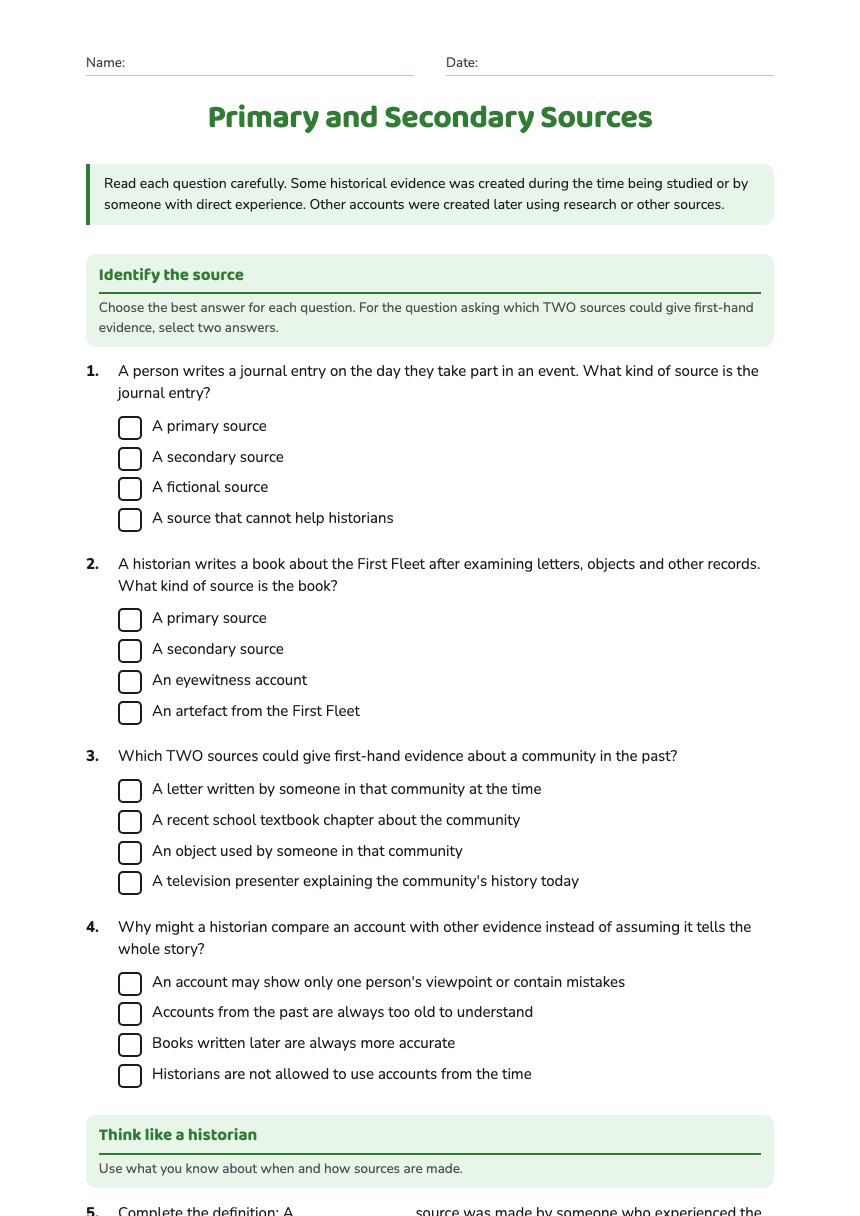
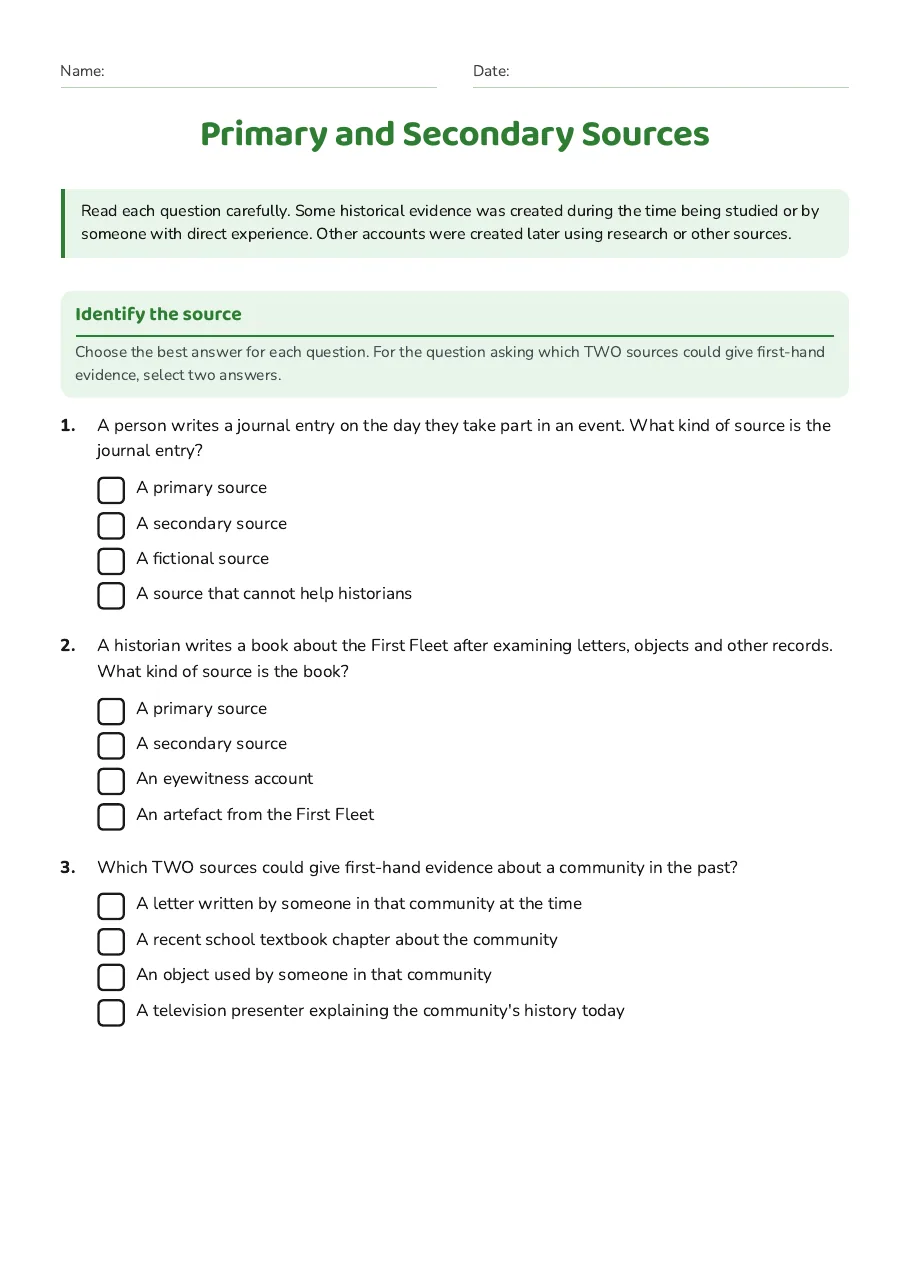
Name:Date:
Primary and Secondary Sources
Read each question carefully. Some historical evidence was created during the time being studied or by someone with direct experience. Other accounts were created later using research or other sources.
Identify the source
Choose the best answer for each question. For the question asking which TWO sources could give first-hand evidence, select two answers.
1.A person writes a journal entry on the day they take part in an event. What kind of source is the journal entry?
- A primary source
- A secondary source
- A fictional source
- A source that cannot help historians
2.A historian writes a book about the First Fleet after examining letters, objects and other records. What kind of source is the book?
- A primary source
- A secondary source
- An eyewitness account
- An artefact from the First Fleet
3.Which TWO sources could give first-hand evidence about a community in the past?
- A letter written by someone in that community at the time
- A recent school textbook chapter about the community
- An object used by someone in that community
- A television presenter explaining the community's history today
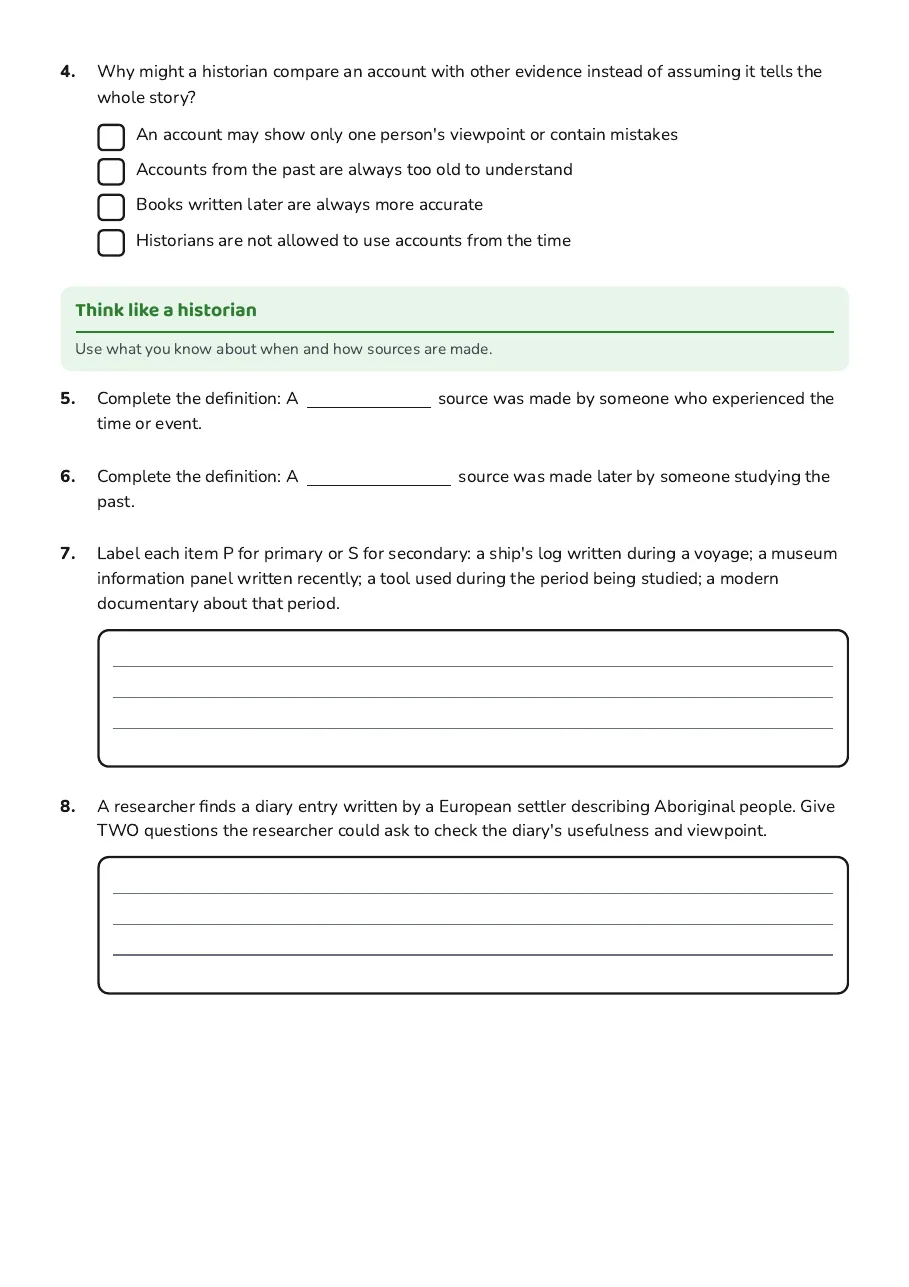
4.Why might a historian compare an account with other evidence instead of assuming it tells the whole story?
- An account may show only one person's viewpoint or contain mistakes
- Accounts from the past are always too old to understand
- Books written later are always more accurate
- Historians are not allowed to use accounts from the time
Think like a historian
Use what you know about when and how sources are made.
5.Complete the definition: A source was made by someone who experienced the time or event.
6.Complete the definition: A source was made later by someone studying the past.
7.Label each item P for primary or S for secondary: a ship's log written during a voyage; a museum information panel written recently; a tool used during the period being studied; a modern documentary about that period.
8.A researcher finds a diary entry written by a European settler describing Aboriginal people. Give TWO questions the researcher could ask to check the diary's usefulness and viewpoint.
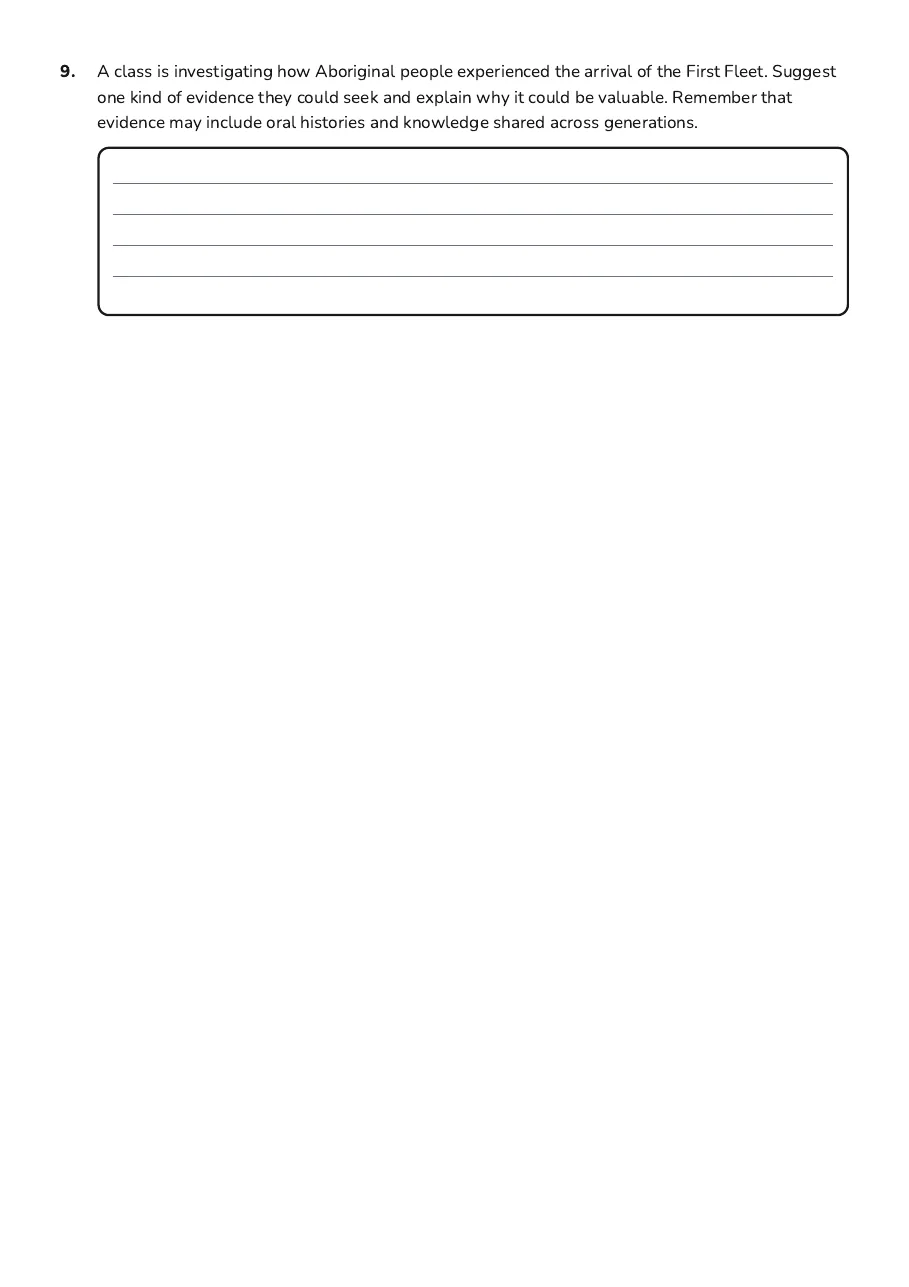
9.A class is investigating how Aboriginal people experienced the arrival of the First Fleet. Suggest one kind of evidence they could seek and explain why it could be valuable. Remember that evidence may include oral histories and knowledge shared across generations.
3 printable pages
Page 1
Page 2
Page 3
About This Worksheet
Free in Kuraplan
Sign up free, grab the PDF, and customize it for your class.
Print-Ready
Formatted for standard paper. Clean layout, easy to read.
AI-Generated
Created with Kuraplan's AI, designed for real classroom use.
For Teachers & Parents
Use in classrooms, for homework, tutoring, or homeschool.
Need a custom version of this worksheet?
Kuraplan's AI generates custom worksheets in seconds — differentiated for every learner, aligned to your curriculum.
Generate Custom Worksheets — Free No credit card Curriculum-aligned Under 60 seconds