Rhyming Poetry Reference Guide
A free english worksheet ready for your classroom. Open in Kuraplan to grab the print-ready PDF, customize it for your students, or generate a fresh version in seconds.
Rhyming Poetry Reference Guide
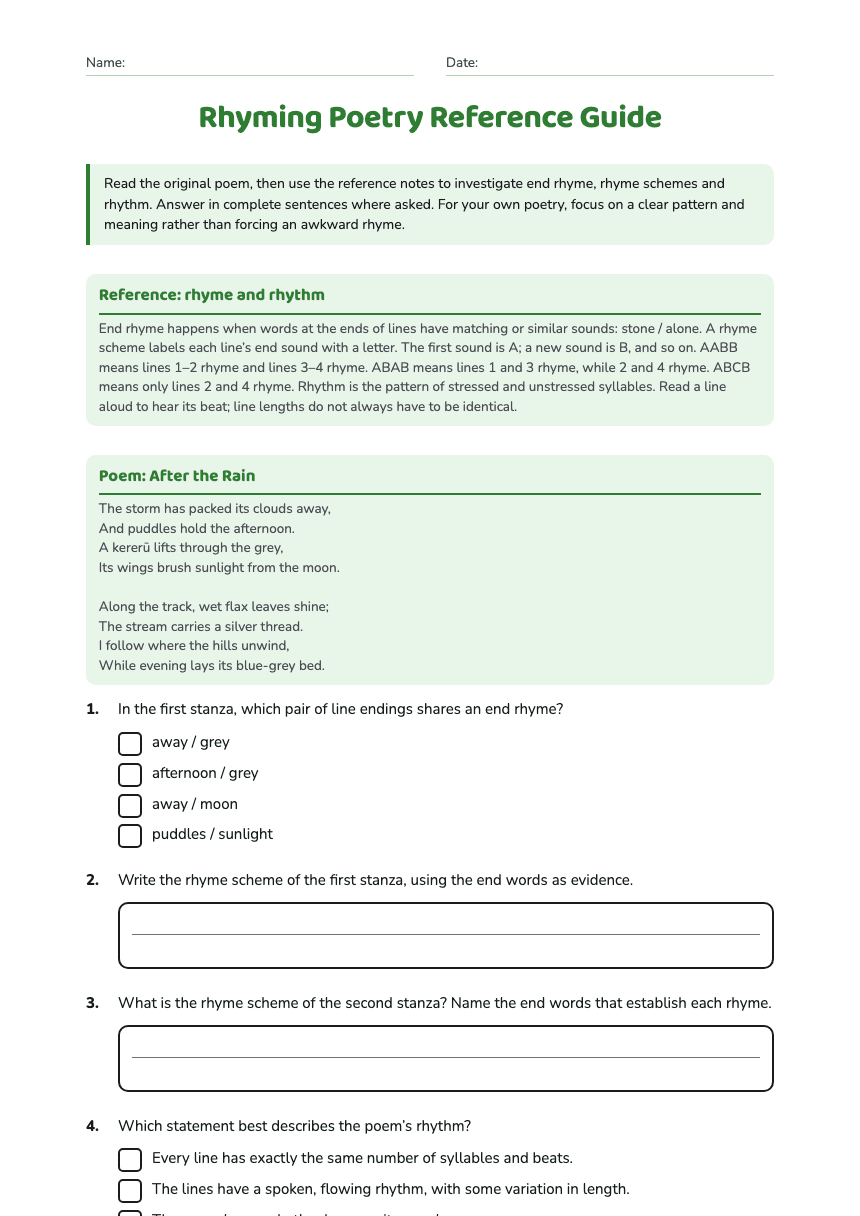
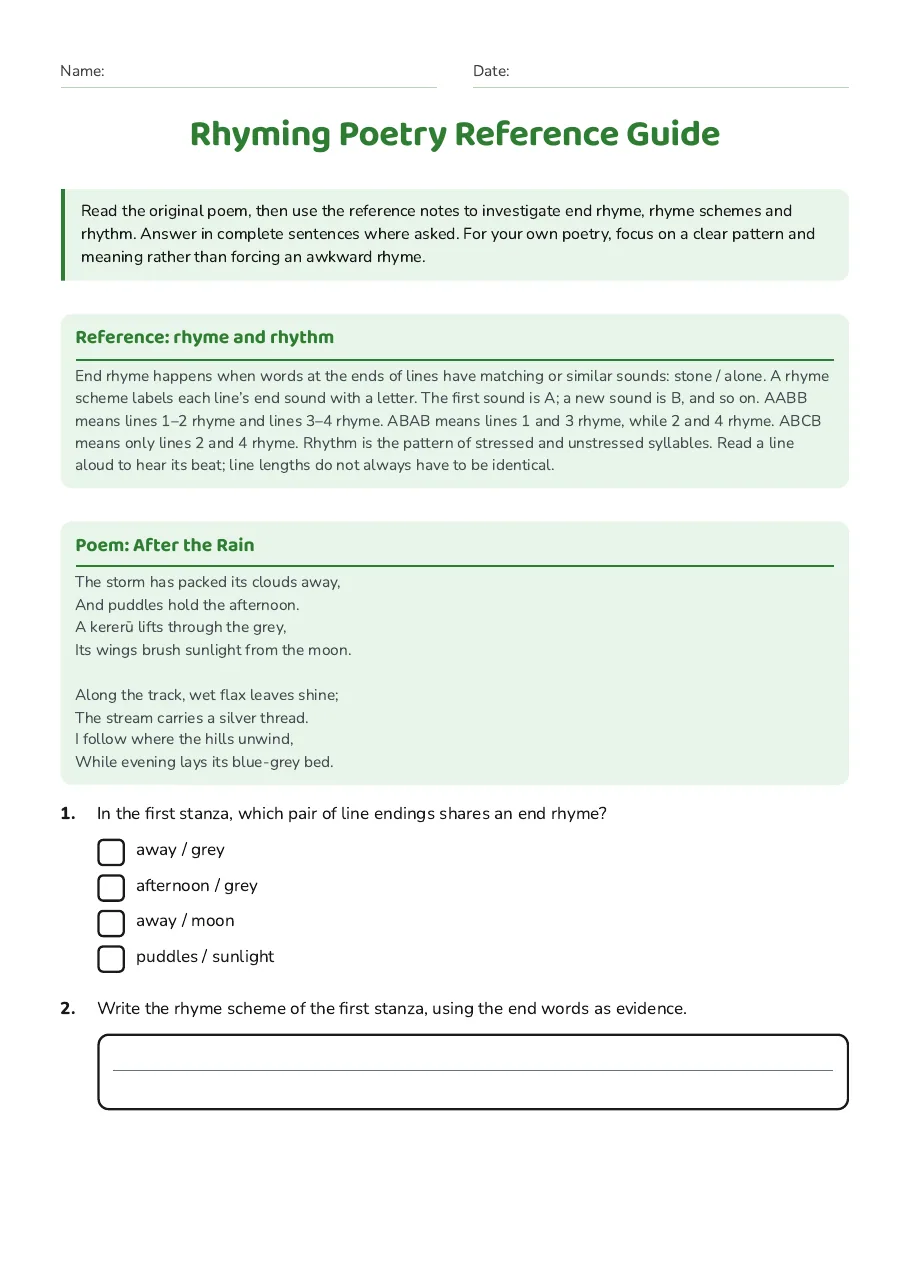
Reference: rhyme and rhythm
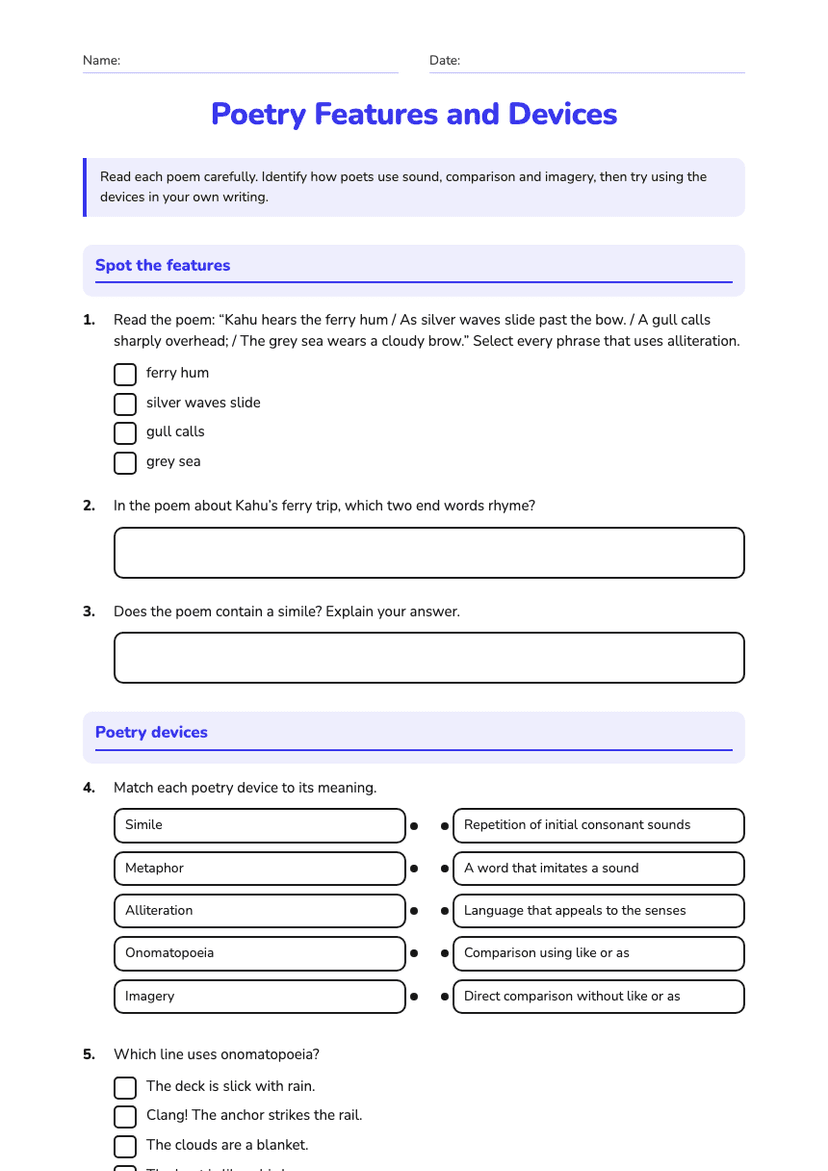
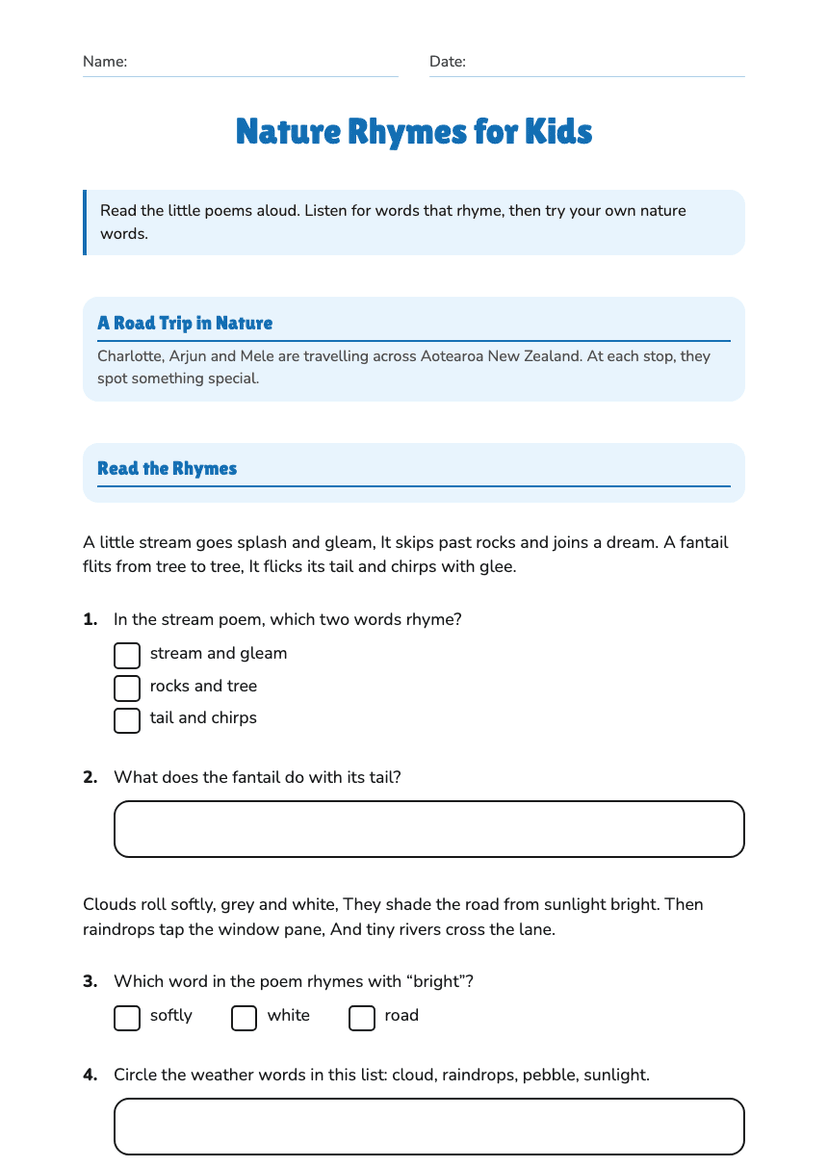
End rhyme happens when words at the ends of lines have matching or similar sounds: stone / alone. A rhyme scheme labels each line’s end sound with a letter. The first sound is A; a new sound is B, and so on. AABB means lines 1–2 rhyme and lines 3–4 rhyme. ABAB means lines 1 and 3 rhyme, while 2 and 4 rhyme. ABCB means only lines 2 and 4 rhyme. Rhythm is the pattern of stressed and unstressed syllables. Read a line aloud to hear its beat; line lengths do not always have to be identical.
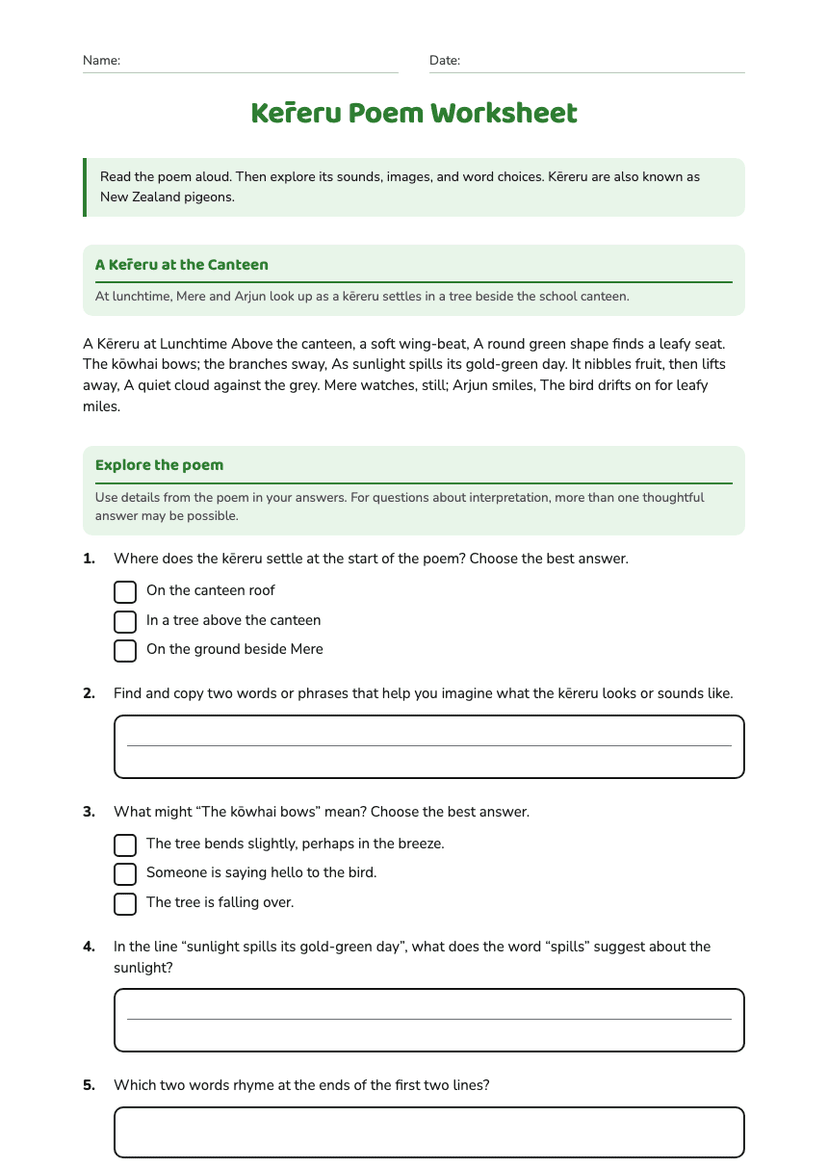
Poem: After the Rain
The storm has packed its clouds away, And puddles hold the afternoon. A kererū lifts through the grey, Its wings brush sunlight from the moon. Along the track, wet flax leaves shine; The stream carries a silver thread. I follow where the hills unwind, While evening lays its blue-grey bed.
- away / grey
- afternoon / grey
- away / moon
- puddles / sunlight
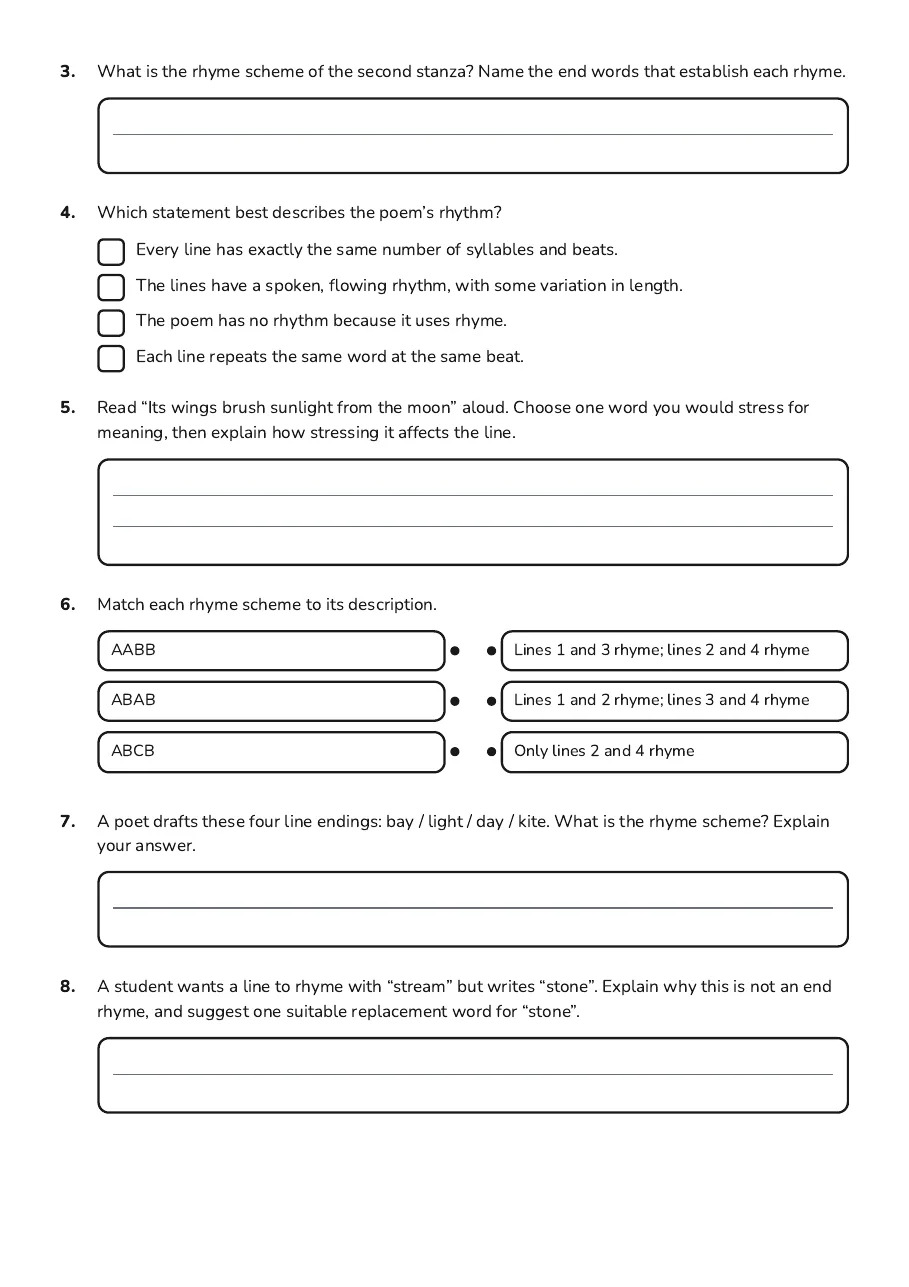
- Every line has exactly the same number of syllables and beats.
- The lines have a spoken, flowing rhythm, with some variation in length.
- The poem has no rhythm because it uses rhyme.
- Each line repeats the same word at the same beat.
- AABB
- ABAB
- ABCB
- Lines 1 and 3 rhyme; lines 2 and 4 rhyme
- Lines 1 and 2 rhyme; lines 3 and 4 rhyme
- Only lines 2 and 4 rhyme
3 printable pages
Page 1
Page 2
Page 3
About This Worksheet
Free in Kuraplan
Sign up free, grab the PDF, and customize it for your class.
Print-Ready
Formatted for standard paper. Clean layout, easy to read.
AI-Generated
Created with Kuraplan's AI, designed for real classroom use.
For Teachers & Parents
Use in classrooms, for homework, tutoring, or homeschool.
Need a custom version of this worksheet?
Kuraplan's AI generates custom worksheets in seconds — differentiated for every learner, aligned to your curriculum.
Generate Custom Worksheets — Free