Roman Religion and Christianity
A free social sciences worksheet ready for your classroom. Open in Kuraplan to grab the print-ready PDF, customize it for your students, or generate a fresh version in seconds.
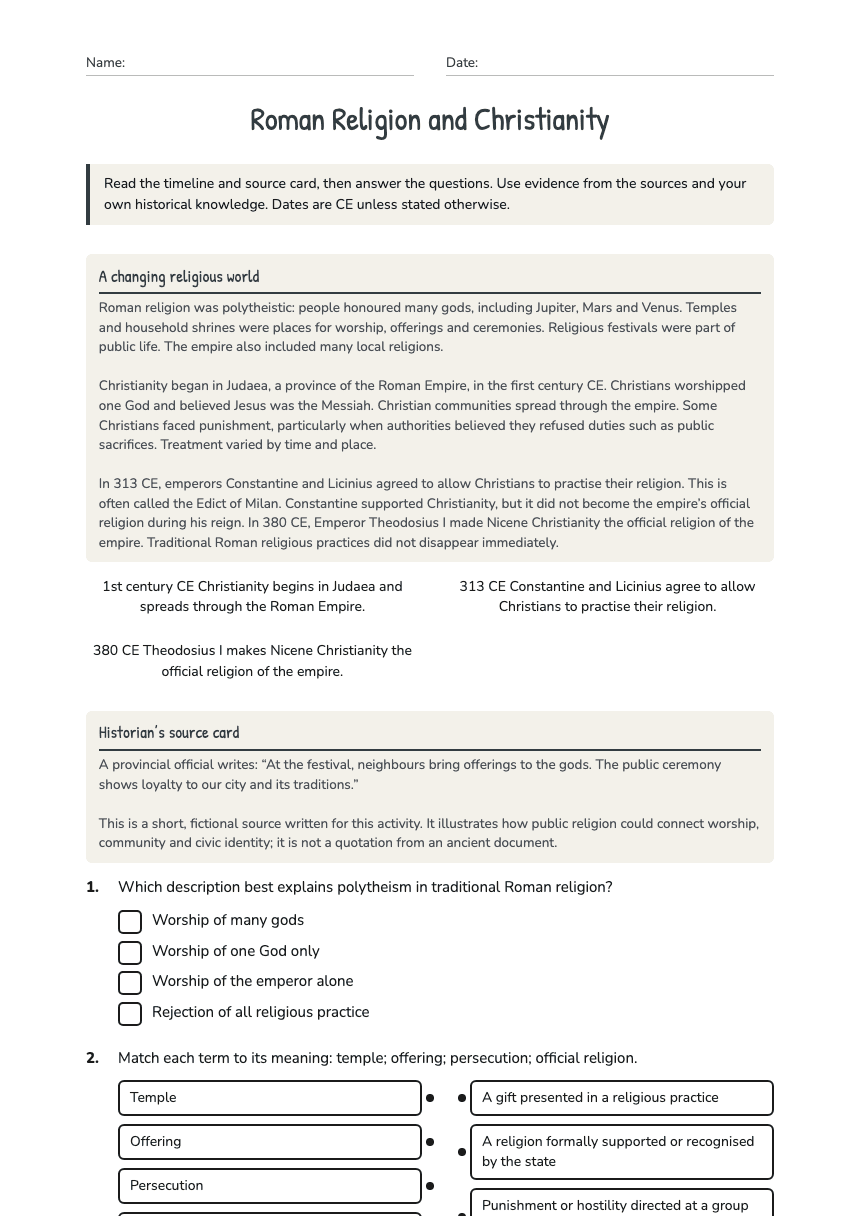
Roman Religion and Christianity
A changing religious world
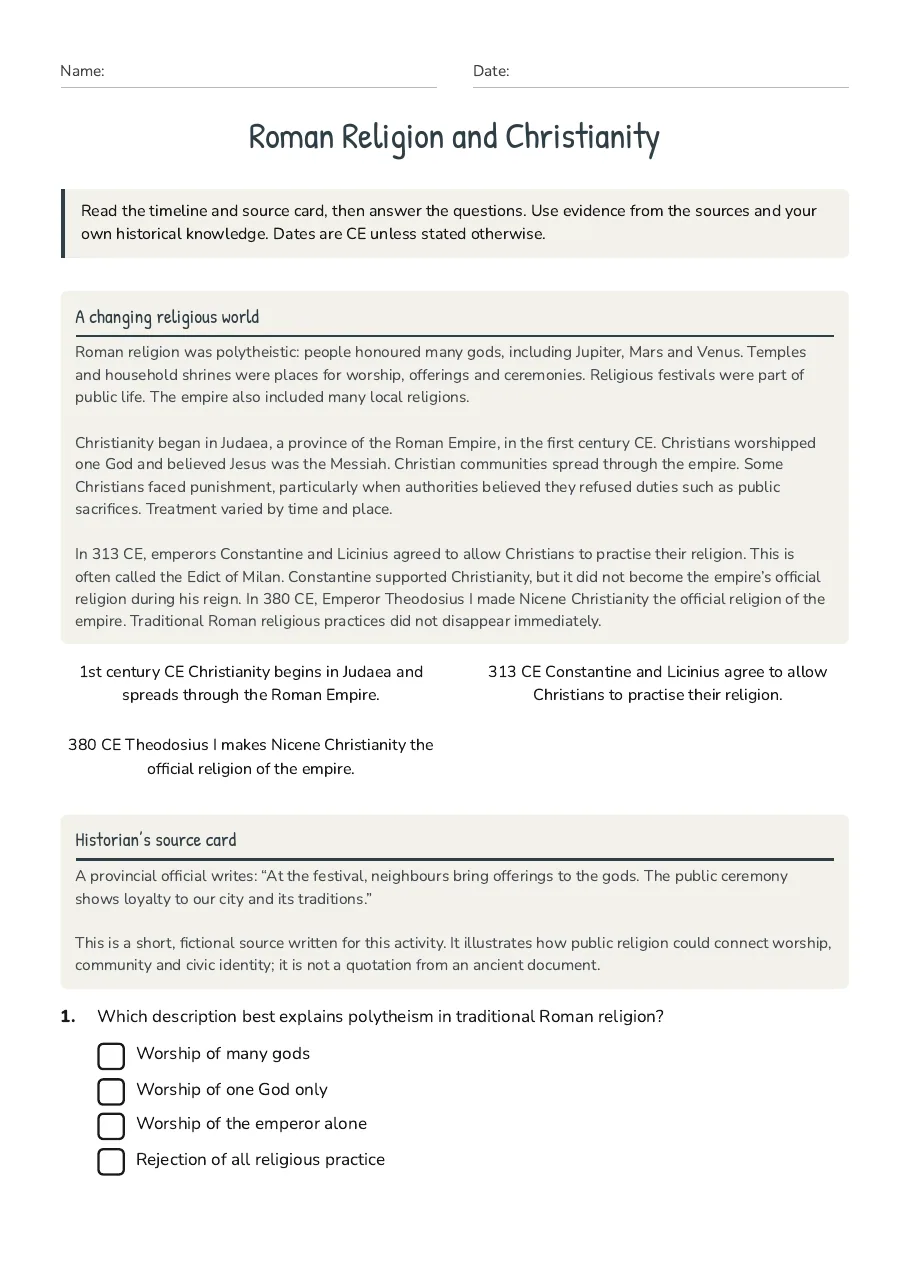
Roman religion was polytheistic: people honoured many gods, including Jupiter, Mars and Venus. Temples and household shrines were places for worship, offerings and ceremonies. Religious festivals were part of public life. The empire also included many local religions. Christianity began in Judaea, a province of the Roman Empire, in the first century CE. Christians worshipped one God and believed Jesus was the Messiah. Christian communities spread through the empire. Some Christians faced punishment, particularly when authorities believed they refused duties such as public sacrifices. Treatment varied by time and place. In 313 CE, emperors Constantine and Licinius agreed to allow Christians to practise their religion. This is often called the Edict of Milan. Constantine supported Christianity, but it did not become the empire’s official religion during his reign. In 380 CE, Emperor Theodosius I made Nicene Christianity the official religion of the empire. Traditional Roman religious practices did not disappear immediately.
1st century CE Christianity begins in Judaea and spreads through the Roman Empire.
313 CE Constantine and Licinius agree to allow Christians to practise their religion.
380 CE Theodosius I makes Nicene Christianity the official religion of the empire.
Historian’s source card
A provincial official writes: “At the festival, neighbours bring offerings to the gods. The public ceremony shows loyalty to our city and its traditions.” This is a short, fictional source written for this activity. It illustrates how public religion could connect worship, community and civic identity; it is not a quotation from an ancient document.
- Worship of many gods
- Worship of one God only
- Worship of the emperor alone
- Rejection of all religious practice
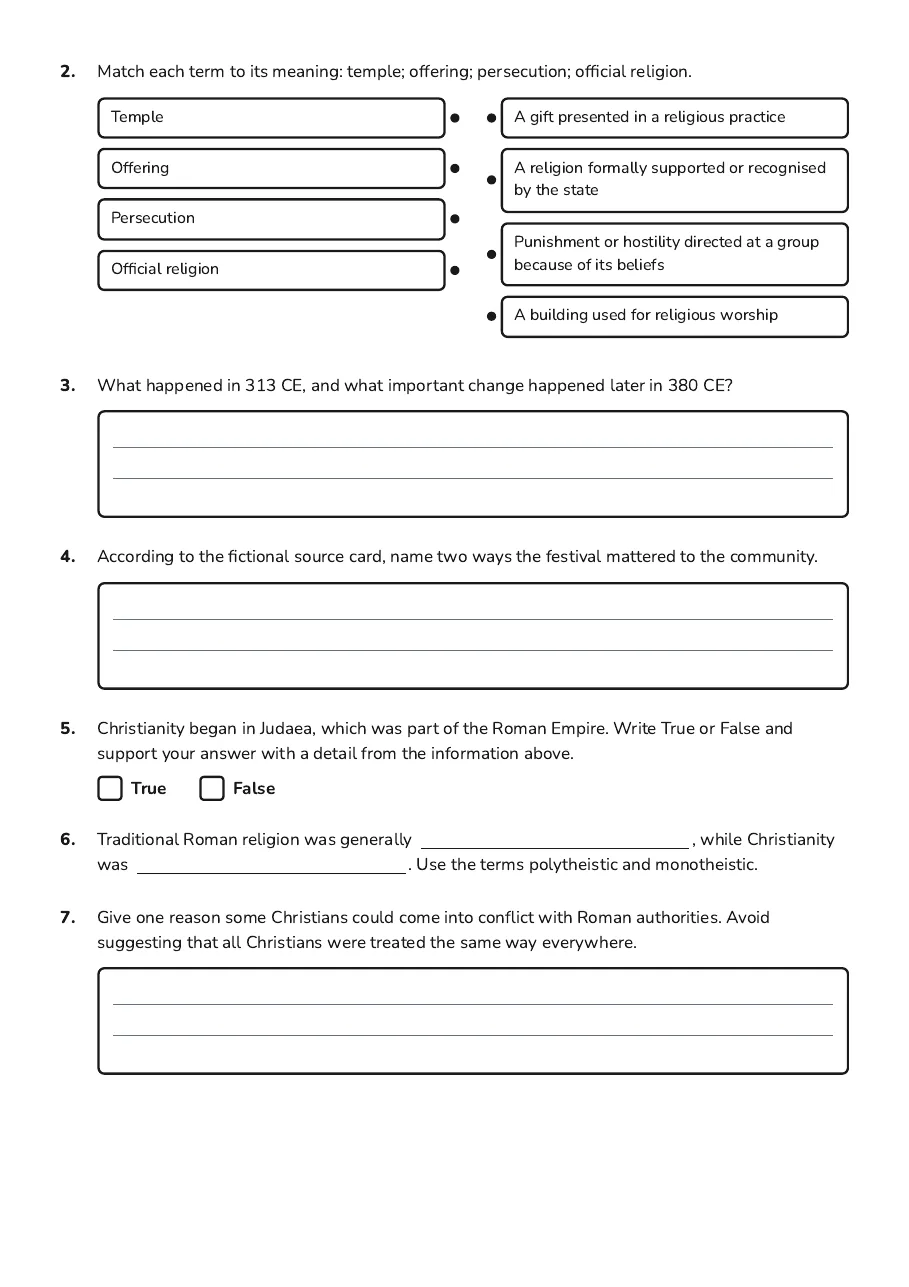
- Temple
- Offering
- Persecution
- Official religion
- A gift presented in a religious practice
- A religion formally supported or recognised by the state
- Punishment or hostility directed at a group because of its beliefs
- A building used for religious worship
3 printable pages
Page 1
Page 2
Page 3
About This Worksheet
Free in Kuraplan
Sign up free, grab the PDF, and customize it for your class.
Print-Ready
Formatted for standard paper. Clean layout, easy to read.
AI-Generated
Created with Kuraplan's AI, designed for real classroom use.
For Teachers & Parents
Use in classrooms, for homework, tutoring, or homeschool.
Need a custom version of this worksheet?
Kuraplan's AI generates custom worksheets in seconds — differentiated for every learner, aligned to your curriculum.
Generate Custom Worksheets — Free