ScienceFreePrintable

Skeletal System Study

A free science worksheet ready for your classroom. Open in Kuraplan to grab the print-ready PDF, customize it for your students, or generate a fresh version in seconds.
Skeletal System Study worksheet preview
Name:Date:

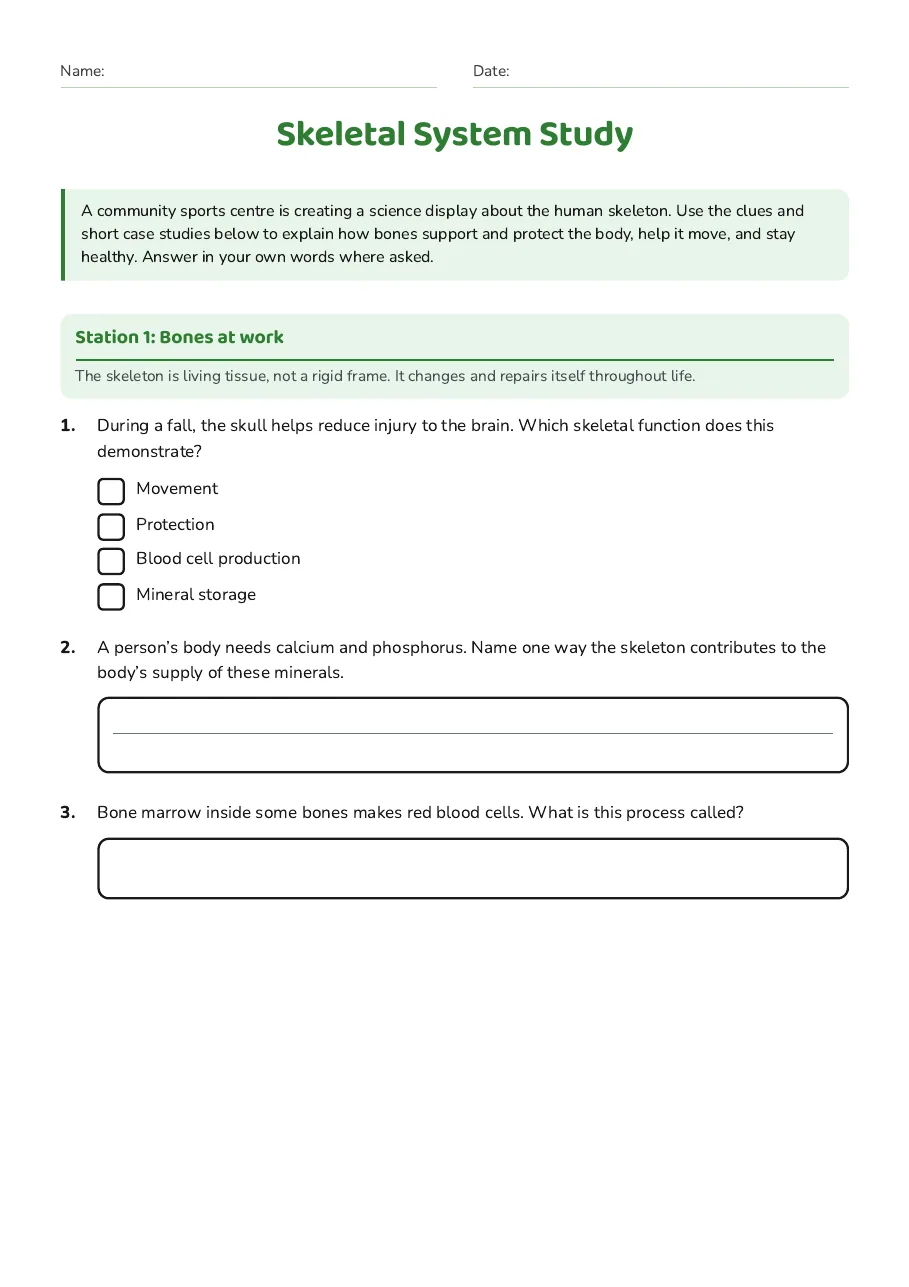
Skeletal System Study

A community sports centre is creating a science display about the human skeleton. Use the clues and short case studies below to explain how bones support and protect the body, help it move, and stay healthy. Answer in your own words where asked.

Station 1: Bones at work

The skeleton is living tissue, not a rigid frame. It changes and repairs itself throughout life.

1.During a fall, the skull helps reduce injury to the brain. Which skeletal function does this demonstrate?
  • Movement
  • Protection
  • Blood cell production
  • Mineral storage
2.A person’s body needs calcium and phosphorus. Name one way the skeleton contributes to the body’s supply of these minerals.
3.Bone marrow inside some bones makes red blood cells. What is this process called?

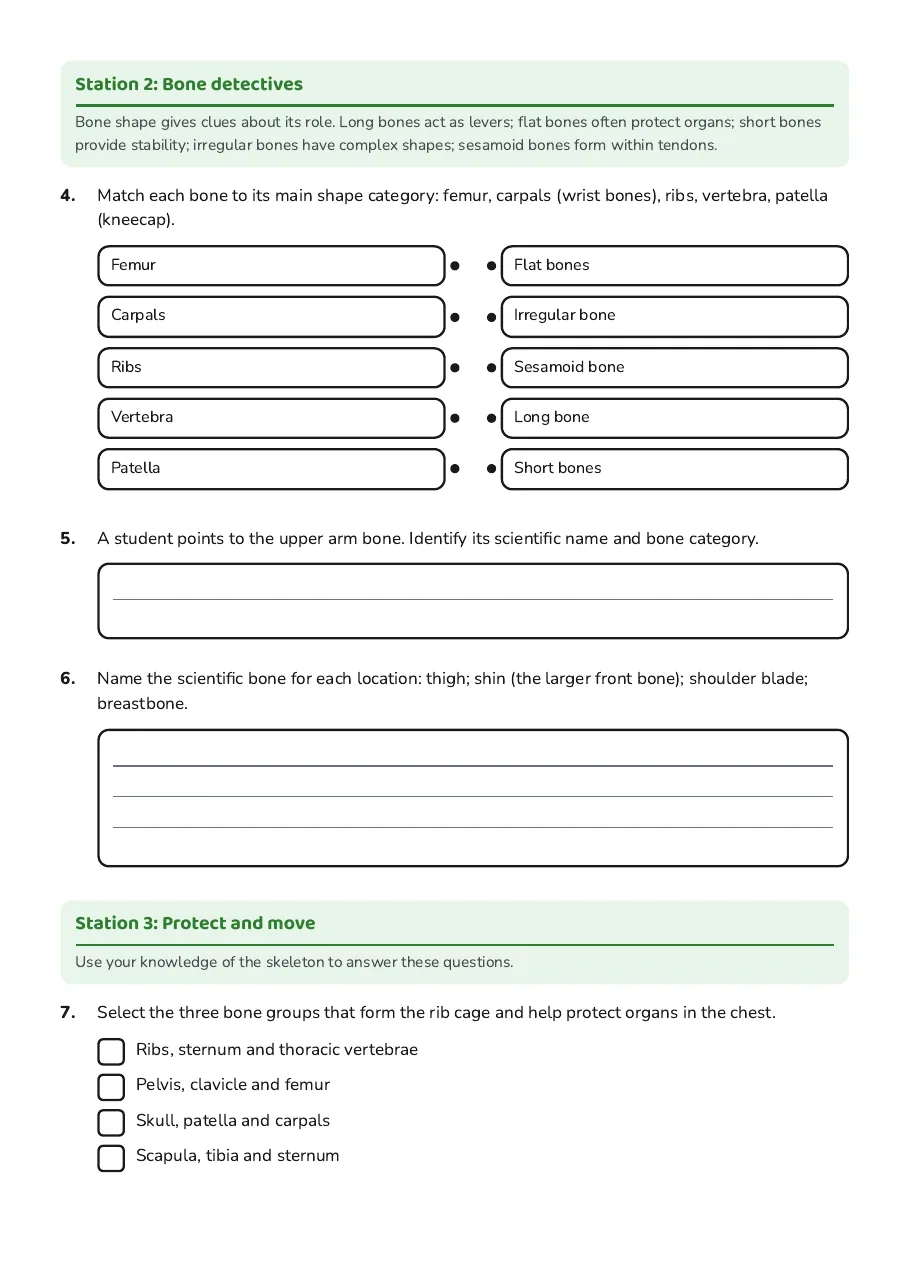
Station 2: Bone detectives

Bone shape gives clues about its role. Long bones act as levers; flat bones often protect organs; short bones provide stability; irregular bones have complex shapes; sesamoid bones form within tendons.

4.Match each bone to its main shape category: femur, carpals (wrist bones), ribs, vertebra, patella (kneecap).
  • Femur
  • Carpals
  • Ribs
  • Vertebra
  • Patella
  • Flat bones
  • Irregular bone
  • Sesamoid bone
  • Long bone
  • Short bones
5.A student points to the upper arm bone. Identify its scientific name and bone category.
6.Name the scientific bone for each location: thigh; shin (the larger front bone); shoulder blade; breastbone.

Station 3: Protect and move

Use your knowledge of the skeleton to answer these questions.

7.Select the three bone groups that form the rib cage and help protect organs in the chest.
  • Ribs, sternum and thoracic vertebrae
  • Pelvis, clavicle and femur
  • Skull, patella and carpals
  • Scapula, tibia and sternum
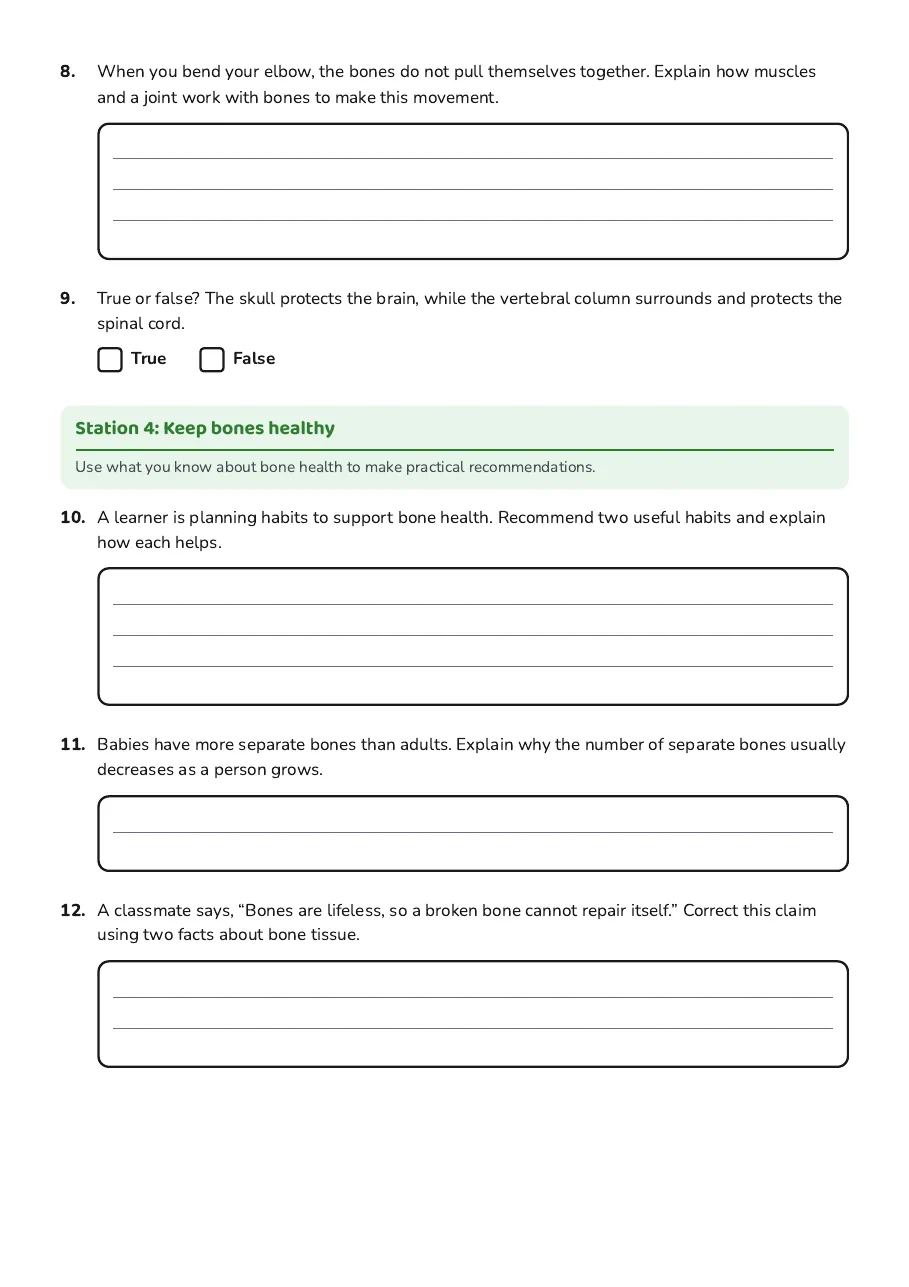
8.When you bend your elbow, the bones do not pull themselves together. Explain how muscles and a joint work with bones to make this movement.
9.True or false? The skull protects the brain, while the vertebral column surrounds and protects the spinal cord.
TrueFalse

Station 4: Keep bones healthy

Use what you know about bone health to make practical recommendations.

10.A learner is planning habits to support bone health. Recommend two useful habits and explain how each helps.
11.Babies have more separate bones than adults. Explain why the number of separate bones usually decreases as a person grows.
12.A classmate says, “Bones are lifeless, so a broken bone cannot repair itself.” Correct this claim using two facts about bone tissue.

3 printable pages

  • Skeletal System Study, page 1 of 3: Station 1: Bones at work

    Page 1

  • Skeletal System Study, page 2 of 3: Station 2: Bone detectives, Station 3: Protect and move

    Page 2

  • Skeletal System Study, page 3 of 3: Station 4: Keep bones healthy

    Page 3

About This Worksheet

Free in Kuraplan

Sign up free, grab the PDF, and customize it for your class.

Print-Ready

Formatted for standard paper. Clean layout, easy to read.

AI-Generated

Created with Kuraplan's AI, designed for real classroom use.

For Teachers & Parents

Use in classrooms, for homework, tutoring, or homeschool.

Need a custom version of this worksheet?

Kuraplan's AI generates custom worksheets in seconds — differentiated for every learner, aligned to your curriculum.

Generate Custom Worksheets — Free
No credit card Curriculum-aligned Under 60 seconds