ScienceFreePrintable

Soil Components Observation Worksheet

A free science worksheet ready for your classroom. Open in Kuraplan to grab the print-ready PDF, customize it for your students, or generate a fresh version in seconds.

Soil Components Observation Worksheet worksheet preview
Name:Date:

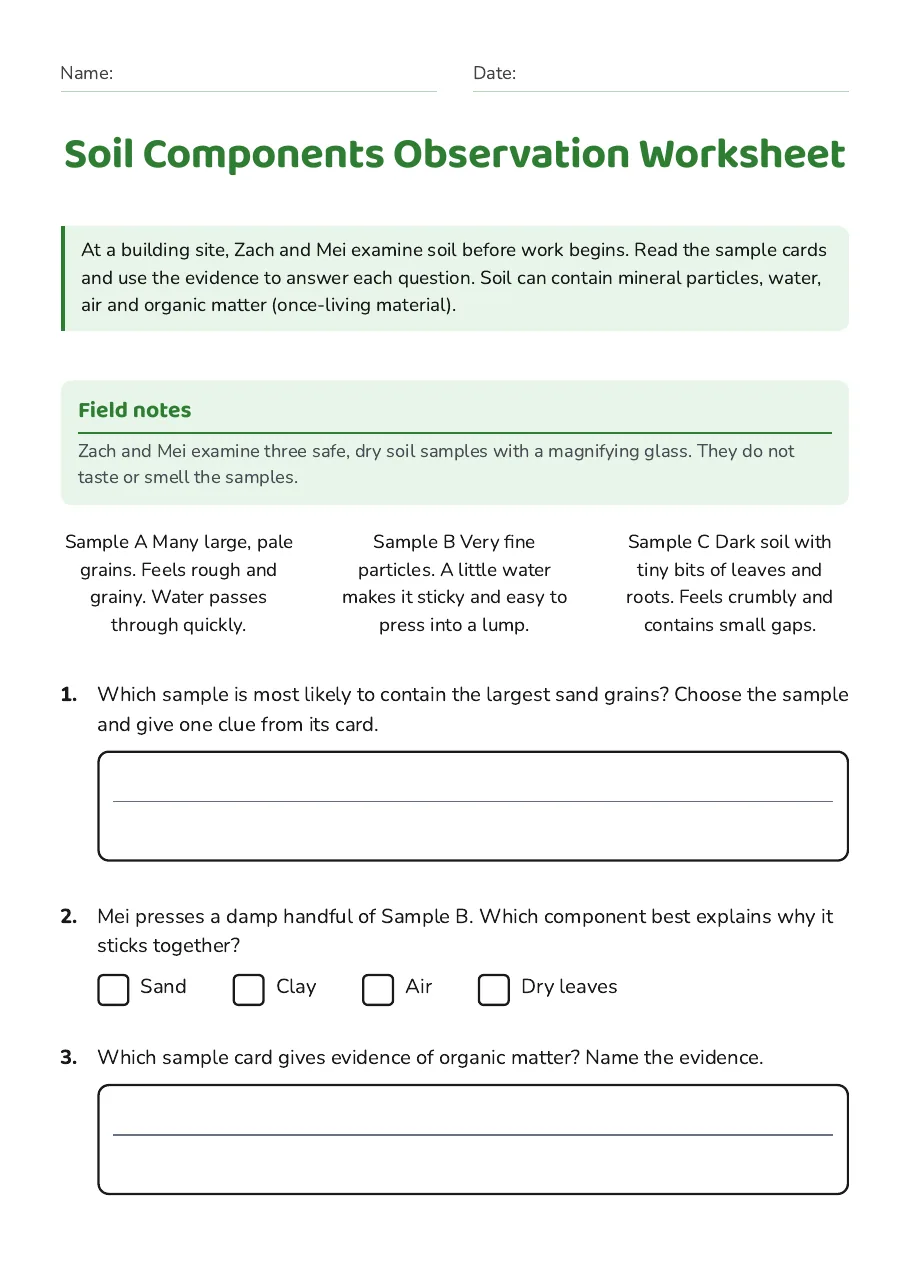
Soil Components Observation Worksheet

At a building site, Zach and Mei examine soil before work begins. Read the sample cards and use the evidence to answer each question. Soil can contain mineral particles, water, air and organic matter (once-living material).

Field notes

Zach and Mei examine three safe, dry soil samples with a magnifying glass. They do not taste or smell the samples.

Sample A Many large, pale grains. Feels rough and grainy. Water passes through quickly.

Sample B Very fine particles. A little water makes it sticky and easy to press into a lump.

Sample C Dark soil with tiny bits of leaves and roots. Feels crumbly and contains small gaps.

1.Which sample is most likely to contain the largest sand grains? Choose the sample and give one clue from its card.
2.Mei presses a damp handful of Sample B. Which component best explains why it sticks together?
  • Sand
  • Clay
  • Air
  • Dry leaves
3.Which sample card gives evidence of organic matter? Name the evidence.
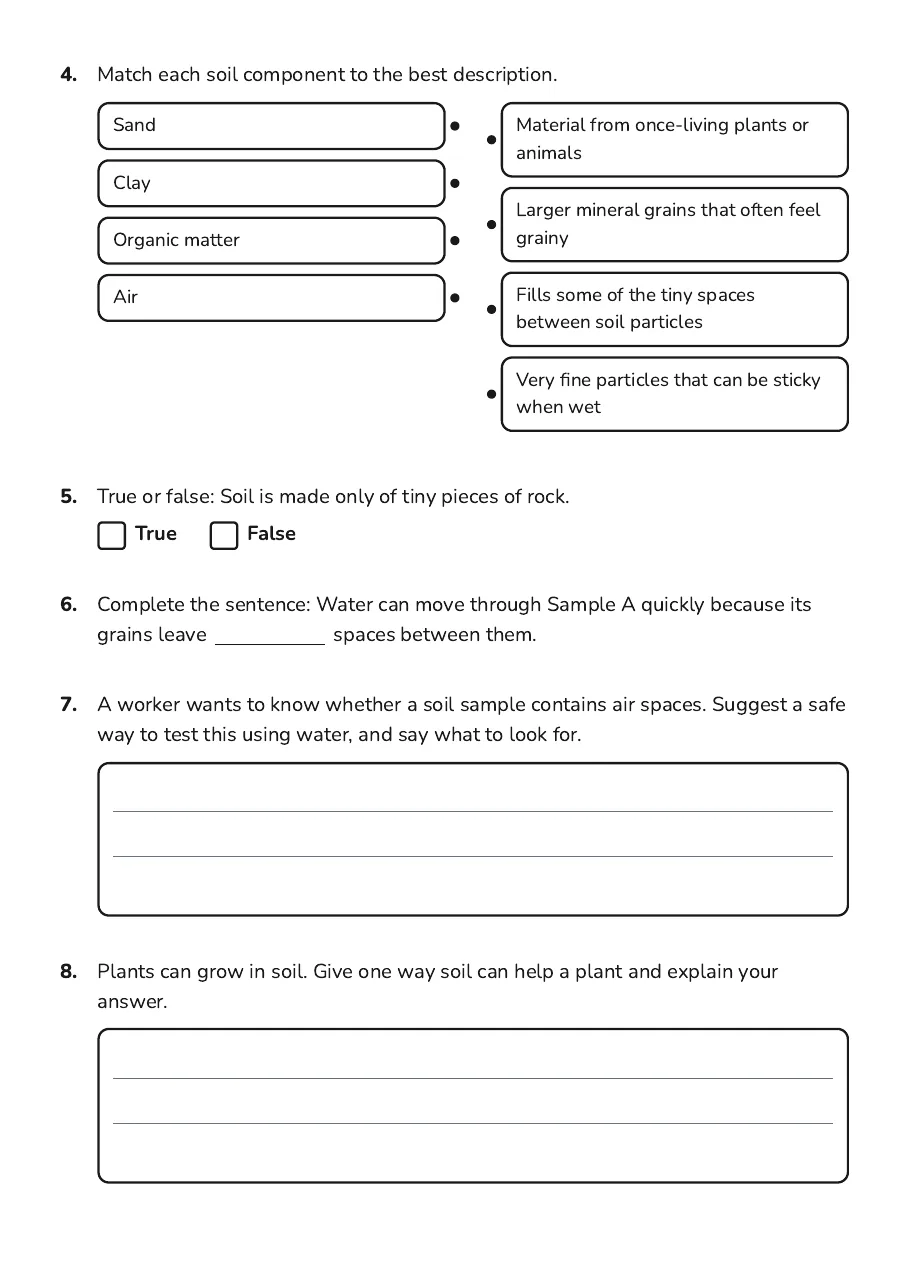
4.Match each soil component to the best description.
  • Sand
  • Clay
  • Organic matter
  • Air
  • Material from once-living plants or animals
  • Larger mineral grains that often feel grainy
  • Fills some of the tiny spaces between soil particles
  • Very fine particles that can be sticky when wet
5.True or false: Soil is made only of tiny pieces of rock.
TrueFalse
6.Complete the sentence: Water can move through Sample A quickly because its grains leave spaces between them.
7.A worker wants to know whether a soil sample contains air spaces. Suggest a safe way to test this using water, and say what to look for.
8.Plants can grow in soil. Give one way soil can help a plant and explain your answer.
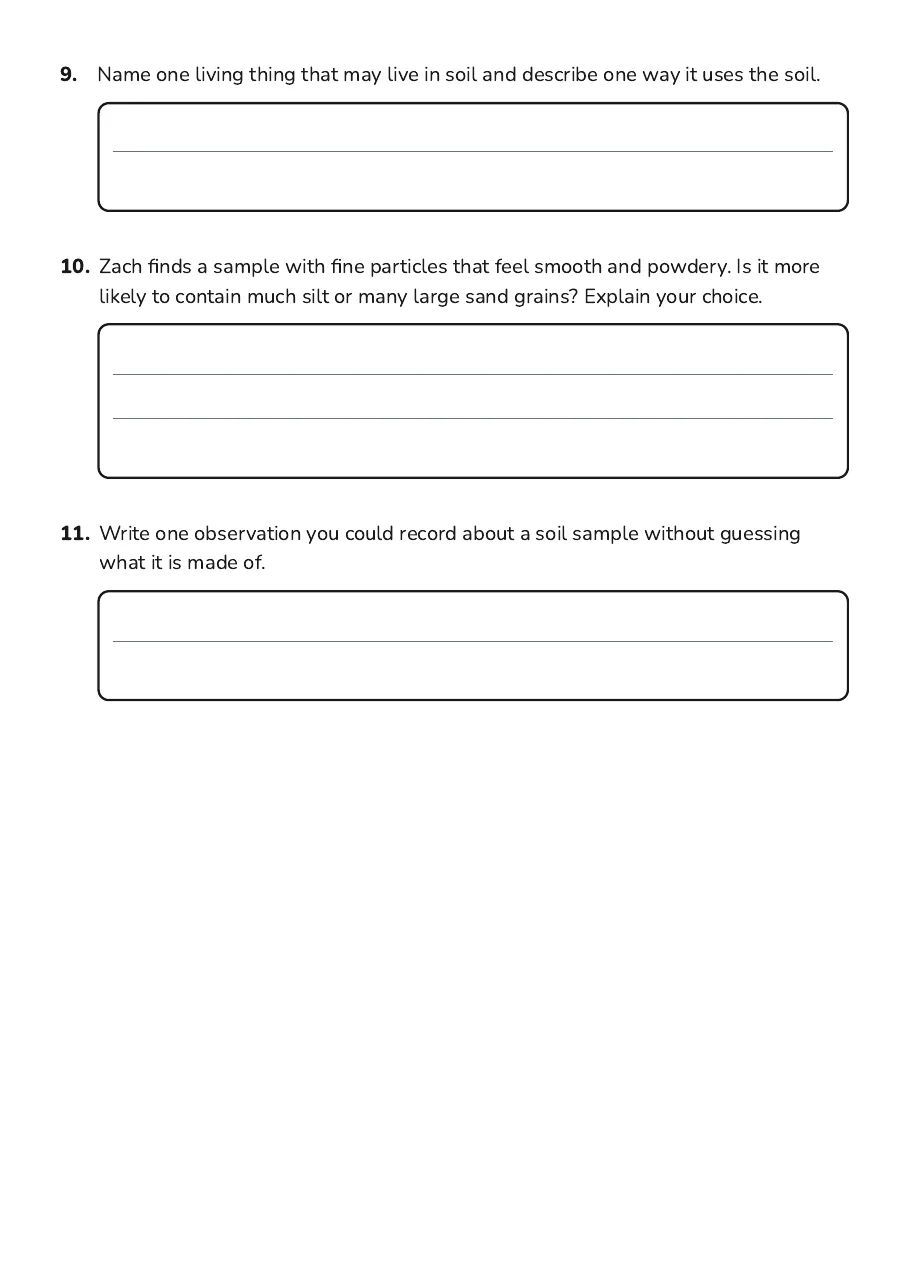
9.Name one living thing that may live in soil and describe one way it uses the soil.
10.Zach finds a sample with fine particles that feel smooth and powdery. Is it more likely to contain much silt or many large sand grains? Explain your choice.
11.Write one observation you could record about a soil sample without guessing what it is made of.

3 printable pages

  • Soil Components Observation Worksheet, page 1 of 3: Field notes

    Page 1

  • Soil Components Observation Worksheet, page 2 of 3: 4. Match each soil component to the best description.

    Page 2

  • Soil Components Observation Worksheet, page 3 of 3: 9. Name one living thing that may live in soil and describe one way it uses the soil.

    Page 3

About This Worksheet

Free in Kuraplan

Sign up free, grab the PDF, and customize it for your class.

Print-Ready

Formatted for standard paper. Clean layout, easy to read.

AI-Generated

Created with Kuraplan's AI, designed for real classroom use.

For Teachers & Parents

Use in classrooms, for homework, tutoring, or homeschool.

Need a custom version of this worksheet?

Kuraplan's AI generates custom worksheets in seconds — differentiated for every learner, aligned to your curriculum.

Generate Custom Worksheets — Free
No credit card Curriculum-aligned Under 60 seconds