Stolen Generations Case Study
A free social sciences worksheet ready for your classroom. Open in Kuraplan to grab the print-ready PDF, customize it for your students, or generate a fresh version in seconds.

Stolen Generations Case Study
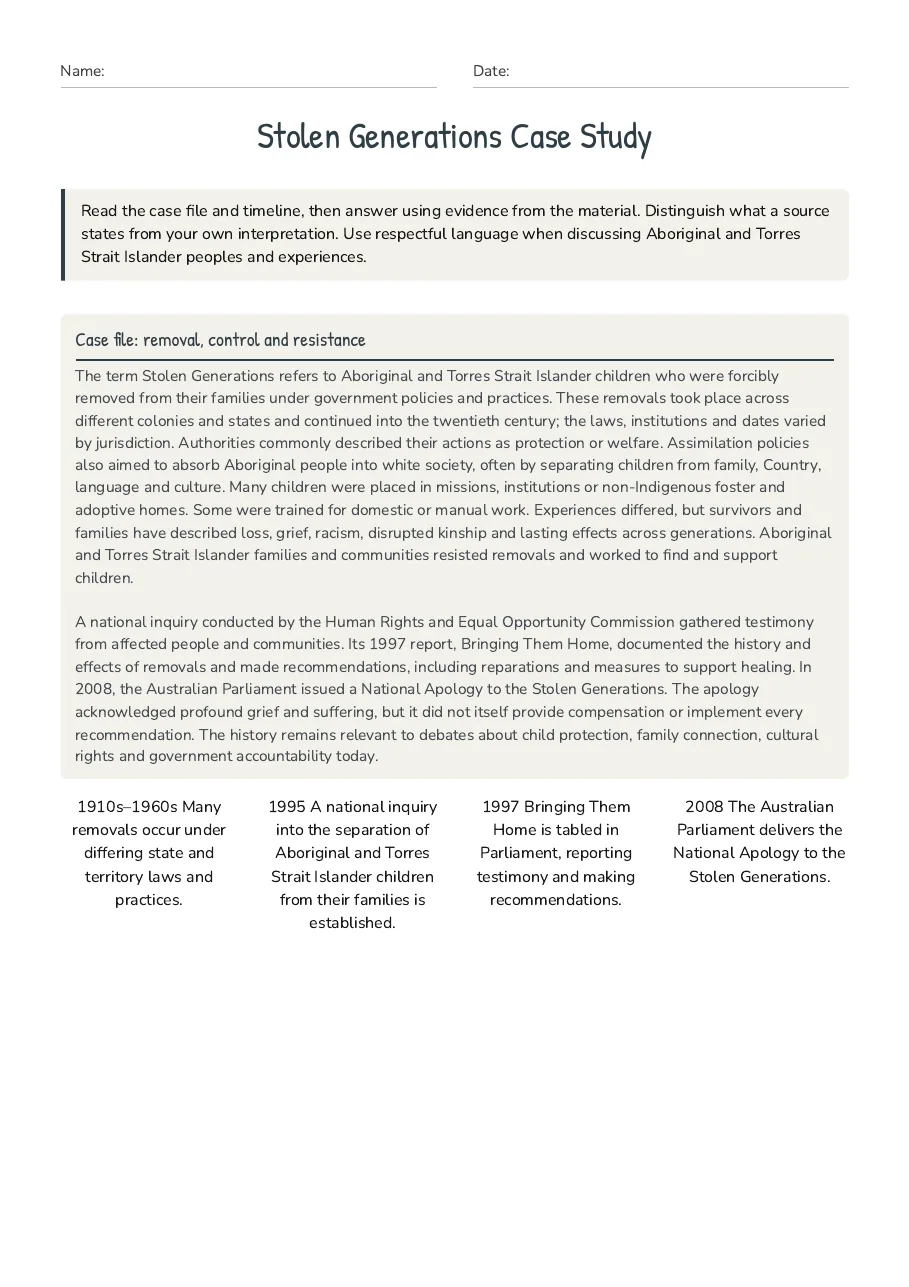
Case file: removal, control and resistance
The term Stolen Generations refers to Aboriginal and Torres Strait Islander children who were forcibly removed from their families under government policies and practices. These removals took place across different colonies and states and continued into the twentieth century; the laws, institutions and dates varied by jurisdiction. Authorities commonly described their actions as protection or welfare. Assimilation policies also aimed to absorb Aboriginal people into white society, often by separating children from family, Country, language and culture. Many children were placed in missions, institutions or non-Indigenous foster and adoptive homes. Some were trained for domestic or manual work. Experiences differed, but survivors and families have described loss, grief, racism, disrupted kinship and lasting effects across generations. Aboriginal and Torres Strait Islander families and communities resisted removals and worked to find and support children. A national inquiry conducted by the Human Rights and Equal Opportunity Commission gathered testimony from affected people and communities. Its 1997 report, Bringing Them Home, documented the history and effects of removals and made recommendations, including reparations and measures to support healing. In 2008, the Australian Parliament issued a National Apology to the Stolen Generations. The apology acknowledged profound grief and suffering, but it did not itself provide compensation or implement every recommendation. The history remains relevant to debates about child protection, family connection, cultural rights and government accountability today.
1910s–1960s Many removals occur under differing state and territory laws and practices.
1995 A national inquiry into the separation of Aboriginal and Torres Strait Islander children from their families is established.
1997 Bringing Them Home is tabled in Parliament, reporting testimony and making recommendations.
2008 The Australian Parliament delivers the National Apology to the Stolen Generations.
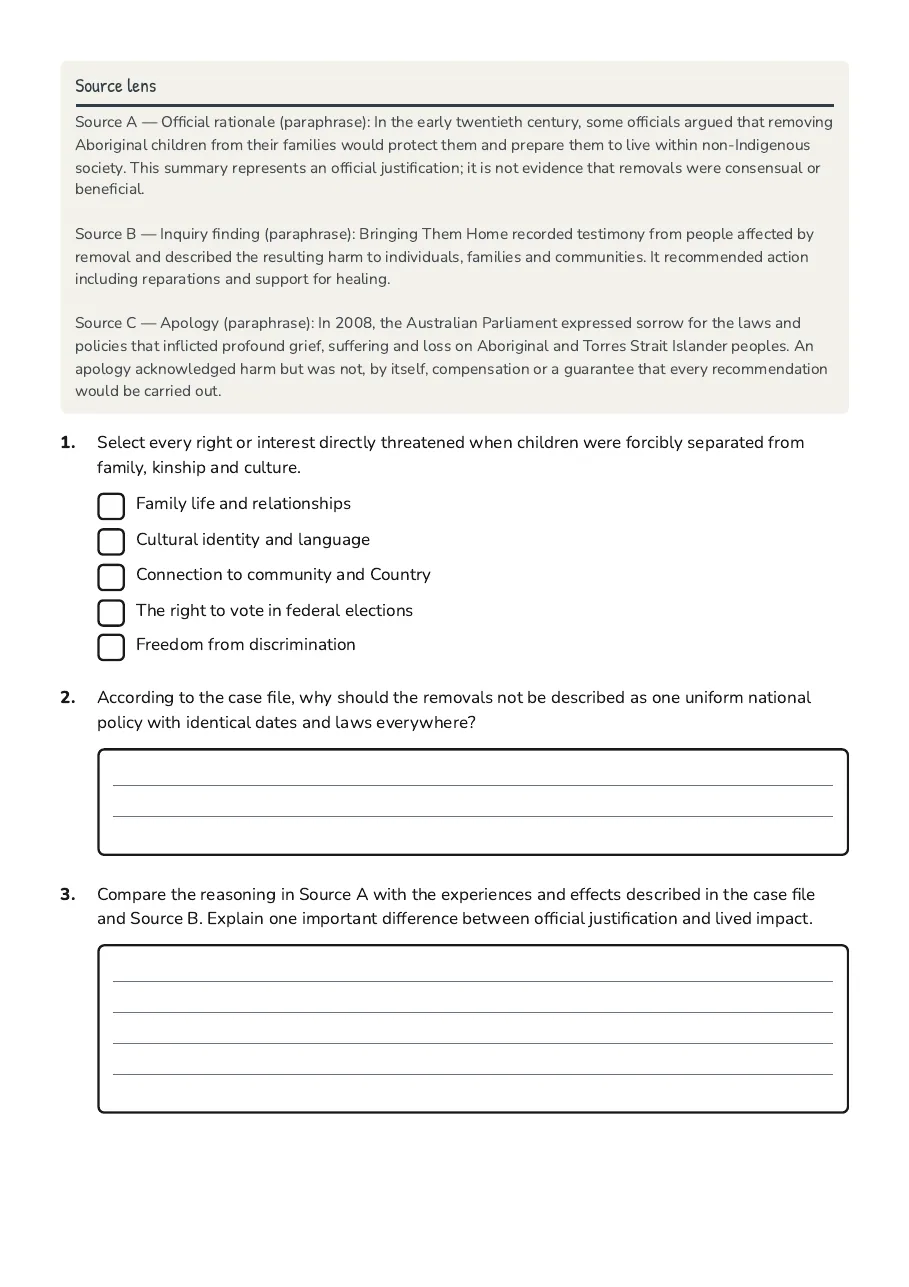
Source lens
Source A — Official rationale (paraphrase): In the early twentieth century, some officials argued that removing Aboriginal children from their families would protect them and prepare them to live within non-Indigenous society. This summary represents an official justification; it is not evidence that removals were consensual or beneficial. Source B — Inquiry finding (paraphrase): Bringing Them Home recorded testimony from people affected by removal and described the resulting harm to individuals, families and communities. It recommended action including reparations and support for healing. Source C — Apology (paraphrase): In 2008, the Australian Parliament expressed sorrow for the laws and policies that inflicted profound grief, suffering and loss on Aboriginal and Torres Strait Islander peoples. An apology acknowledged harm but was not, by itself, compensation or a guarantee that every recommendation would be carried out.
- Family life and relationships
- Cultural identity and language
- Connection to community and Country
- The right to vote in federal elections
- Freedom from discrimination
4 printable pages
Page 1
Page 2
Page 3
Page 4
About This Worksheet
Free in Kuraplan
Sign up free, grab the PDF, and customize it for your class.
Print-Ready
Formatted for standard paper. Clean layout, easy to read.
AI-Generated
Created with Kuraplan's AI, designed for real classroom use.
For Teachers & Parents
Use in classrooms, for homework, tutoring, or homeschool.
Need a custom version of this worksheet?
Kuraplan's AI generates custom worksheets in seconds — differentiated for every learner, aligned to your curriculum.
Generate Custom Worksheets — Free