ScienceFreePrintable

Sydney Zoo Biology Booklet

A free science worksheet ready for your classroom. Open in Kuraplan to grab the print-ready PDF, customize it for your students, or generate a fresh version in seconds.

Sydney Zoo Biology Booklet worksheet preview
Name:Date:

Sydney Zoo Biology Booklet

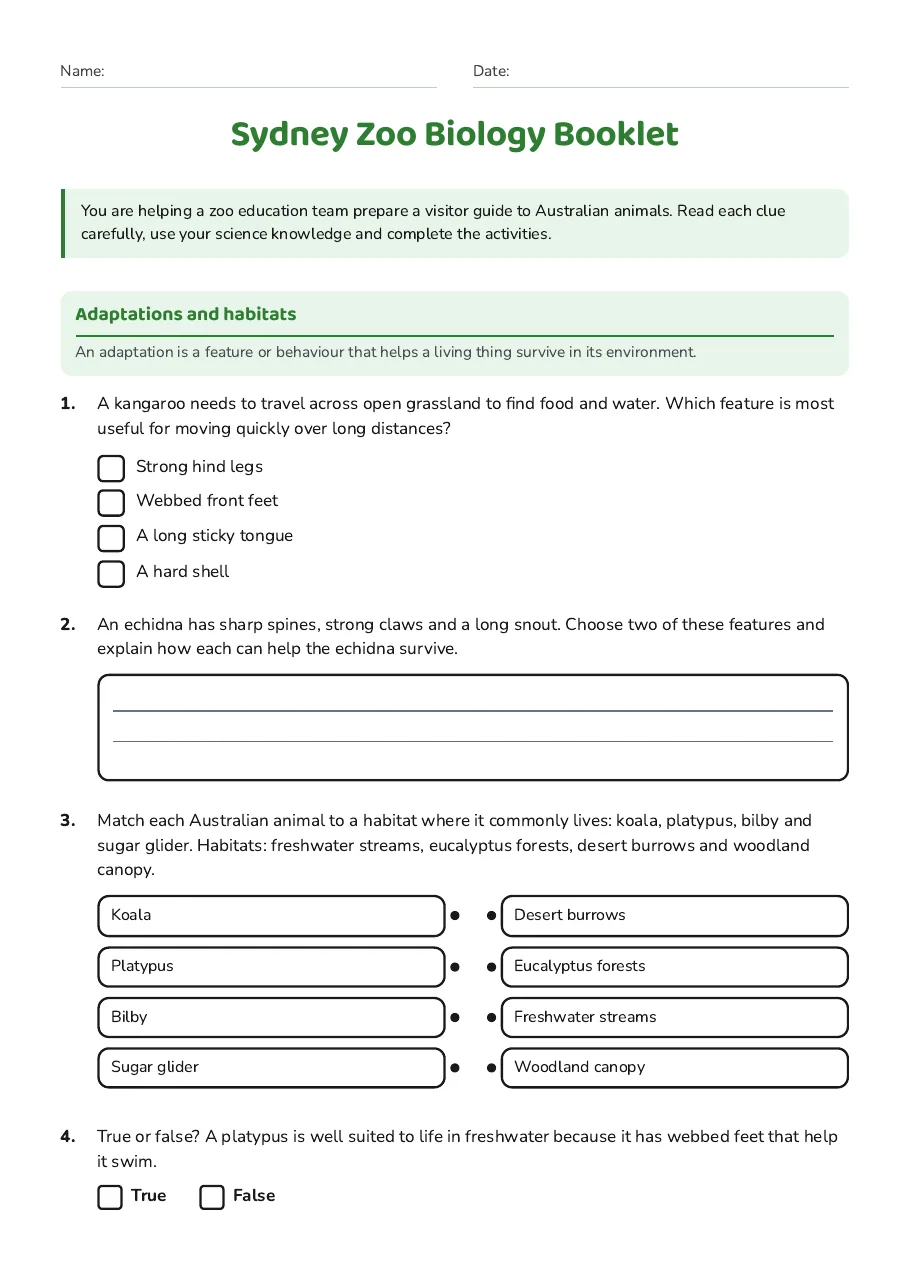
You are helping a zoo education team prepare a visitor guide to Australian animals. Read each clue carefully, use your science knowledge and complete the activities.

Adaptations and habitats

An adaptation is a feature or behaviour that helps a living thing survive in its environment.

1.A kangaroo needs to travel across open grassland to find food and water. Which feature is most useful for moving quickly over long distances?
  • Strong hind legs
  • Webbed front feet
  • A long sticky tongue
  • A hard shell
2.An echidna has sharp spines, strong claws and a long snout. Choose two of these features and explain how each can help the echidna survive.
3.Match each Australian animal to a habitat where it commonly lives: koala, platypus, bilby and sugar glider. Habitats: freshwater streams, eucalyptus forests, desert burrows and woodland canopy.
  • Koala
  • Platypus
  • Bilby
  • Sugar glider
  • Desert burrows
  • Eucalyptus forests
  • Freshwater streams
  • Woodland canopy
4.True or false? A platypus is well suited to life in freshwater because it has webbed feet that help it swim.
TrueFalse

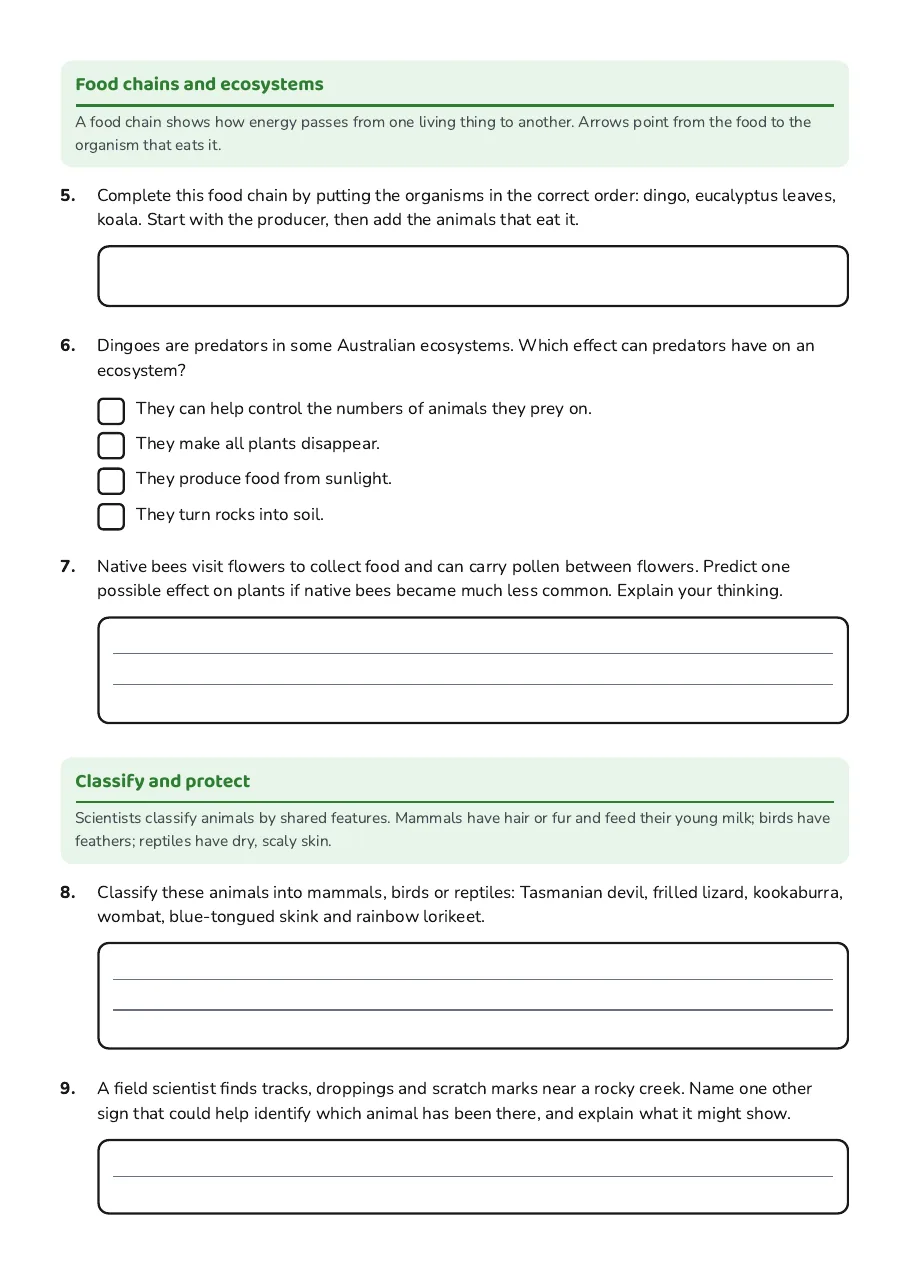
Food chains and ecosystems

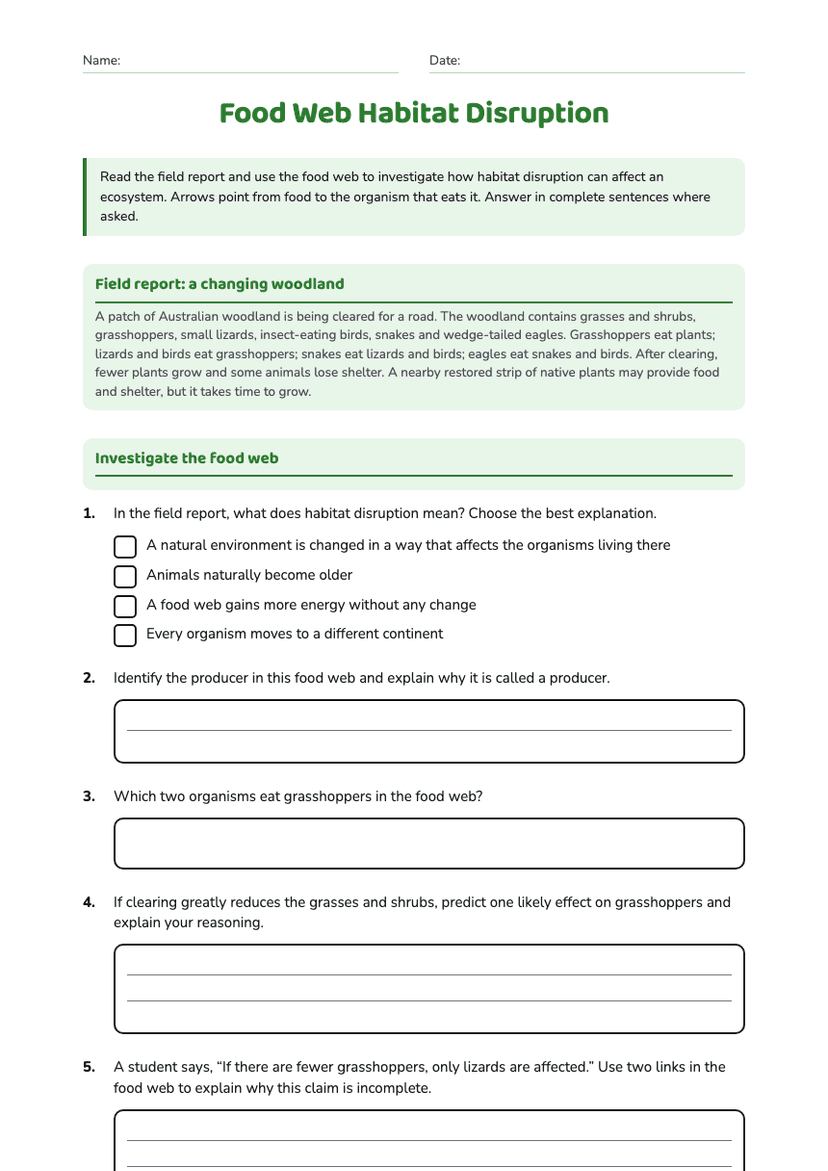
A food chain shows how energy passes from one living thing to another. Arrows point from the food to the organism that eats it.

5.Complete this food chain by putting the organisms in the correct order: dingo, eucalyptus leaves, koala. Start with the producer, then add the animals that eat it.
6.Dingoes are predators in some Australian ecosystems. Which effect can predators have on an ecosystem?
  • They can help control the numbers of animals they prey on.
  • They make all plants disappear.
  • They produce food from sunlight.
  • They turn rocks into soil.
7.Native bees visit flowers to collect food and can carry pollen between flowers. Predict one possible effect on plants if native bees became much less common. Explain your thinking.

Classify and protect

Scientists classify animals by shared features. Mammals have hair or fur and feed their young milk; birds have feathers; reptiles have dry, scaly skin.

8.Classify these animals into mammals, birds or reptiles: Tasmanian devil, frilled lizard, kookaburra, wombat, blue-tongued skink and rainbow lorikeet.
9.A field scientist finds tracks, droppings and scratch marks near a rocky creek. Name one other sign that could help identify which animal has been there, and explain what it might show.
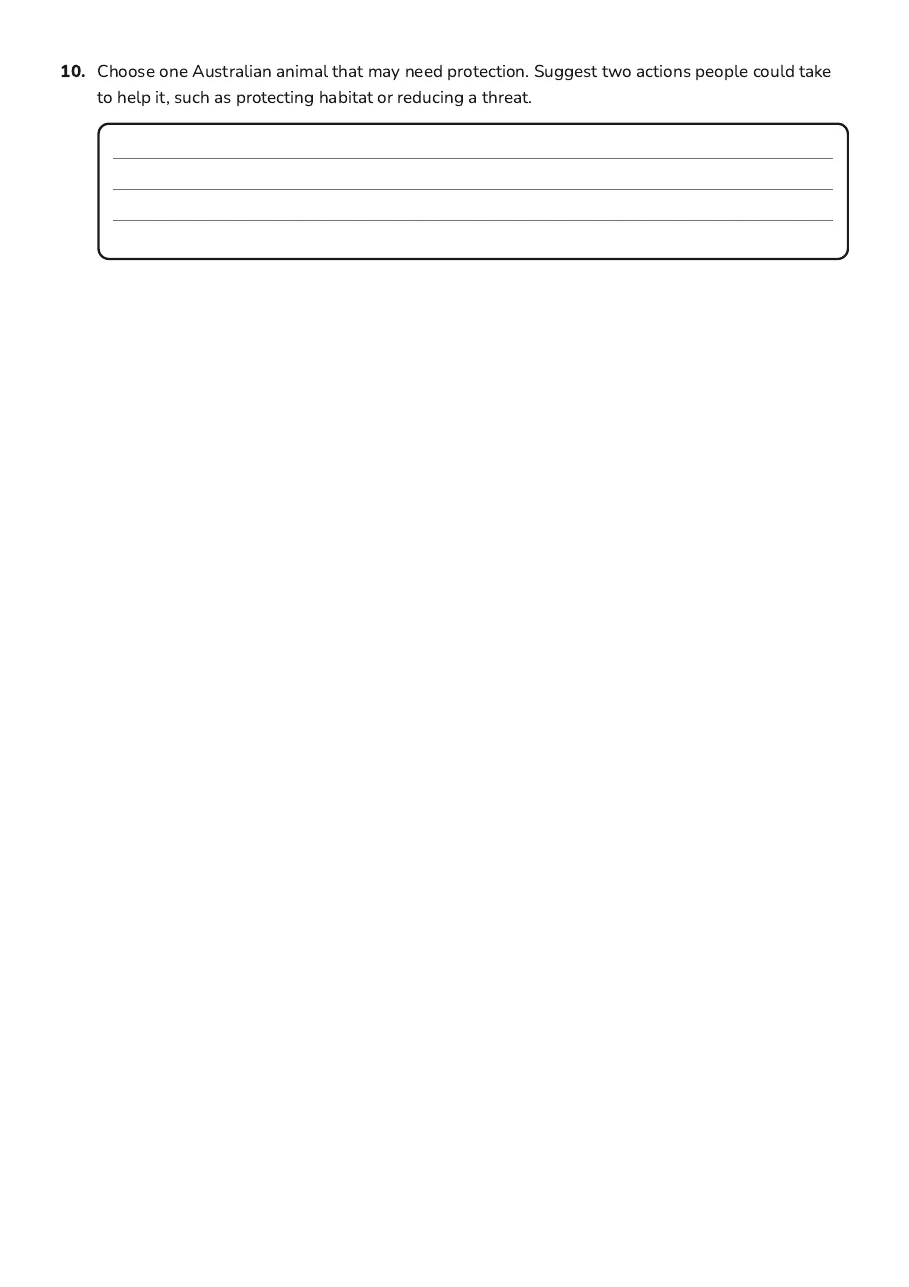
10.Choose one Australian animal that may need protection. Suggest two actions people could take to help it, such as protecting habitat or reducing a threat.

3 printable pages

  • Sydney Zoo Biology Booklet, page 1 of 3: Adaptations and habitats

    Page 1

  • Sydney Zoo Biology Booklet, page 2 of 3: Food chains and ecosystems, Classify and protect

    Page 2

  • Sydney Zoo Biology Booklet, page 3 of 3: 10. Choose one Australian animal that may need protection. Suggest two actions people…

    Page 3

About This Worksheet

Free in Kuraplan

Sign up free, grab the PDF, and customize it for your class.

Print-Ready

Formatted for standard paper. Clean layout, easy to read.

AI-Generated

Created with Kuraplan's AI, designed for real classroom use.

For Teachers & Parents

Use in classrooms, for homework, tutoring, or homeschool.

Need a custom version of this worksheet?

Kuraplan's AI generates custom worksheets in seconds — differentiated for every learner, aligned to your curriculum.

Generate Custom Worksheets — Free
No credit card Curriculum-aligned Under 60 seconds