Take Flight! Forces in Motion
A free science worksheet ready for your classroom. Open in Kuraplan to grab the print-ready PDF, customize it for your students, or generate a fresh version in seconds.
Take Flight! Forces in Motion
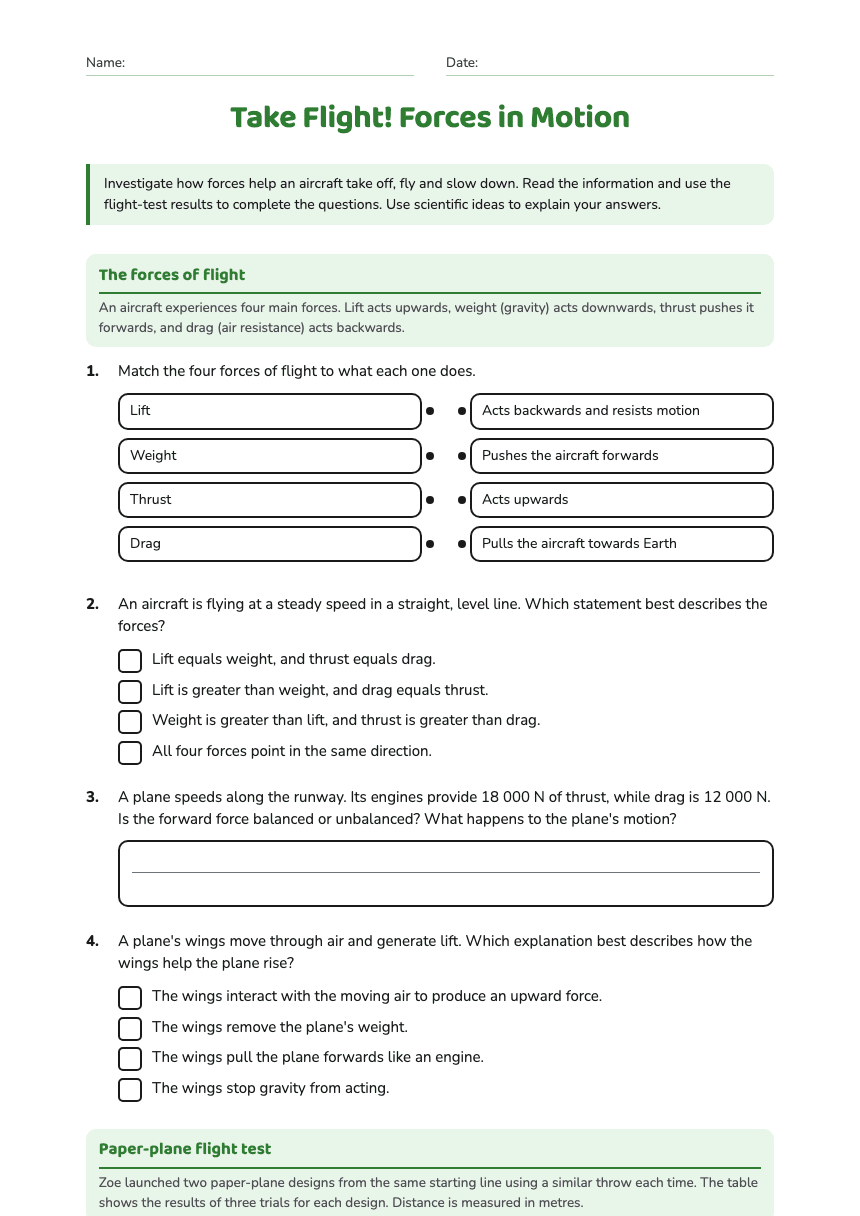
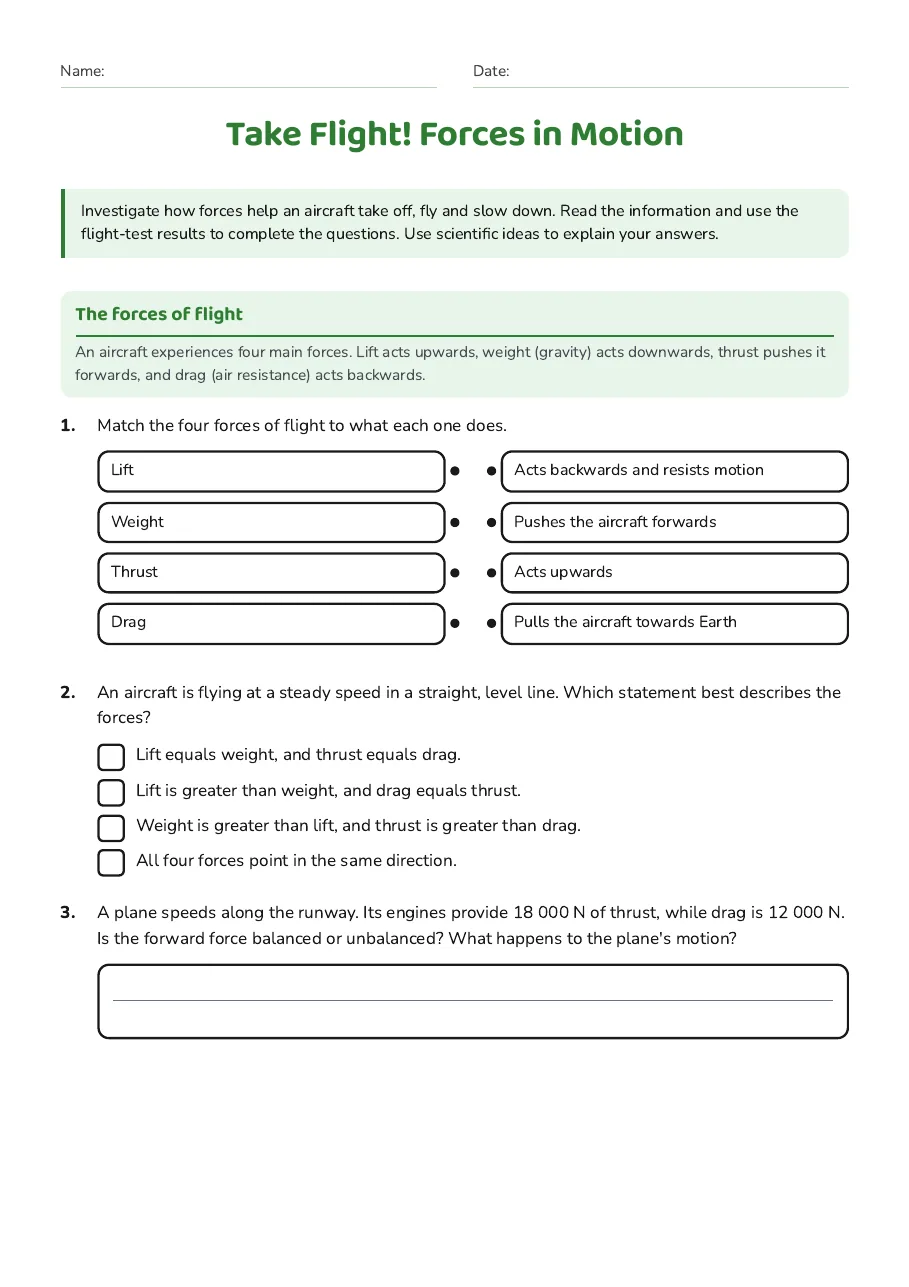
The forces of flight
An aircraft experiences four main forces. Lift acts upwards, weight (gravity) acts downwards, thrust pushes it forwards, and drag (air resistance) acts backwards.
- Lift
- Weight
- Thrust
- Drag
- Acts backwards and resists motion
- Pushes the aircraft forwards
- Acts upwards
- Pulls the aircraft towards Earth
- Lift equals weight, and thrust equals drag.
- Lift is greater than weight, and drag equals thrust.
- Weight is greater than lift, and thrust is greater than drag.
- All four forces point in the same direction.
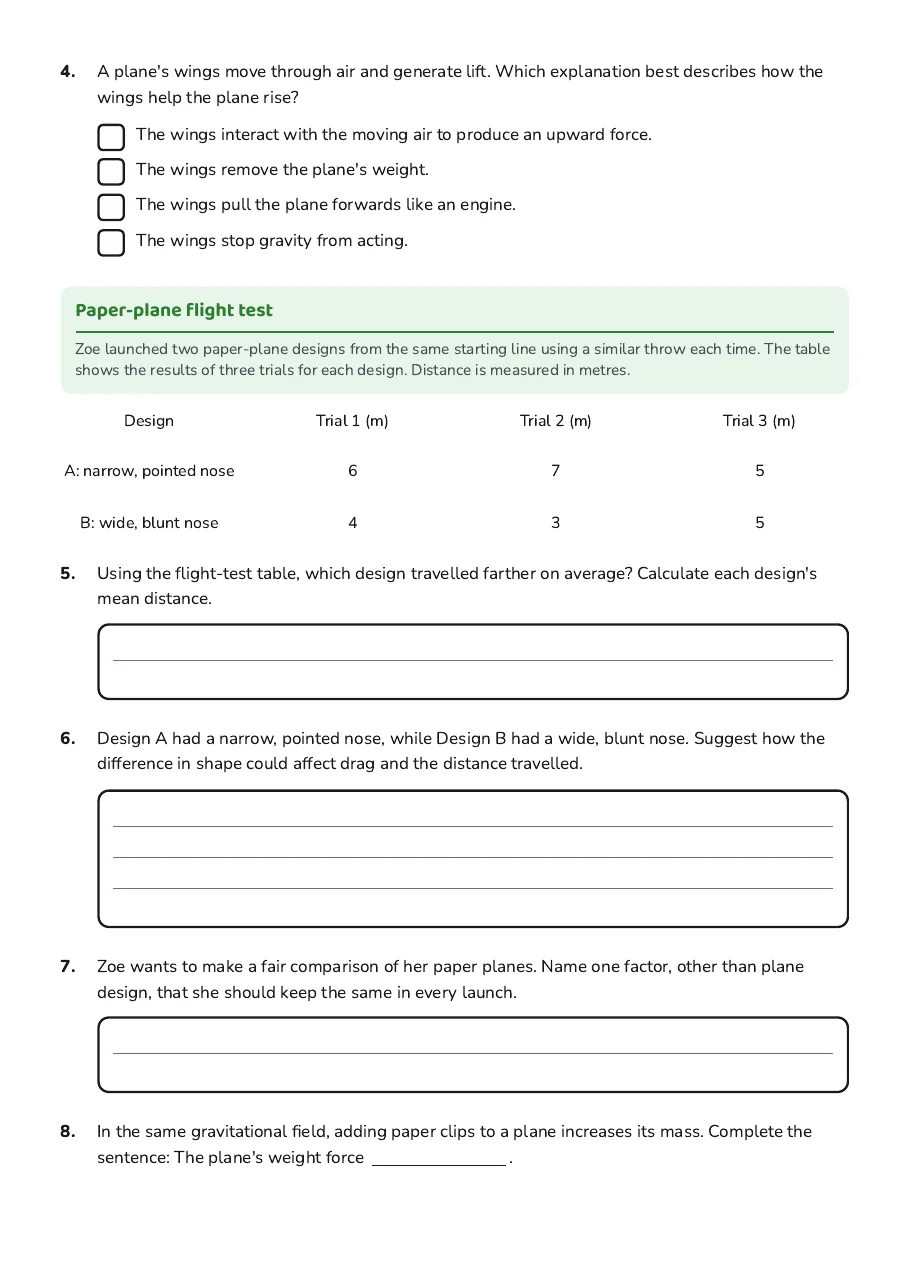
- The wings interact with the moving air to produce an upward force.
- The wings remove the plane's weight.
- The wings pull the plane forwards like an engine.
- The wings stop gravity from acting.
Paper-plane flight test
Zoe launched two paper-plane designs from the same starting line using a similar throw each time. The table shows the results of three trials for each design. Distance is measured in metres.
Design
Trial 1 (m)
Trial 2 (m)
Trial 3 (m)
A: narrow, pointed nose
6
7
5
B: wide, blunt nose
4
3
5
3 printable pages
Page 1
Page 2
Page 3
About This Worksheet
Free in Kuraplan
Sign up free, grab the PDF, and customize it for your class.
Print-Ready
Formatted for standard paper. Clean layout, easy to read.
AI-Generated
Created with Kuraplan's AI, designed for real classroom use.
For Teachers & Parents
Use in classrooms, for homework, tutoring, or homeschool.
Need a custom version of this worksheet?
Kuraplan's AI generates custom worksheets in seconds — differentiated for every learner, aligned to your curriculum.
Generate Custom Worksheets — Free