Textiles in Bridge Engineering
A free technology worksheet ready for your classroom. Open in Kuraplan to grab the print-ready PDF, customize it for your students, or generate a fresh version in seconds.

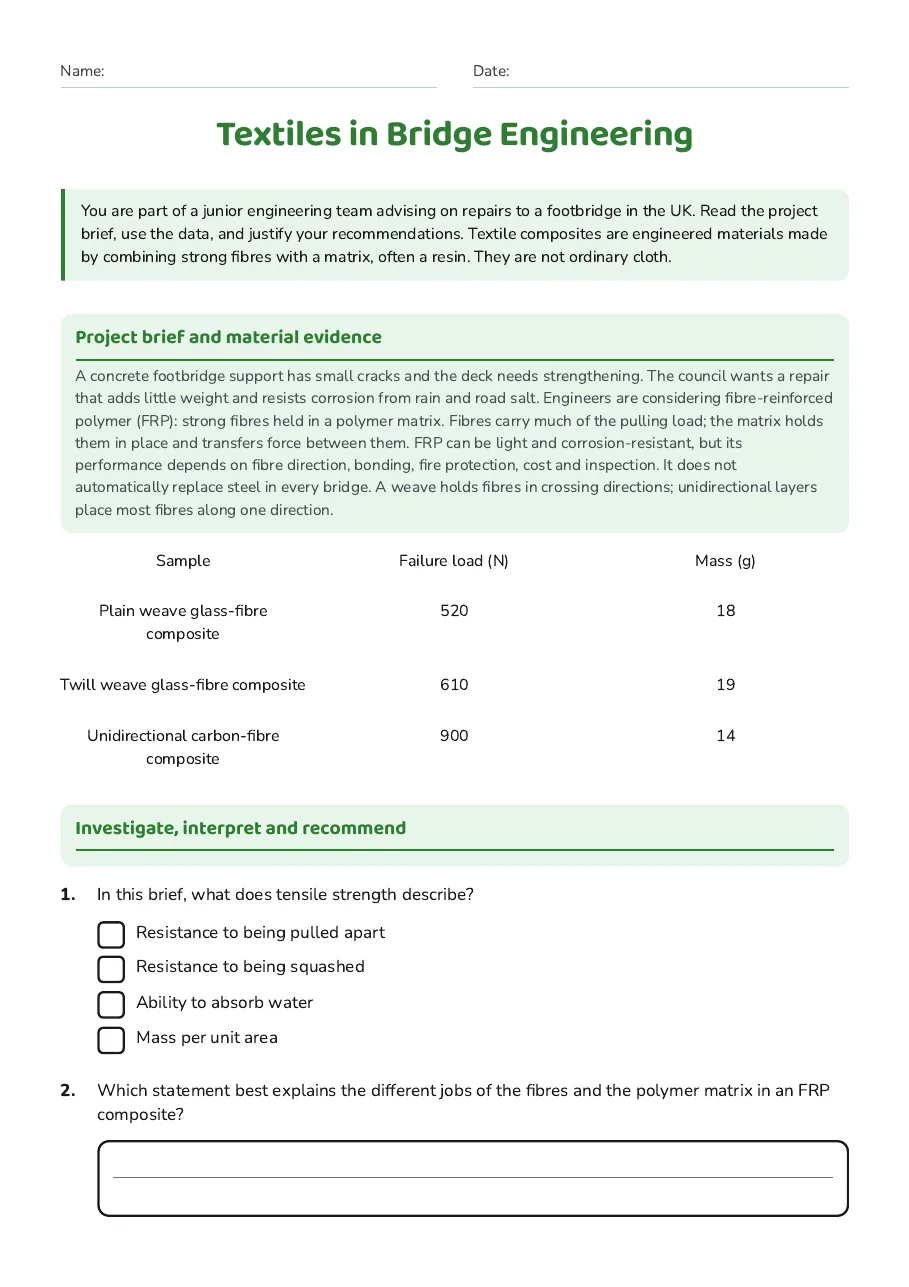
Textiles in Bridge Engineering
Project brief and material evidence
A concrete footbridge support has small cracks and the deck needs strengthening. The council wants a repair that adds little weight and resists corrosion from rain and road salt. Engineers are considering fibre-reinforced polymer (FRP): strong fibres held in a polymer matrix. Fibres carry much of the pulling load; the matrix holds them in place and transfers force between them. FRP can be light and corrosion-resistant, but its performance depends on fibre direction, bonding, fire protection, cost and inspection. It does not automatically replace steel in every bridge. A weave holds fibres in crossing directions; unidirectional layers place most fibres along one direction.
Sample
Failure load (N)
Mass (g)
Plain weave glass-fibre composite
520
18
Twill weave glass-fibre composite
610
19
Unidirectional carbon-fibre composite
900
14
Investigate, interpret and recommend
- Resistance to being pulled apart
- Resistance to being squashed
- Ability to absorb water
- Mass per unit area
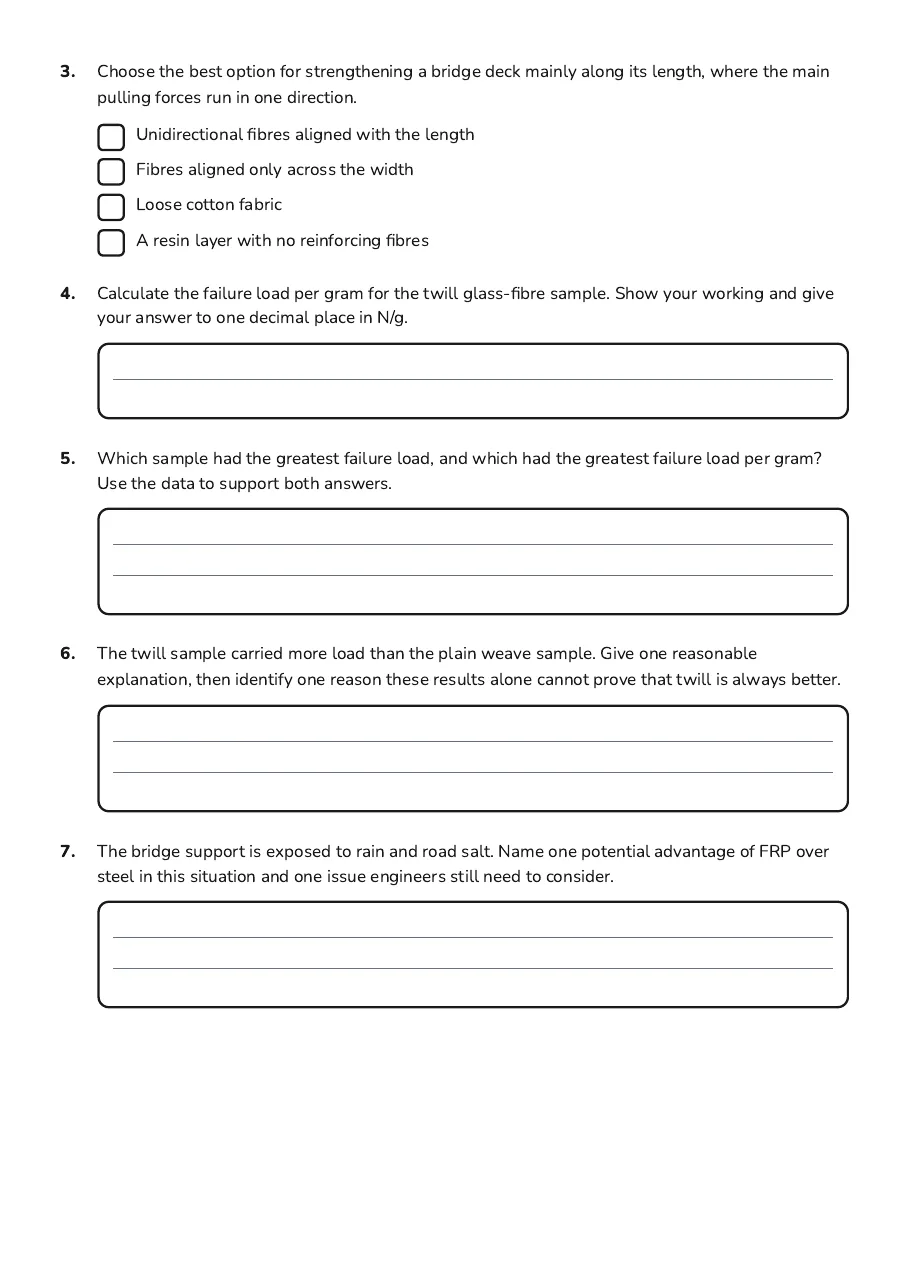
- Unidirectional fibres aligned with the length
- Fibres aligned only across the width
- Loose cotton fabric
- A resin layer with no reinforcing fibres
3 printable pages
Page 1
Page 2

Page 3
About This Worksheet
Free in Kuraplan
Sign up free, grab the PDF, and customize it for your class.
Print-Ready
Formatted for standard paper. Clean layout, easy to read.
AI-Generated
Created with Kuraplan's AI, designed for real classroom use.
For Teachers & Parents
Use in classrooms, for homework, tutoring, or homeschool.
Need a custom version of this worksheet?
Kuraplan's AI generates custom worksheets in seconds — differentiated for every learner, aligned to your curriculum.
Generate Custom Worksheets — Free