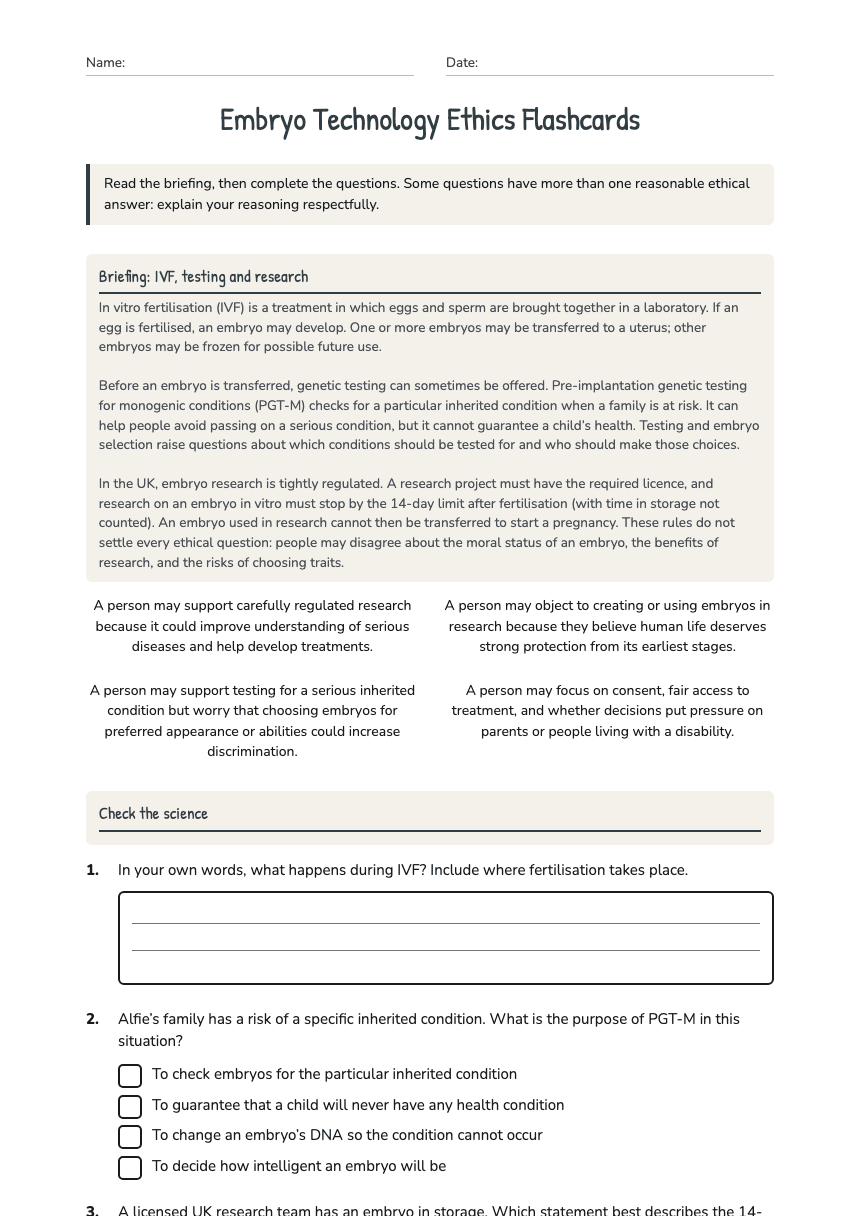
Embryo Technology Ethics Flashcards
A free science worksheet ready for your classroom. Open in Kuraplan to grab the print-ready PDF, customize it for your students, or generate a fresh version in seconds.
Embryo Technology Ethics Flashcards
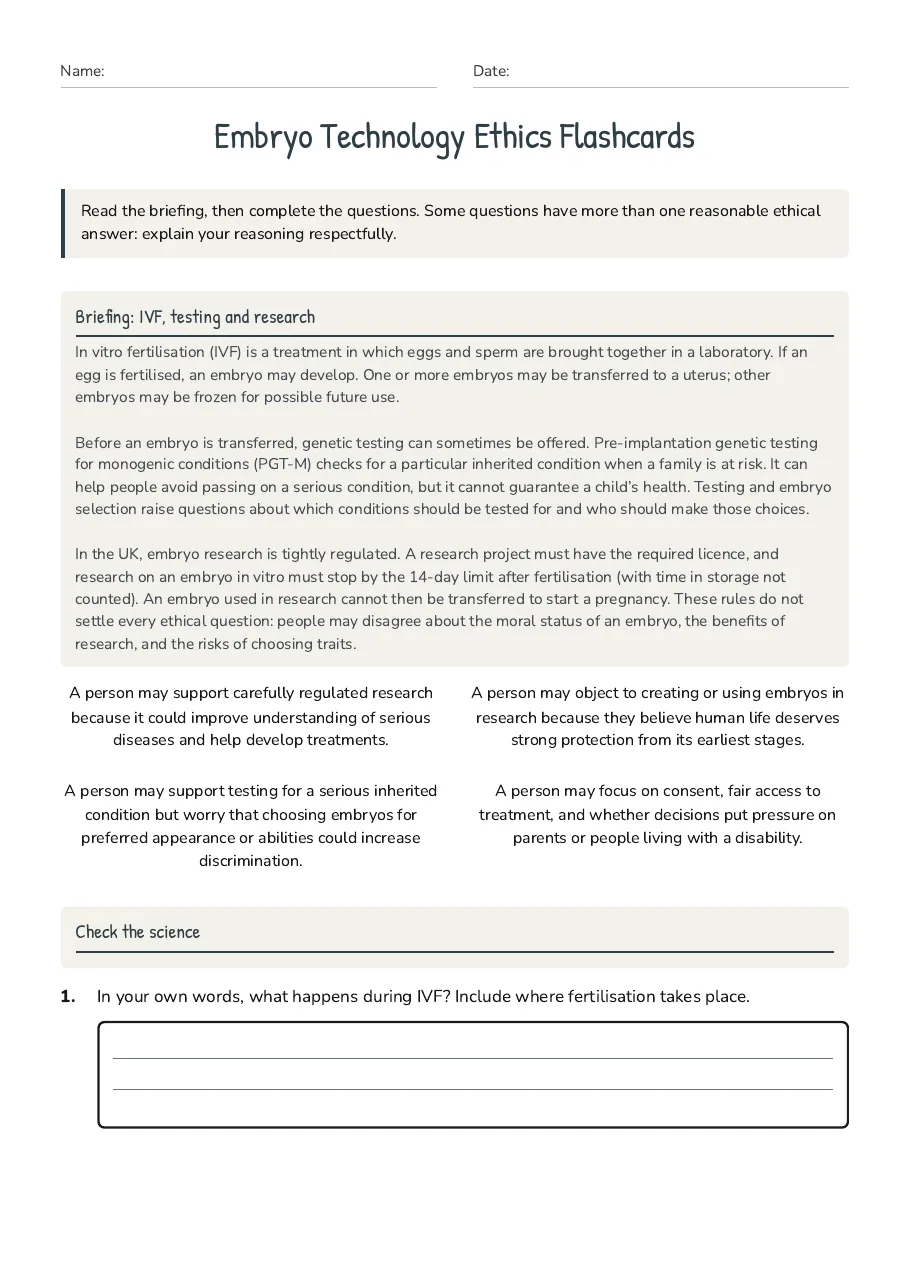
Briefing: IVF, testing and research
In vitro fertilisation (IVF) is a treatment in which eggs and sperm are brought together in a laboratory. If an egg is fertilised, an embryo may develop. One or more embryos may be transferred to a uterus; other embryos may be frozen for possible future use. Before an embryo is transferred, genetic testing can sometimes be offered. Pre-implantation genetic testing for monogenic conditions (PGT-M) checks for a particular inherited condition when a family is at risk. It can help people avoid passing on a serious condition, but it cannot guarantee a child’s health. Testing and embryo selection raise questions about which conditions should be tested for and who should make those choices. In the UK, embryo research is tightly regulated. A research project must have the required licence, and research on an embryo in vitro must stop by the 14-day limit after fertilisation (with time in storage not counted). An embryo used in research cannot then be transferred to start a pregnancy. These rules do not settle every ethical question: people may disagree about the moral status of an embryo, the benefits of research, and the risks of choosing traits.
A person may support carefully regulated research because it could improve understanding of serious diseases and help develop treatments.
A person may object to creating or using embryos in research because they believe human life deserves strong protection from its earliest stages.
A person may support testing for a serious inherited condition but worry that choosing embryos for preferred appearance or abilities could increase discrimination.
A person may focus on consent, fair access to treatment, and whether decisions put pressure on parents or people living with a disability.
Check the science
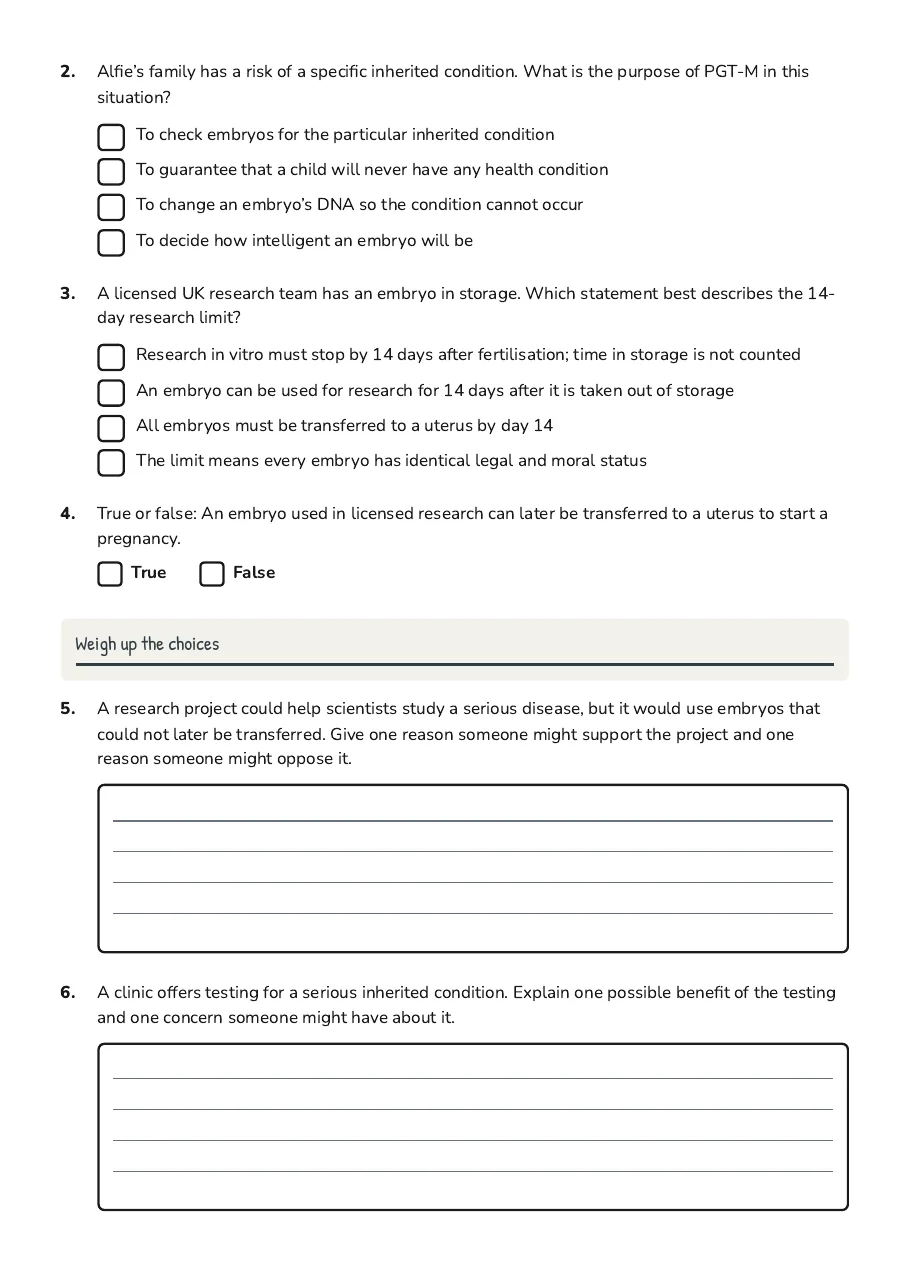
- To check embryos for the particular inherited condition
- To guarantee that a child will never have any health condition
- To change an embryo’s DNA so the condition cannot occur
- To decide how intelligent an embryo will be
- Research in vitro must stop by 14 days after fertilisation; time in storage is not counted
- An embryo can be used for research for 14 days after it is taken out of storage
- All embryos must be transferred to a uterus by day 14
- The limit means every embryo has identical legal and moral status
Weigh up the choices
3 printable pages
Page 1
Page 2
Page 3
About This Worksheet
Free in Kuraplan
Sign up free, grab the PDF, and customize it for your class.
Print-Ready
Formatted for standard paper. Clean layout, easy to read.
AI-Generated
Created with Kuraplan's AI, designed for real classroom use.
For Teachers & Parents
Use in classrooms, for homework, tutoring, or homeschool.
Need a custom version of this worksheet?
Kuraplan's AI generates custom worksheets in seconds — differentiated for every learner, aligned to your curriculum.
Generate Custom Worksheets — Free