Transport in Living Organisms
A free science worksheet ready for your classroom. Open in Kuraplan to grab the print-ready PDF, customize it for your students, or generate a fresh version in seconds.
Transport in Living Organisms
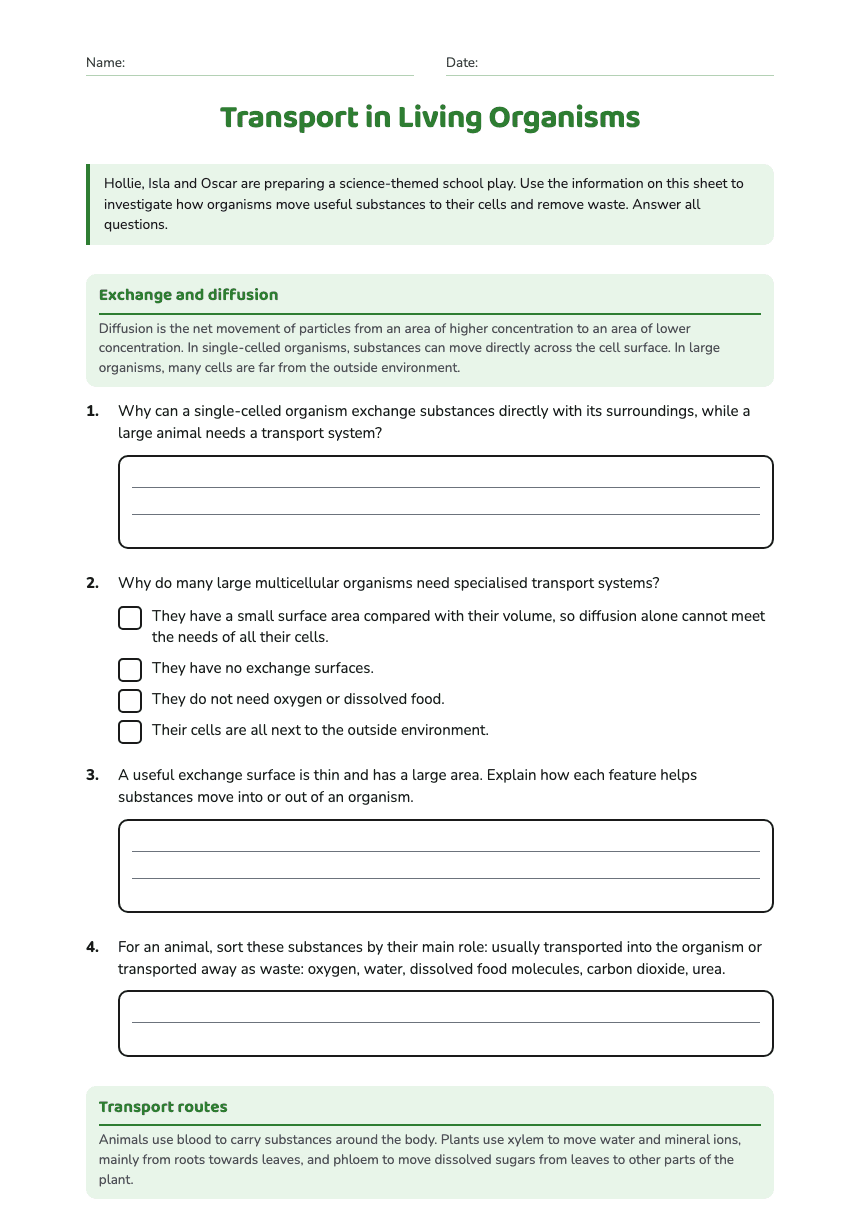
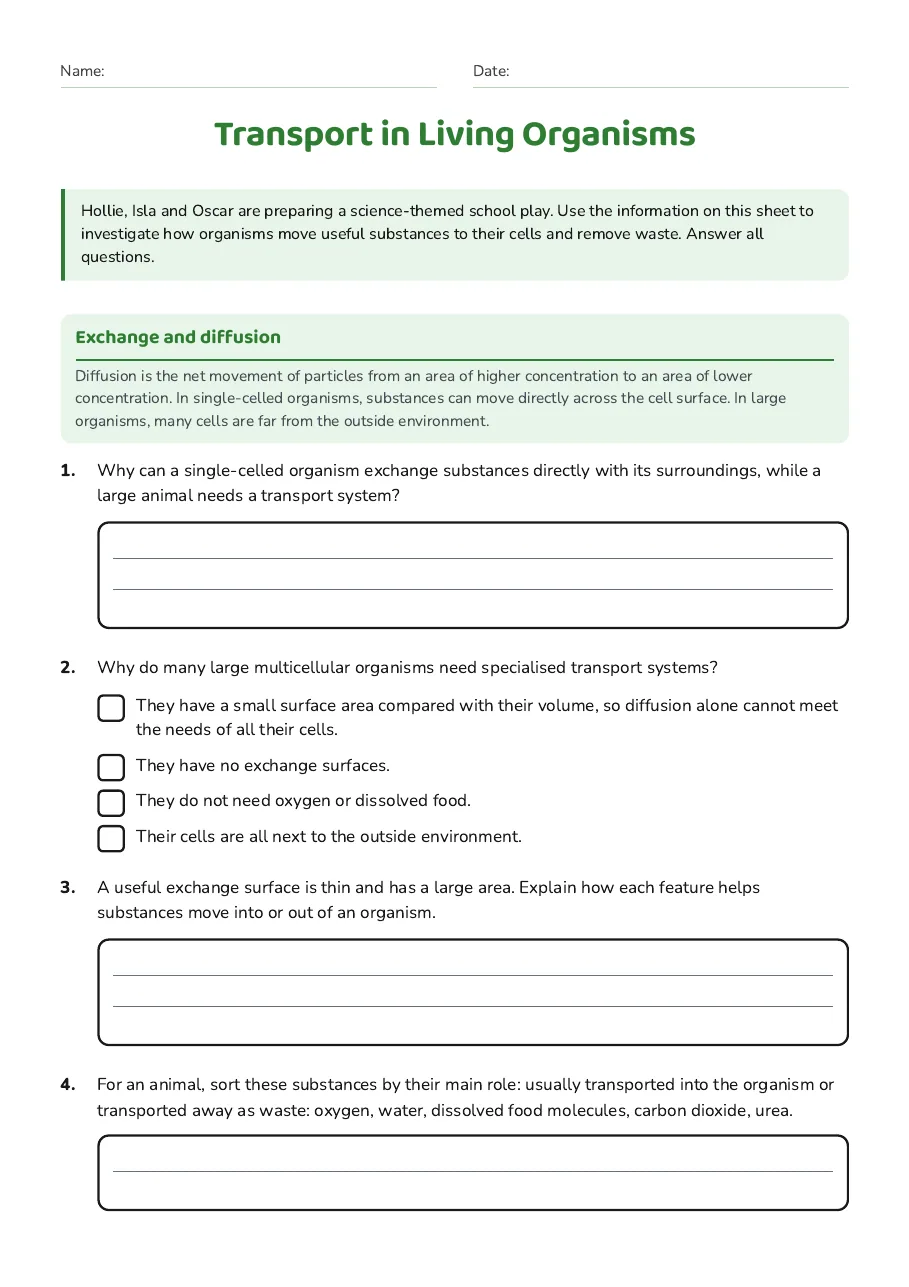
Exchange and diffusion
Diffusion is the net movement of particles from an area of higher concentration to an area of lower concentration. In single-celled organisms, substances can move directly across the cell surface. In large organisms, many cells are far from the outside environment.
- They have a small surface area compared with their volume, so diffusion alone cannot meet the needs of all their cells.
- They have no exchange surfaces.
- They do not need oxygen or dissolved food.
- Their cells are all next to the outside environment.
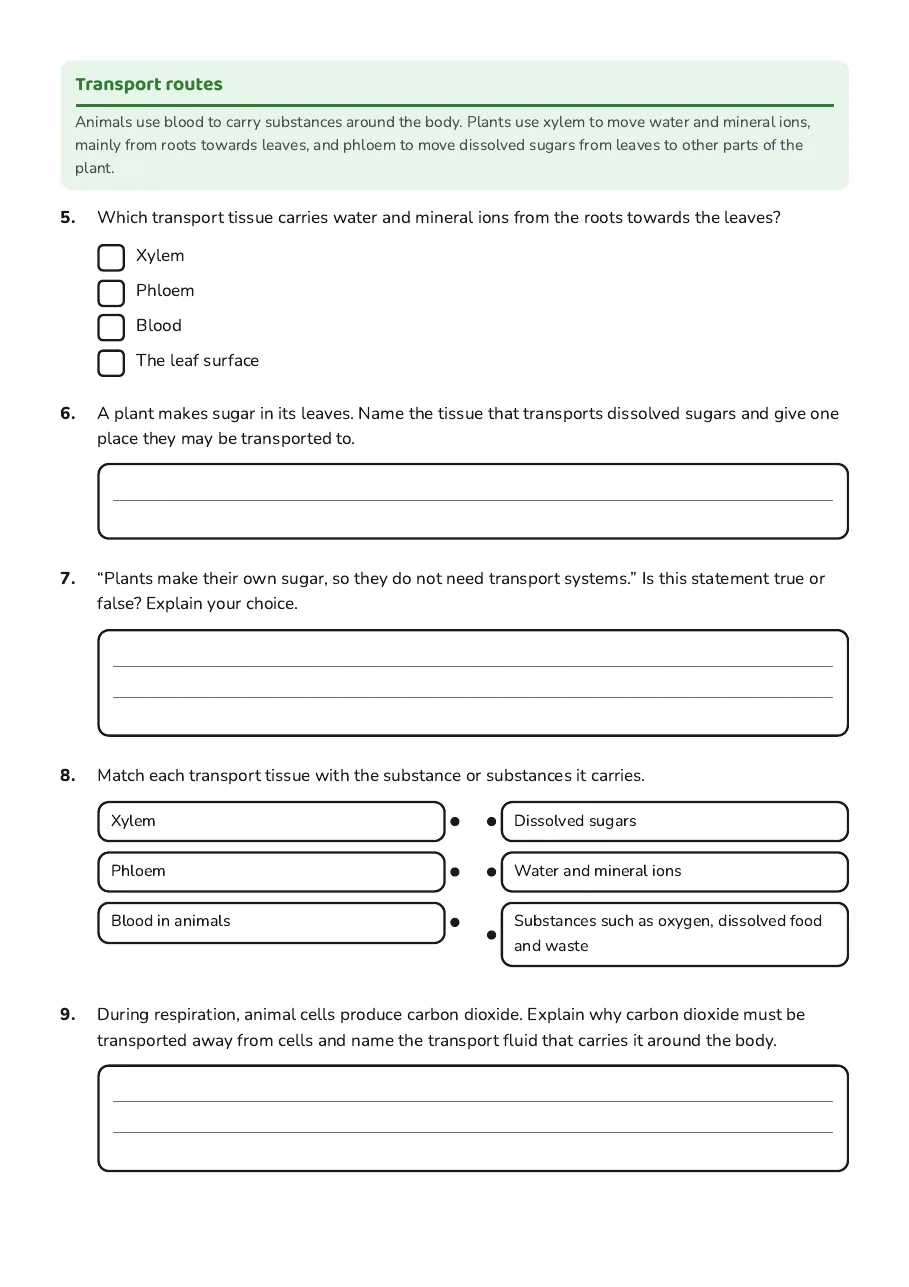
Transport routes
Animals use blood to carry substances around the body. Plants use xylem to move water and mineral ions, mainly from roots towards leaves, and phloem to move dissolved sugars from leaves to other parts of the plant.
- Xylem
- Phloem
- Blood
- The leaf surface
- Xylem
- Phloem
- Blood in animals
- Dissolved sugars
- Water and mineral ions
- Substances such as oxygen, dissolved food and waste
2 printable pages
Page 1
Page 2
About This Worksheet
Free in Kuraplan
Sign up free, grab the PDF, and customize it for your class.
Print-Ready
Formatted for standard paper. Clean layout, easy to read.
AI-Generated
Created with Kuraplan's AI, designed for real classroom use.
For Teachers & Parents
Use in classrooms, for homework, tutoring, or homeschool.
Need a custom version of this worksheet?
Kuraplan's AI generates custom worksheets in seconds — differentiated for every learner, aligned to your curriculum.
Generate Custom Worksheets — Free