ScienceFreePrintable
Understanding Endangerment in Animals
A free science worksheet ready for your classroom. Open in Kuraplan to grab the print-ready PDF, customize it for your students, or generate a fresh version in seconds.
Name:Date:
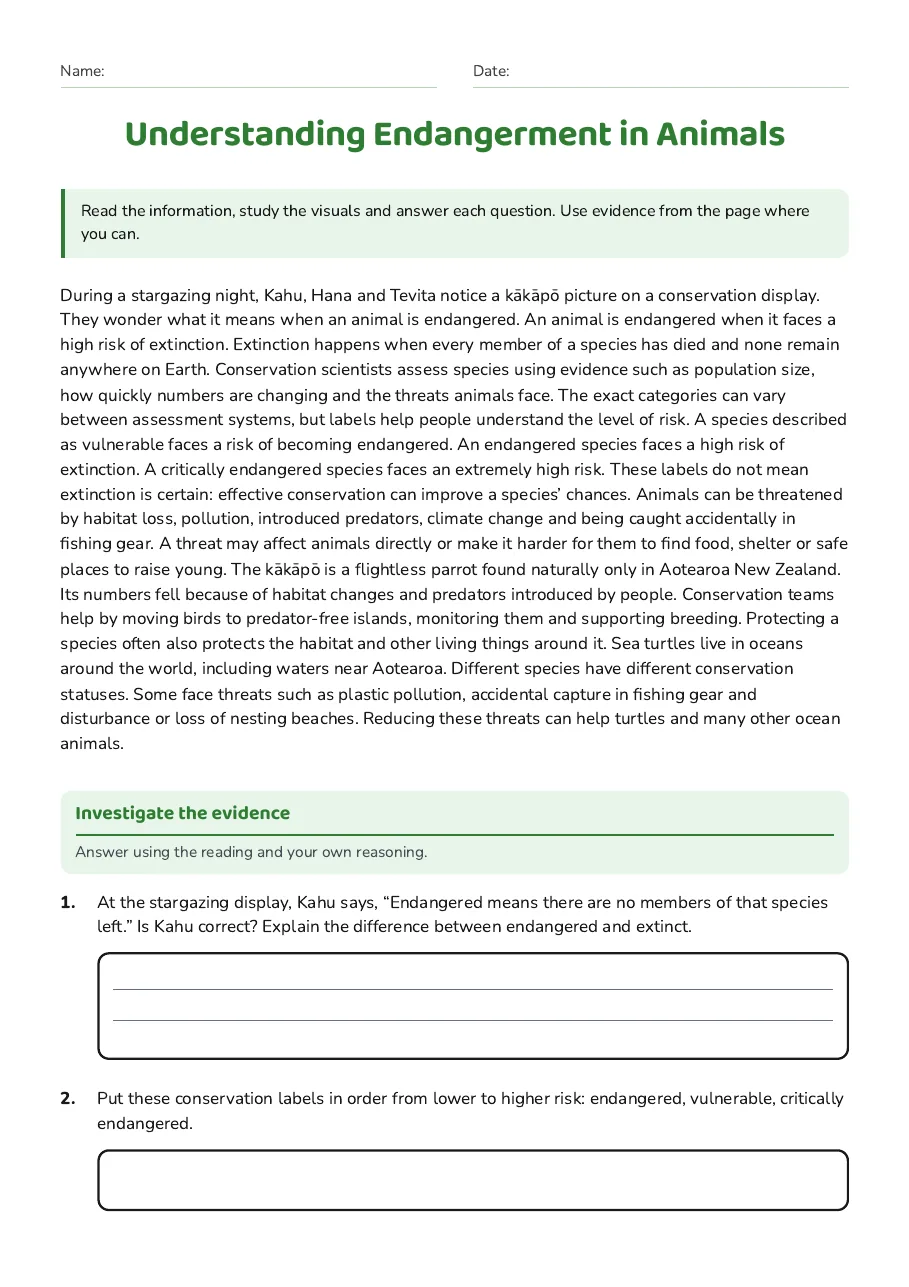
Understanding Endangerment in Animals
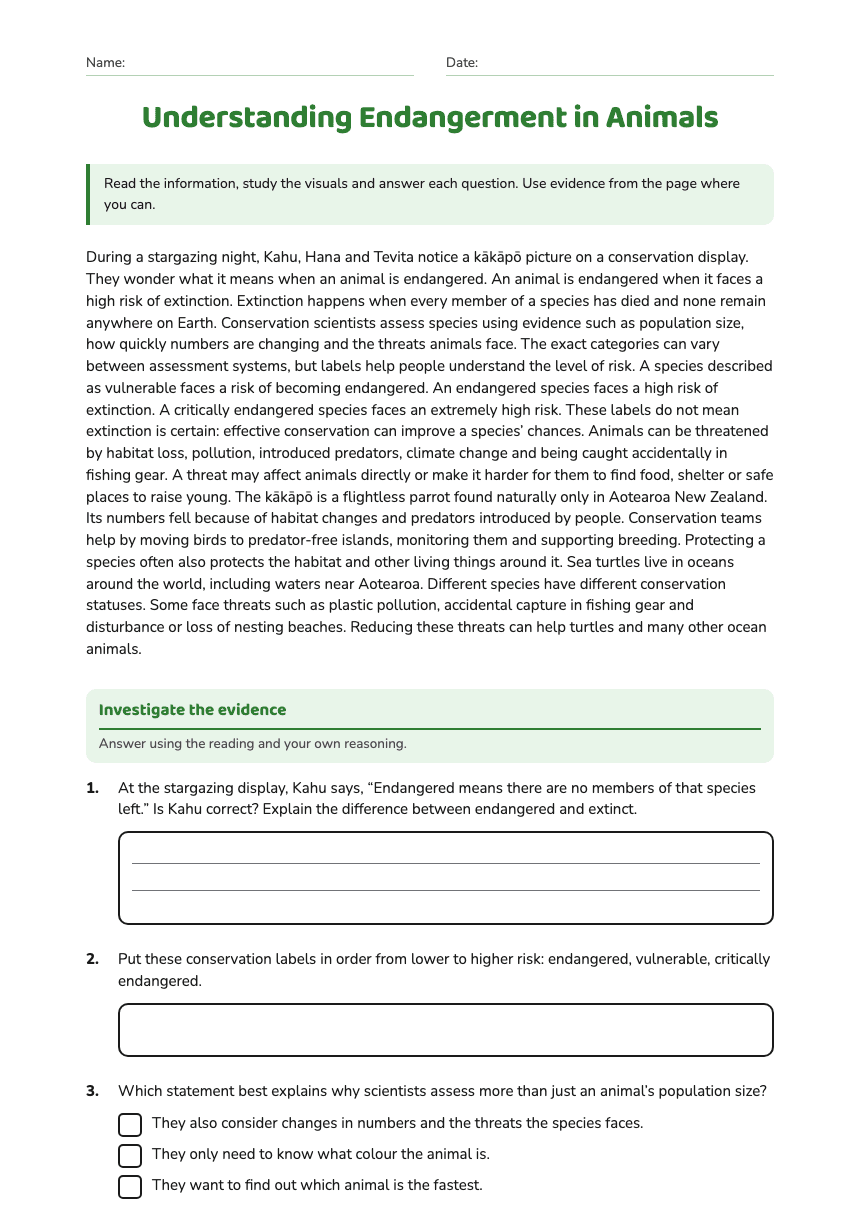
Read the information, study the visuals and answer each question. Use evidence from the page where you can.
During a stargazing night, Kahu, Hana and Tevita notice a kākāpō picture on a conservation display. They wonder what it means when an animal is endangered.
An animal is endangered when it faces a high risk of extinction. Extinction happens when every member of a species has died and none remain anywhere on Earth. Conservation scientists assess species using evidence such as population size, how quickly numbers are changing and the threats animals face. The exact categories can vary between assessment systems, but labels help people understand the level of risk.
A species described as vulnerable faces a risk of becoming endangered. An endangered species faces a high risk of extinction. A critically endangered species faces an extremely high risk. These labels do not mean extinction is certain: effective conservation can improve a species’ chances.
Animals can be threatened by habitat loss, pollution, introduced predators, climate change and being caught accidentally in fishing gear. A threat may affect animals directly or make it harder for them to find food, shelter or safe places to raise young.
The kākāpō is a flightless parrot found naturally only in Aotearoa New Zealand. Its numbers fell because of habitat changes and predators introduced by people. Conservation teams help by moving birds to predator-free islands, monitoring them and supporting breeding. Protecting a species often also protects the habitat and other living things around it.
Sea turtles live in oceans around the world, including waters near Aotearoa. Different species have different conservation statuses. Some face threats such as plastic pollution, accidental capture in fishing gear and disturbance or loss of nesting beaches. Reducing these threats can help turtles and many other ocean animals.
Investigate the evidence
Answer using the reading and your own reasoning.
1.At the stargazing display, Kahu says, “Endangered means there are no members of that species left.” Is Kahu correct? Explain the difference between endangered and extinct.
2.Put these conservation labels in order from lower to higher risk: endangered, vulnerable, critically endangered.
3.Which statement best explains why scientists assess more than just an animal’s population size?
- They also consider changes in numbers and the threats the species faces.
- They only need to know what colour the animal is.
- They want to find out which animal is the fastest.
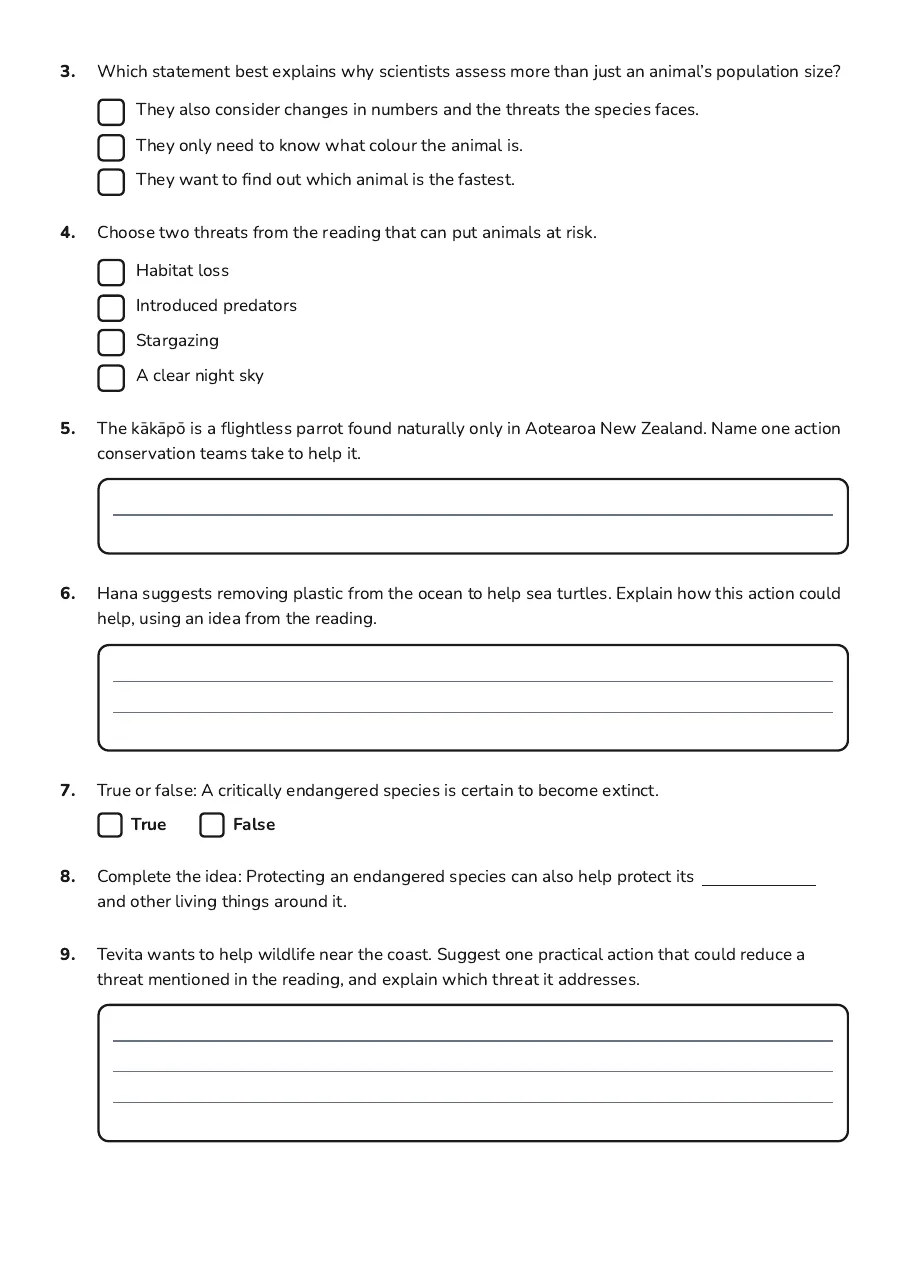
4.Choose two threats from the reading that can put animals at risk.
- Habitat loss
- Introduced predators
- Stargazing
- A clear night sky
5.The kākāpō is a flightless parrot found naturally only in Aotearoa New Zealand. Name one action conservation teams take to help it.
6.Hana suggests removing plastic from the ocean to help sea turtles. Explain how this action could help, using an idea from the reading.
7.True or false: A critically endangered species is certain to become extinct.
TrueFalse
8.Complete the idea: Protecting an endangered species can also help protect its and other living things around it.
9.Tevita wants to help wildlife near the coast. Suggest one practical action that could reduce a threat mentioned in the reading, and explain which threat it addresses.
2 printable pages
Page 1
Page 2
About This Worksheet
Free in Kuraplan
Sign up free, grab the PDF, and customize it for your class.
Print-Ready
Formatted for standard paper. Clean layout, easy to read.
AI-Generated
Created with Kuraplan's AI, designed for real classroom use.
For Teachers & Parents
Use in classrooms, for homework, tutoring, or homeschool.
Need a custom version of this worksheet?
Kuraplan's AI generates custom worksheets in seconds — differentiated for every learner, aligned to your curriculum.
Generate Custom Worksheets — Free No credit card Curriculum-aligned Under 60 seconds