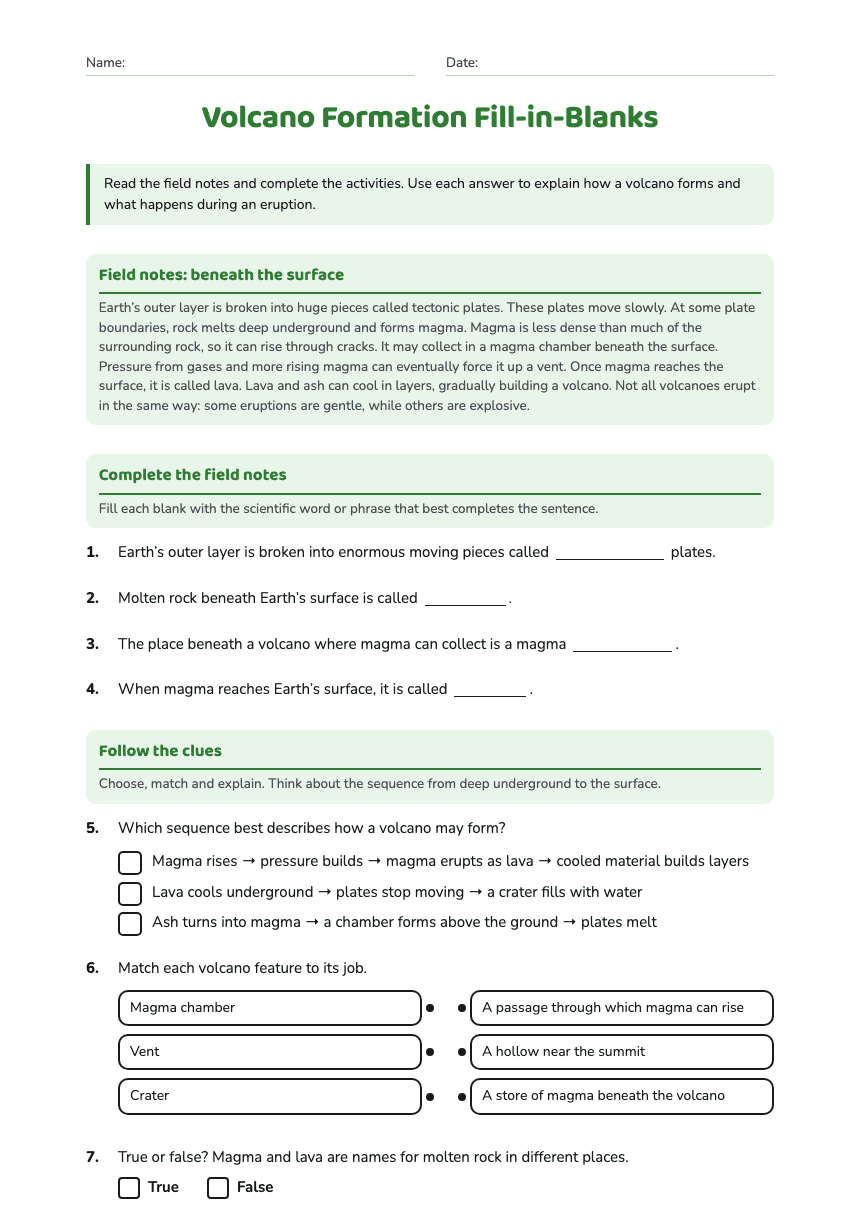
Volcano Formation Fill-in-Blanks
A free science worksheet ready for your classroom. Open in Kuraplan to grab the print-ready PDF, customize it for your students, or generate a fresh version in seconds.
Volcano Formation Fill-in-Blanks
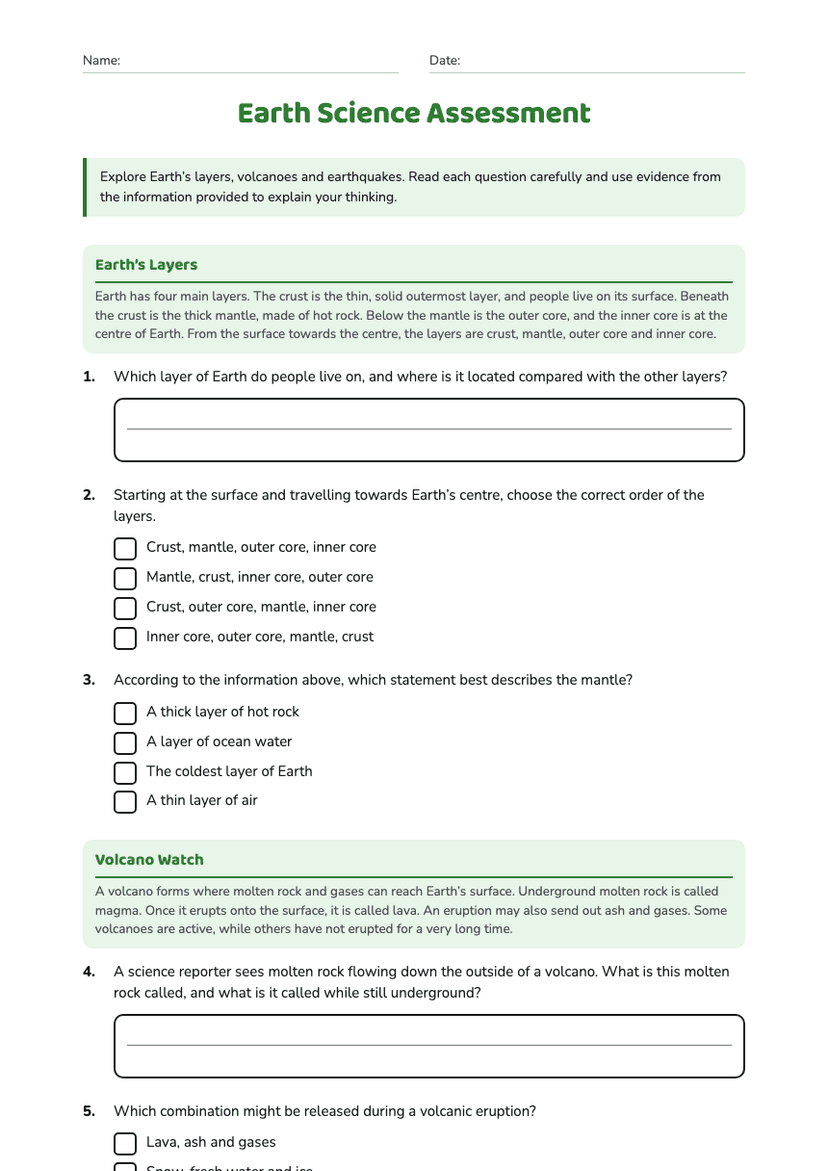
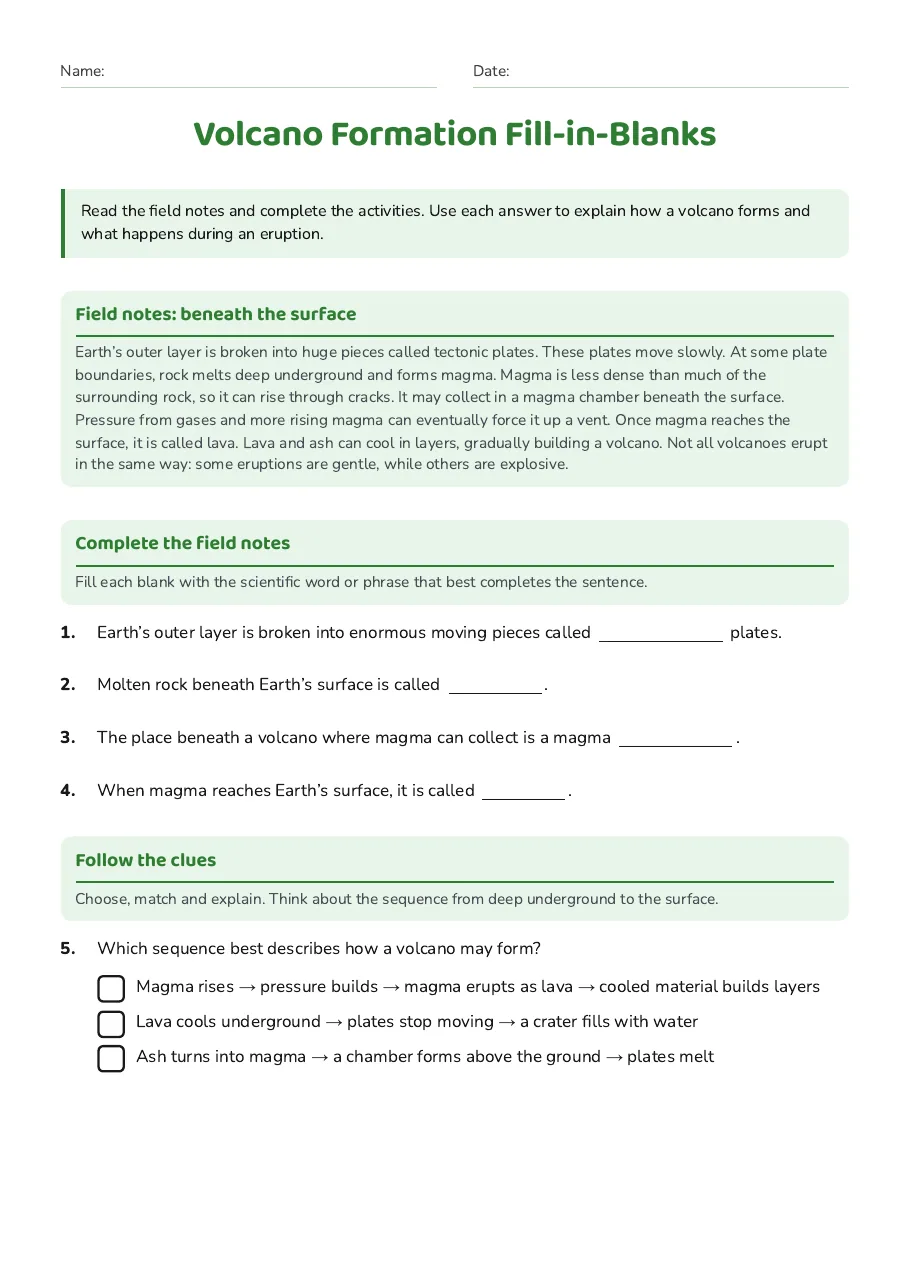
Field notes: beneath the surface
Earth’s outer layer is broken into huge pieces called tectonic plates. These plates move slowly. At some plate boundaries, rock melts deep underground and forms magma. Magma is less dense than much of the surrounding rock, so it can rise through cracks. It may collect in a magma chamber beneath the surface. Pressure from gases and more rising magma can eventually force it up a vent. Once magma reaches the surface, it is called lava. Lava and ash can cool in layers, gradually building a volcano. Not all volcanoes erupt in the same way: some eruptions are gentle, while others are explosive.
Complete the field notes
Fill each blank with the scientific word or phrase that best completes the sentence.
Follow the clues
Choose, match and explain. Think about the sequence from deep underground to the surface.
- Magma rises → pressure builds → magma erupts as lava → cooled material builds layers
- Lava cools underground → plates stop moving → a crater fills with water
- Ash turns into magma → a chamber forms above the ground → plates melt
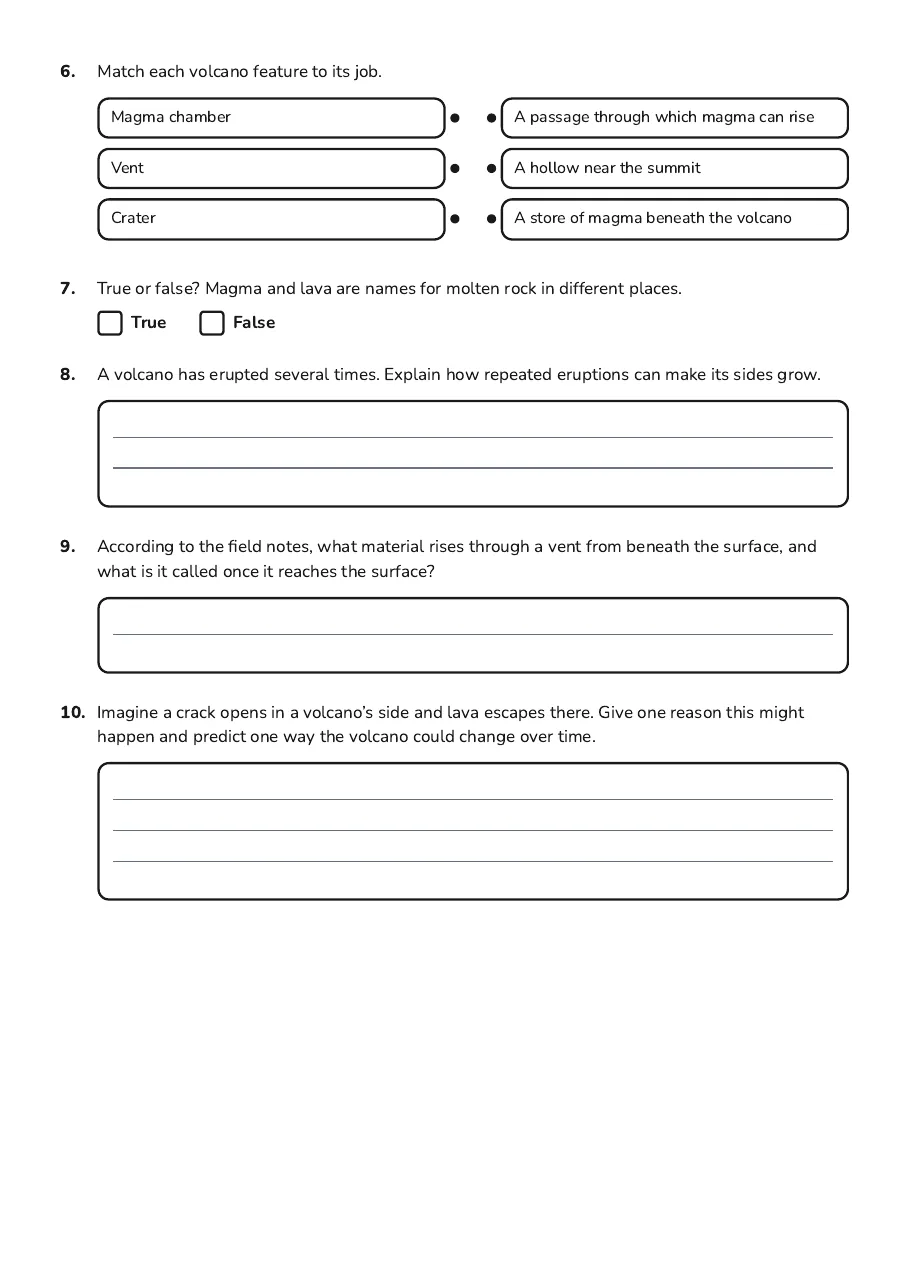
- Magma chamber
- Vent
- Crater
- A passage through which magma can rise
- A hollow near the summit
- A store of magma beneath the volcano
2 printable pages
Page 1
Page 2
About This Worksheet
Free in Kuraplan
Sign up free, grab the PDF, and customize it for your class.
Print-Ready
Formatted for standard paper. Clean layout, easy to read.
AI-Generated
Created with Kuraplan's AI, designed for real classroom use.
For Teachers & Parents
Use in classrooms, for homework, tutoring, or homeschool.
Need a custom version of this worksheet?
Kuraplan's AI generates custom worksheets in seconds — differentiated for every learner, aligned to your curriculum.
Generate Custom Worksheets — Free