EnglishFreePrintable

War Poetry Imagery Analysis

A free english worksheet ready for your classroom. Open in Kuraplan to grab the print-ready PDF, customize it for your students, or generate a fresh version in seconds.
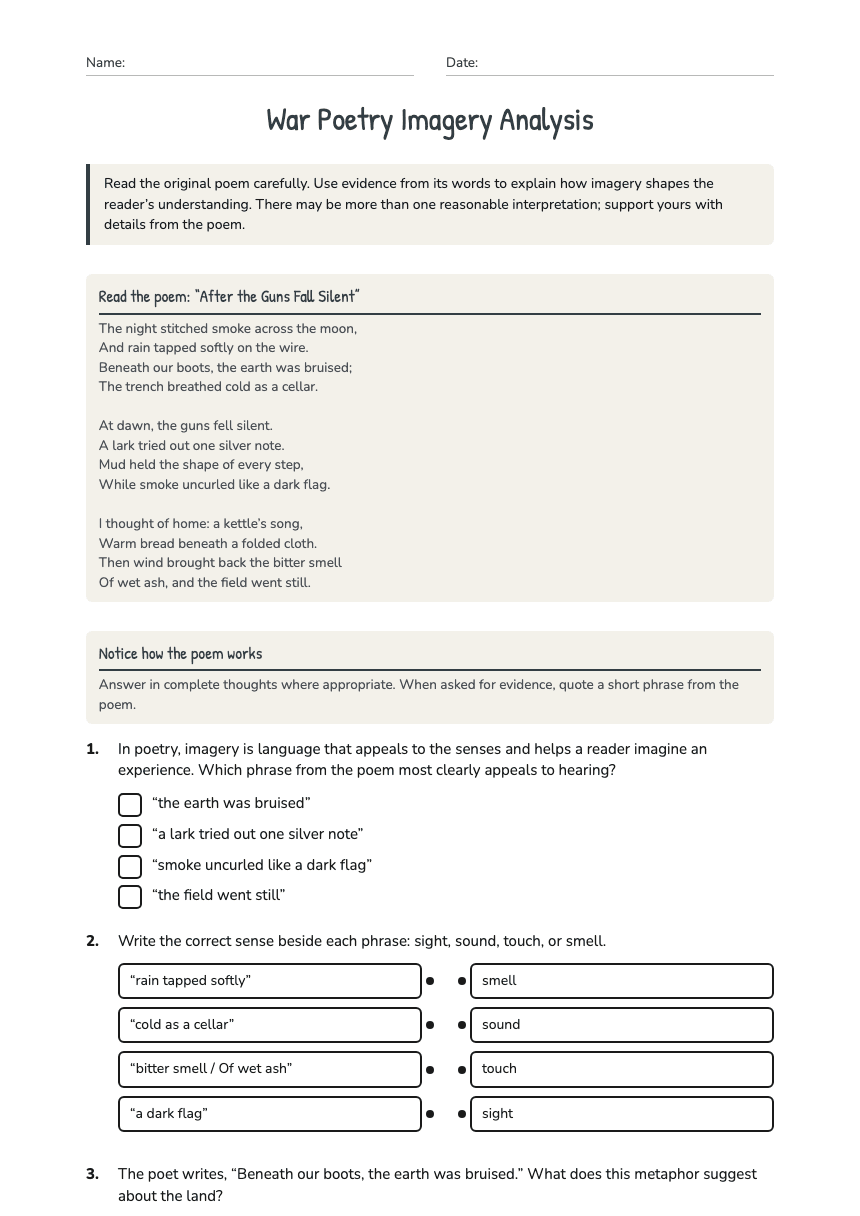
War Poetry Imagery Analysis worksheet preview
Name:Date:

War Poetry Imagery Analysis

Read the original poem carefully. Use evidence from its words to explain how imagery shapes the reader’s understanding. There may be more than one reasonable interpretation; support yours with details from the poem.

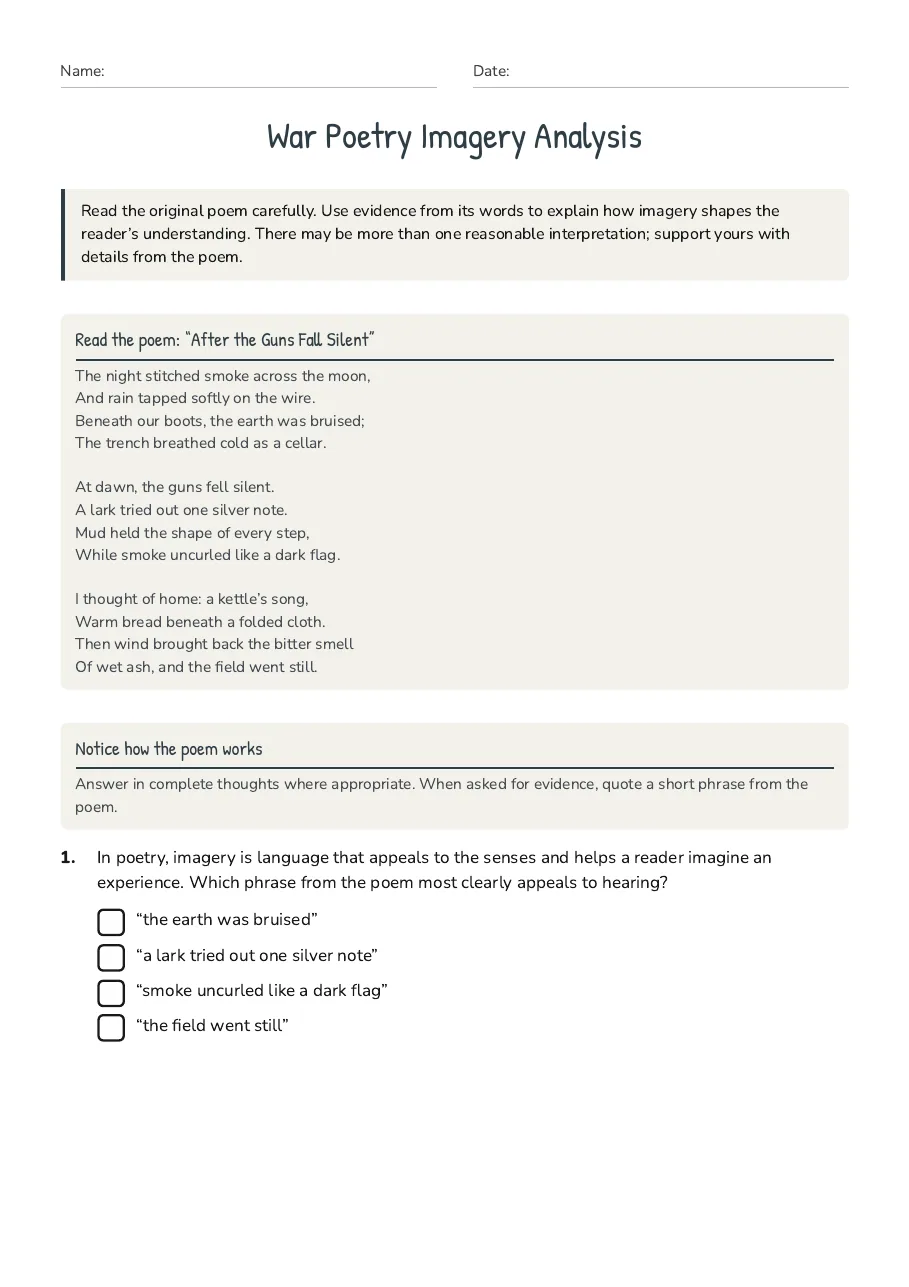
Read the poem: “After the Guns Fall Silent”

The night stitched smoke across the moon, And rain tapped softly on the wire. Beneath our boots, the earth was bruised; The trench breathed cold as a cellar. At dawn, the guns fell silent. A lark tried out one silver note. Mud held the shape of every step, While smoke uncurled like a dark flag. I thought of home: a kettle’s song, Warm bread beneath a folded cloth. Then wind brought back the bitter smell Of wet ash, and the field went still.

Notice how the poem works

Answer in complete thoughts where appropriate. When asked for evidence, quote a short phrase from the poem.

1.In poetry, imagery is language that appeals to the senses and helps a reader imagine an experience. Which phrase from the poem most clearly appeals to hearing?
  • “the earth was bruised”
  • “a lark tried out one silver note”
  • “smoke uncurled like a dark flag”
  • “the field went still”
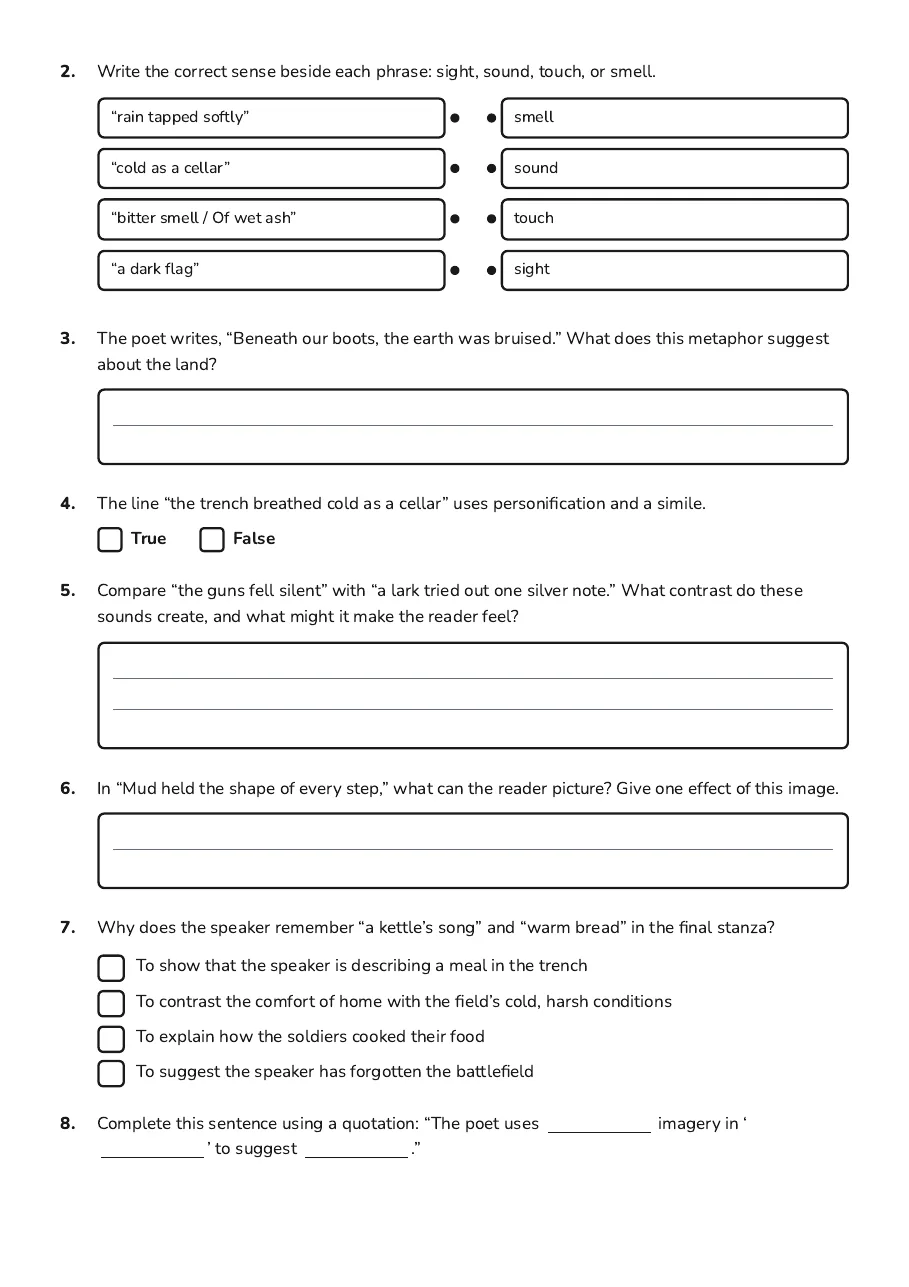
2.Write the correct sense beside each phrase: sight, sound, touch, or smell.
  • “rain tapped softly”
  • “cold as a cellar”
  • “bitter smell / Of wet ash”
  • “a dark flag”
  • smell
  • sound
  • touch
  • sight
3.The poet writes, “Beneath our boots, the earth was bruised.” What does this metaphor suggest about the land?
4.The line “the trench breathed cold as a cellar” uses personification and a simile.
TrueFalse
5.Compare “the guns fell silent” with “a lark tried out one silver note.” What contrast do these sounds create, and what might it make the reader feel?
6.In “Mud held the shape of every step,” what can the reader picture? Give one effect of this image.
7.Why does the speaker remember “a kettle’s song” and “warm bread” in the final stanza?
  • To show that the speaker is describing a meal in the trench
  • To contrast the comfort of home with the field’s cold, harsh conditions
  • To explain how the soldiers cooked their food
  • To suggest the speaker has forgotten the battlefield
8.Complete this sentence using a quotation: “The poet uses imagery in ‘’ to suggest .”
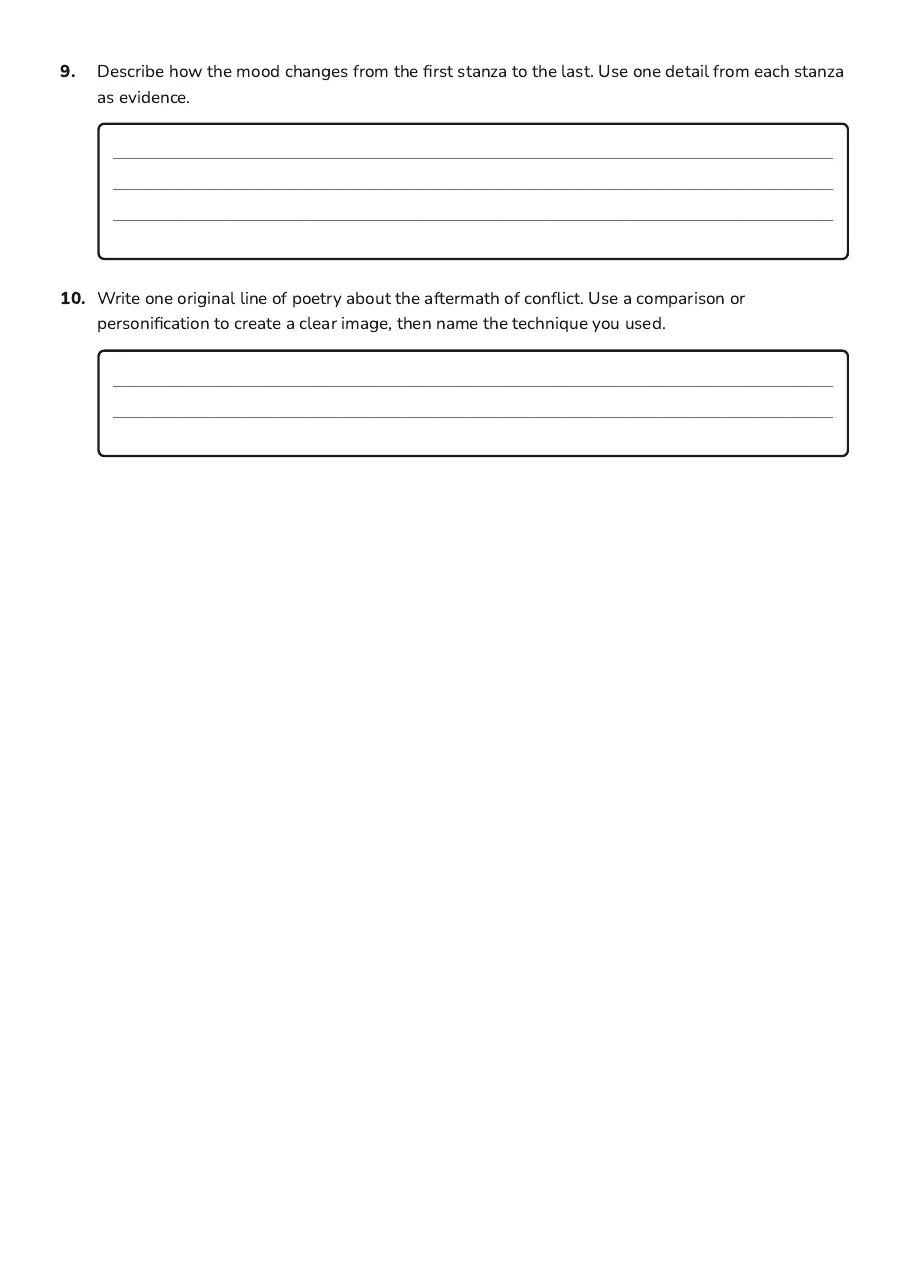
9.Describe how the mood changes from the first stanza to the last. Use one detail from each stanza as evidence.
10.Write one original line of poetry about the aftermath of conflict. Use a comparison or personification to create a clear image, then name the technique you used.

3 printable pages

  • War Poetry Imagery Analysis, page 1 of 3: Read the poem: “After the Guns Fall Silent”, Notice how the poem works

    Page 1

  • War Poetry Imagery Analysis, page 2 of 3: 2. Write the correct sense beside each phrase: sight, sound, touch, or smell.

    Page 2

  • War Poetry Imagery Analysis, page 3 of 3: 9. Describe how the mood changes from the first stanza to the last. Use one detail from…

    Page 3

About This Worksheet

Free in Kuraplan

Sign up free, grab the PDF, and customize it for your class.

Print-Ready

Formatted for standard paper. Clean layout, easy to read.

AI-Generated

Created with Kuraplan's AI, designed for real classroom use.

For Teachers & Parents

Use in classrooms, for homework, tutoring, or homeschool.

Need a custom version of this worksheet?

Kuraplan's AI generates custom worksheets in seconds — differentiated for every learner, aligned to your curriculum.

Generate Custom Worksheets — Free
No credit card Curriculum-aligned Under 60 seconds