Te Reo MāoriFreePrintable

Whakarongo Assessment Rubric Worksheet

A free te reo māori worksheet ready for your classroom. Open in Kuraplan to grab the print-ready PDF, customize it for your students, or generate a fresh version in seconds.
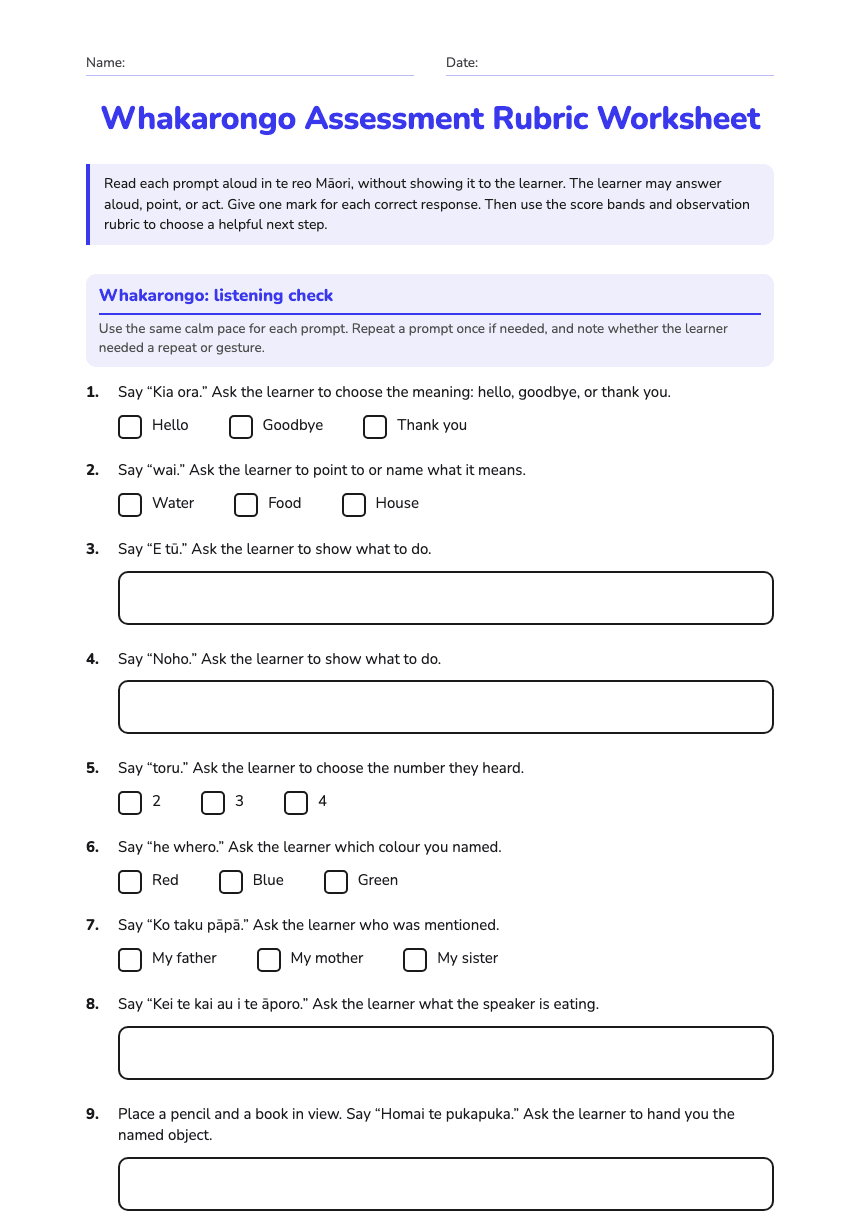
Whakarongo Assessment Rubric Worksheet worksheet preview
Name:Date:

Whakarongo Assessment Rubric Worksheet

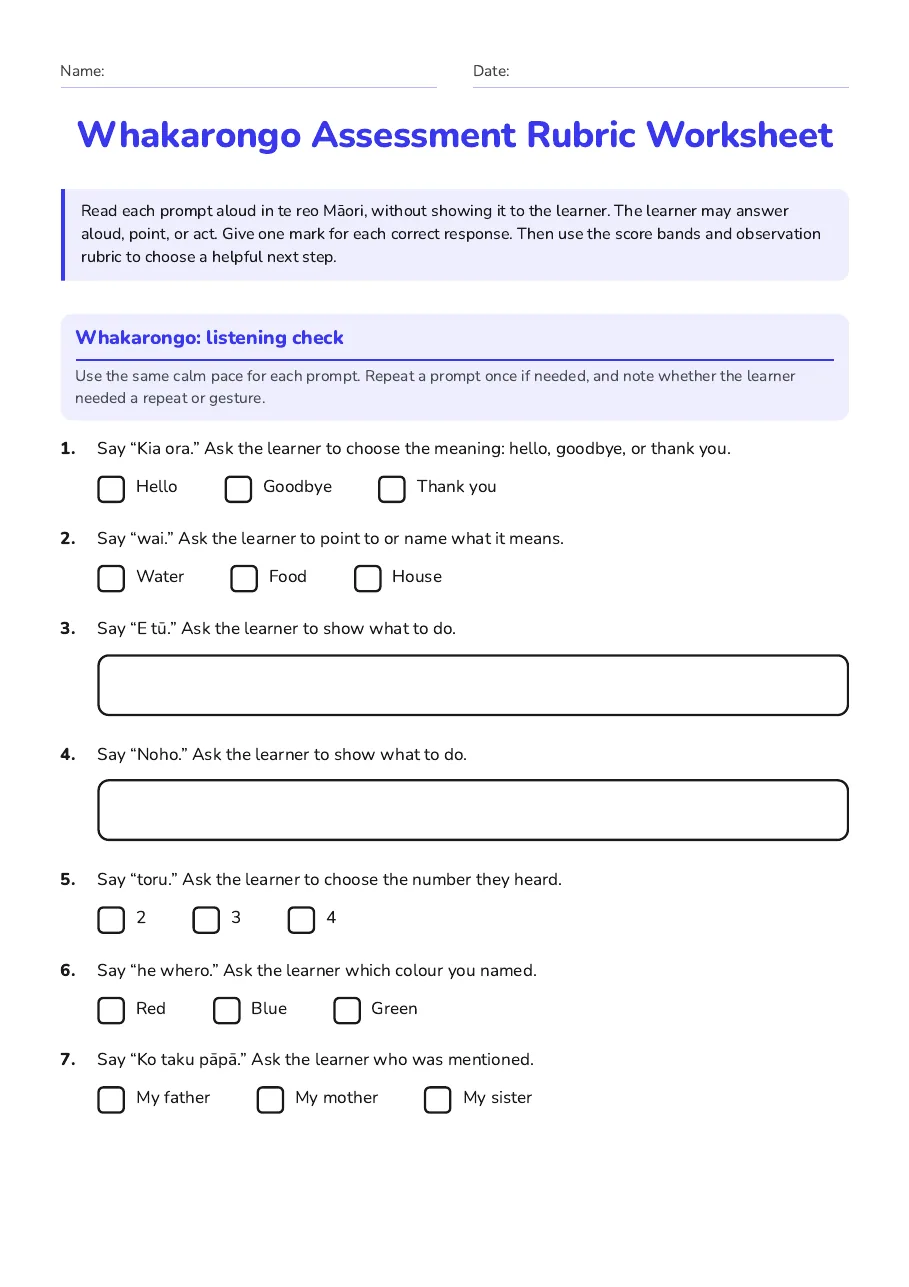
Read each prompt aloud in te reo Māori, without showing it to the learner. The learner may answer aloud, point, or act. Give one mark for each correct response. Then use the score bands and observation rubric to choose a helpful next step.

Whakarongo: listening check

Use the same calm pace for each prompt. Repeat a prompt once if needed, and note whether the learner needed a repeat or gesture.

1.Say “Kia ora.” Ask the learner to choose the meaning: hello, goodbye, or thank you.
  • Hello
  • Goodbye
  • Thank you
2.Say “wai.” Ask the learner to point to or name what it means.
  • Water
  • Food
  • House
3.Say “E tū.” Ask the learner to show what to do.
4.Say “Noho.” Ask the learner to show what to do.
5.Say “toru.” Ask the learner to choose the number they heard.
  • 2
  • 3
  • 4
6.Say “he whero.” Ask the learner which colour you named.
  • Red
  • Blue
  • Green
7.Say “Ko taku pāpā.” Ask the learner who was mentioned.
  • My father
  • My mother
  • My sister
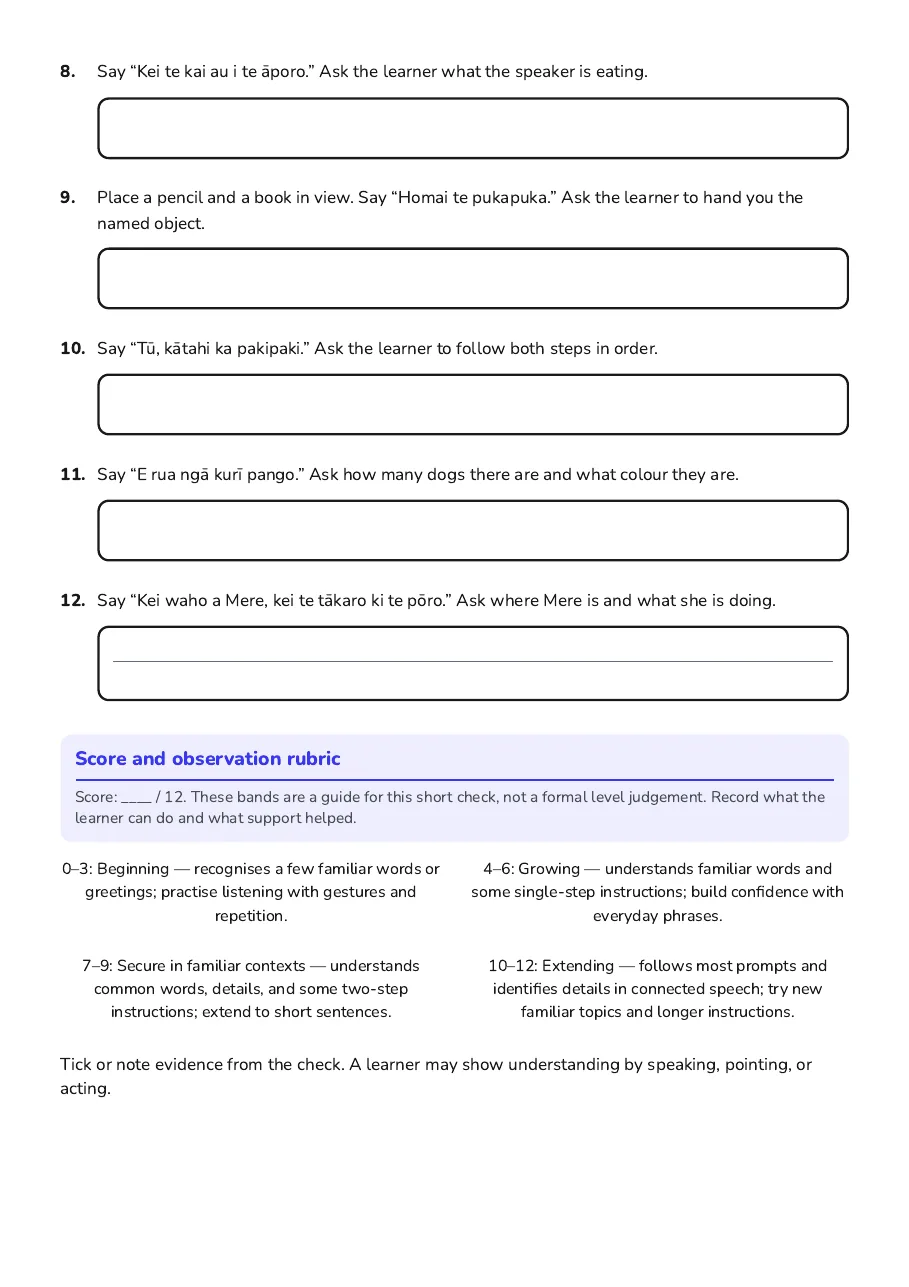
8.Say “Kei te kai au i te āporo.” Ask the learner what the speaker is eating.
9.Place a pencil and a book in view. Say “Homai te pukapuka.” Ask the learner to hand you the named object.
10.Say “Tū, kātahi ka pakipaki.” Ask the learner to follow both steps in order.
11.Say “E rua ngā kurī pango.” Ask how many dogs there are and what colour they are.
12.Say “Kei waho a Mere, kei te tākaro ki te pōro.” Ask where Mere is and what she is doing.

Score and observation rubric

Score: ____ / 12. These bands are a guide for this short check, not a formal level judgement. Record what the learner can do and what support helped.

0–3: Beginning — recognises a few familiar words or greetings; practise listening with gestures and repetition.

4–6: Growing — understands familiar words and some single-step instructions; build confidence with everyday phrases.

7–9: Secure in familiar contexts — understands common words, details, and some two-step instructions; extend to short sentences.

10–12: Extending — follows most prompts and identifies details in connected speech; try new familiar topics and longer instructions.

Tick or note evidence from the check. A learner may show understanding by speaking, pointing, or acting.
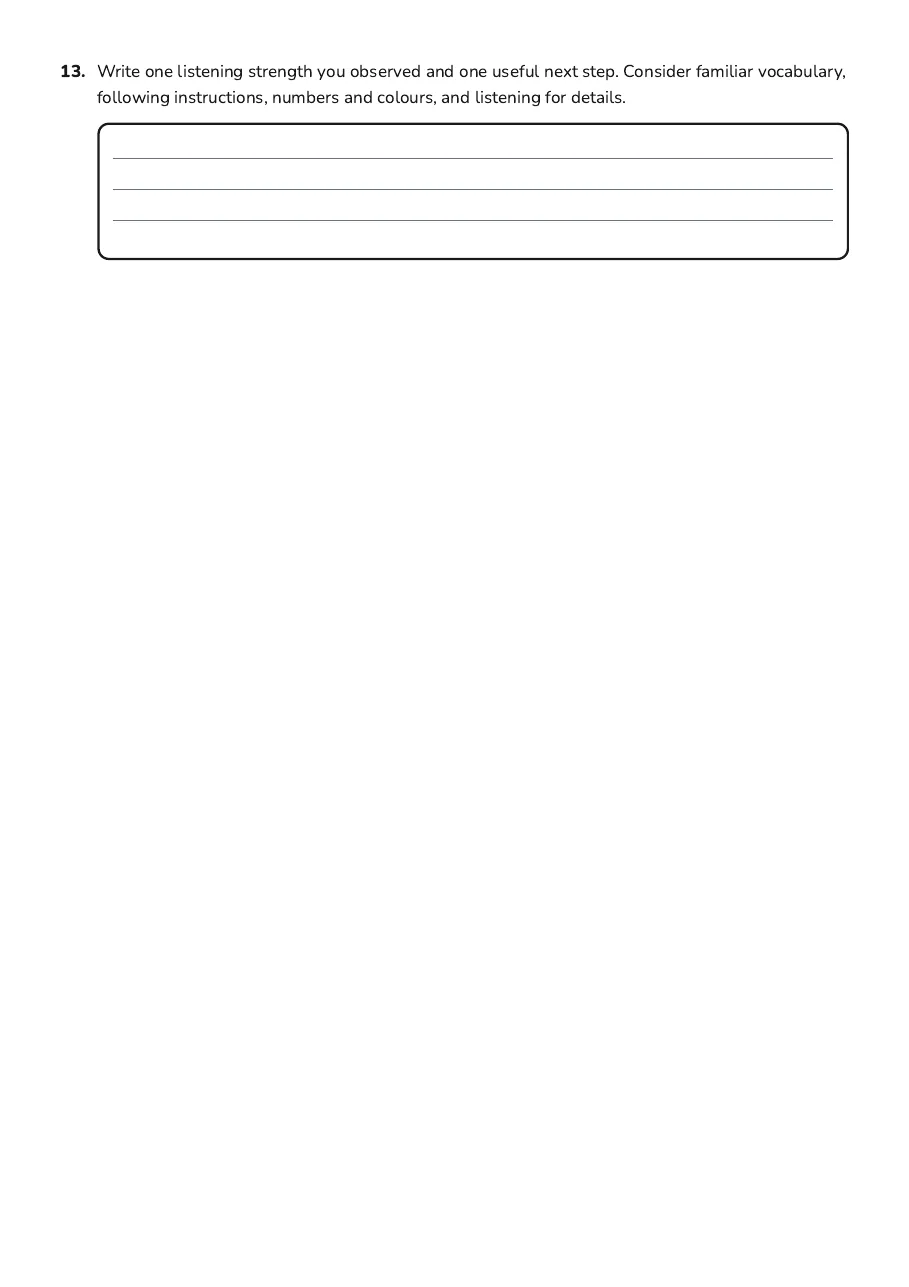
13.Write one listening strength you observed and one useful next step. Consider familiar vocabulary, following instructions, numbers and colours, and listening for details.

3 printable pages

  • Whakarongo Assessment Rubric Worksheet, page 1 of 3: Whakarongo: listening check

    Page 1

  • Whakarongo Assessment Rubric Worksheet, page 2 of 3: Score and observation rubric

    Page 2

  • Whakarongo Assessment Rubric Worksheet, page 3 of 3: 13. Write one listening strength you observed and one useful next step. Consider familiar…

    Page 3

About This Worksheet

Free in Kuraplan

Sign up free, grab the PDF, and customize it for your class.

Print-Ready

Formatted for standard paper. Clean layout, easy to read.

AI-Generated

Created with Kuraplan's AI, designed for real classroom use.

For Teachers & Parents

Use in classrooms, for homework, tutoring, or homeschool.

Need a custom version of this worksheet?

Kuraplan's AI generates custom worksheets in seconds — differentiated for every learner, aligned to your curriculum.

Generate Custom Worksheets — Free
No credit card Curriculum-aligned Under 60 seconds

Explore more free resources