Te Reo MāoriFreePrintable

Whakarongo Assessment Rubric Worksheet

A free te reo māori worksheet ready for your classroom. Open in Kuraplan to grab the print-ready PDF, customize it for your students, or generate a fresh version in seconds.
Whakarongo Assessment Rubric Worksheet worksheet preview
Name:Date:

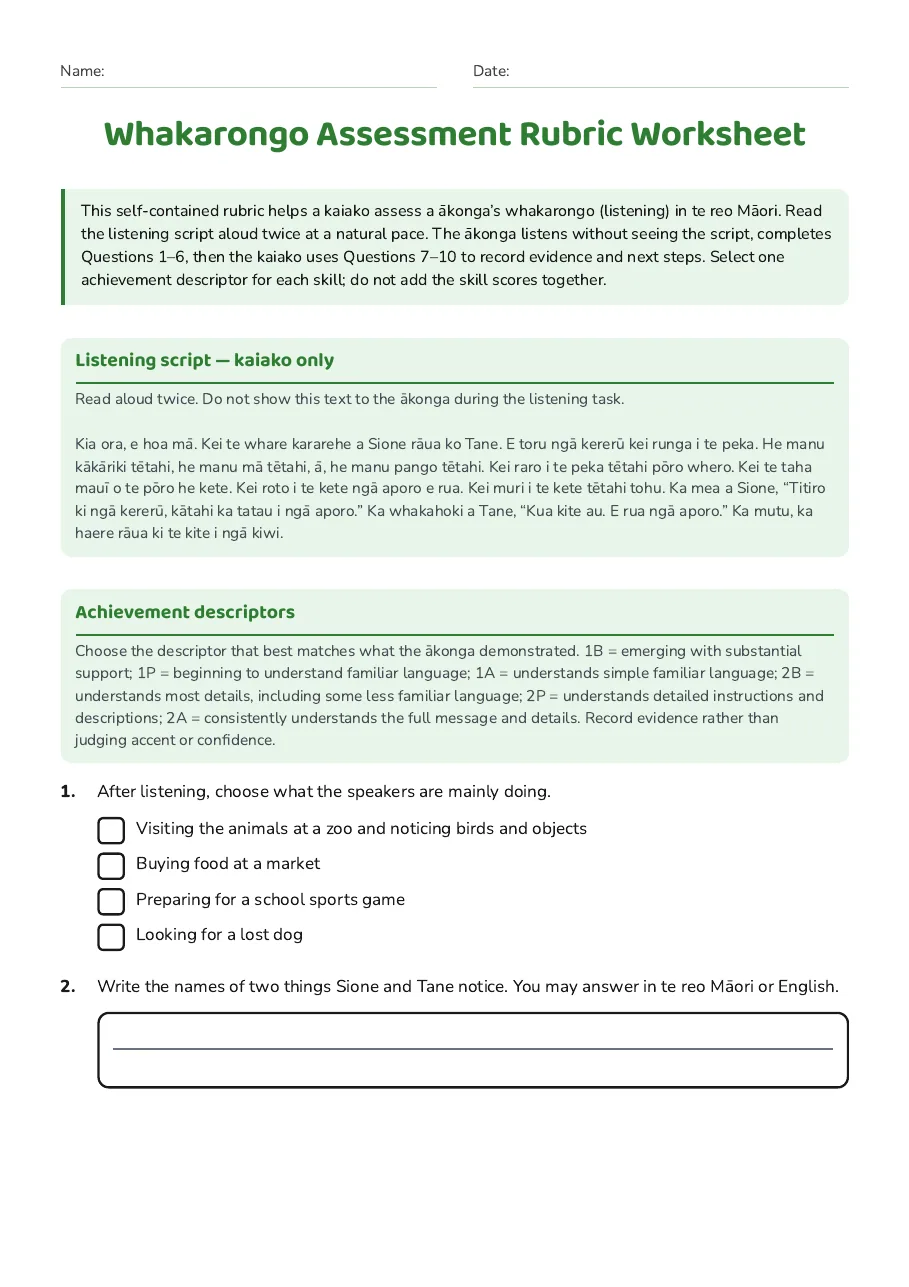
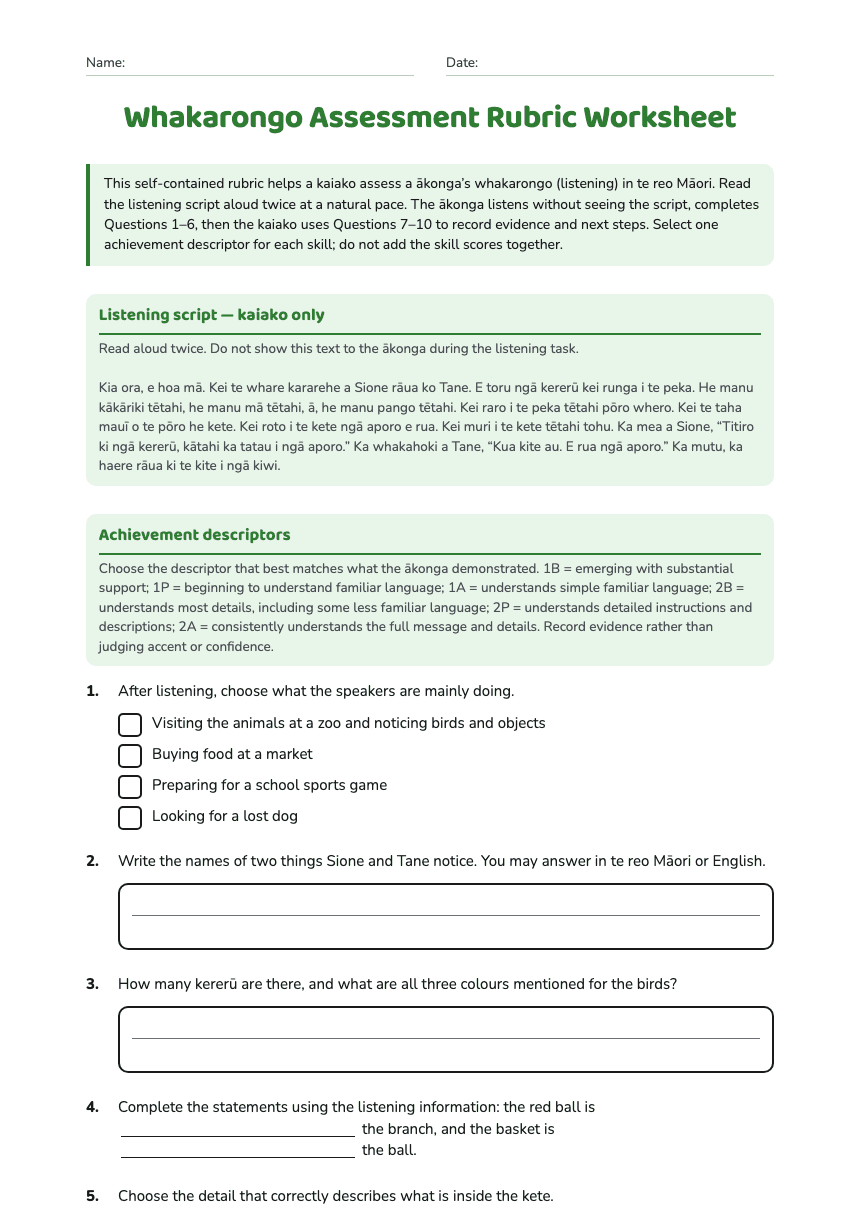
Whakarongo Assessment Rubric Worksheet

This self-contained rubric helps a kaiako assess a ākonga’s whakarongo (listening) in te reo Māori. Read the listening script aloud twice at a natural pace. The ākonga listens without seeing the script, completes Questions 1–6, then the kaiako uses Questions 7–10 to record evidence and next steps. Select one achievement descriptor for each skill; do not add the skill scores together.

Listening script — kaiako only

Read aloud twice. Do not show this text to the ākonga during the listening task. Kia ora, e hoa mā. Kei te whare kararehe a Sione rāua ko Tane. E toru ngā kererū kei runga i te peka. He manu kākāriki tētahi, he manu mā tētahi, ā, he manu pango tētahi. Kei raro i te peka tētahi pōro whero. Kei te taha mauī o te pōro he kete. Kei roto i te kete ngā aporo e rua. Kei muri i te kete tētahi tohu. Ka mea a Sione, “Titiro ki ngā kererū, kātahi ka tatau i ngā aporo.” Ka whakahoki a Tane, “Kua kite au. E rua ngā aporo.” Ka mutu, ka haere rāua ki te kite i ngā kiwi.

Achievement descriptors

Choose the descriptor that best matches what the ākonga demonstrated. 1B = emerging with substantial support; 1P = beginning to understand familiar language; 1A = understands simple familiar language; 2B = understands most details, including some less familiar language; 2P = understands detailed instructions and descriptions; 2A = consistently understands the full message and details. Record evidence rather than judging accent or confidence.

1.After listening, choose what the speakers are mainly doing.
  • Visiting the animals at a zoo and noticing birds and objects
  • Buying food at a market
  • Preparing for a school sports game
  • Looking for a lost dog
2.Write the names of two things Sione and Tane notice. You may answer in te reo Māori or English.
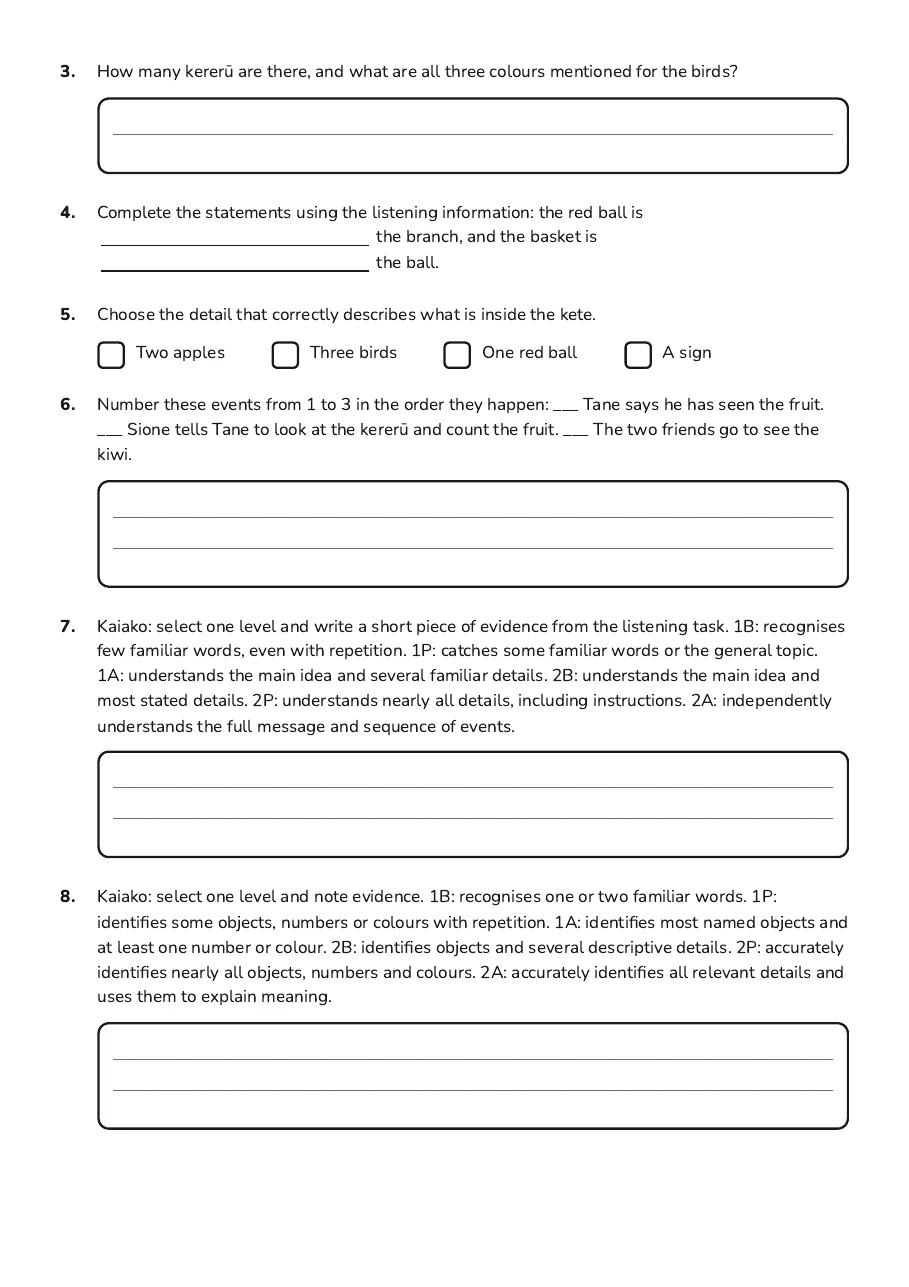
3.How many kererū are there, and what are all three colours mentioned for the birds?
4.Complete the statements using the listening information: the red ball is the branch, and the basket is the ball.
5.Choose the detail that correctly describes what is inside the kete.
  • Two apples
  • Three birds
  • One red ball
  • A sign
6.Number these events from 1 to 3 in the order they happen: ___ Tane says he has seen the fruit. ___ Sione tells Tane to look at the kererū and count the fruit. ___ The two friends go to see the kiwi.
7.Kaiako: select one level and write a short piece of evidence from the listening task. 1B: recognises few familiar words, even with repetition. 1P: catches some familiar words or the general topic. 1A: understands the main idea and several familiar details. 2B: understands the main idea and most stated details. 2P: understands nearly all details, including instructions. 2A: independently understands the full message and sequence of events.
8.Kaiako: select one level and note evidence. 1B: recognises one or two familiar words. 1P: identifies some objects, numbers or colours with repetition. 1A: identifies most named objects and at least one number or colour. 2B: identifies objects and several descriptive details. 2P: accurately identifies nearly all objects, numbers and colours. 2A: accurately identifies all relevant details and uses them to explain meaning.
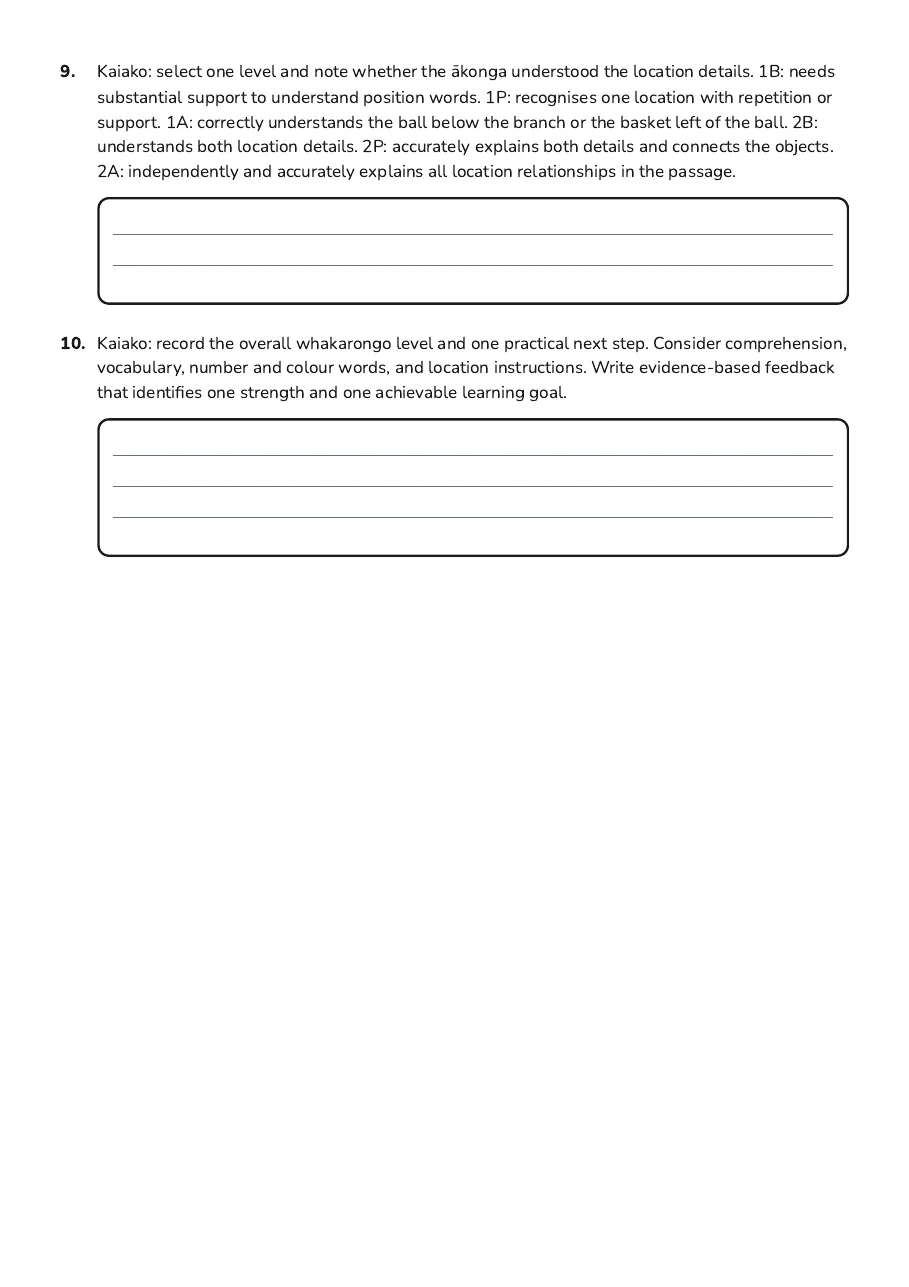
9.Kaiako: select one level and note whether the ākonga understood the location details. 1B: needs substantial support to understand position words. 1P: recognises one location with repetition or support. 1A: correctly understands the ball below the branch or the basket left of the ball. 2B: understands both location details. 2P: accurately explains both details and connects the objects. 2A: independently and accurately explains all location relationships in the passage.
10.Kaiako: record the overall whakarongo level and one practical next step. Consider comprehension, vocabulary, number and colour words, and location instructions. Write evidence-based feedback that identifies one strength and one achievable learning goal.

3 printable pages

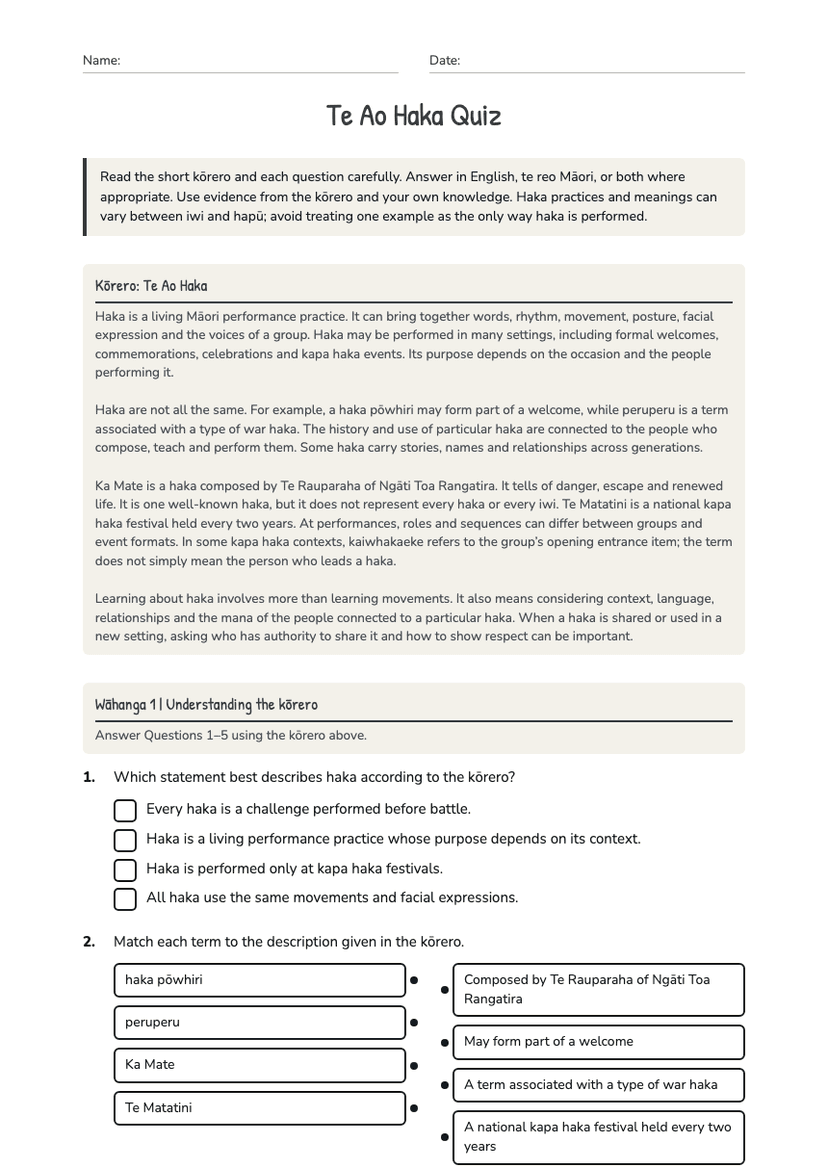
  • Whakarongo Assessment Rubric Worksheet, page 1 of 3: Listening script — kaiako only, Achievement descriptors

    Page 1

  • Whakarongo Assessment Rubric Worksheet, page 2 of 3: 3. How many kererū are there, and what are all three colours mentioned for the birds?

    Page 2

  • Whakarongo Assessment Rubric Worksheet, page 3 of 3: 9. Kaiako: select one level and note whether the ā konga understood the location details.…

    Page 3

About This Worksheet

Free in Kuraplan

Sign up free, grab the PDF, and customize it for your class.

Print-Ready

Formatted for standard paper. Clean layout, easy to read.

AI-Generated

Created with Kuraplan's AI, designed for real classroom use.

For Teachers & Parents

Use in classrooms, for homework, tutoring, or homeschool.

Need a custom version of this worksheet?

Kuraplan's AI generates custom worksheets in seconds — differentiated for every learner, aligned to your curriculum.

Generate Custom Worksheets — Free
No credit card Curriculum-aligned Under 60 seconds

Explore more free resources