ScienceFreePrintable

Atomic Number Identification

A free science worksheet ready for your classroom. Open in Kuraplan to grab the print-ready PDF, customize it for your students, or generate a fresh version in seconds.
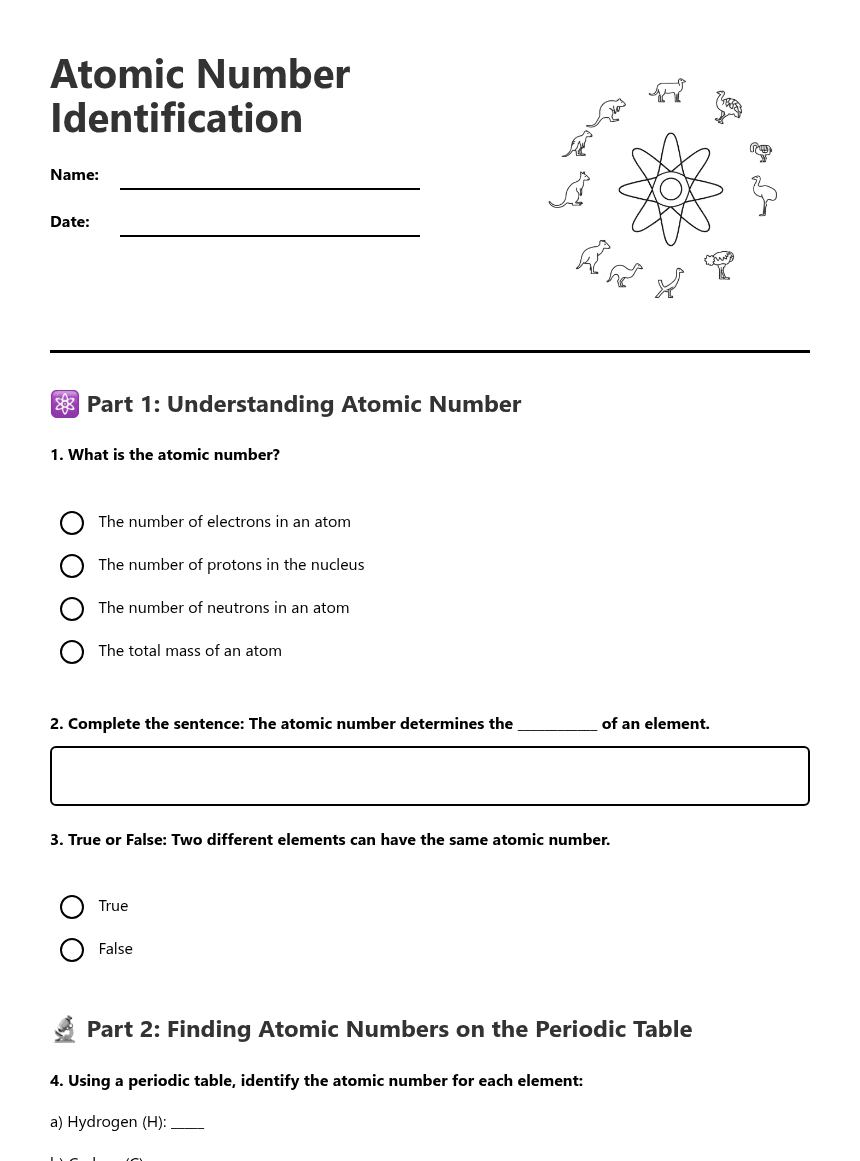
Atomic Number Identification worksheet preview

Atomic Number Identification

Atomic Number Identification

Periodic table with atomic numbers highlighted

⚛️ Part 1: Understanding Atomic Number

1. What is the atomic number?

The number of electrons in an atom

The number of protons in the nucleus

The number of neutrons in an atom

The total mass of an atom

2. Complete the sentence: The atomic number determines the ____________ of an element.
3. True or False: Two different elements can have the same atomic number.

True

False

🔬 Part 2: Finding Atomic Numbers on the Periodic Table

4. Using a periodic table, identify the atomic number for each element:

a) Hydrogen (H): _____

b) Carbon (C): _____

c) Oxygen (O): _____

d) Sodium (Na): _____

e) Iron (Fe): _____

f) Gold (Au): _____

5. If an element has 12 protons in its nucleus, what is its atomic number?
6. Which element has an atomic number of 6?

Nitrogen

Carbon

Oxygen

Boron

📊 Part 3: Periodic Table Organisation

7. How are elements arranged on the periodic table?

Alphabetically by name

By increasing atomic mass

By increasing atomic number

By the number of electrons

8. Match each element with its atomic number:
1. Helium (He)
2. Lithium (Li)
3. Nitrogen (N)
4. Neon (Ne)
A. Atomic number 10
B. Atomic number 2
C. Atomic number 7
D. Atomic number 3

🎯 Part 4: Atomic Structure Connection

9. Draw a simple diagram of an atom showing the nucleus and electrons. Label where the protons are located.
10. Fill in the blanks:

An atom of oxygen has an atomic number of ____. This means it has ____ protons in its nucleus. In a neutral atom, it would also have ____ electrons.

11. Explain in one sentence why the atomic number is important for identifying elements:

🧠 Part 5: Challenge Questions

12. If you change the number of protons in an atom, what happens to the element?
13. Which of these statements about atomic number are correct? (Select all that apply)

Atomic number equals the number of protons

Atomic number can change in chemical reactions

Each element has a unique atomic number

Atomic number determines an element's position on the periodic table

Atomic number equals the number of neutrons

14. Research Extension: Look up the atomic number of your favourite element and explain why you chose it.

About This Worksheet

Free in Kuraplan

Sign up free, grab the PDF, and customize it for your class.

Print-Ready

Formatted for standard paper. Clean layout, easy to read.

AI-Generated

Created with Kuraplan's AI, designed for real classroom use.

For Teachers & Parents

Use in classrooms, for homework, tutoring, or homeschool.

Need a custom version of this worksheet?

Kuraplan's AI generates custom worksheets in seconds — differentiated for every learner, aligned to your curriculum.

Generate Custom Worksheets — Free
No credit card Curriculum-aligned Under 60 seconds