Data and Probability Experiments
A free maths worksheet ready for your classroom. Open in Kuraplan to grab the print-ready PDF, customize it for your students, or generate a fresh version in seconds.
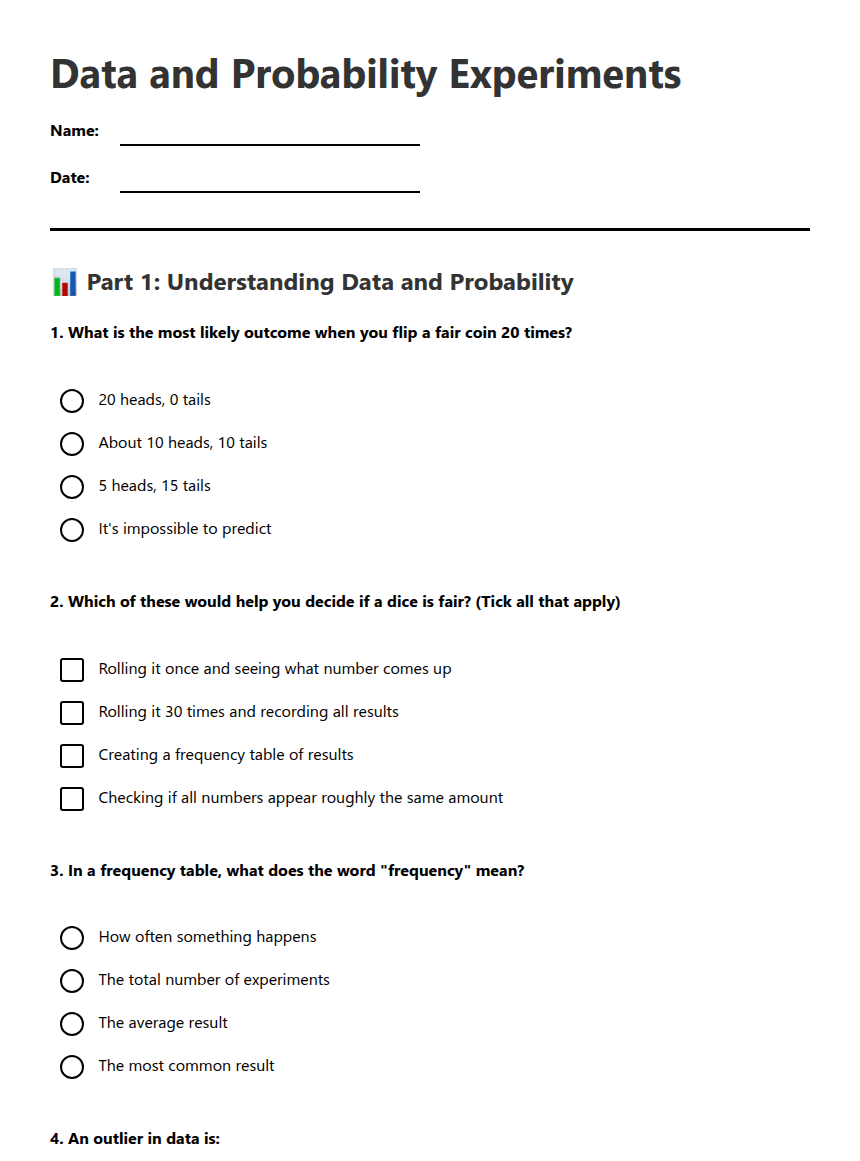
Data and Probability Experiments
📊 Part 1: Understanding Data and Probability
🎲 Part 2: Probability Experiment Design
What will you test? (e.g., coin, dice, spinner)
How many trials will you conduct? ___________
List all possible outcomes:
If your experiment tool is fair, predict how many times each outcome should occur:
📈 Part 3: Data Analysis Challenge
Dice A: Rolled 30 times - Number 1: 5 times, Number 2: 4 times, Number 3: 6 times, Number 4: 5 times, Number 5: 5 times, Number 6: 5 times
Dice B: Rolled 30 times - Number 1: 1 time, Number 2: 2 times, Number 3: 3 times, Number 4: 8 times, Number 5: 8 times, Number 6: 8 times
a) Which dice appears to be fairer? ___________
b) Explain your answer using the concept of "centre" and "spread":
About This Worksheet
Free in Kuraplan
Sign up free, grab the PDF, and customize it for your class.
Print-Ready
Formatted for standard paper. Clean layout, easy to read.
AI-Generated
Created with Kuraplan's AI, designed for real classroom use.
For Teachers & Parents
Use in classrooms, for homework, tutoring, or homeschool.
Need a custom version of this worksheet?
Kuraplan's AI generates custom worksheets in seconds — differentiated for every learner, aligned to your curriculum.
Generate Custom Worksheets — FreeMore Maths Worksheets

Year 7 Statistics Pretest
Free
Year 7 Statistics and Probability Pretest
Free
Rivergum Market Probability Revision
Free
Z-Scores in Real Life
Free
Stem-and-Leaf Plots Worksheet
Free
Carnival Game Probability Challenge
Free
Drawing Histograms Worksheet
Free