MathsFreePrintable

Grade 8 Probability Answer Key

A free maths worksheet ready for your classroom. Open in Kuraplan to grab the print-ready PDF, customize it for your students, or generate a fresh version in seconds.
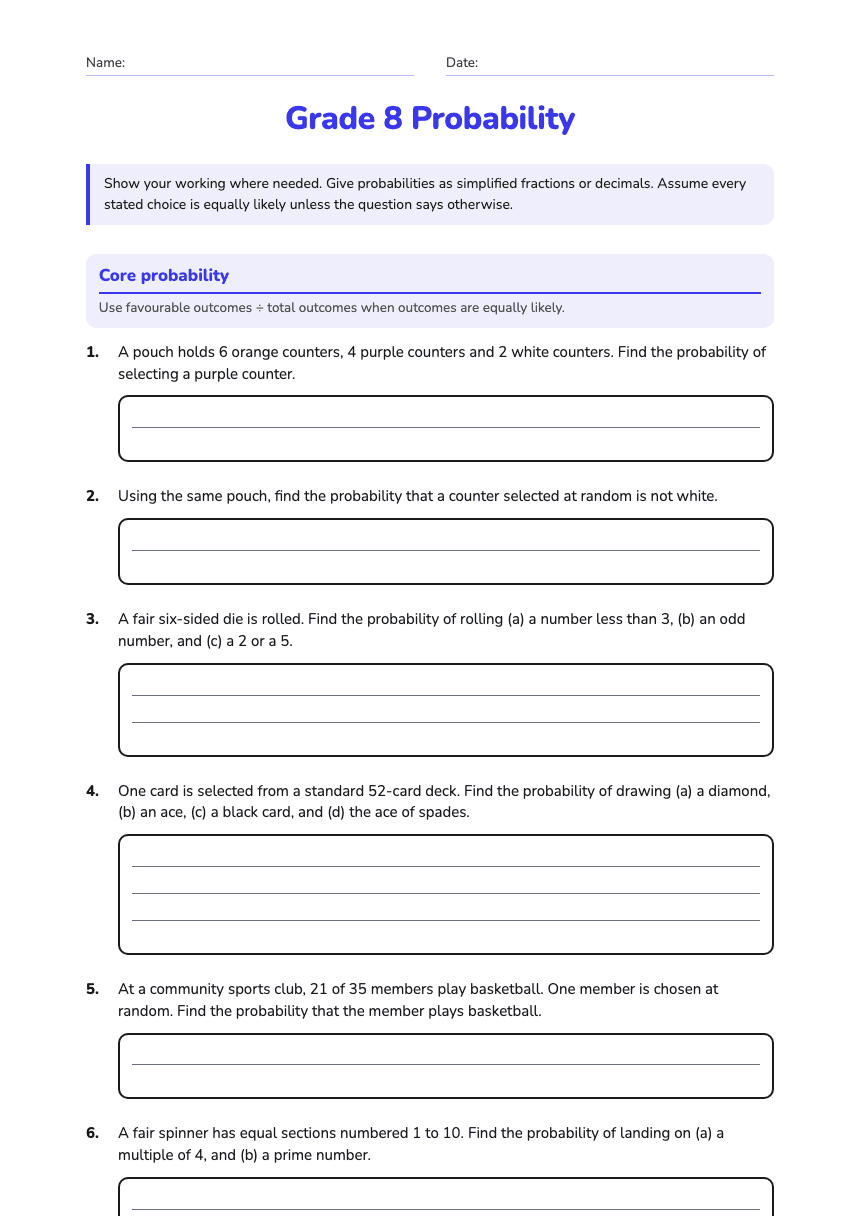
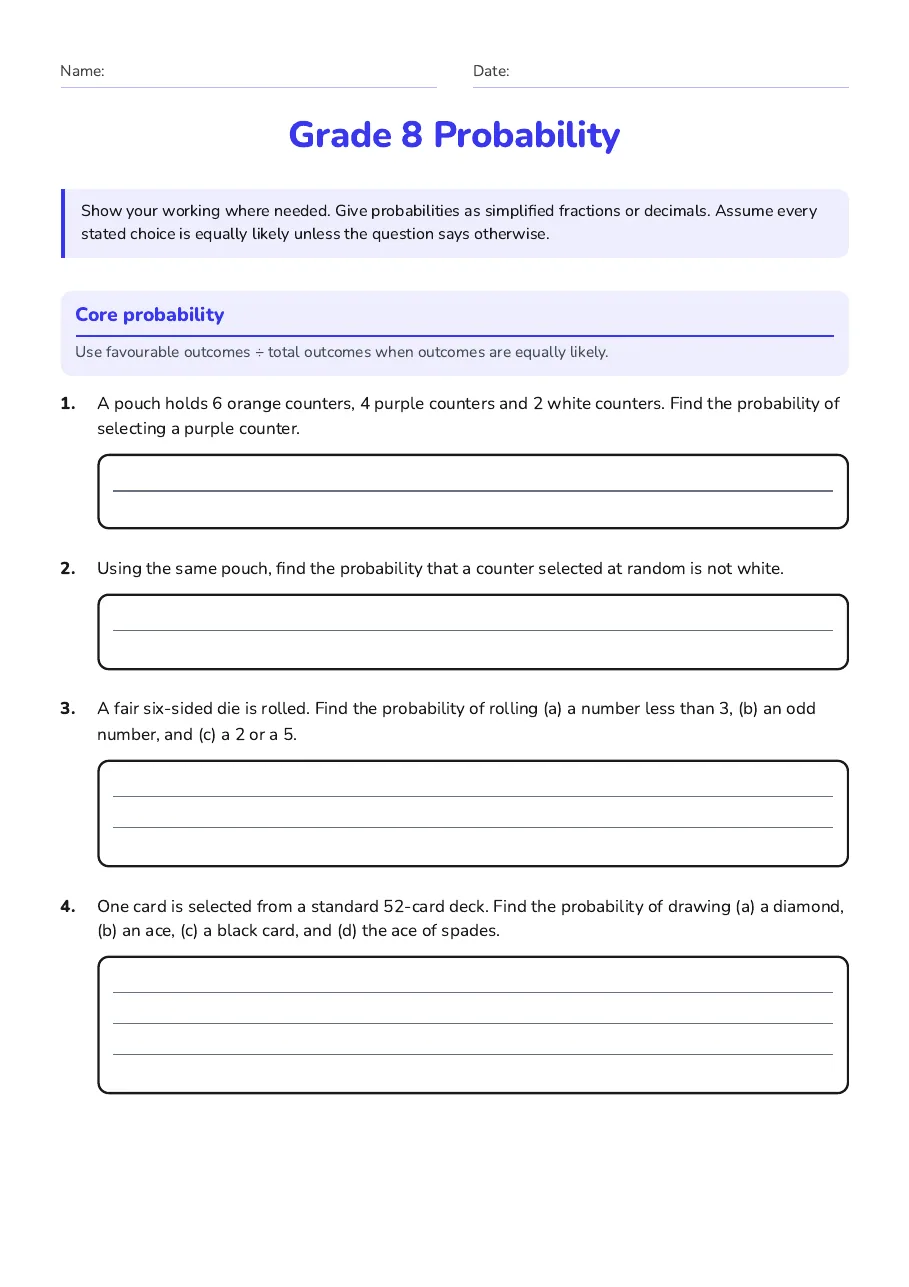
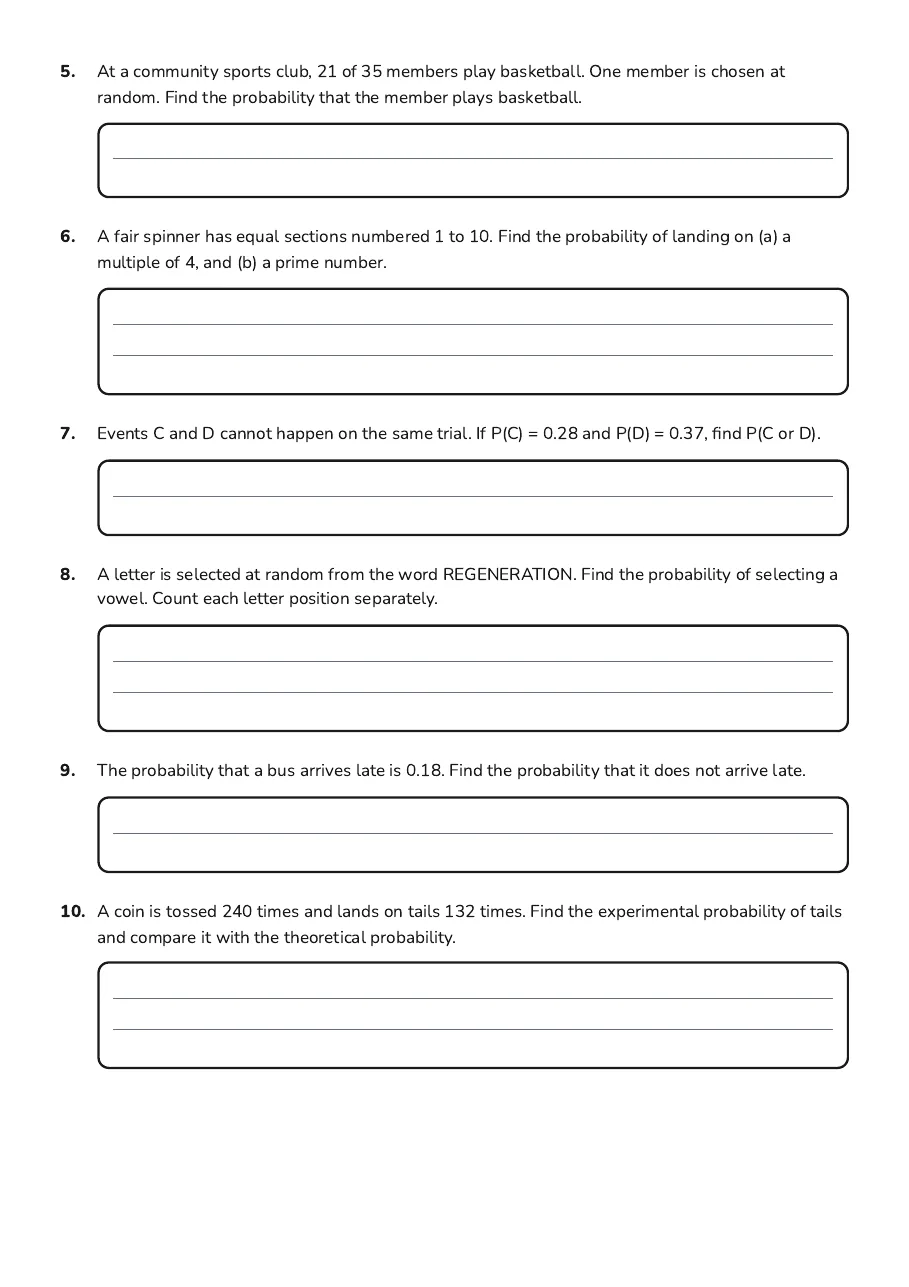
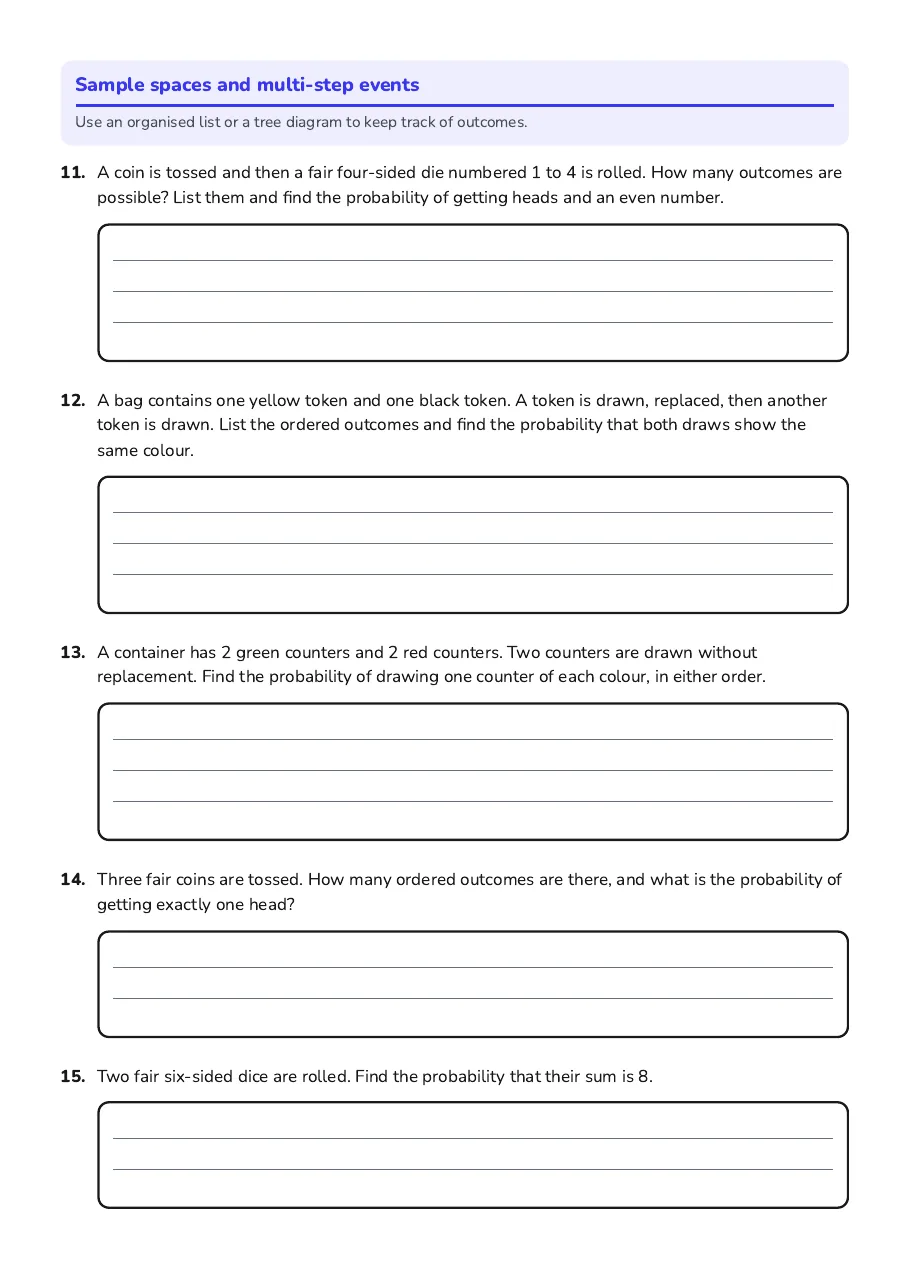
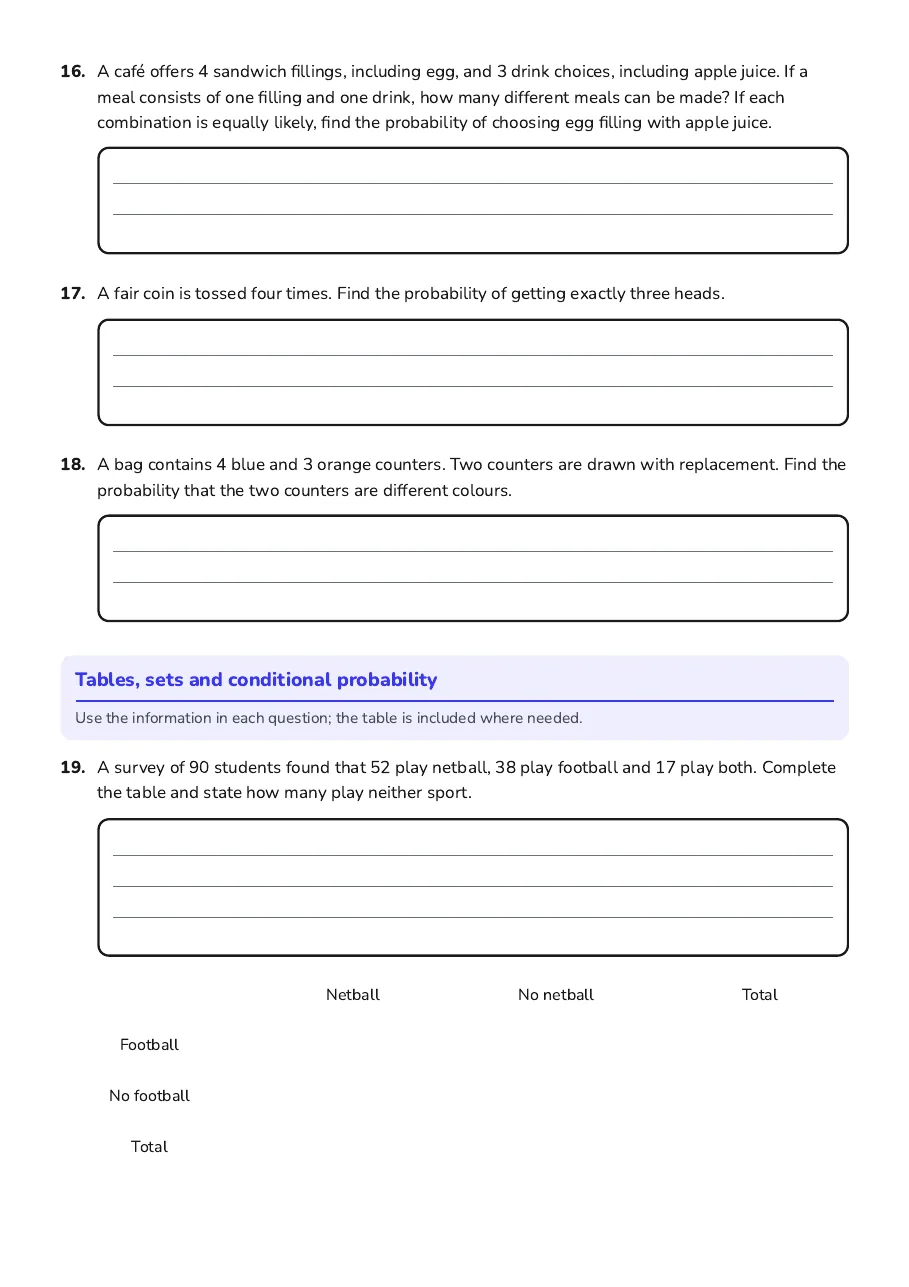
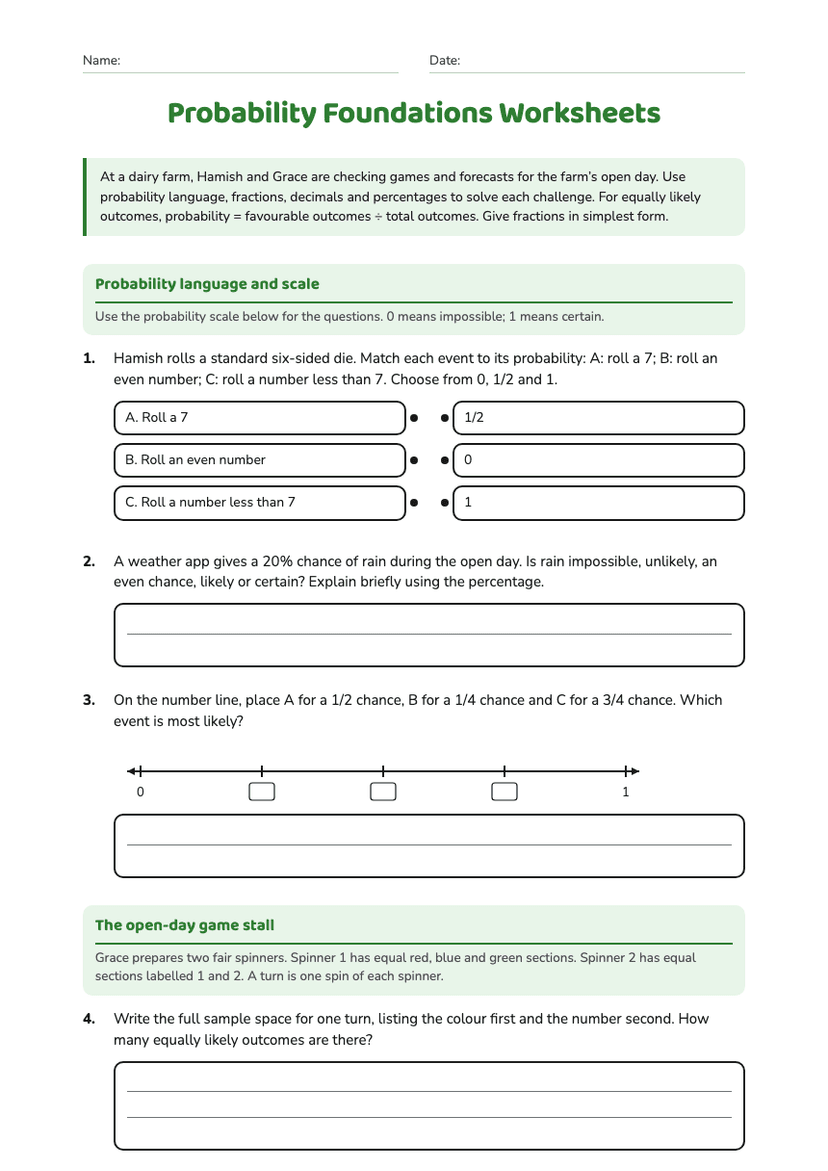
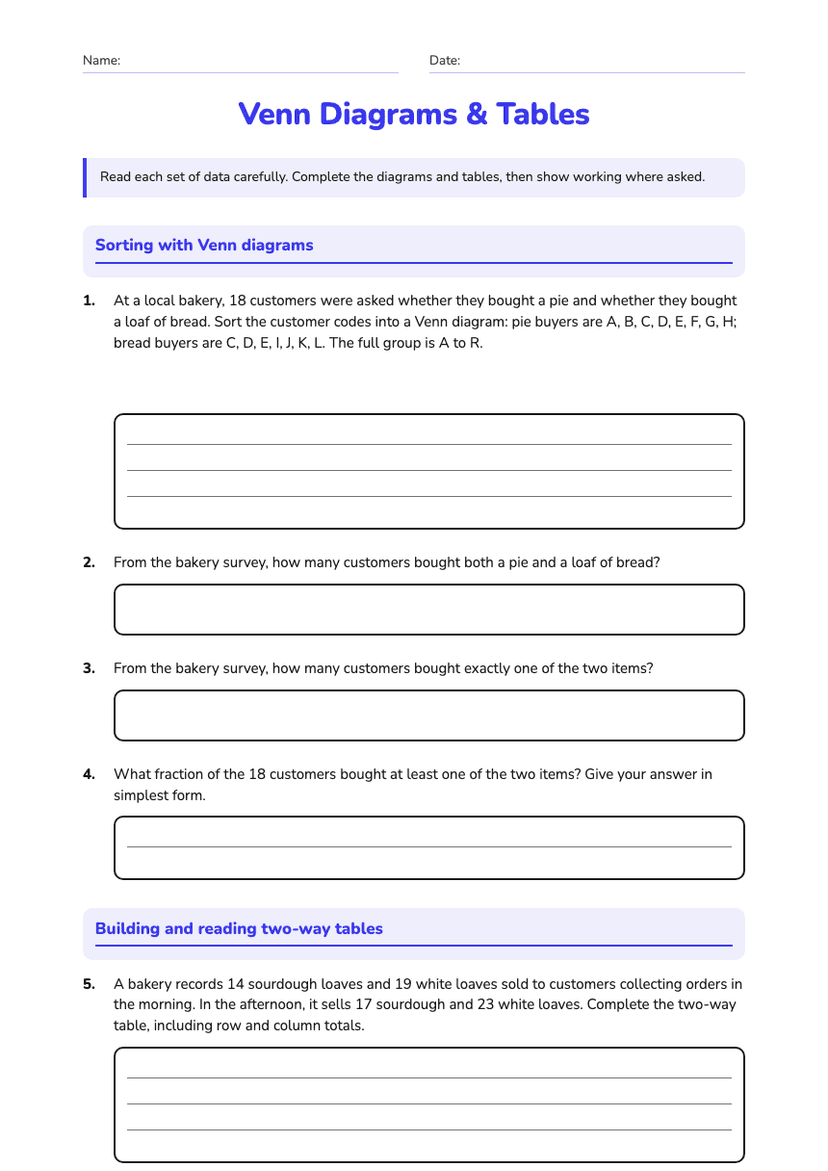
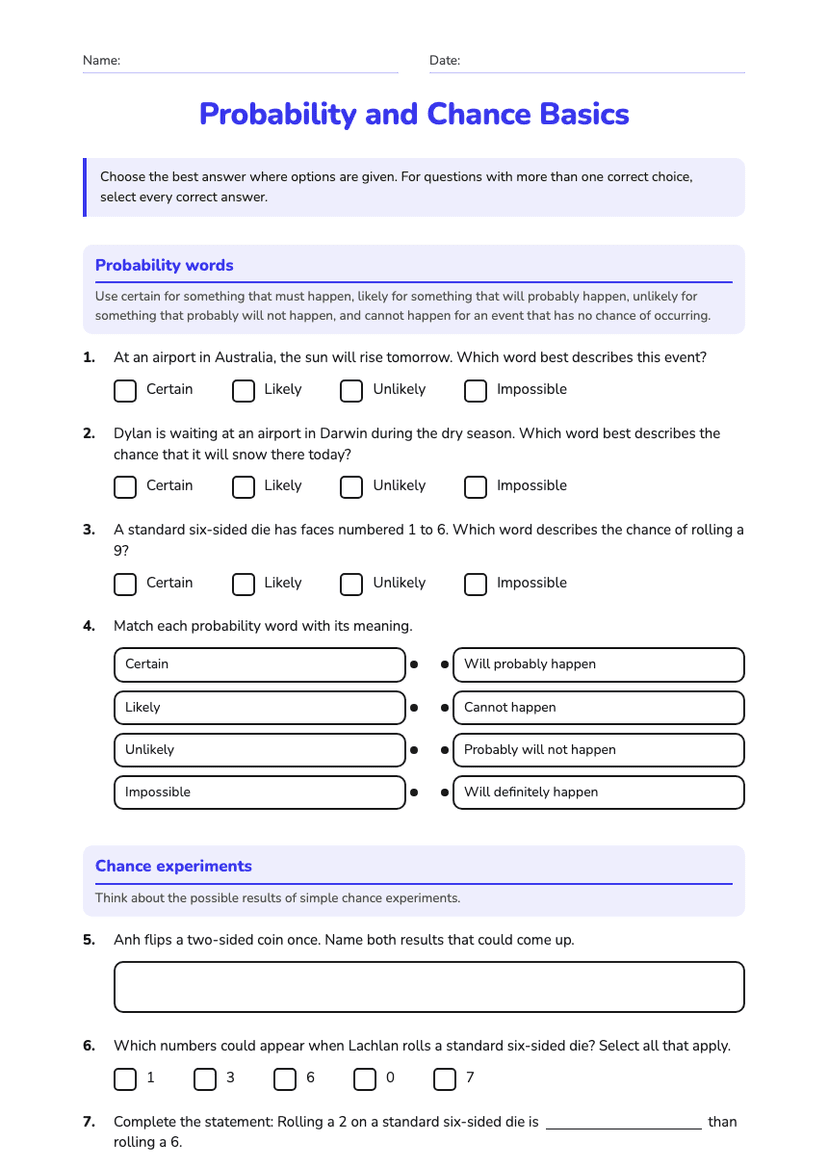
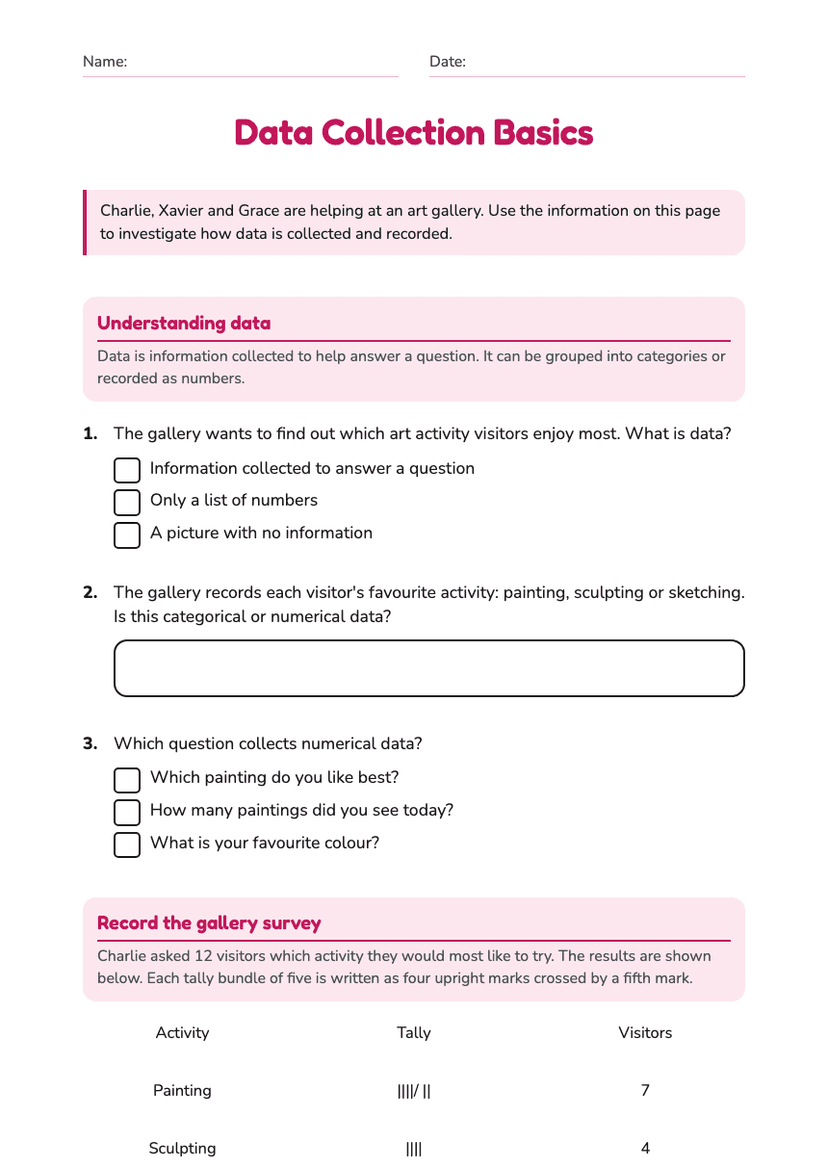
Grade 8 Probability Answer Key worksheet preview

Grade 8 Probability — Answer Key

Victorian Curriculum | Year 8 Mathematics | Tutor Reference Copy

Probability and maths illustration

🎯 Success Criteria

By the end of this unit, students should be able to:

✅ Calculate theoretical probability using P(event) = favourable outcomes ÷ total outcomes

✅ Construct and interpret tree diagrams to list sample spaces for multi-step experiments

✅ Complete and interpret two-way tables and calculate associated probabilities

✅ Draw and interpret Venn diagrams including union (∪), intersection (∩), and complement (A′)

✅ Distinguish between experimental and theoretical probability

✅ Solve multi-step probability problems using correct mathematical notation

📌 Differentiation Note: Core questions = Q1–Q20 | Extension = Q21–Q30. Scaffold lower-level learners with worked examples before independent practice.

📋 Part 1: Basic Probability (Q1–Q10) — Answers

Q1. A bag contains 4 red, 3 blue, and 5 green marbles. What is the probability of picking a red marble?
Answer: Total marbles = 4 + 3 + 5 = 12
P(red) = 4/12 = 1/3 ≈ 0.333
Q2. What is the probability of NOT picking a green marble from the same bag?
Answer: P(green) = 5/12, so P(not green) = 1 − 5/12 = 7/12 ≈ 0.583
Q3. A standard die is rolled. Find: (a) P(even number)   (b) P(number greater than 4)   (c) P(1 or 6)
(a) Even numbers: {2, 4, 6} → P(even) = 3/6 = 1/2
(b) Numbers > 4: {5, 6} → P(>4) = 2/6 = 1/3
(c) {1, 6} → P(1 or 6) = 2/6 = 1/3
Q4. A card is drawn from a standard 52-card deck. Find: (a) P(heart)   (b) P(king)   (c) P(red card)   (d) P(king of hearts)
(a) P(heart) = 13/52 = 1/4
(b) P(king) = 4/52 = 1/13
(c) P(red) = 26/52 = 1/2
(d) P(king of hearts) = 1/52 ≈ 0.019
Q5. In a class of 30 students, 18 play sport and 12 do not. A student is chosen at random. Find P(plays sport).
Answer: P(plays sport) = 18/30 = 3/5 = 0.6
Q6. A spinner has 8 equal sections numbered 1–8. Find: (a) P(prime number)   (b) P(multiple of 3)
(a) Primes in 1–8: {2, 3, 5, 7} → P(prime) = 4/8 = 1/2
(b) Multiples of 3: {3, 6} → P(multiple of 3) = 2/8 = 1/4
Q7. Two events A and B are mutually exclusive. P(A) = 0.35 and P(B) = 0.45. Find P(A or B).
Answer: Since mutually exclusive: P(A ∪ B) = P(A) + P(B) = 0.35 + 0.45 = 0.80
Q8. A letter is chosen randomly from the word PROBABILITY. Find P(vowel).
Answer: Letters: P-R-O-B-A-B-I-L-I-T-Y = 11 letters
Vowels: O, A, I, I → 4 vowels
P(vowel) = 4/11 ≈ 0.364
Q9. If P(event) = 0.72, what is the probability of the complementary event?
Answer: P(complement) = 1 − 0.72 = 0.28
Q10. A coin is flipped 200 times and lands on heads 86 times. (a) What is the experimental probability of heads? (b) How does this compare to theoretical probability?
(a) P(heads) = 86/200 = 0.43
(b) Theoretical P(heads) = 0.5. The experimental probability (0.43) is slightly less than theoretical. With more trials, experimental probability tends to approach the theoretical value. (Law of Large Numbers)

🌳 Part 2: Tree Diagrams & Sample Spaces (Q11–Q18) — Answers

Q11. A coin is flipped and a die is rolled. (a) How many outcomes are in the sample space? (b) List all outcomes. (c) Find P(heads and even number).
(a) 2 × 6 = 12 outcomes
(b) {H1, H2, H3, H4, H5, H6, T1, T2, T3, T4, T5, T6}
(c) Favourable: {H2, H4, H6} → P = 3/12 = 1/4
Tree diagram: Coin branches (H/T) → each branches into 6 die outcomes
Q12. A bag has 1 red (R) and 1 blue (B) ball. A ball is drawn, replaced, then drawn again. (a) Draw the tree diagram outcomes. (b) Find P(same colour both times). (c) Find P(at least one red).
(a) Outcomes: {RR, RB, BR, BB} — 4 equally likely outcomes
Tree: R → {RR, RB} | B → {BR, BB}
(b) Same colour: {RR, BB} → P = 2/4 = 1/2
(c) At least one red: {RR, RB, BR} → P = 3/4 = 0.75
Q13. A bag has 2 red and 1 blue ball. A ball is drawn WITHOUT replacement, then a second ball is drawn. (a) List the sample space. (b) Find P(both red). (c) Find P(one of each colour).
Label balls: R1, R2, B
(a) Outcomes: {R1R2, R1B, R2R1, R2B, BR1, BR2} — 6 outcomes
(b) Both red: {R1R2, R2R1} → P = 2/6 = 1/3
(c) One of each: {R1B, R2B, BR1, BR2} → P = 4/6 = 2/3
Q14. A family has 3 children. Assuming equal probability of boy (B) or girl (G): (a) How many outcomes in the sample space? (b) Find P(exactly 2 girls). (c) Find P(at least 1 boy).
(a) 2³ = 8 outcomes: {BBB, BBG, BGB, BGG, GBB, GBG, GGB, GGG}
(b) Exactly 2 girls: {BGG, GBG, GGB} → P = 3/8 = 0.375
(c) At least 1 boy: all except {GGG} → P = 7/8 = 0.875
Q15. Two dice are rolled. Find: (a) P(sum = 7)   (b) P(sum ≥ 10)   (c) P(doubles)
Total outcomes: 6 × 6 = 36
(a) Sum = 7: {(1,6),(2,5),(3,4),(4,3),(5,2),(6,1)} → P = 6/36 = 1/6
(b) Sum ≥ 10: {(4,6),(5,5),(6,4),(5,6),(6,5),(6,6)} → P = 6/36 = 1/6
(c) Doubles: {(1,1),(2,2),(3,3),(4,4),(5,5),(6,6)} → P = 6/36 = 1/6
Q16. A restaurant offers 3 mains (chicken, fish, pasta) and 2 desserts (cake, ice cream). (a) How many meal combinations are possible? (b) Find P(choosing pasta and cake).
(a) 3 × 2 = 6 combinations: {chicken-cake, chicken-ice cream, fish-cake, fish-ice cream, pasta-cake, pasta-ice cream}
(b) P(pasta and cake) = 1/6 ≈ 0.167
Q17. Using a tree diagram, find the probability of getting exactly 2 heads when 3 coins are flipped.
Sample space (8 outcomes): {HHH, HHT, HTH, HTT, THH, THT, TTH, TTT}
Exactly 2 heads: {HHT, HTH, THH} → 3 outcomes
P(exactly 2 heads) = 3/8 = 0.375
Q18. A bag has 3 red and 2 blue balls. Two balls are drawn WITH replacement. Find P(different colours).
P(red) = 3/5, P(blue) = 2/5
P(red then blue) = 3/5 × 2/5 = 6/25
P(blue then red) = 2/5 × 3/5 = 6/25
P(different colours) = 6/25 + 6/25 = 12/25 = 0.48

📊 Part 3: Two-Way Tables & Venn Diagrams (Q19–Q25) — Answers

Q19. Complete the two-way table and answer the questions.
Survey: 80 students — play sport or play music (or both/neither).
Play sport: 45 | Play music: 30 | Both: 12 | Neither: ?
Finding "Neither": Using inclusion-exclusion:
|Sport ∪ Music| = 45 + 30 − 12 = 63
Neither = 80 − 63 = 17 students

Completed table:
                | Sport | No Sport | Total
Music       |  12    |   18     |  30
No Music  |  33    |   17     |  50
Total        |  45    |   35     |  80
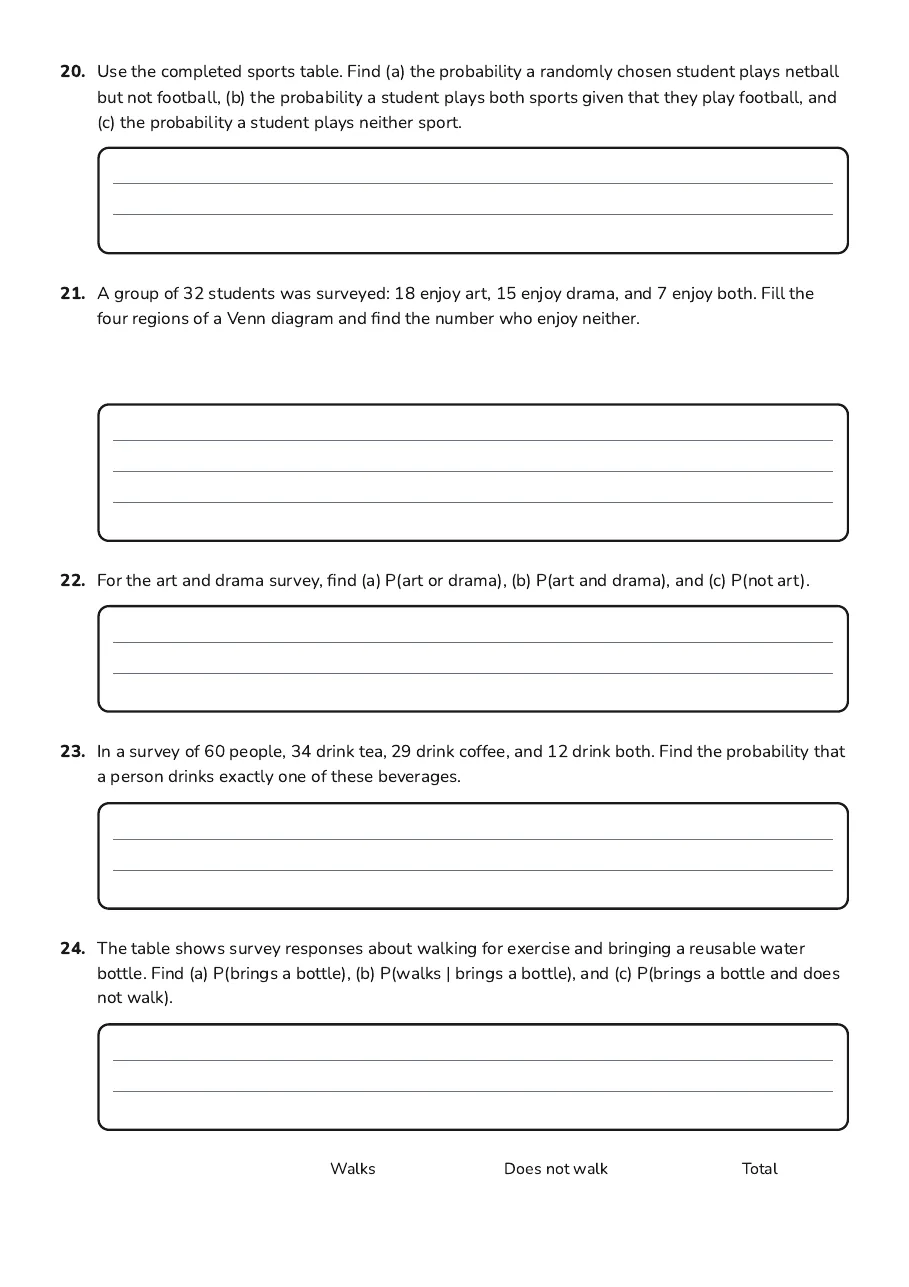
Q20. Using the table from Q19, find: (a) P(plays sport only)   (b) P(plays music | plays sport)   (c) P(neither)
(a) Sport only (not music) = 33 → P = 33/80 ≈ 0.4125
(b) P(music | sport) = 12/45 = 4/15 ≈ 0.267 (conditional probability)
(c) P(neither) = 17/80 ≈ 0.2125
Q21. In a class of 25 students: 14 like maths (M), 11 like science (S), 6 like both, and some like neither. (a) Draw and complete the Venn diagram values. (b) Find how many like neither. (c) Find P(likes maths only).
(a) Venn diagram values:
Maths only = 14 − 6 = 8
Science only = 11 − 6 = 5
Both = 6
(b) Neither = 25 − (8 + 6 + 5) = 25 − 19 = 6 students
(c) P(maths only) = 8/25 = 0.32
Q22. Using the Venn diagram from Q21, find: (a) P(M ∪ S)   (b) P(M ∩ S)   (c) P(M′) — complement of maths
(a) P(M ∪ S) = (8 + 6 + 5)/25 = 19/25 = 0.76
(b) P(M ∩ S) = 6/25 = 0.24
(c) P(M′) = 1 − 14/25 = 11/25 = 0.44
Q23. A survey of 50 people asked about tea (T) and coffee (C) preference: 28 drink tea, 20 drink coffee, 8 drink both. Find P(drinks tea or coffee but not both).
Tea only = 28 − 8 = 20
Coffee only = 20 − 8 = 12
Tea or coffee but NOT both = 20 + 12 = 32
P = 32/50 = 16/25 = 0.64
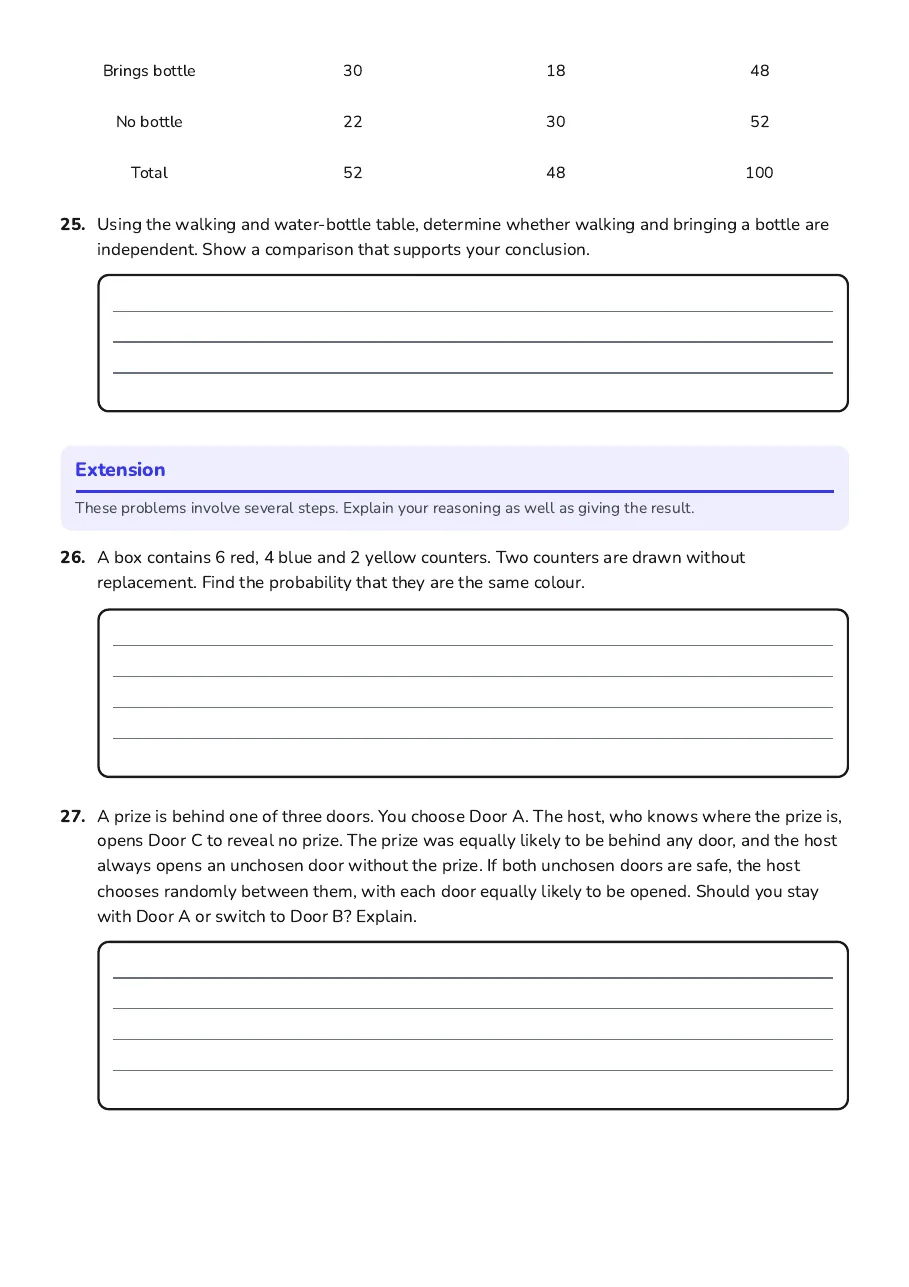
Q24. Two-way table — 100 people surveyed about exercise habits and diet quality.
Good diet + exercises: 35 | Good diet + no exercise: 15 | Poor diet + exercises: 20 | Poor diet + no exercise: 30
Find: (a) P(good diet)   (b) P(exercises | good diet)   (c) P(poor diet and no exercise)
Total = 100 ✓
(a) Good diet = 35 + 15 = 50 → P(good diet) = 50/100 = 0.5
(b) P(exercises | good diet) = 35/50 = 7/10 = 0.7 (conditional)
(c) P(poor diet ∩ no exercise) = 30/100 = 0.3
Q25. Are "good diet" and "exercises" independent in Q24? Show working to justify.
Check independence: P(A ∩ B) = P(A) × P(B) if independent
P(good diet) = 0.5 | P(exercises) = (35+20)/100 = 55/100 = 0.55
P(A) × P(B) = 0.5 × 0.55 = 0.275
P(good diet ∩ exercises) = 35/100 = 0.35 ≠ 0.275
Conclusion: NOT independent — diet and exercise are associated.

🚀 Part 4: Extension Activities (Q26–Q30) — Answers

📌 For advanced learners preparing for Maths Olympiad, ICAS, or Selective School entry.

Q26. (Extension) A box contains 5 red, 3 blue, and 2 green balls. Two balls are drawn WITHOUT replacement. Find P(both the same colour).
Total balls = 10
P(both red) = (5/10) × (4/9) = 20/90
P(both blue) = (3/10) × (2/9) = 6/90
P(both green) = (2/10) × (1/9) = 2/90
P(same colour) = (20 + 6 + 2)/90 = 28/90 = 14/45 ≈ 0.311
Q27. (Extension) A game show has 3 doors. Behind one is a car; behind the others are goats. You pick Door 1. The host opens Door 3 (revealing a goat). Should you switch to Door 2? Justify using probability. (Monty Hall Problem)
Initial pick: P(car behind Door 1) = 1/3, P(car behind Door 2 or 3) = 2/3
Host reveals goat behind Door 3.
The probability the car is behind Door 2 = 2/3 (the host's action concentrates the 2/3 probability onto Door 2).
P(win by staying) = 1/3
P(win by switching) = 2/3
Conclusion: YES — always switch. Switching doubles your chance of winning.
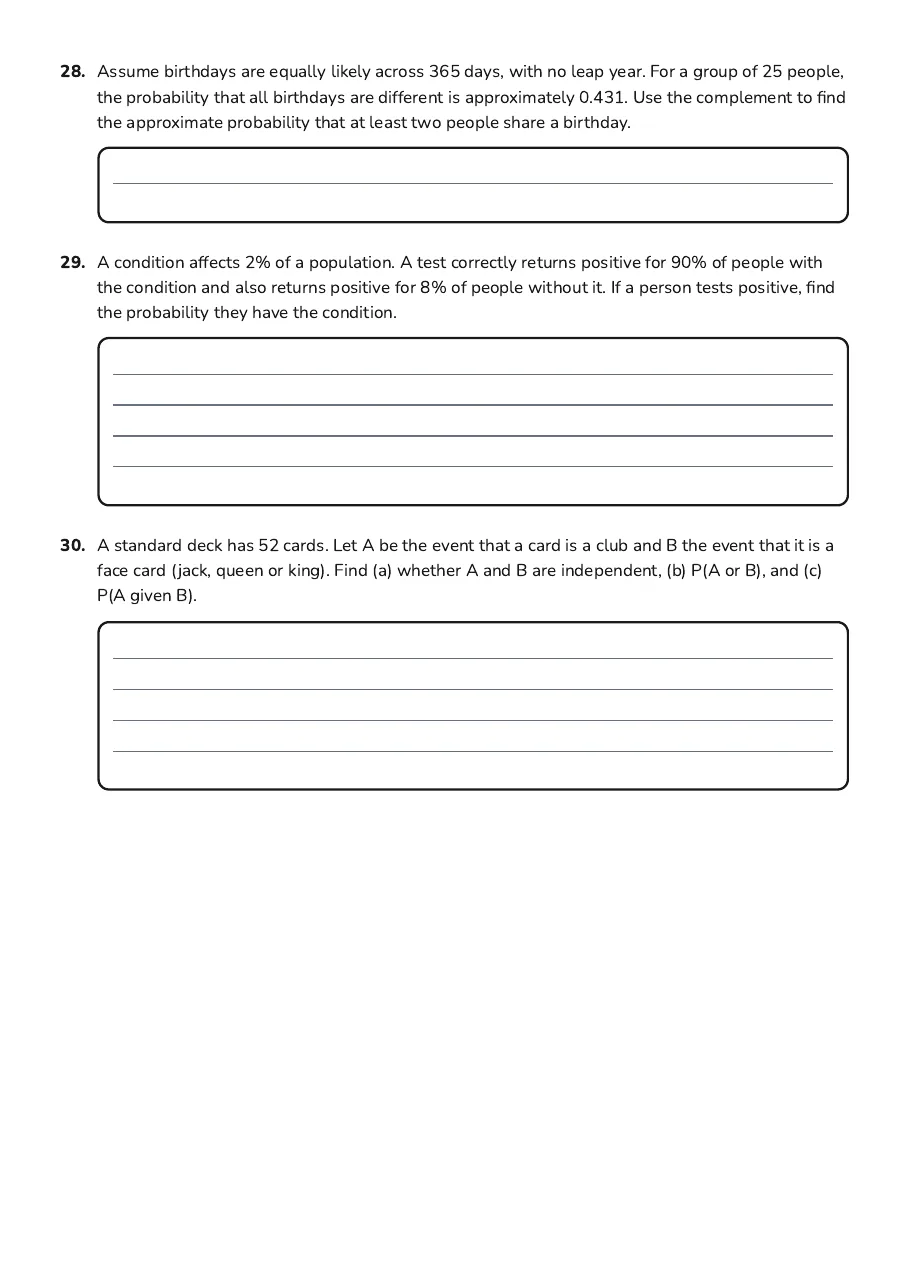
Q28. (Extension) In a group of 30 students, what is the probability that at least 2 students share the same birthday? (Use the complement method — assume 365 days, ignore leap years.)
Use complement: P(at least 2 share) = 1 − P(all different)
P(all 30 have different birthdays) = (365/365) × (364/365) × (363/365) × ... × (336/365)
= 365!/(335! × 365³⁰)
≈ 1 − 0.294 = 0.706 (approximately)
Answer: ≈ 70.6% chance at least 2 students share a birthday.
This is the famous Birthday Problem — a surprising result in probability!
Q29. (Extension) A test for a disease is 95% accurate. The disease affects 1% of the population. If a person tests positive, what is the probability they actually have the disease? (Bayes' Theorem)
Let D = has disease, T = tests positive
P(D) = 0.01 | P(D′) = 0.99
P(T|D) = 0.95 (true positive) | P(T|D′) = 0.05 (false positive)

Bayes' Theorem:
P(D|T) = P(T|D) × P(D) / P(T)
P(T) = (0.95 × 0.01) + (0.05 × 0.99) = 0.0095 + 0.0495 = 0.059
P(D|T) = 0.0095 / 0.059 ≈ 0.161 = 16.1%
Despite 95% accuracy, only ~16% of positive tests indicate actual disease — highlighting the importance of base rates!
Q30. (Extension) A card is drawn from a 52-card deck. Event A = drawing a red card. Event B = drawing a face card (J, Q, K). (a) Are A and B independent? (b) Find P(A ∪ B). (c) Find P(A | B).
(a) Independence check:
P(A) = 26/52 = 1/2 | P(B) = 12/52 = 3/13
P(A ∩ B) = 6/52 = 3/26 (red face cards: J♥, Q♥, K♥, J♦, Q♦, K♦)
P(A) × P(B) = 1/2 × 3/13 = 3/26 = P(A ∩ B) ✓
YES — A and B are independent events.
(b) P(A ∪ B) = 1/2 + 3/13 − 3/26 = 13/26 + 6/26 − 3/26 = 16/26 = 8/13 ≈ 0.615
(c) P(A|B) = P(A ∩ B)/P(B) = (6/52)/(12/52) = 6/12 = 1/2 (same as P(A) — confirms independence)

📌 Differentiation Strategies for Diverse Learners

🟢 Foundation (Year 7–8 level): Focus on Q1–Q10. Use concrete materials (dice, cards, spinners). Provide probability scales (0 to 1) and vocabulary cards.

🟡 Core (Year 8 on-level): Complete Q1–Q25. Emphasise correct notation (P(A), ∩, ∪, A′). Use systematic listing before tree diagrams.

🔴 Extension (Advanced / Olympiad): Complete Q26–Q30. Introduce Bayes' Theorem, conditional probability, and independence proofs. Encourage investigation of the Birthday Problem and Monty Hall Problem.

🔵 NAPLAN / ICAS Prep: Focus on multi-step problems, two-way tables (Q19–Q24), and problems requiring justification. Practice writing clear mathematical reasoning.

About This Worksheet

Free in Kuraplan

Sign up free, grab the PDF, and customize it for your class.

Print-Ready

Formatted for standard paper. Clean layout, easy to read.

AI-Generated

Created with Kuraplan's AI, designed for real classroom use.

For Teachers & Parents

Use in classrooms, for homework, tutoring, or homeschool.

Need a custom version of this worksheet?

Kuraplan's AI generates custom worksheets in seconds — differentiated for every learner, aligned to your curriculum.

Generate Custom Worksheets — Free
No credit card Curriculum-aligned Under 60 seconds