ScienceFreePrintable

Earth Science Revision Worksheet

A free science worksheet ready for your classroom. Open in Kuraplan to grab the print-ready PDF, customize it for your students, or generate a fresh version in seconds.
Earth Science Revision Worksheet worksheet preview
Name:Date:

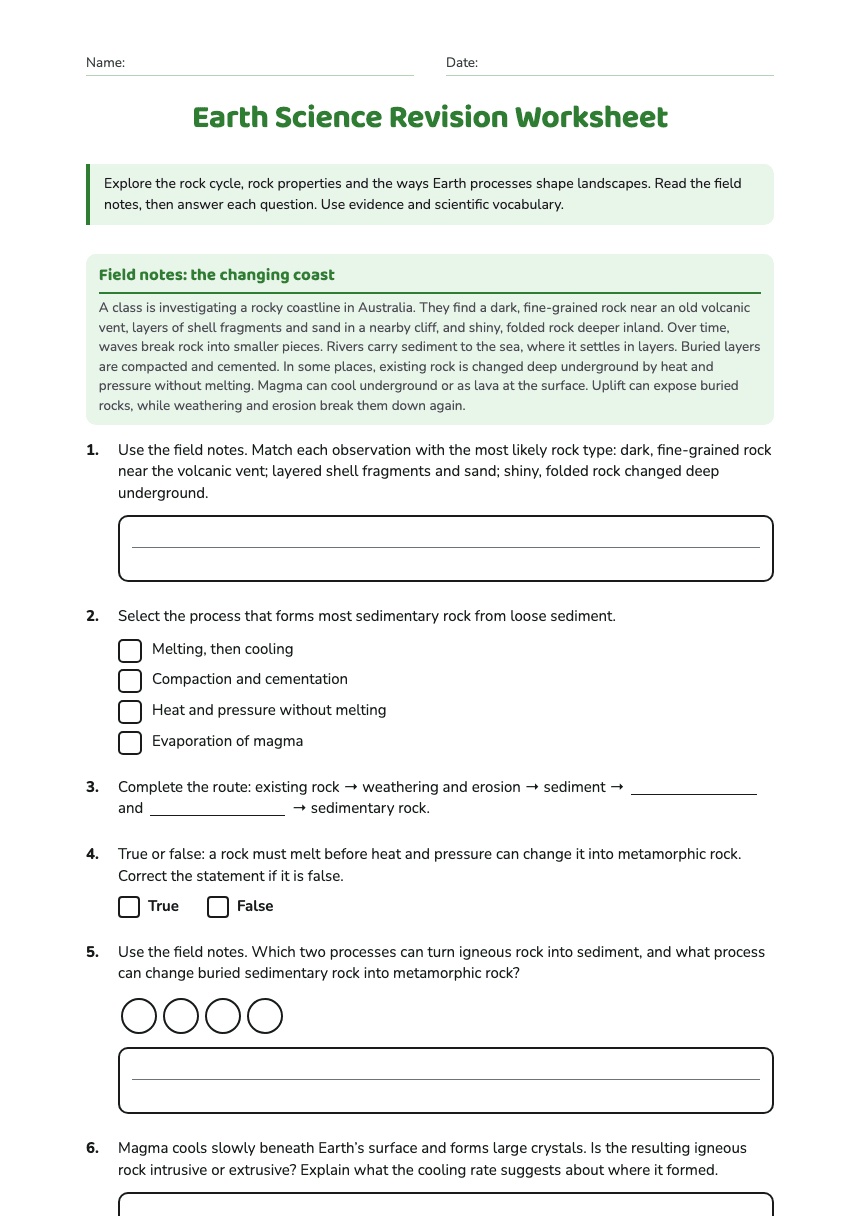
Earth Science Revision Worksheet

Explore the rock cycle, rock properties and the ways Earth processes shape landscapes. Read the field notes, then answer each question. Use evidence and scientific vocabulary.

Field notes: the changing coast

A class is investigating a rocky coastline in Australia. They find a dark, fine-grained rock near an old volcanic vent, layers of shell fragments and sand in a nearby cliff, and shiny, folded rock deeper inland. Over time, waves break rock into smaller pieces. Rivers carry sediment to the sea, where it settles in layers. Buried layers are compacted and cemented. In some places, existing rock is changed deep underground by heat and pressure without melting. Magma can cool underground or as lava at the surface. Uplift can expose buried rocks, while weathering and erosion break them down again.

1.Use the field notes. Match each observation with the most likely rock type: dark, fine-grained rock near the volcanic vent; layered shell fragments and sand; shiny, folded rock changed deep underground.
2.Select the process that forms most sedimentary rock from loose sediment.
  • Melting, then cooling
  • Compaction and cementation
  • Heat and pressure without melting
  • Evaporation of magma
3.Complete the route: existing rock → weathering and erosion → sediment → and → sedimentary rock.
4.True or false: a rock must melt before heat and pressure can change it into metamorphic rock. Correct the statement if it is false.
TrueFalse
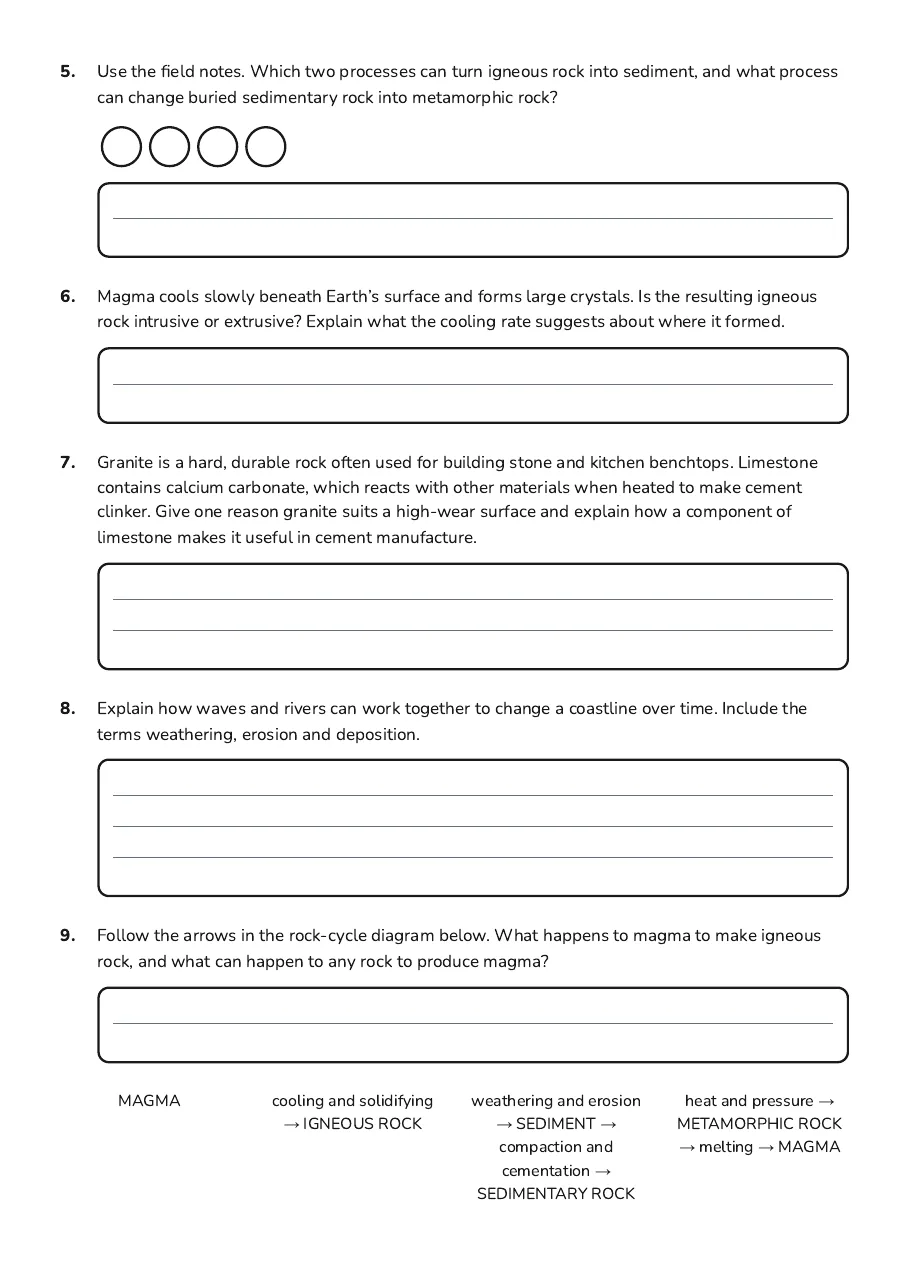
5.Use the field notes. Which two processes can turn igneous rock into sediment, and what process can change buried sedimentary rock into metamorphic rock?
6.Magma cools slowly beneath Earth’s surface and forms large crystals. Is the resulting igneous rock intrusive or extrusive? Explain what the cooling rate suggests about where it formed.
7.Granite is a hard, durable rock often used for building stone and kitchen benchtops. Limestone contains calcium carbonate, which reacts with other materials when heated to make cement clinker. Give one reason granite suits a high-wear surface and explain how a component of limestone makes it useful in cement manufacture.
8.Explain how waves and rivers can work together to change a coastline over time. Include the terms weathering, erosion and deposition.
9.Follow the arrows in the rock-cycle diagram below. What happens to magma to make igneous rock, and what can happen to any rock to produce magma?

MAGMA

cooling and solidifying → IGNEOUS ROCK

weathering and erosion → SEDIMENT → compaction and cementation → SEDIMENTARY ROCK

heat and pressure → METAMORPHIC ROCK → melting → MAGMA

2 printable pages
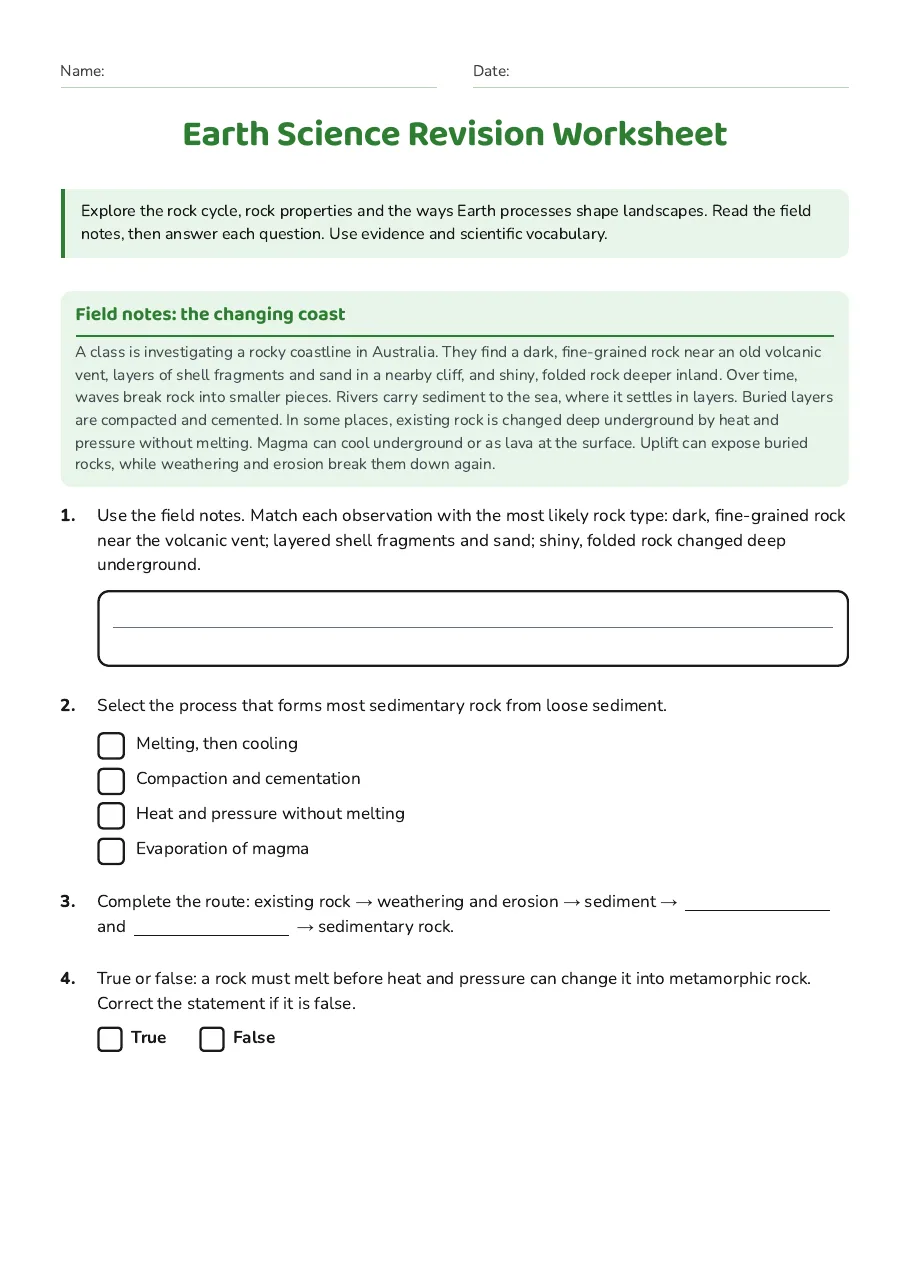
  • Earth Science Revision Worksheet, page 1 of 2: Field notes: the changing coast

    Page 1

  • Earth Science Revision Worksheet, page 2 of 2: 5. Use the field notes. Which two processes can turn igneous rock into sediment, and what…

    Page 2

About This Worksheet

Free in Kuraplan

Sign up free, grab the PDF, and customize it for your class.

Print-Ready

Formatted for standard paper. Clean layout, easy to read.

AI-Generated

Created with Kuraplan's AI, designed for real classroom use.

For Teachers & Parents

Use in classrooms, for homework, tutoring, or homeschool.

Need a custom version of this worksheet?

Kuraplan's AI generates custom worksheets in seconds — differentiated for every learner, aligned to your curriculum.

Generate Custom Worksheets — Free
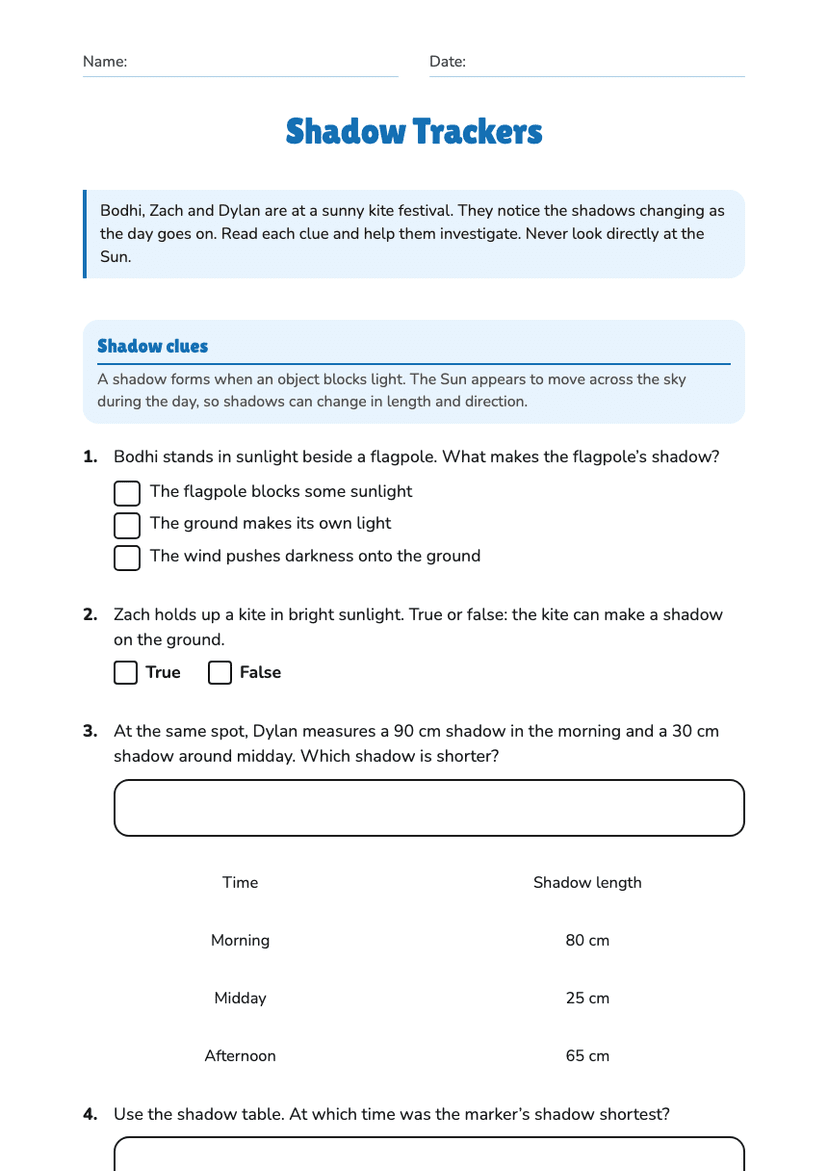
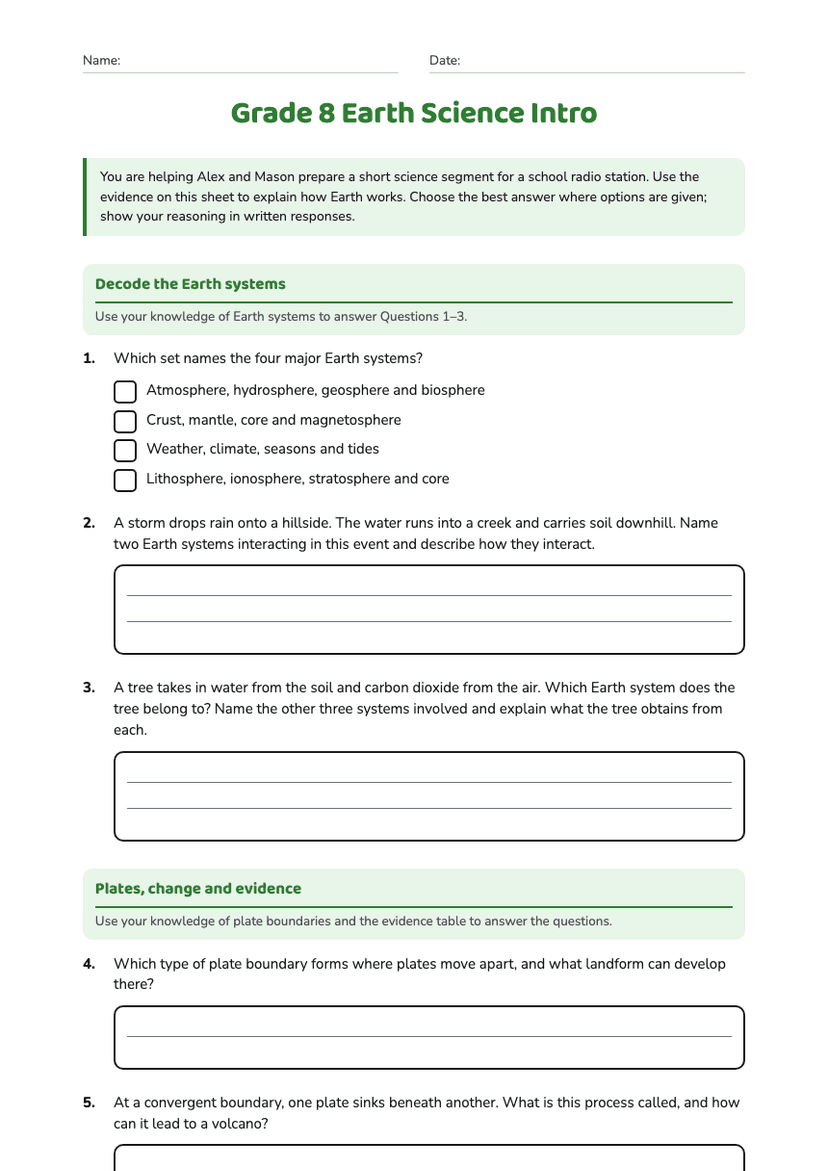
No credit card Curriculum-aligned Under 60 seconds