ScienceFreePrintable

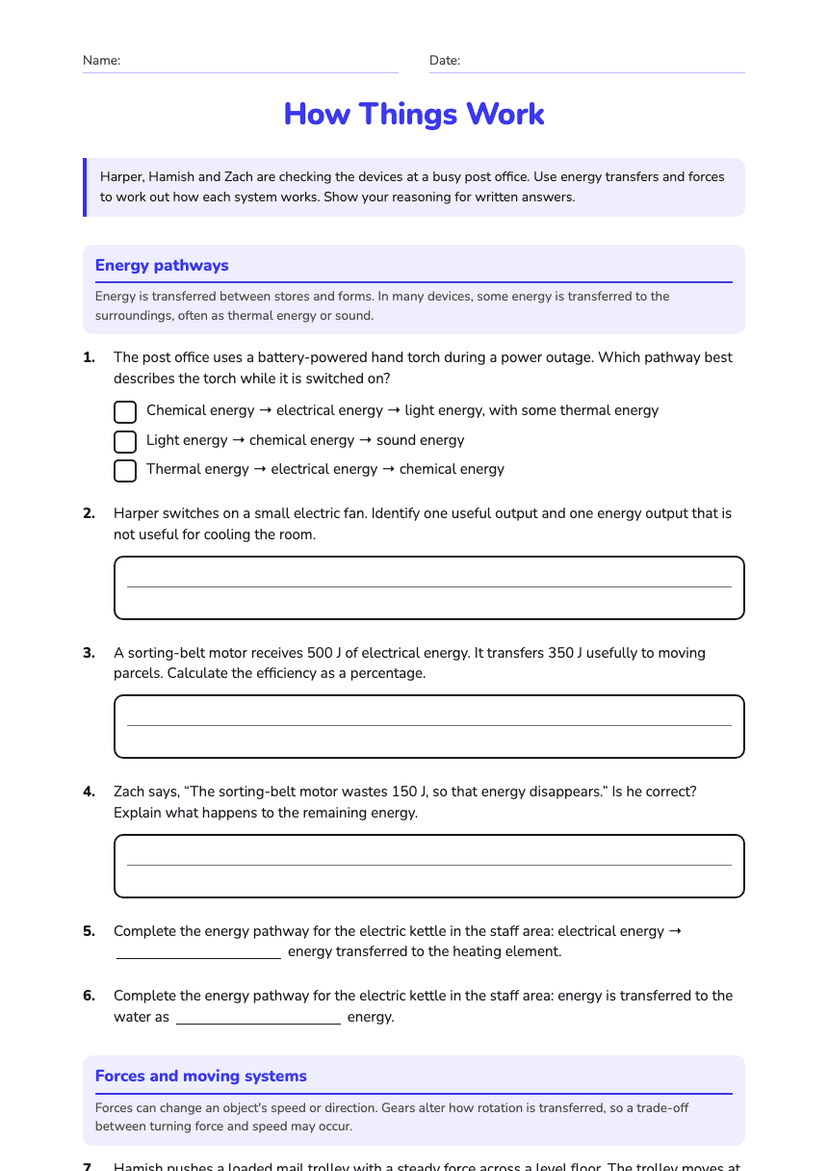
Energy in Action Worksheet

A free science worksheet ready for your classroom. Open in Kuraplan to grab the print-ready PDF, customize it for your students, or generate a fresh version in seconds.
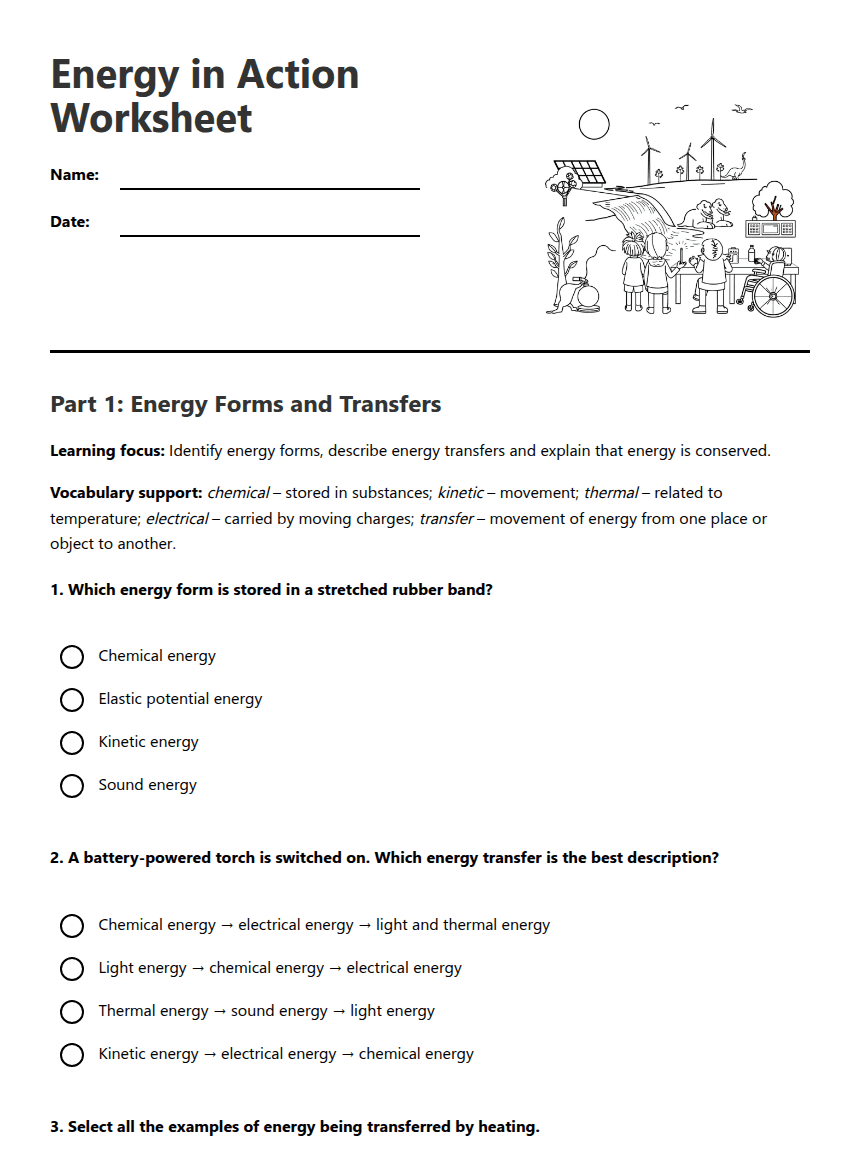
Energy in Action Worksheet worksheet preview
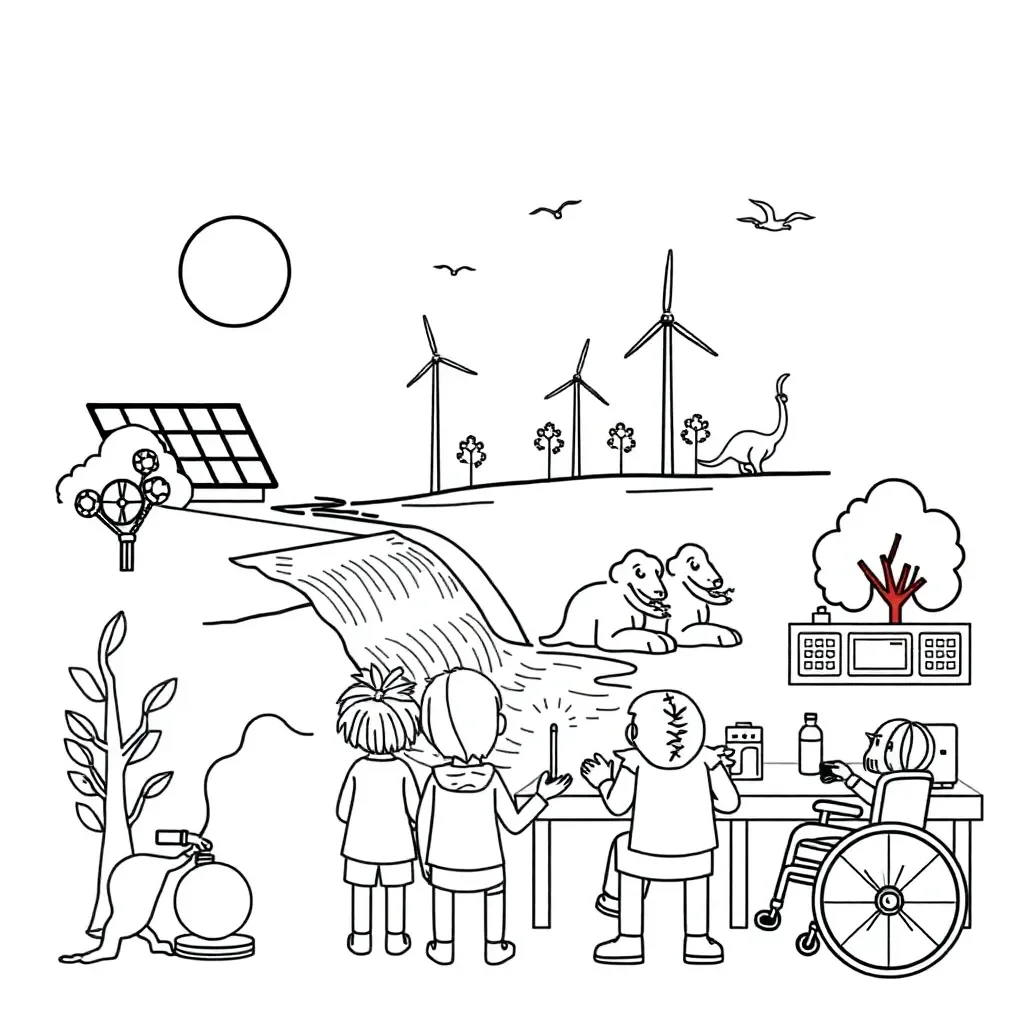
Energy in Action Worksheet

Worksheet illustration

Part 1: Energy Forms and Transfers

Learning focus: Identify energy forms, describe energy transfers and explain that energy is conserved.

Vocabulary support: chemical – stored in substances; kinetic – movement; thermal – related to temperature; electrical – carried by moving charges; transfer – movement of energy from one place or object to another.

1. Which energy form is stored in a stretched rubber band?

Chemical energy

Elastic potential energy

Kinetic energy

Sound energy

2. A battery-powered torch is switched on. Which energy transfer is the best description?

Chemical energy → electrical energy → light and thermal energy

Light energy → chemical energy → electrical energy

Thermal energy → sound energy → light energy

Kinetic energy → electrical energy → chemical energy

3. Select all the examples of energy being transferred by heating.

A saucepan warming on a hotplate

Sunlight reaching your skin

A speaker producing sound

A warm drink cooling on a table

4. Match each device to its main useful energy output. Draw a line between each pair.
a. Electric fan
b. Solar panel
c. Microwave oven
d. Bicycle bell
Electrical energy
Sound energy
Kinetic energy
Thermal energy

Part 2: Use Evidence to Explain Energy

Remember: Energy is not created or destroyed. It is transferred between objects or transformed from one form to another. Some energy spreads to the surroundings, often as thermal or sound energy.

5. Write the energy transformation for a person eating food and riding a bicycle. Include at least three energy forms.
6. A kettle receives 2,000 joules (J) of electrical energy. The water gains 1,600 J of thermal energy, while 400 J is transferred to the kettle and surrounding air. Complete the calculation.

Useful energy ÷ total input energy × 100 = ________ ÷ 2,000 × 100 = ________%

7. Is the kettle 100% efficient? Use the data from Question 6 to justify your answer.
8. Two identical torches use the same batteries. Torch A produces a bright beam but becomes warm. Torch B produces a dim beam and stays cool. Which torch transfers more energy to its useful output? Explain your reasoning and identify one form of wasted or less useful energy.

Part 3: Energy in Everyday Life

Choose one device you have used today, such as a phone, toaster, bicycle, heater or computer.

9. Name your device and describe its energy input, useful output and one energy transfer to the surroundings.

Device: ________________________________

Input energy: ___________________________ Useful output: ___________________________

10. Suggest one design change that could make your device more efficient. Explain how your change would reduce unwanted energy transfers.

About This Worksheet

Free in Kuraplan

Sign up free, grab the PDF, and customize it for your class.

Print-Ready

Formatted for standard paper. Clean layout, easy to read.

AI-Generated

Created with Kuraplan's AI, designed for real classroom use.

For Teachers & Parents

Use in classrooms, for homework, tutoring, or homeschool.

Need a custom version of this worksheet?

Kuraplan's AI generates custom worksheets in seconds — differentiated for every learner, aligned to your curriculum.

Generate Custom Worksheets — Free
No credit card Curriculum-aligned Under 60 seconds