Earth and Rock Cycle Cheat Sheet
A free science worksheet ready for your classroom. Open in Kuraplan to grab the print-ready PDF, customize it for your students, or generate a fresh version in seconds.
Earth and Rock Cycle Cheat Sheet
🌏 Earth’s Layers and Geological Time
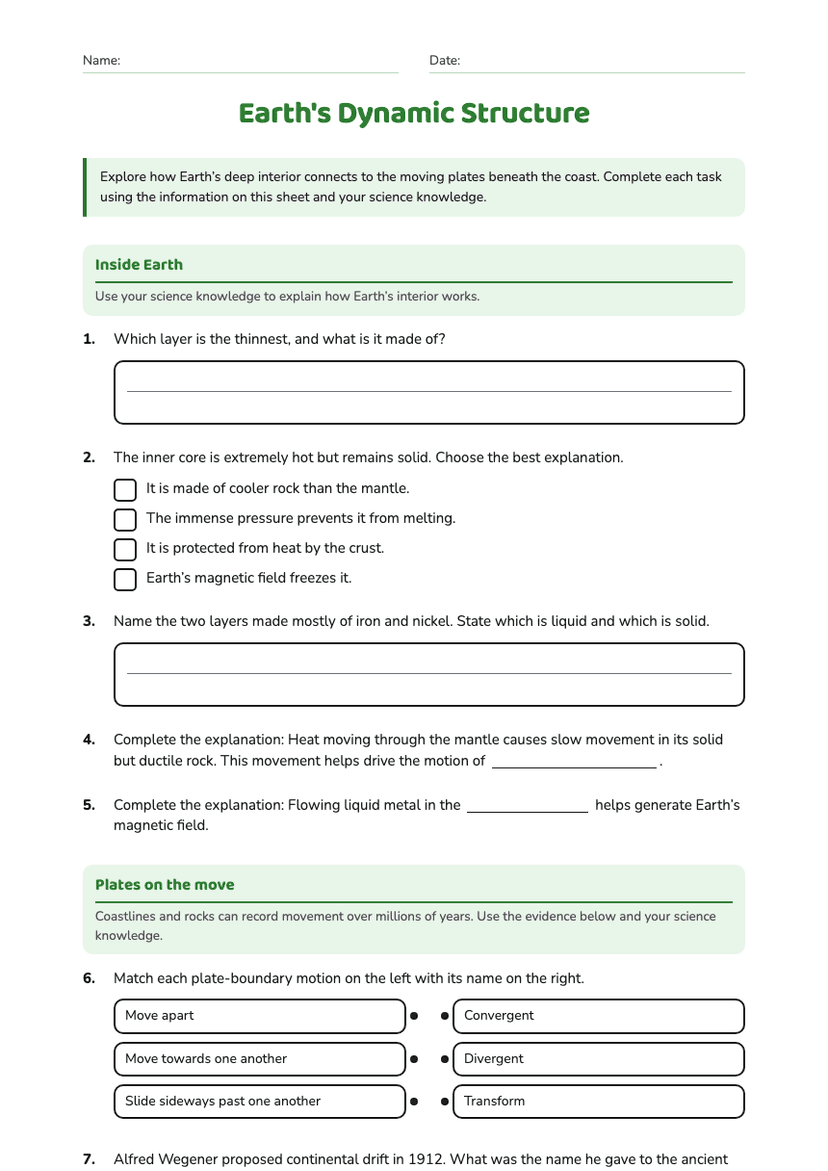
Crust: The thin, solid outer layer made of rock. It is about 5–70 km thick and is thickest beneath continents.
Mantle: The thickest layer, made of solid and partly molten rock. Mantle material can move slowly because of heat.
Outer core: A liquid mixture mainly of iron and nickel. Its movement helps generate Earth’s magnetic field.
Inner core: A solid mixture mainly of iron and nickel. Extreme pressure keeps it solid, even at very high temperatures.
Memory cue: C-M-O-I = Crust, Mantle, Outer core, Inner core.
With increasing depth: Temperature and pressure generally increase. Pressure is caused by the weight of the material above.
Geological time: Earth’s history is divided into very long intervals called eons, eras and periods. Relative dating compares the ages of rocks and layers rather than giving an exact numerical age.
Law of superposition: In undisturbed sedimentary layers, lower layers are generally older than the layers above them. Folding, faulting, erosion or volcanic activity can disturb this order.
Solid iron–nickel centre: ____________________
Liquid iron–nickel layer: ____________________
Thin outer rock layer: ____________________
Thick layer of hot rock: ____________________
🪨 Rocks and the Rock Cycle
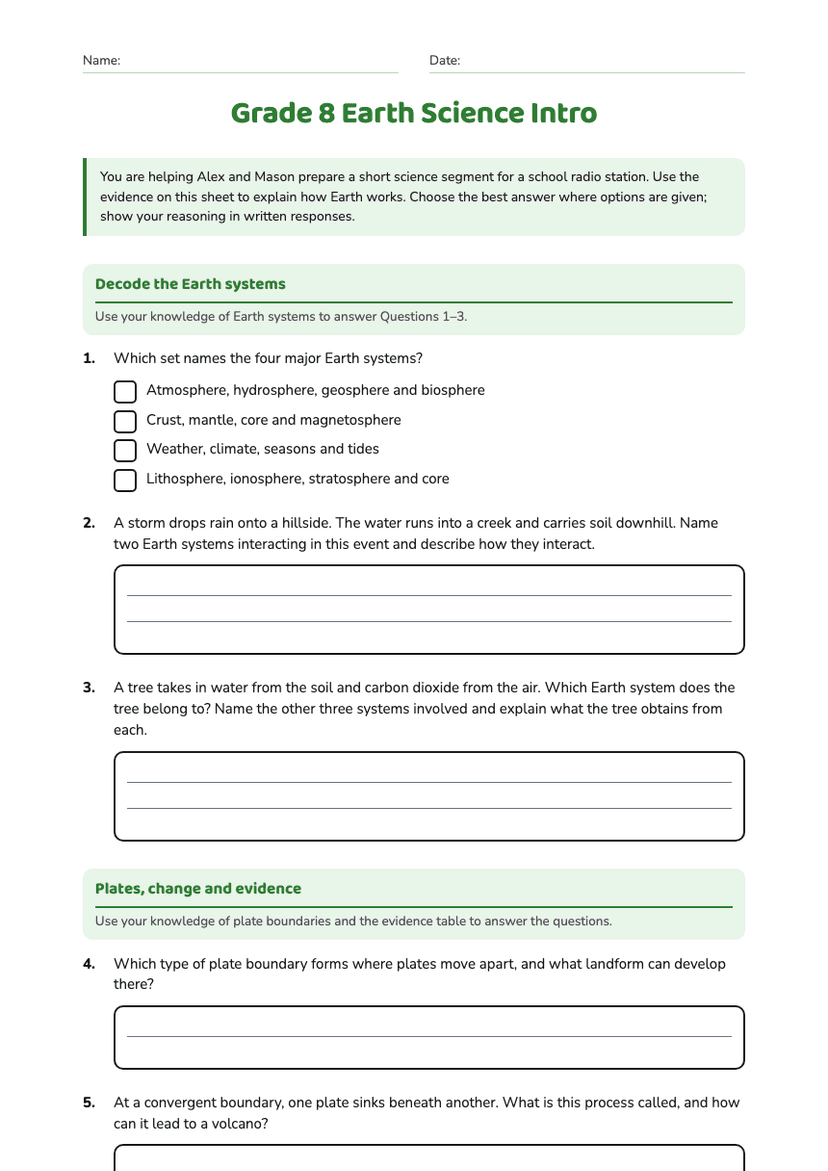
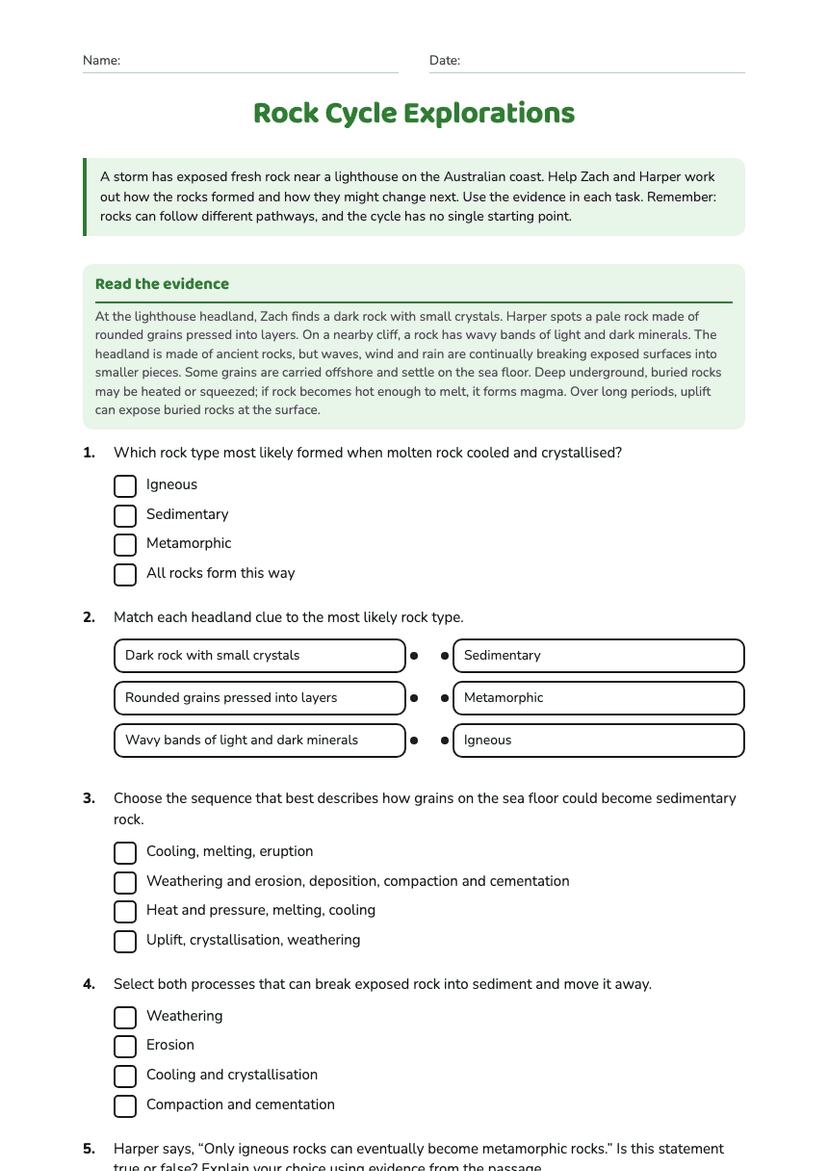
Igneous rocks: Form when magma or lava cools and crystallises. They are often hard and may contain visible crystals. Examples include granite and basalt. Uses include building stone, roads and kitchen benches.
Sedimentary rocks: Form when sediment is deposited, then compacted and cemented. They commonly have layers and may contain fossils. Examples include sandstone, shale and limestone. Uses include building materials, cement and some sources of fossil fuels.
Metamorphic rocks: Form when existing rock is changed by heat and pressure without melting. They may have bands, flattened crystals or a new texture. Examples include marble and slate. Uses include tiles, roofing and sculptures.
Magma is molten rock below Earth’s surface. Lava is molten rock that reaches the surface.
Key processes: Weathering and erosion break down and move rock. Deposition drops sediment. Compaction and cementation form sedimentary rock. Cooling and crystallisation form igneous rock. Heat and pressure cause metamorphism. Melting forms magma.
Rock-cycle flow diagram:
Existing rock → weathering and erosion → sediment → deposition, compaction and cementation → sedimentary rock
Any rock → heat and pressure → metamorphic rock → melting → magma
Magma → cooling and crystallisation → igneous rock
The arrows can go in many directions. The rock cycle is not a one-way process: any rock type can be changed into another through different processes.
🔎 Apply Your Knowledge: Hazards and Rock Identification
Natural hazards: A landslide is the rapid movement of rock, soil or debris down a slope. A lahar is a fast-moving volcanic mudflow containing water, ash, mud and rock. Both can transport and deposit sediment.
Colour: ____________________ Grain or crystal size: ____________________
Layers or bands: ____________________ Texture: ____________________
Hardness: ____________________ Fossils: ____________________
Holes or vesicles: ____________________
Sentence starters for strong explanations
“The rock’s __________ property suggests it formed when __________.”
“Because this rock has __________, it is likely to be __________ rock.”
“Its formation explains its use because __________.”
“The rock is suitable for __________ because it is __________.”
Remember: Link formation → properties → use. For example, slow cooling can produce large crystals, which may make a rock strong and useful as a building material.
Australian Curriculum: AC9S8U04
About This Worksheet
Free in Kuraplan
Sign up free, grab the PDF, and customize it for your class.
Print-Ready
Formatted for standard paper. Clean layout, easy to read.
AI-Generated
Created with Kuraplan's AI, designed for real classroom use.
For Teachers & Parents
Use in classrooms, for homework, tutoring, or homeschool.
Need a custom version of this worksheet?
Kuraplan's AI generates custom worksheets in seconds — differentiated for every learner, aligned to your curriculum.
Generate Custom Worksheets — Free