Environment and Homeostasis
A free science worksheet ready for your classroom. Open in Kuraplan to grab the print-ready PDF, customize it for your students, or generate a fresh version in seconds.
Environment and Homeostasis
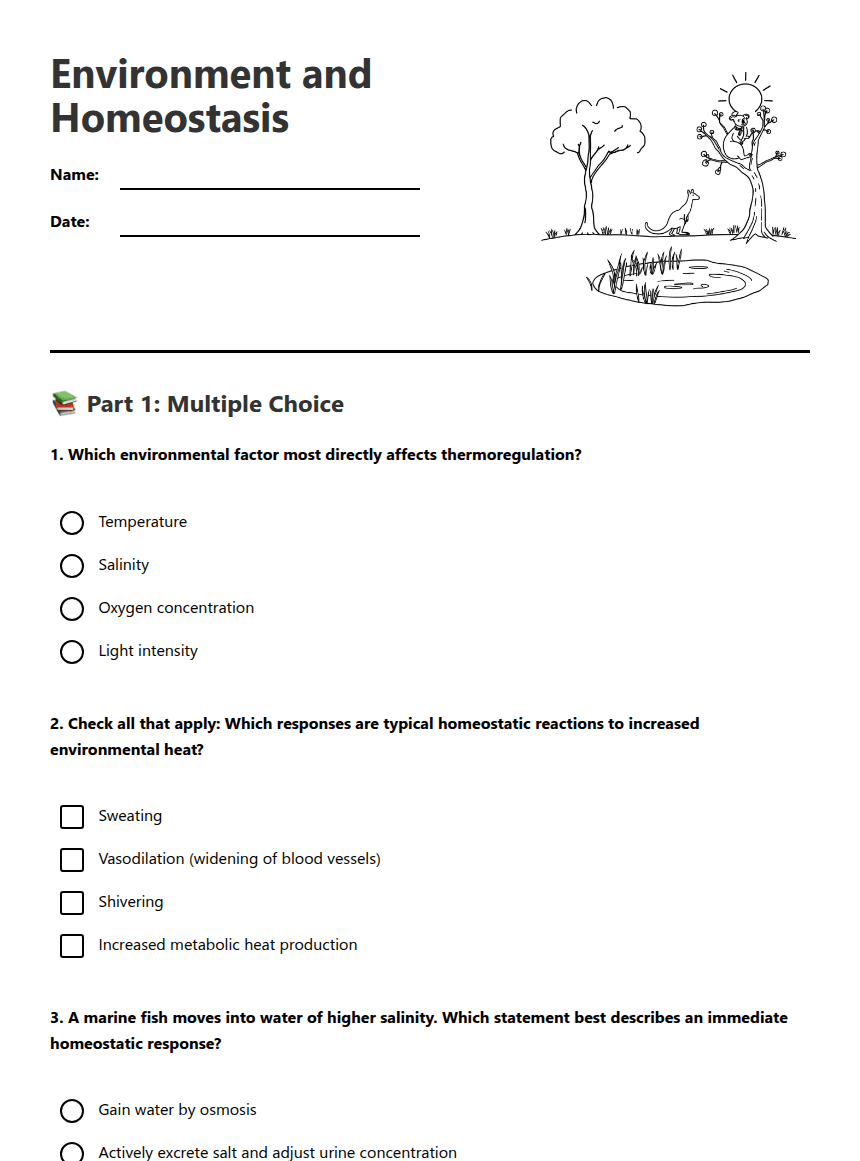
📚 Part 1: Multiple Choice
✏️ Part 2: Short Answers & Activities
Success criteria: I can list environmental factors that affect homeostasis; explain how a homeostatic response restores balance; give an organism example; suggest an extension research topic.
Differentiation strategies: Sentence starters and glossary provided for students needing support. Challenge prompts and extension tasks available for advanced learners. Work in pairs if helpful.
Extension activities (for advanced learners): Research and prepare a short summary on one of the following—coral bleaching from warming seas, kangaroo physiological adaptations to drought, or how Antarctic fish prevent ice crystal formation. Include a recent study or data point.
Teacher note: Use the answers to assess understanding and support group presentations: check correct identification of factors, clarity of mechanistic explanations and suggested examples.
About This Worksheet
Free in Kuraplan
Sign up free, grab the PDF, and customize it for your class.
Print-Ready
Formatted for standard paper. Clean layout, easy to read.
AI-Generated
Created with Kuraplan's AI, designed for real classroom use.
For Teachers & Parents
Use in classrooms, for homework, tutoring, or homeschool.
Need a custom version of this worksheet?
Kuraplan's AI generates custom worksheets in seconds — differentiated for every learner, aligned to your curriculum.
Generate Custom Worksheets — FreeMore Science Worksheets

Rainforest Explorers Worksheet
Free
Ocean Acidification Basics
Free
Marine Ecosystems and Impacts
Free
Ecosystem Interaction Scenarios
Free
Food Chains and Webs
Free
Copy of Biomes and Their Features
Free
Reducing Resource Impact Worksheet
Free