MathsFreePrintable

Equally Likely Outcomes

A free maths worksheet ready for your classroom. Open in Kuraplan to grab the print-ready PDF, customize it for your students, or generate a fresh version in seconds.
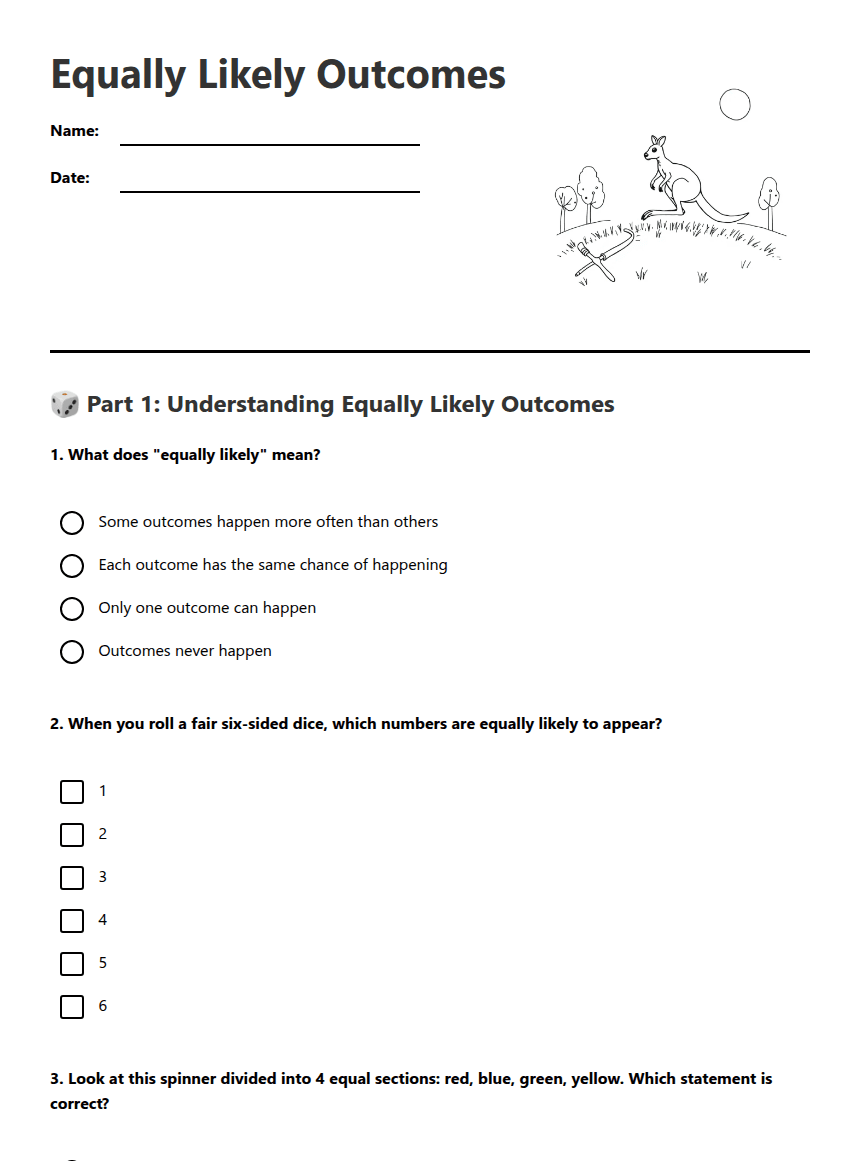
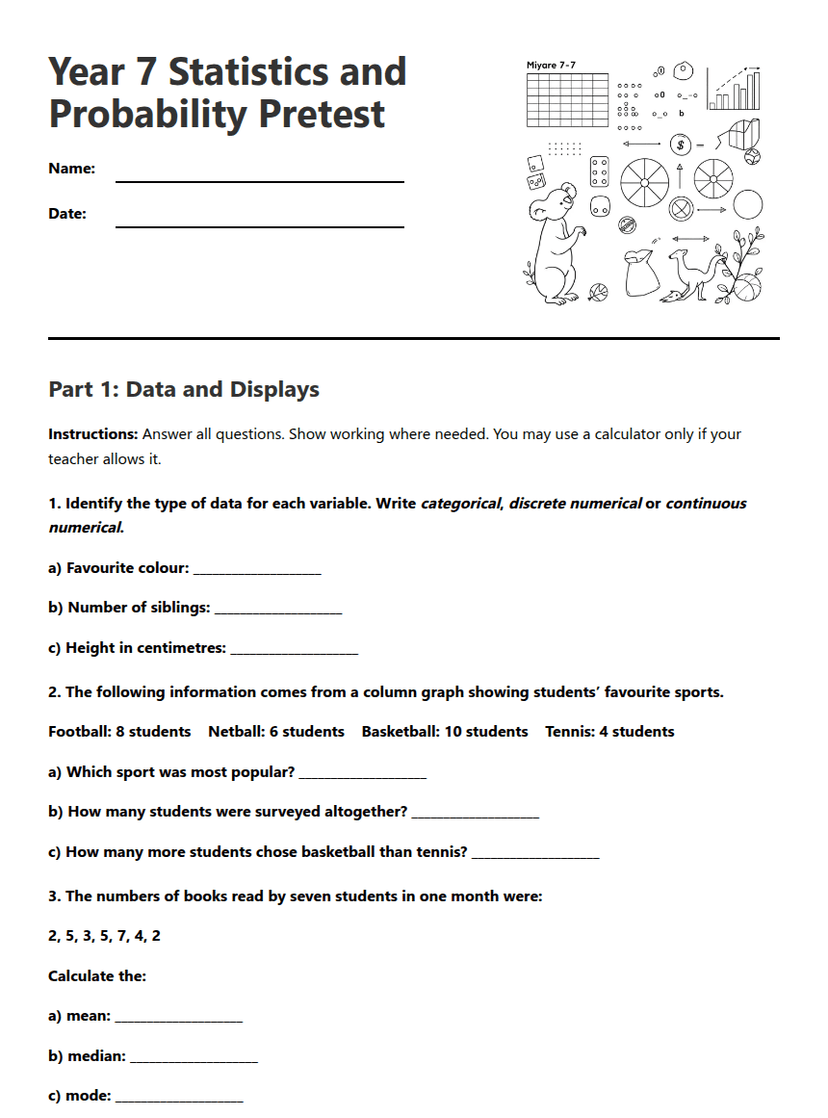
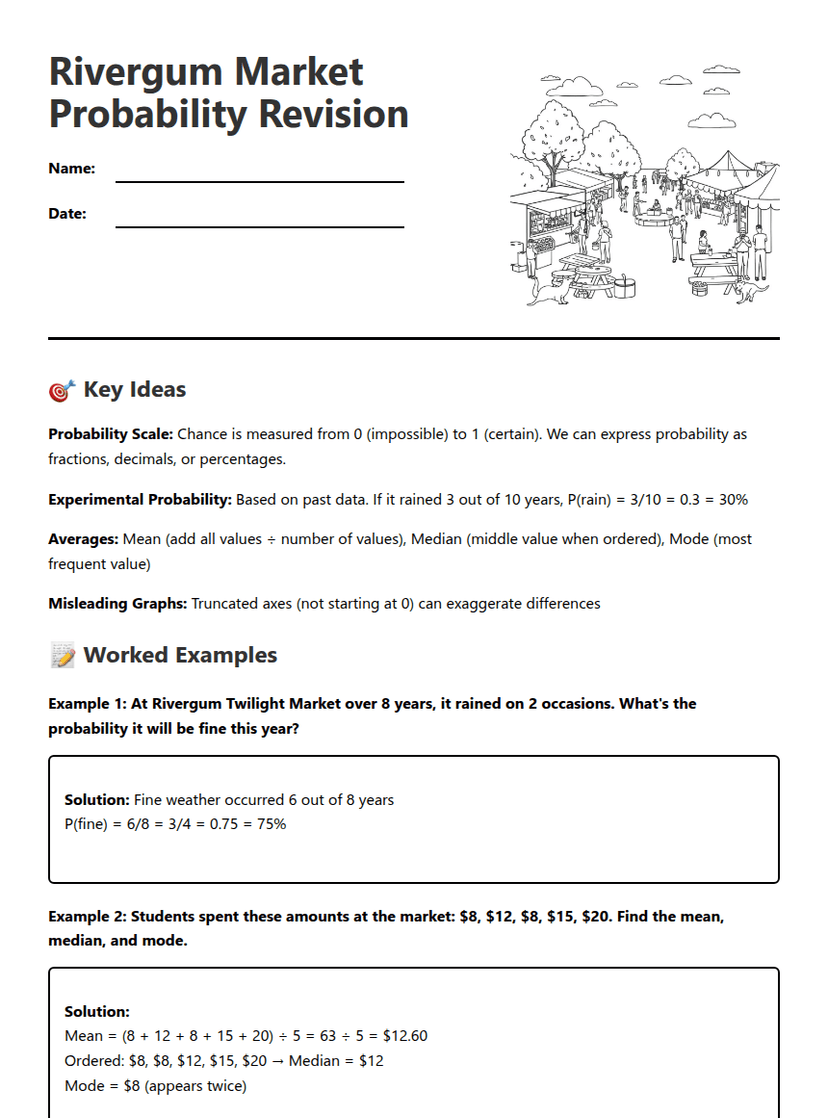
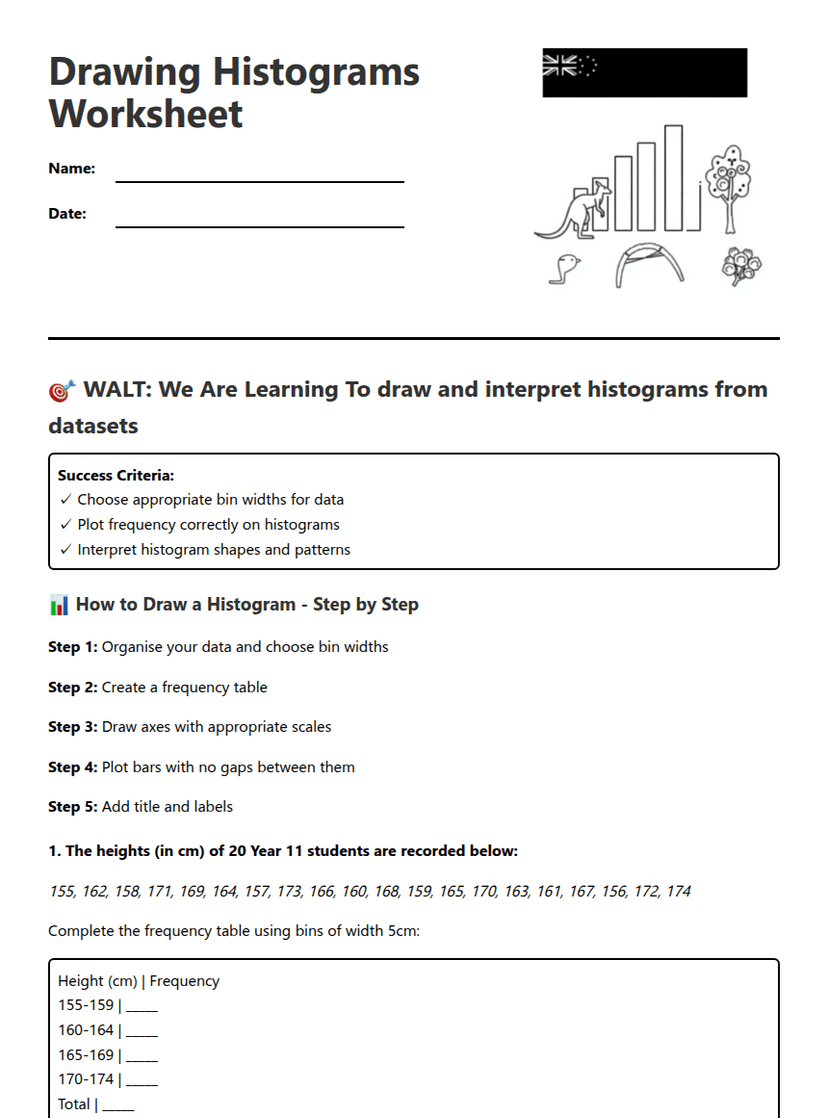
Equally Likely Outcomes worksheet preview
Equally Likely Outcomes

Dice and spinner illustration

🎲 Part 1: Understanding Equally Likely Outcomes

1. What does "equally likely" mean?

Some outcomes happen more often than others

Each outcome has the same chance of happening

Only one outcome can happen

Outcomes never happen

2. When you roll a fair six-sided dice, which numbers are equally likely to appear?

1

2

3

4

5

6

3. Look at this spinner divided into 4 equal sections: red, blue, green, yellow. Which statement is correct?

Red is most likely to win

All colours are equally likely

Yellow is least likely to win

Blue and green are more likely than red and yellow

4. Circle the examples that show equally likely outcomes:

Flipping a coin (heads or tails)

Picking a marble from a bag with 5 red and 2 blue marbles

Spinning a wheel with 6 equal sections

Rolling a standard dice

📊 Part 2: Predictions and Experiments

5. Before rolling a dice 20 times, predict: Will each number (1-6) appear exactly the same number of times?
6. Complete this dice experiment recording table. Roll a dice 10 times and tally your results:

Dice Roll Results:

Number 1: _________________ (tally marks)

Number 2: _________________ (tally marks)

Number 3: _________________ (tally marks)

Number 4: _________________ (tally marks)

Number 5: _________________ (tally marks)

Number 6: _________________ (tally marks)

7. After your experiment, explain: Did each number appear the same number of times? Why or why not?
8. Design your own fair spinner. Draw a spinner with 4 equal sections and colour each section differently. Explain why your spinner shows equally likely outcomes.

Explanation: _________________________________________________

____________________________________________________________

🤔 Part 3: Thinking About Fairness

9. Sam says: "I rolled my dice 5 times and got three 6s. The dice must be unfair!" Do you agree with Sam? Explain your thinking.
10. Which spinner would be fair for a game between 3 friends?

A spinner with 2 equal sections

A spinner with 3 equal sections

A spinner with 1 large section and 2 small sections

A spinner with 6 equal sections

11. Give one real-life example of equally likely outcomes that you might see at home or school:

About This Worksheet

Free in Kuraplan

Sign up free, grab the PDF, and customize it for your class.

Print-Ready

Formatted for standard paper. Clean layout, easy to read.

AI-Generated

Created with Kuraplan's AI, designed for real classroom use.

For Teachers & Parents

Use in classrooms, for homework, tutoring, or homeschool.

Need a custom version of this worksheet?

Kuraplan's AI generates custom worksheets in seconds — differentiated for every learner, aligned to your curriculum.

Generate Custom Worksheets — Free
No credit card Curriculum-aligned Under 60 seconds