HealthFreePrintable

Food Label Analysis

A free health worksheet ready for your classroom. Open in Kuraplan to grab the print-ready PDF, customize it for your students, or generate a fresh version in seconds.
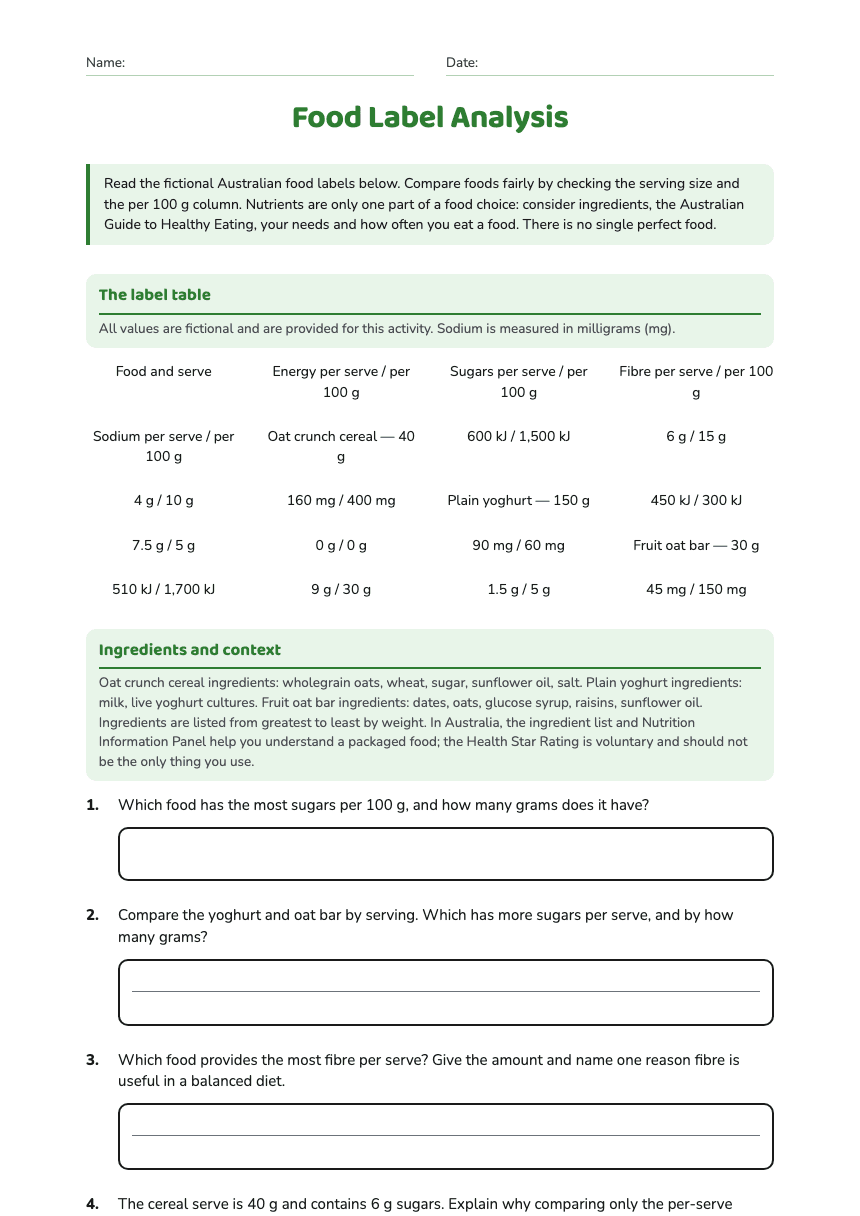
Food Label Analysis worksheet preview
Name:Date:

Food Label Analysis

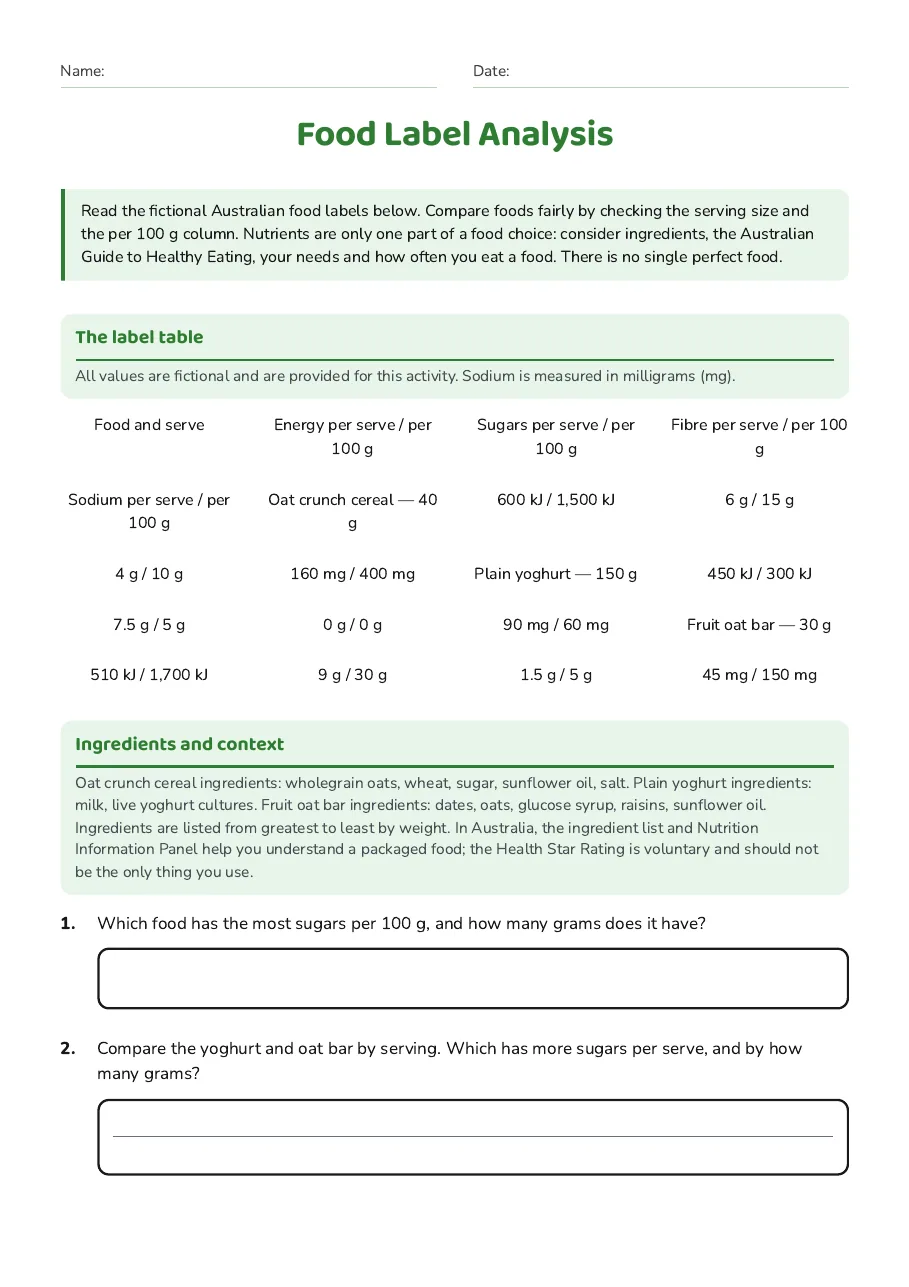
Read the fictional Australian food labels below. Compare foods fairly by checking the serving size and the per 100 g column. Nutrients are only one part of a food choice: consider ingredients, the Australian Guide to Healthy Eating, your needs and how often you eat a food. There is no single perfect food.

The label table

All values are fictional and are provided for this activity. Sodium is measured in milligrams (mg).

Food and serve

Energy per serve / per 100 g

Sugars per serve / per 100 g

Fibre per serve / per 100 g

Sodium per serve / per 100 g

Oat crunch cereal — 40 g

600 kJ / 1,500 kJ

6 g / 15 g

4 g / 10 g

160 mg / 400 mg

Plain yoghurt — 150 g

450 kJ / 300 kJ

7.5 g / 5 g

0 g / 0 g

90 mg / 60 mg

Fruit oat bar — 30 g

510 kJ / 1,700 kJ

9 g / 30 g

1.5 g / 5 g

45 mg / 150 mg

Ingredients and context

Oat crunch cereal ingredients: wholegrain oats, wheat, sugar, sunflower oil, salt. Plain yoghurt ingredients: milk, live yoghurt cultures. Fruit oat bar ingredients: dates, oats, glucose syrup, raisins, sunflower oil. Ingredients are listed from greatest to least by weight. In Australia, the ingredient list and Nutrition Information Panel help you understand a packaged food; the Health Star Rating is voluntary and should not be the only thing you use.

1.Which food has the most sugars per 100 g, and how many grams does it have?
2.Compare the yoghurt and oat bar by serving. Which has more sugars per serve, and by how many grams?
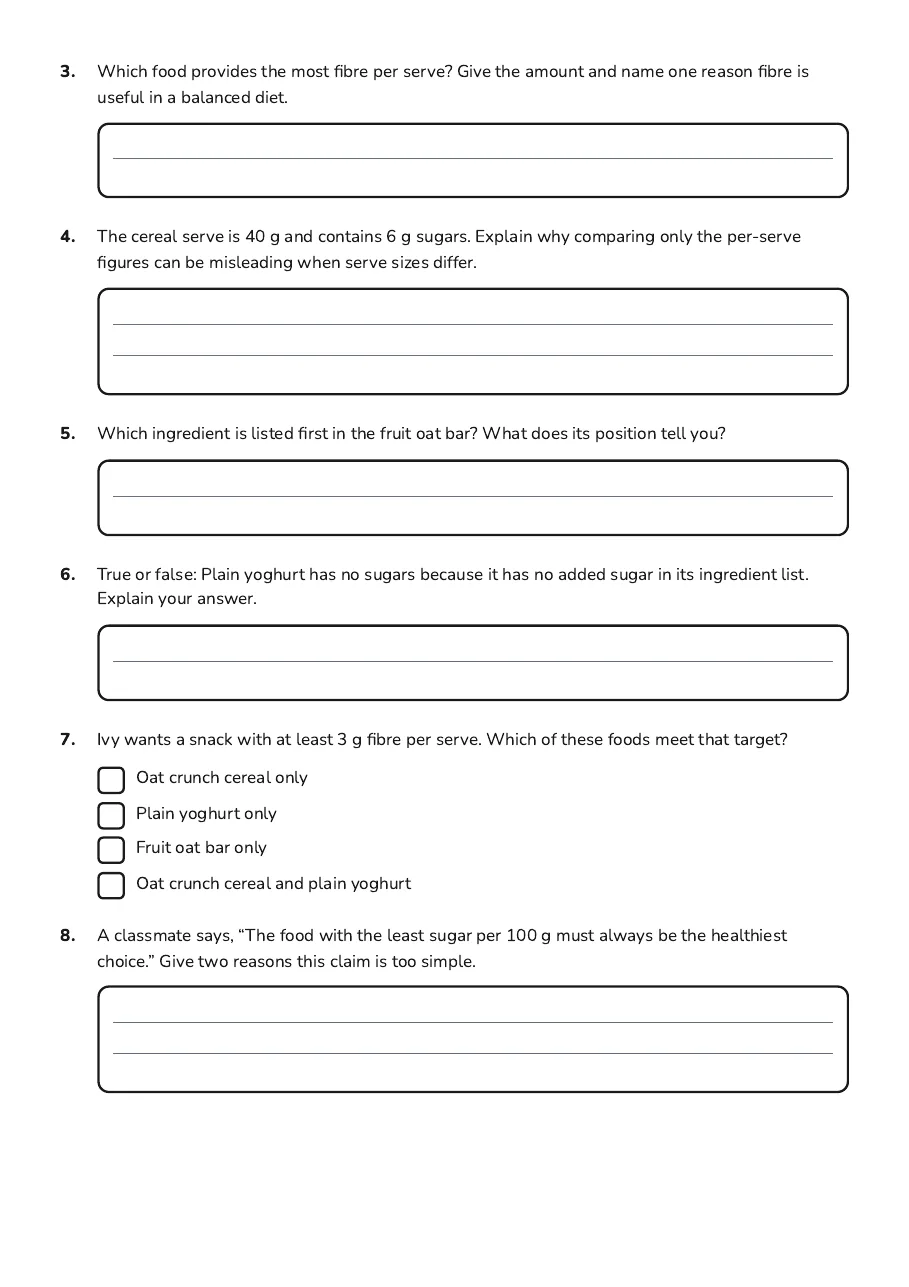
3.Which food provides the most fibre per serve? Give the amount and name one reason fibre is useful in a balanced diet.
4.The cereal serve is 40 g and contains 6 g sugars. Explain why comparing only the per-serve figures can be misleading when serve sizes differ.
5.Which ingredient is listed first in the fruit oat bar? What does its position tell you?
6.True or false: Plain yoghurt has no sugars because it has no added sugar in its ingredient list. Explain your answer.
7.Ivy wants a snack with at least 3 g fibre per serve. Which of these foods meet that target?
  • Oat crunch cereal only
  • Plain yoghurt only
  • Fruit oat bar only
  • Oat crunch cereal and plain yoghurt
8.A classmate says, “The food with the least sugar per 100 g must always be the healthiest choice.” Give two reasons this claim is too simple.
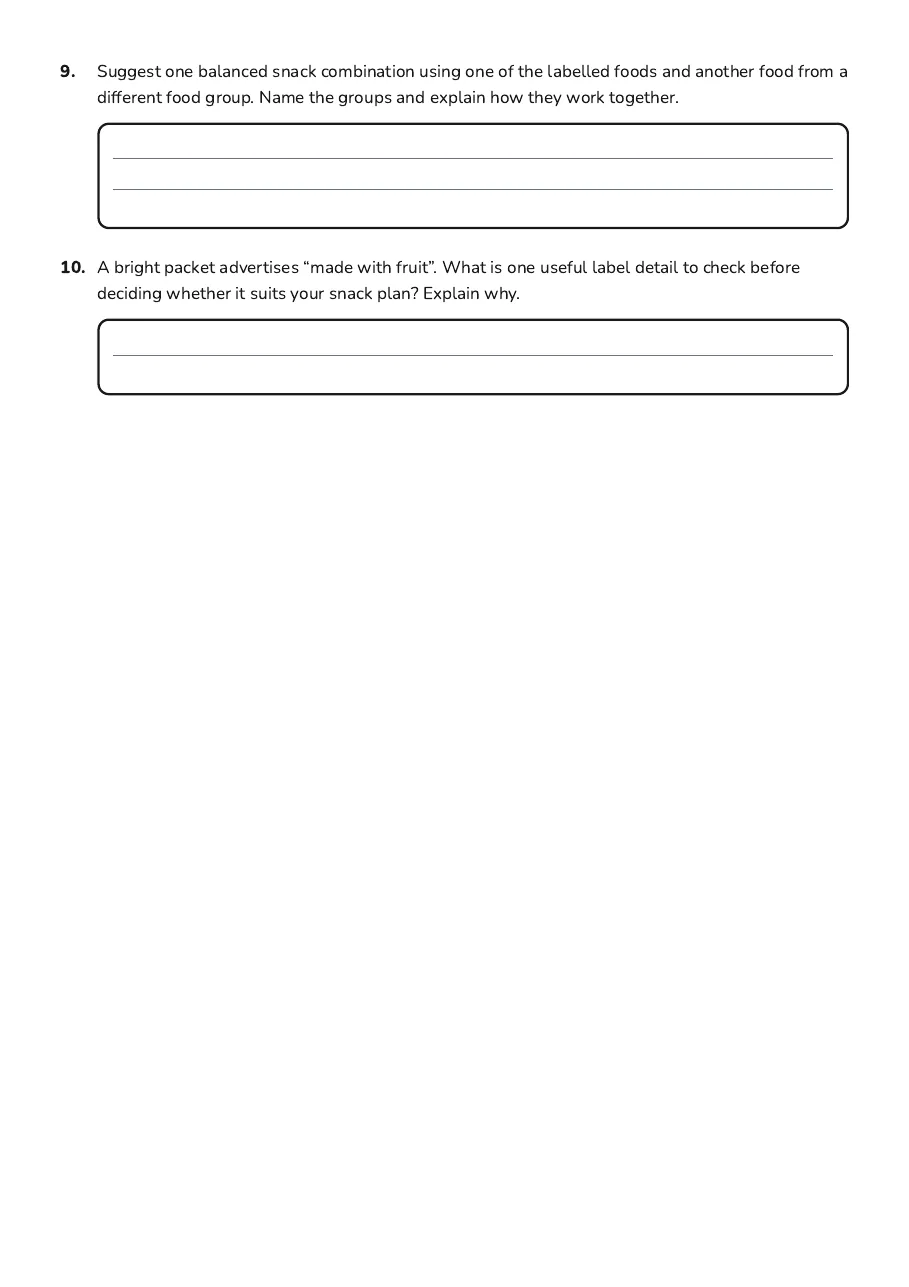
9.Suggest one balanced snack combination using one of the labelled foods and another food from a different food group. Name the groups and explain how they work together.
10.A bright packet advertises “made with fruit”. What is one useful label detail to check before deciding whether it suits your snack plan? Explain why.

3 printable pages

  • Food Label Analysis, page 1 of 3: The label table, Ingredients and context

    Page 1

  • Food Label Analysis, page 2 of 3: 3. Which food provides the most fibre per serve? Give the amount and name one reason…

    Page 2

  • Food Label Analysis, page 3 of 3: 9. Suggest one balanced snack combination using one of the labelled foods and another…

    Page 3

About This Worksheet

Free in Kuraplan

Sign up free, grab the PDF, and customize it for your class.

Print-Ready

Formatted for standard paper. Clean layout, easy to read.

AI-Generated

Created with Kuraplan's AI, designed for real classroom use.

For Teachers & Parents

Use in classrooms, for homework, tutoring, or homeschool.

Need a custom version of this worksheet?

Kuraplan's AI generates custom worksheets in seconds — differentiated for every learner, aligned to your curriculum.

Generate Custom Worksheets — Free
No credit card Curriculum-aligned Under 60 seconds