MathsFreePrintable

Grade 8 Probability Mastery

A free maths worksheet ready for your classroom. Open in Kuraplan to grab the print-ready PDF, customize it for your students, or generate a fresh version in seconds.
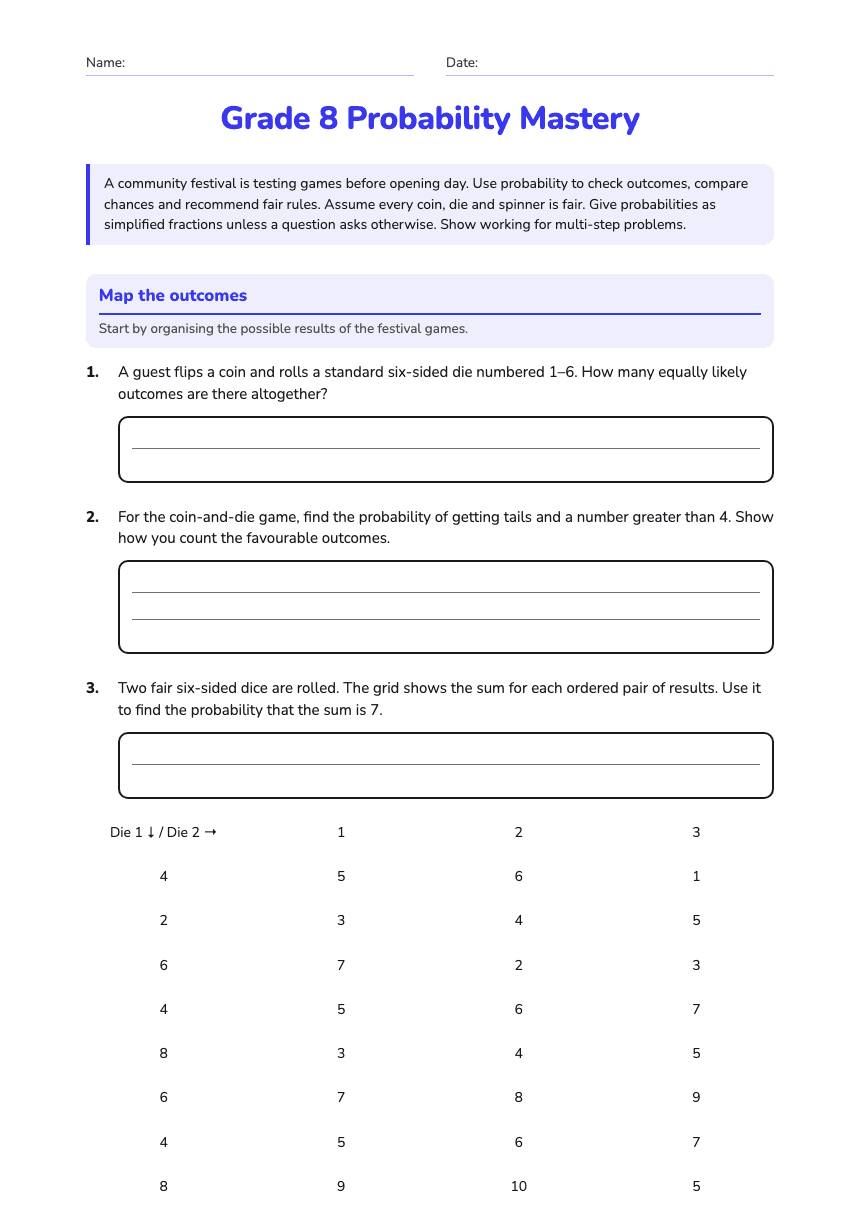
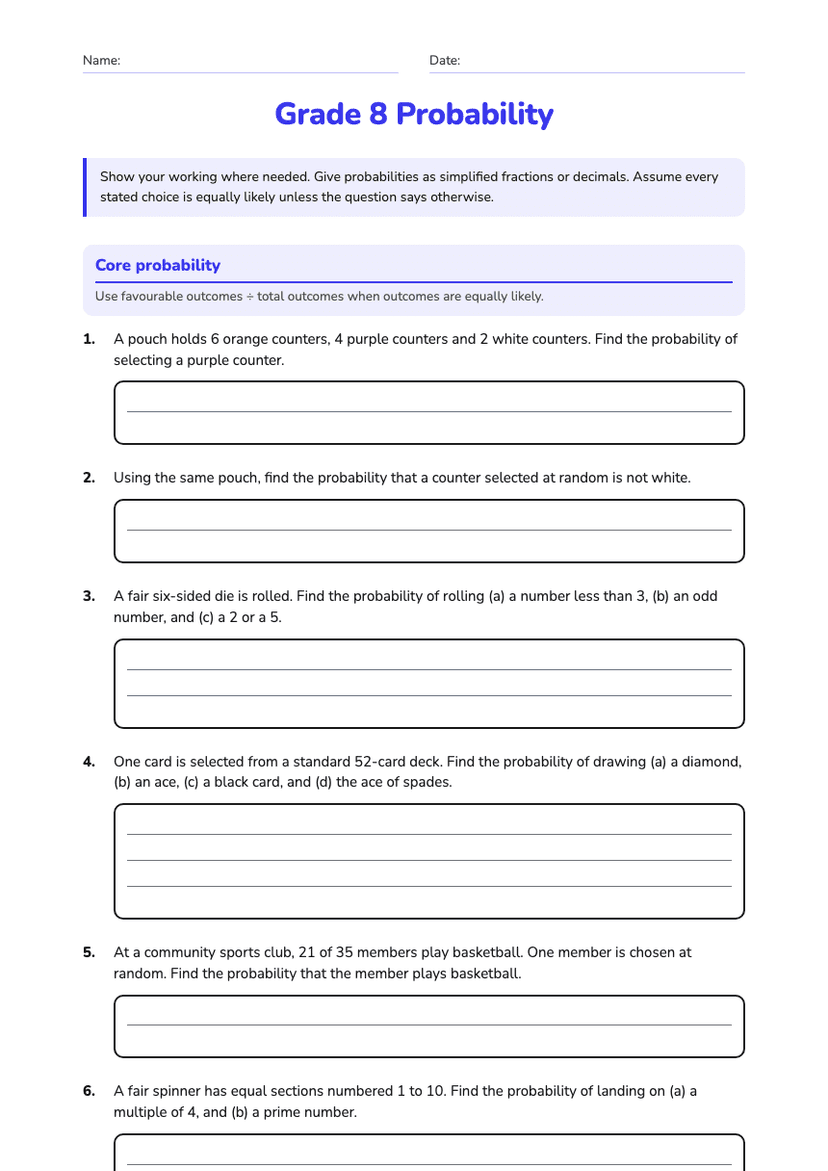
Grade 8 Probability Mastery worksheet preview
```html

Grade 8 Probability Mastery

Year 8 Mathematics — Victorian Curriculum

Probability worksheet illustration

🎯 Success Criteria

By the end of this worksheet, you will be able to:

✅ Construct and interpret tree diagrams to list sample spaces and calculate probabilities

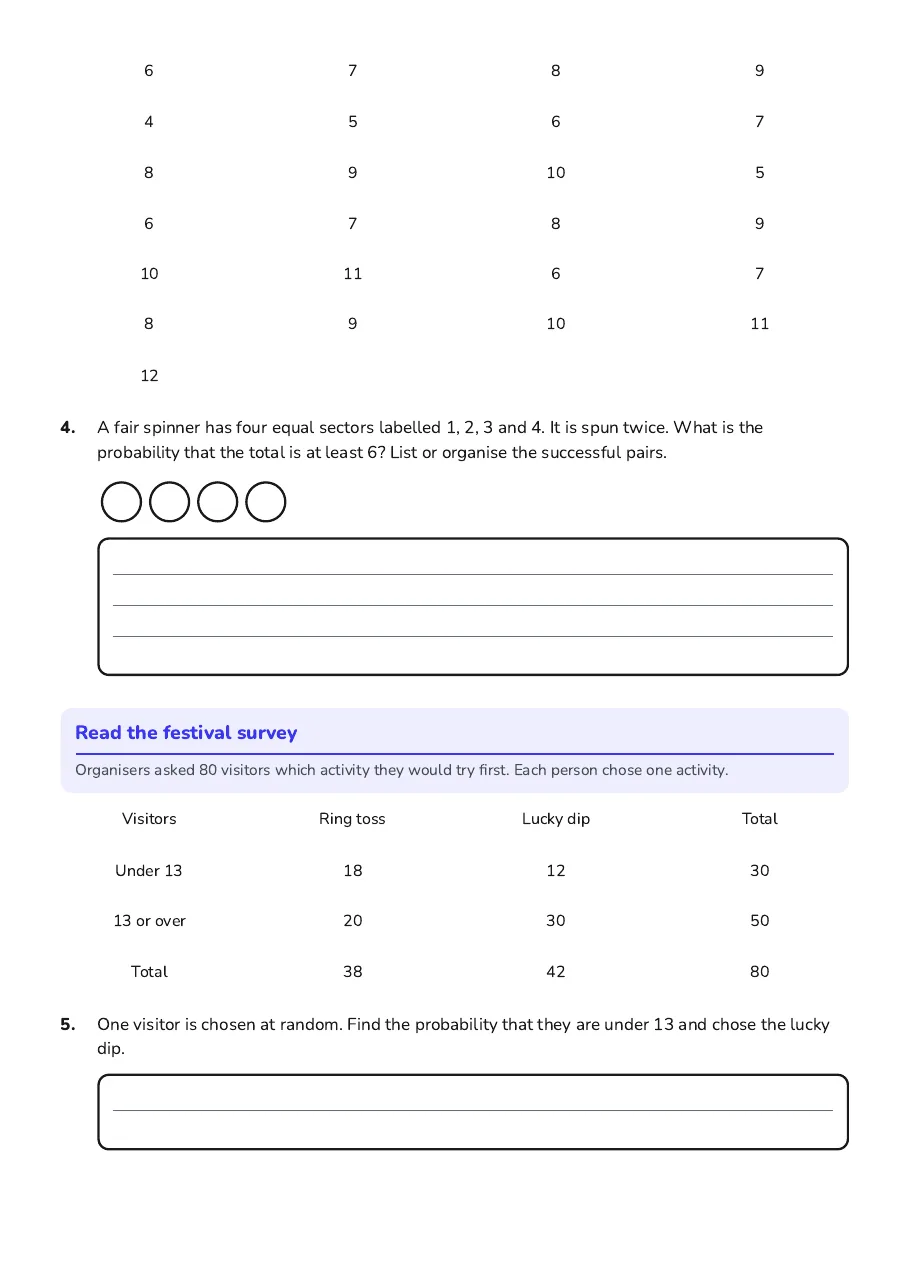
✅ Read and complete two-way tables and calculate probabilities from them

✅ Draw and interpret Venn diagrams to find probabilities, including unions and intersections

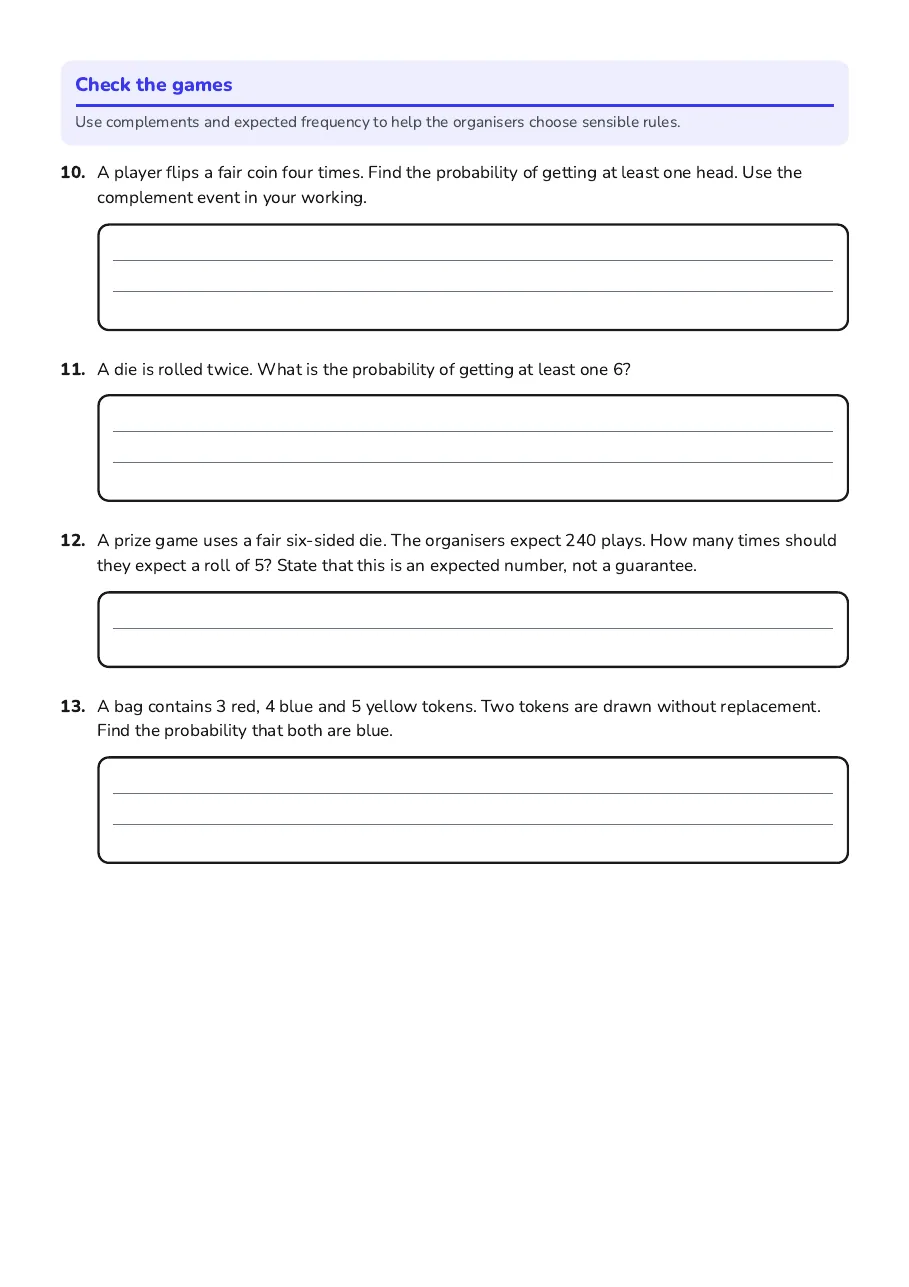
✅ Calculate 'at least' and 'at most' probabilities using complementary events

✅ Apply probability concepts to real-world contexts including cards, dice, letters, and coins

Differentiation Note for Students: Questions marked 🌱 are foundational, ⭐ are core, and 🚀 are extension/challenge questions.

🌳 Part 1: Tree Diagrams

Show all working. Express probabilities as fractions, decimals, or percentages unless stated otherwise.

Q1. 🌱 A coin is flipped twice. Complete the tree diagram below and list all possible outcomes in the sample space.

First Flip: H (Heads) or T (Tails)

Second Flip: H (Heads) or T (Tails)

(a) List all outcomes in the sample space: _____________________________________________

(b) How many outcomes are in the sample space? ________

(c) P(two heads) = ________

(d) P(at least one tail) = ________

(e) P(exactly one head) = ________

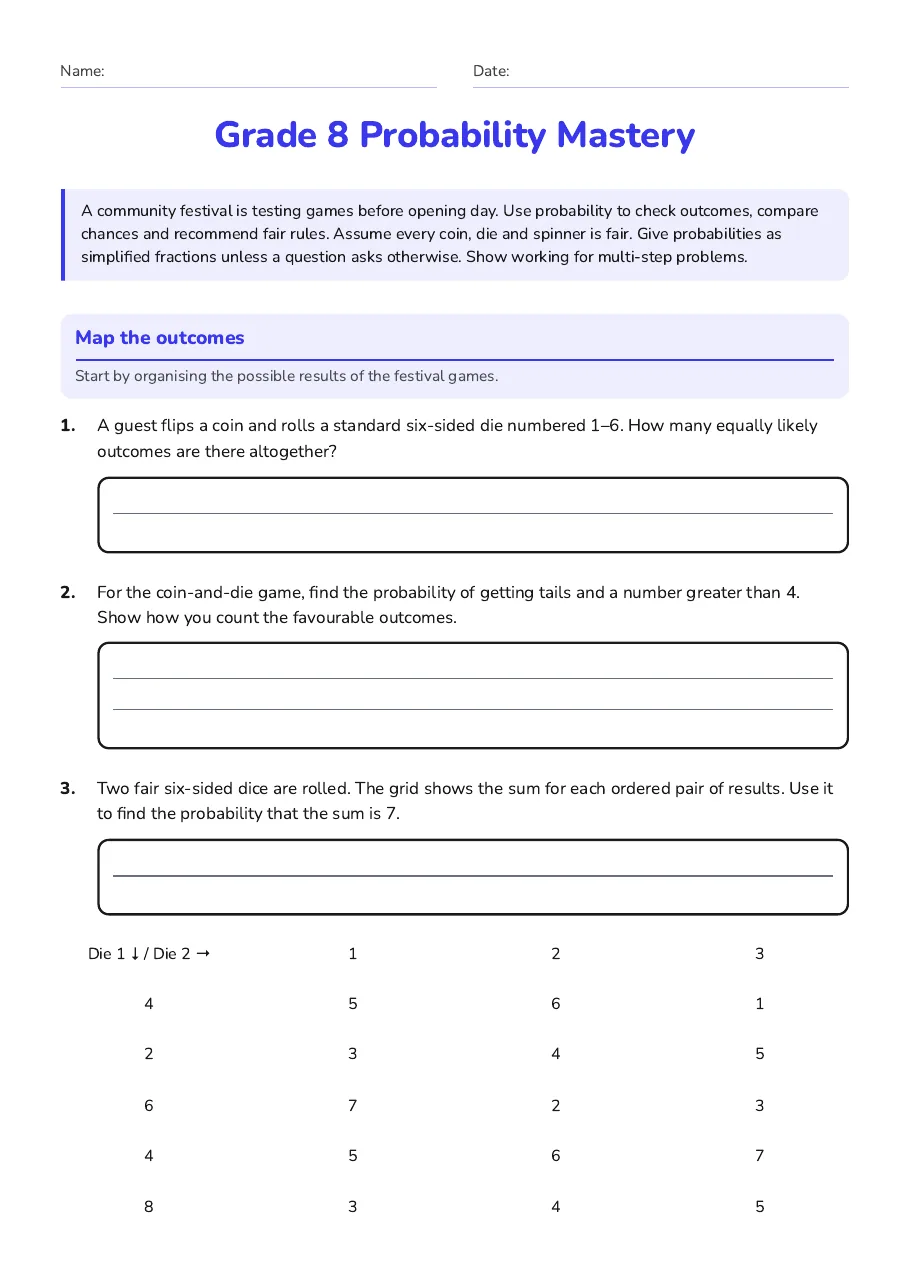
Q2. ⭐ A coin is flipped and a standard six-sided die is rolled.

(a) Draw a tree diagram to show all possible outcomes.

(b) How many outcomes are in the sample space? ________

(c) P(Head and an even number) = ________

(d) P(Tail and a number greater than 4) = ________

(e) P(Head and a prime number) = ________

Q3. ⭐ A bag contains one red (R), one blue (B), and one green (G) marble. A marble is drawn, its colour noted, and it is not replaced. A second marble is then drawn.

(a) Draw a tree diagram showing all possible outcomes.

(b) How many outcomes are in the sample space? ________

(c) P(Red then Blue) = ________

(d) P(Green is drawn at least once) = ________

(e) P(Both marbles are the same colour) = ________

Q4. ⭐ A coin is flipped three times.

(a) Draw a tree diagram to show all possible outcomes.

(b) Total number of outcomes: ________

(c) P(exactly two heads) = ________

(d) P(at least one head) = ________

(e) P(at most two tails) = ________

(f) P(all three the same) = ________

Q5. 🚀 A spinner has three equal sections labelled 1, 2, and 3. It is spun twice.

(a) Draw a tree diagram showing all outcomes and their probabilities on each branch.

(b) P(sum equals 4) = ________

(c) P(sum is at least 5) = ________

(d) P(both spins show the same number) = ________

(e) P(product is even) = ________

Q6. 🚀 In a family, two children are born. Assume the probability of a boy (B) or girl (G) is equal.

(a) Use a tree diagram to show all outcomes.

(b) P(both children are girls) = ________

(c) P(at least one boy) = ________

(d) P(children are different genders) = ________

Q7. 🚀 (Extension) A bag contains 2 red and 1 blue ball. A ball is drawn and replaced before drawing again. Draw a tree diagram, label each branch with its probability, and find:

(a) P(two red balls) = ________

(b) P(at least one blue ball) = ________

(c) P(the two balls are different colours) = ________

📊 Part 2: Two-Way Tables

Use the tables provided to answer each question. Show all working.

Q8. 🌱 Two dice are rolled and the results recorded. Complete the two-way table showing the sum of the two dice.

Use the table below (Die 1 across the top, Die 2 down the side):

(a) How many outcomes are in the sample space? ________

(b) P(sum = 7) = ________

(c) P(sum = 2) = ________

(d) P(sum is even) = ________

(e) P(sum is at least 10) = ________

(f) P(sum is at most 4) = ________

(g) Which sum is most likely? ________

Q9. ⭐ The two-way table below shows survey results from 60 Year 8 students about their favourite sport.

Table data:

                   Football    Basketball    Total
Boys:         18            12              30
Girls:          10            20              30
Total:         28            32              60

(a) P(randomly selected student is a girl who likes basketball) = ________

(b) P(randomly selected student likes football) = ________

(c) P(student is a boy, given they like football) = ________

(d) P(student likes basketball, given they are a girl) = ________

(e) Are gender and sport preference independent? Explain: ________________________________

Q10. ⭐ Two coins are tossed simultaneously. Complete the two-way table showing all outcomes (H = Heads, T = Tails).

(a) P(HH) = ________

(b) P(at least one H) = ________

(c) P(exactly one T) = ________

Q11. ⭐ A card is drawn from a standard 52-card deck and a die is rolled. Use a two-way table structure to answer:

(a) P(red card and even number on die) = ________

(b) P(black card and number less than 3 on die) = ________

(c) P(heart and a 6) = ________

Q12. 🚀 The table below shows data about 80 students and whether they own a pet and play a sport.

                        Plays Sport    Does Not Play Sport    Total
Owns a Pet:      35                    15                            50
No Pet:            20                    10                            30
Total:              55                    25                            80

(a) P(owns a pet and plays sport) = ________

(b) P(does not own a pet and does not play sport) = ________

(c) P(plays sport | owns a pet) = ________

(d) P(owns a pet | plays sport) = ________

(e) 🚀 Are owning a pet and playing sport independent events? Show calculations to justify your answer.

Q13. 🚀 A die is rolled twice. Complete a two-way table showing the product of the two dice.

(a) P(product = 6) = ________

(b) P(product is a perfect square) = ________

(c) P(product is at most 6) = ________

(d) P(product is at least 20) = ________

Q14. 🚀 (Extension) Using the sum table from Q8, if you roll two dice 180 times, how many times would you expect to get a sum of 7? Show your working.

⭕ Part 3: Venn Diagrams

Draw Venn diagrams where required. Use correct notation: P(A), P(A ∩ B), P(A ∪ B), P(A')

Q15. 🌱 In a class of 30 students: 18 like Maths (M), 15 like Science (S), and 8 like both.

(a) Draw a Venn diagram to represent this information.

(b) How many students like Maths only? ________

(c) How many students like Science only? ________

(d) How many students like neither? ________

(e) P(likes Maths or Science) = P(M ∪ S) = ________

(f) P(likes both) = P(M ∩ S) = ________

(g) P(likes neither) = ________

Q16. ⭐ A survey of 50 people found: 30 drink coffee (C), 25 drink tea (T), and 10 drink both.

(a) Draw a Venn diagram.

(b) P(C ∩ T) = ________

(c) P(C ∪ T) = ________

(d) P(coffee only) = ________

(e) P(tea only) = ________

(f) P(neither coffee nor tea) = ________

(g) P(not coffee) = P(C') = ________

Q17. ⭐ The letters of the word PROBABILITY are written on separate cards and one card is chosen at random.

(a) How many cards are there in total? ________

(b) List the letters: _____________________________________________

(c) P(letter B) = ________

(d) P(a vowel) = ________

(e) P(a consonant) = ________

(f) P(letter I) = ________

(g) P(a letter that appears more than once) = ________

(h) Draw a Venn diagram with sets: V = {vowels} and R = {letters that repeat}. Place all letters correctly.

(i) P(V ∩ R) = ________

(j) P(V ∪ R) = ________

Q18. ⭐ The letters of the word MATHEMATICS are written on cards. One card is chosen at random.

(a) Total number of cards: ________

(b) P(letter M) = ________

(c) P(letter A) = ________

(d) P(a vowel) = ________

(e) P(a letter from the word "STEAM") = ________

(f) 🚀 Draw a Venn diagram with sets: A = {letters in MATHS} and B = {letters in ATICS}. List all letters in each region.

(g) P(A ∩ B) = ________

(h) P(A only) = ________

Q19. ⭐ In a group of 40 students, some play cricket (C) and some play tennis (T).

Given: n(C) = 22, n(T) = 18, n(C ∩ T) = 6

(a) Complete the Venn diagram.

(b) n(C only) = ________

(c) n(T only) = ________

(d) n(neither) = ________

(e) P(C ∪ T) = ________

(f) P(C | T) — probability of cricket given tennis = ________

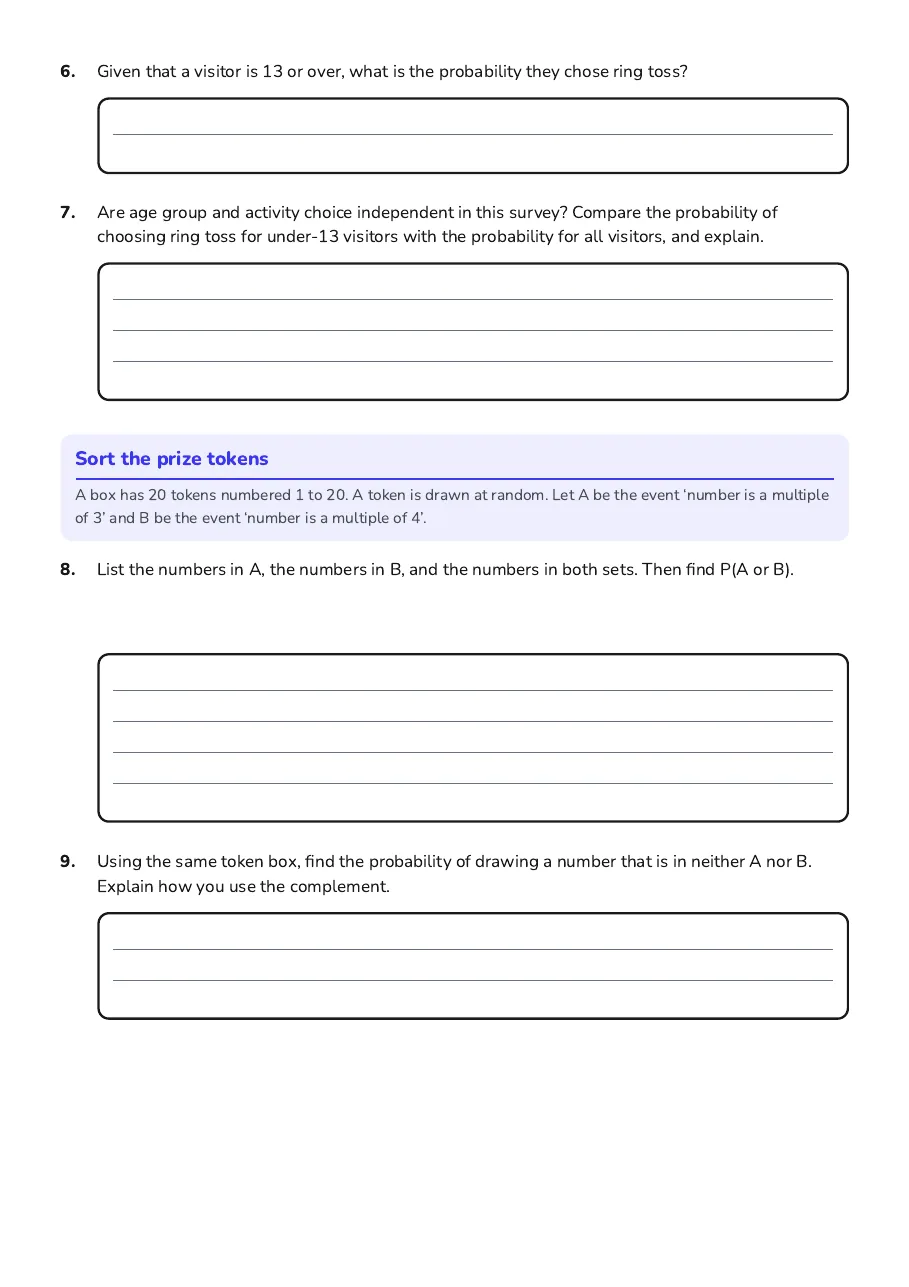
Q20. 🚀 A number is chosen at random from 1 to 20. Let A = {multiples of 3} and B = {multiples of 4}.

(a) List the elements of A: _____________________________________________

(b) List the elements of B: _____________________________________________

(c) List A ∩ B: _____________________________________________

(d) Draw a Venn diagram.

(e) P(A) = ________

(f) P(B) = ________

(g) P(A ∩ B) = ________

(h) P(A ∪ B) = ________

(i) P(A' ∩ B') = ________

Q21. 🚀 (Extension — Three Sets) In a class of 35 students: 20 like Art (A), 18 like Music (M), 15 like Drama (D). 10 like Art and Music, 8 like Music and Drama, 6 like Art and Drama, and 4 like all three.

(a) Draw a three-circle Venn diagram and fill in all regions.

(b) How many students like exactly one subject? ________

(c) How many students like none of the three? ________

(d) P(likes exactly two subjects) = ________

(e) P(likes Art or Music but not Drama) = ________

🃏 Part 4: Cards, Dice, Letters & Mixed Probability

A standard deck has 52 cards: 4 suits (Hearts ♥, Diamonds ♦, Clubs ♣, Spades ♠), each with 13 cards (Ace, 2–10, Jack, Queen, King).

Q22. 🌱 A card is chosen at random from a standard 52-card deck. Find:

(a) P(an Ace) = ________

(b) P(a Heart) = ________

(c) P(a red card) = ________

(d) P(a King or Queen) = ________

(e) P(a black Ace) = ________

(f) P(a card with a number between 2 and 9 inclusive) = ________

(g) P(not a face card) — face cards are Jack, Queen, King = ________

Q23. ⭐ A card is drawn from a deck. Find the probability that it is:

(a) A Diamond or a Club = ________

(b) A red card or a King = ________

(c) A black card and a 7 = ________

(d) An Ace or a Heart = ________

(e) Not a Spade = ________

(f) A face card from a red suit = ________

(g) 🚀 Two cards are drawn without replacement. P(both are Aces) = ________

Q24. 🌱 A standard six-sided die (faces: 1, 2, 3, 4, 5, 6) is rolled once. Find:

(a) P(rolling a 4) = ________

(b) P(rolling an even number) = ________

(c) P(rolling a prime number) = ________

(d) P(rolling a number greater than 4) = ________

(e) P(rolling at least 3) = ________

(f) P(rolling at most 2) = ________

(g) P(rolling a factor of 6) = ________

Q25. ⭐ Two standard six-sided dice are rolled. Find:

(a) P(both dice show 6) = ________

(b) P(sum = 8) = ________

(c) P(at least one die shows a 1) = ________

(d) P(both dice show the same number) = ________

(e) P(sum is at most 4) = ________

(f) P(difference between the two dice is exactly 2) = ________

(g) P(sum is at least 11) = ________

Q26. ⭐ The letters of the word STATISTICS are written on cards. One card is drawn at random.

(a) How many cards are there? ________

(b) List all letters and their frequencies: _____________________________________________

(c) P(letter S) = ________

(d) P(letter T) = ________

(e) P(a vowel) = ________

(f) P(a letter that appears exactly twice) = ________

(g) P(not the letter I) = ________

Q27. ⭐ The letters of the word MELBOURNE are placed in a bag. One letter is drawn at random.

(a) Total letters: ________

(b) P(letter E) = ________

(c) P(a vowel) = ________

(d) P(a consonant) = ________

(e) P(letter M or letter B) = ________

(f) 🚀 If two letters are drawn without replacement, P(both are vowels) = ________

Q28. 🚀 'At Least' and 'At Most' — Coins A coin is flipped four times. Using a tree diagram or listing method:

(a) Total number of outcomes = ________

(b) P(at least one head) = ________

(c) P(at most two heads) = ________

(d) P(at least three tails) = ________

(e) P(exactly two heads) = ________

(f) 🚀 Using the complement, recalculate P(at least one head) = ________

Q29. 🚀 'At Least' and 'At Most' — Dice A die is rolled three times.

(a) P(at least one 6) = ________

(b) P(at most one 6) = ________

(c) P(no sixes at all) = ________

(d) P(exactly two sixes) = ________

Hint: Use the complement rule for (a): P(at least one 6) = 1 − P(no sixes)

Q30. 🚀 (Extension — Olympiad Style) A bag contains 3 red, 4 blue, and 5 green marbles. Two marbles are drawn without replacement.

(a) P(both red) = ________

(b) P(one red and one blue) = ________

(c) P(at least one green) = ________

(d) P(both the same colour) = ________

Hint: Total ways to choose 2 from 12 = ¹²C₂ = 66

🚀 Extension Activities for Advanced Learners

Extension 1: Experimental vs Theoretical Probability

Flip a coin 40 times and record your results in the table below.

(a) Experimental P(Heads) = ________

(b) Theoretical P(Heads) = ________

(c) Explain any difference between your experimental and theoretical probabilities:

(d) What would happen to the experimental probability if you flipped the coin 1000 times? Explain using the Law of Large Numbers:

Extension 2: Design Your Own Probability Problem

Create an original probability problem using one of the following contexts: a deck of cards, a bag of coloured marbles, or letters from a word of your choice. Your problem must include:

✅ A clear description of the sample space

✅ At least three probability questions including one 'at least' or 'at most' question

✅ A Venn diagram or tree diagram

✅ A full worked solution

Extension 3: ICAS / Olympiad Challenge

A class of 25 students each write their birthday month on a slip of paper. What is the probability that at least two students share the same birthday month? (Hint: Use the complement — what is the probability that ALL students have DIFFERENT birthday months?)

📋 Answer Key — For Teacher / Self-Assessment Use

Detailed solutions for all questions.

Part 1: Tree Diagrams

Q1 — Coin flipped twice

(a) Sample space: {HH, HT, TH, TT}

About This Worksheet

Free in Kuraplan

Sign up free, grab the PDF, and customize it for your class.

Print-Ready

Formatted for standard paper. Clean layout, easy to read.

AI-Generated

Created with Kuraplan's AI, designed for real classroom use.

For Teachers & Parents

Use in classrooms, for homework, tutoring, or homeschool.

Need a custom version of this worksheet?

Kuraplan's AI generates custom worksheets in seconds — differentiated for every learner, aligned to your curriculum.

Generate Custom Worksheets — Free
No credit card Curriculum-aligned Under 60 seconds