```html
🎯 Success Criteria
By the end of this worksheet, you will be able to:
✅ Calculate theoretical and experimental probability as a fraction, decimal, and percentage
✅ Identify and work with complementary, mutually exclusive, independent, and dependent events
✅ Solve problems involving simple and compound events using lists, tables, and tree diagrams
Probability Scale: 0 (Impossible) ←————————→ 1 (Certain)
Key Formula: P(event) = Number of favourable outcomes ÷ Total number of possible outcomes
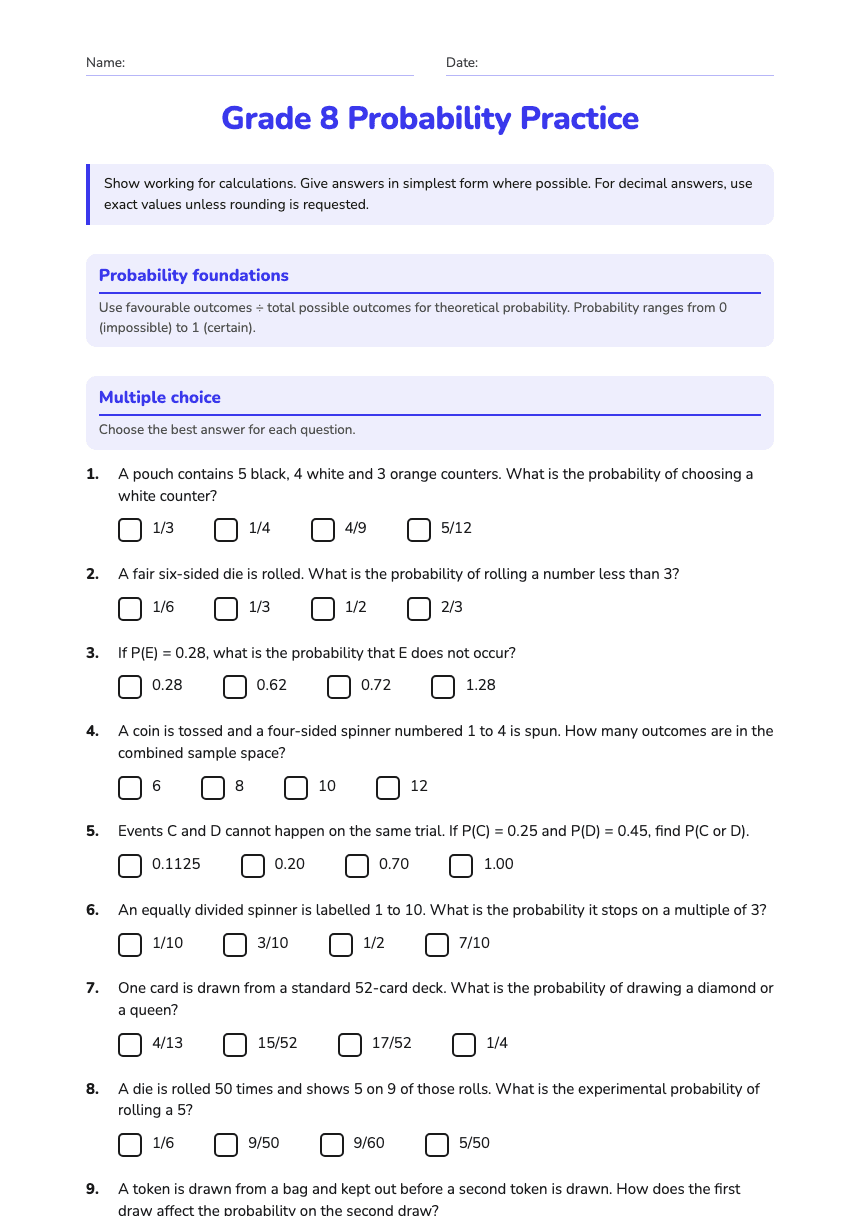
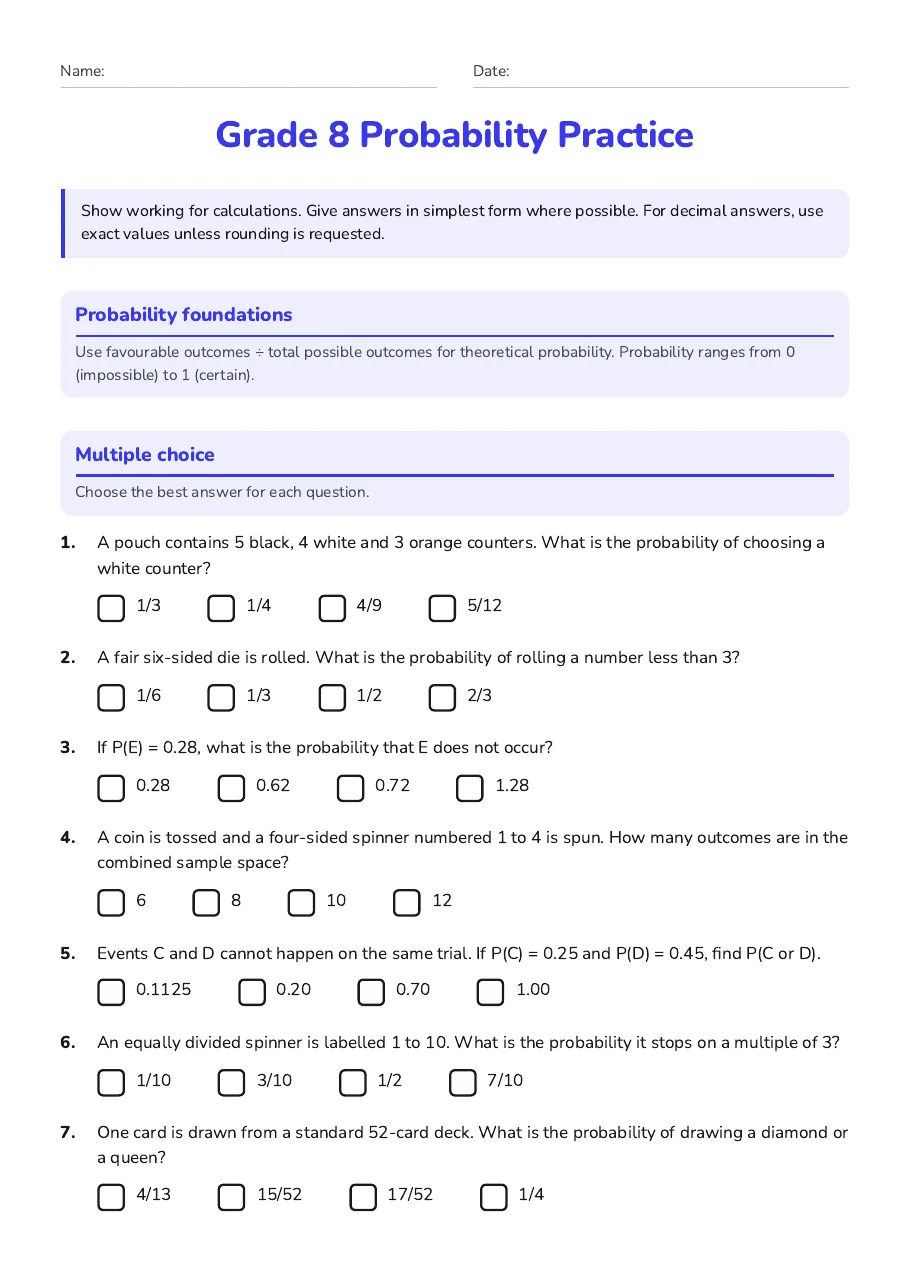
📚 Part 1: Multiple Choice (Questions 1–12)
Circle the letter of the best answer. (1 mark each)
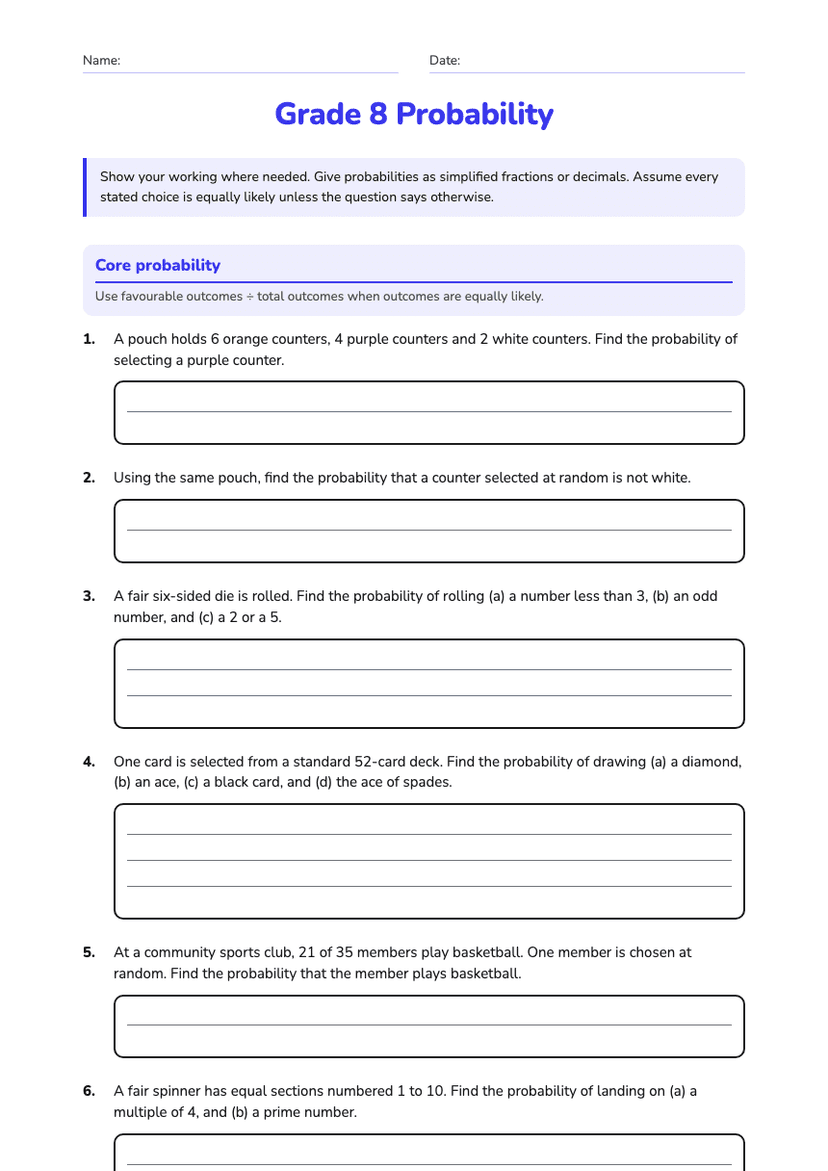
1. A bag contains 4 red, 3 blue, and 5 green marbles. What is the probability of randomly selecting a red marble?
A) 1/4
B) 1/3
C) 4/12 = 1/3
D) 4/12 = 1/3
(Hint: simplify!)
A) 1/4
B) 1/3
C) 5/12
D) 4/12
2. A standard six-sided die is rolled. What is the probability of rolling a number greater than 4?
A) 1/6
B) 1/3
C) 1/2
D) 2/3
3. If P(A) = 0.35, what is P(A'), the probability of the complement of A?
A) 0.35
B) 0.65
C) 0.75
D) 1.35
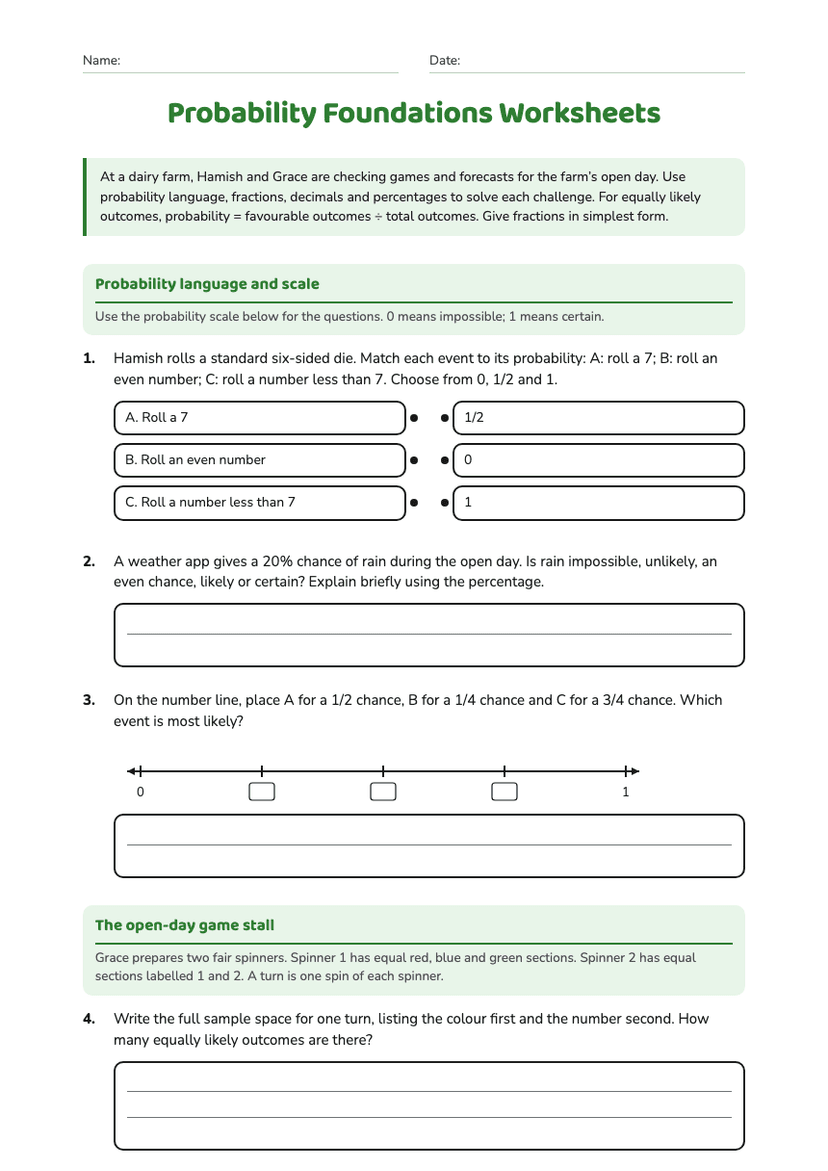
4. A coin is flipped and a die is rolled. How many outcomes are in the sample space?
5. Two events are mutually exclusive. If P(A) = 0.4 and P(B) = 0.3, what is P(A or B)?
A) 0.12
B) 0.1
C) 0.7
D) 1.0
6. A spinner has 8 equal sections numbered 1–8. What is the probability of spinning an even number?
A) 3/8
B) 1/2
C) 5/8
D) 1/4
7. A card is drawn from a standard 52-card deck. What is the probability it is a heart OR a king?
A) 17/52
B) 16/52
C) 4/52
D) 13/52
8. A student rolled a die 60 times and got a 3 exactly 12 times. What is the experimental probability of rolling a 3?
A) 1/6
B) 1/5
C) 1/4
D) 12/100
9. A bag has 5 red and 3 blue balls. One ball is drawn and NOT replaced. A second ball is then drawn. These events are:
A) Independent events
B) Dependent events
C) Mutually exclusive events
D) Complementary events
10. Two fair coins are tossed. What is the probability of getting exactly one head?
A) 1/4
B) 1/2
C) 3/4
D) 1
11. If events A and B are independent, P(A) = 0.5 and P(B) = 0.4, what is P(A and B)?
A) 0.9
B) 0.1
C) 0.2
D) 0.45
12. A class of 30 students has 12 who play football and 10 who play basketball. 4 students play both. What is the probability a randomly chosen student plays football OR basketball?
A) 18/30
B) 22/30
C) 26/30
D) 4/30
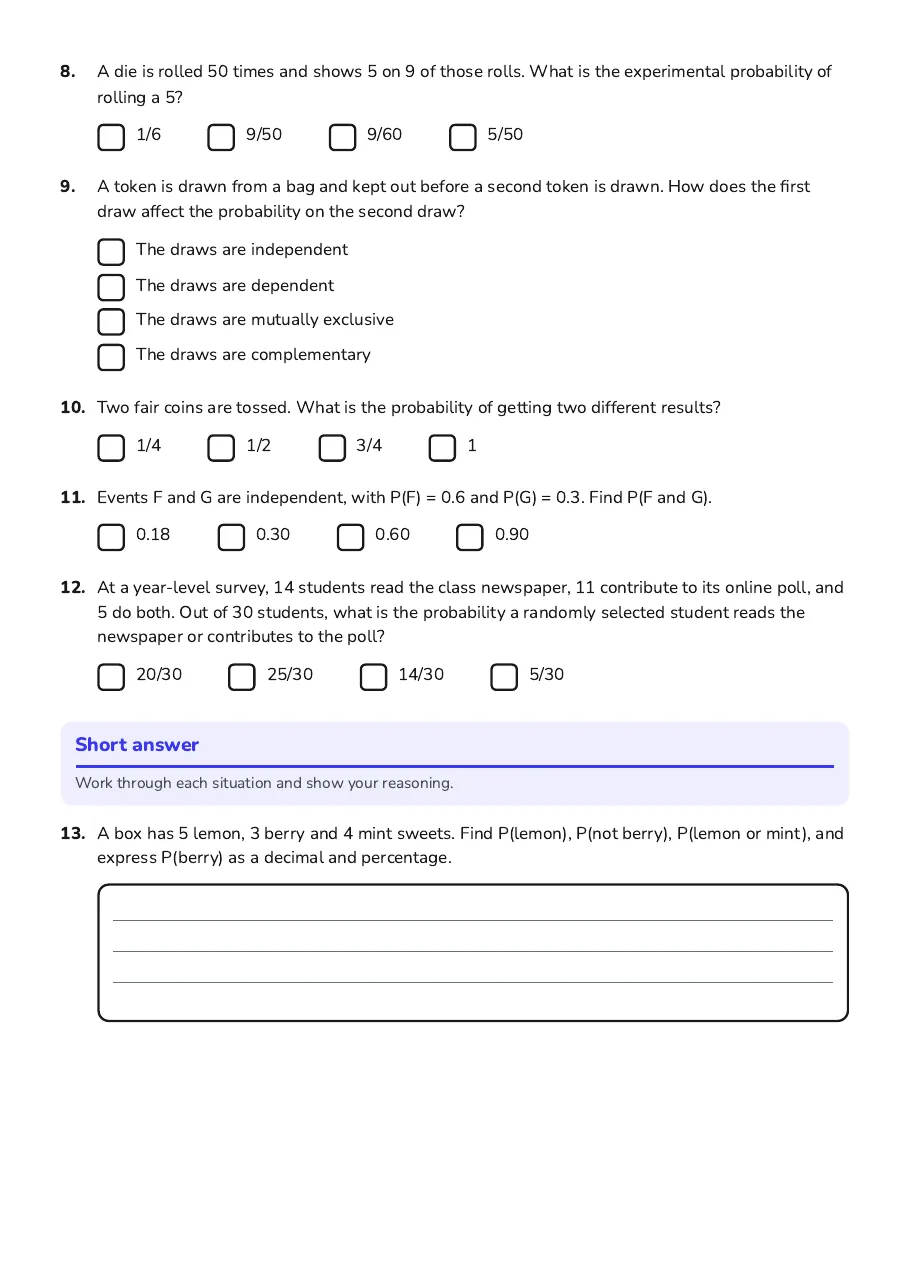
✏️ Part 2: Short Answer (Questions 13–30)
Show all working. Express answers as fractions, decimals, AND percentages where asked.
13. A bag contains 6 yellow, 4 purple, and 2 orange lollies. A lolly is chosen at random. Find:
a) P(yellow) = _____________
b) P(not orange) = _____________
c) P(yellow or purple) = _____________
d) Express P(purple) as a decimal and percentage: decimal = _____________ percentage = _____________
14. A standard die is rolled once. List the sample space and find:
Sample space: { _______, _______, _______, _______, _______, _______ }
a) P(prime number) = _____________
b) P(factor of 6) = _____________
c) P(greater than 2 AND less than 6) = _____________
15. In a survey of 200 Year 8 students, 85 said they prefer watching movies, 70 prefer gaming, and the rest prefer reading. A student is chosen at random. Find:
a) P(prefers reading) = _____________
b) P(does NOT prefer gaming) = _____________
c) P(prefers movies or gaming) = _____________
16. Complementary Events: The probability that it rains in Melbourne on a given day in July is 3/7. What is the probability that it does NOT rain? Show your working.
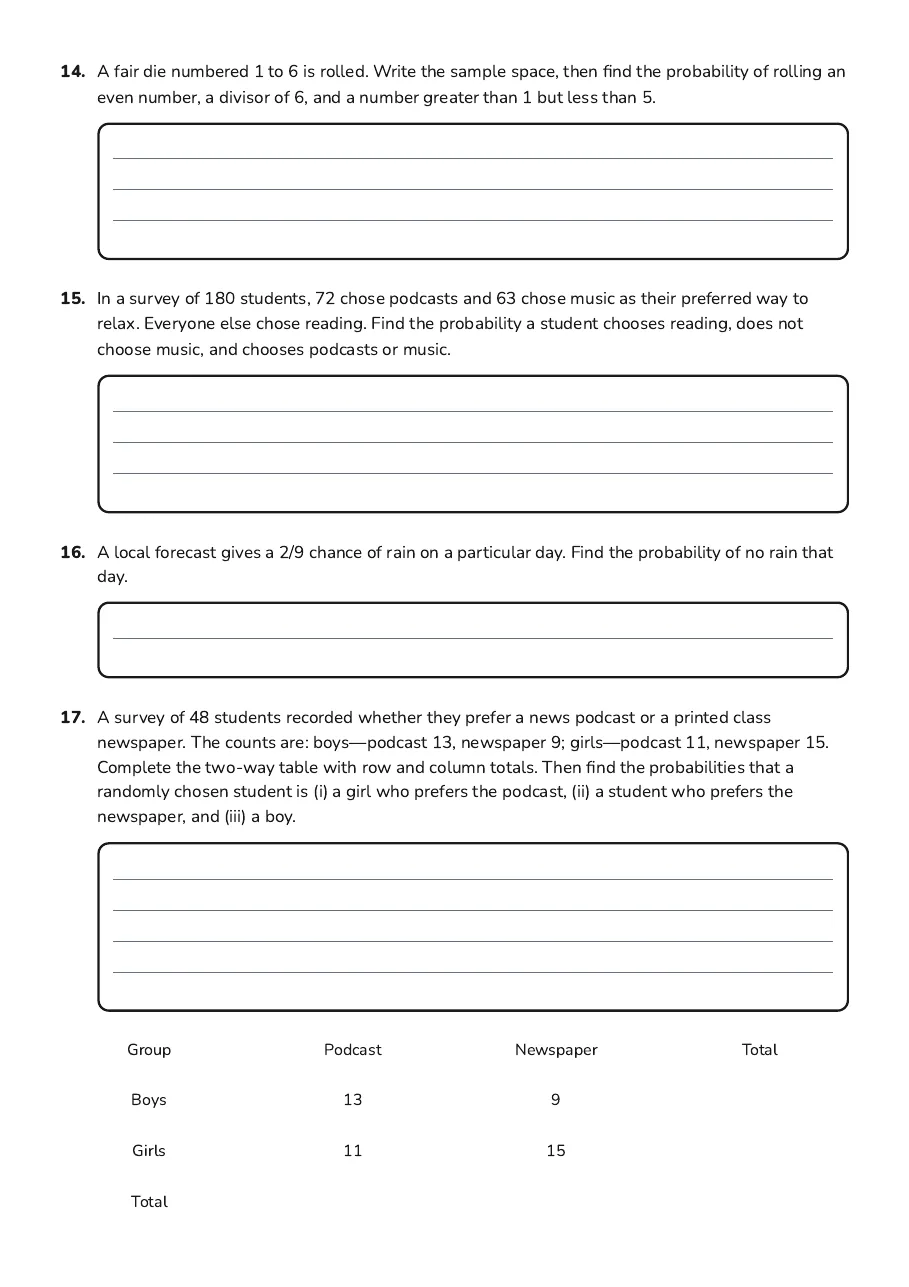
17. Two-Way Table: The table below shows data about 50 students and their preferred sport.
Football Netball Total
Boys 18 7 ____
Girls 8 17 ____
Total ____ ____ 50
a) Complete the table.
b) P(randomly selected student is a girl who prefers football) = _____________
c) P(randomly selected student prefers netball) = _____________
d) P(randomly selected student is a boy) = _____________
18. Experimental vs Theoretical Probability: Mia flipped a coin 40 times. She got heads 22 times.
a) What is the experimental probability of getting heads? _____________
b) What is the theoretical probability of getting heads? _____________
c) Are these the same? Why or why not?
19. Mutually Exclusive Events: A card is drawn from a standard deck. Are the following pairs of events mutually exclusive? Write YES or NO and explain.
a) Drawing a King AND drawing a Queen: _______ Because: _________________________
b) Drawing a Heart AND drawing a King: _______ Because: _________________________
c) Drawing a red card AND drawing a black card: _______ Because: _________________________
20. Independent Events: A spinner with sections 1–5 is spun and a coin is flipped. Find:
a) P(spinning a 3 AND flipping tails) = _____________
b) P(spinning an odd number AND flipping heads) = _____________
c) P(spinning a number less than 4 AND flipping heads) = _____________
21. Dependent Events: A box contains 7 red and 3 white tokens. Two tokens are drawn WITHOUT replacement. Find:
a) P(first token is red) = _____________
b) P(second token is red, given the first was red) = _____________
c) P(both tokens are red) = _____________
22. Tree Diagram: A student takes two tests. The probability of passing each test is 0.7. Draw a tree diagram and find the probability of:
a) Passing both tests = _____________
b) Failing both tests = _____________
c) Passing exactly one test = _____________
23. Sample Space Table: Two dice are rolled. Complete the sample space table below and answer the questions.
(Draw a 6×6 grid in the box below showing all 36 outcomes)
a) P(sum = 7) = _____________
b) P(sum ≥ 10) = _____________
c) P(both dice show the same number) = _____________
d) P(sum is even) = _____________
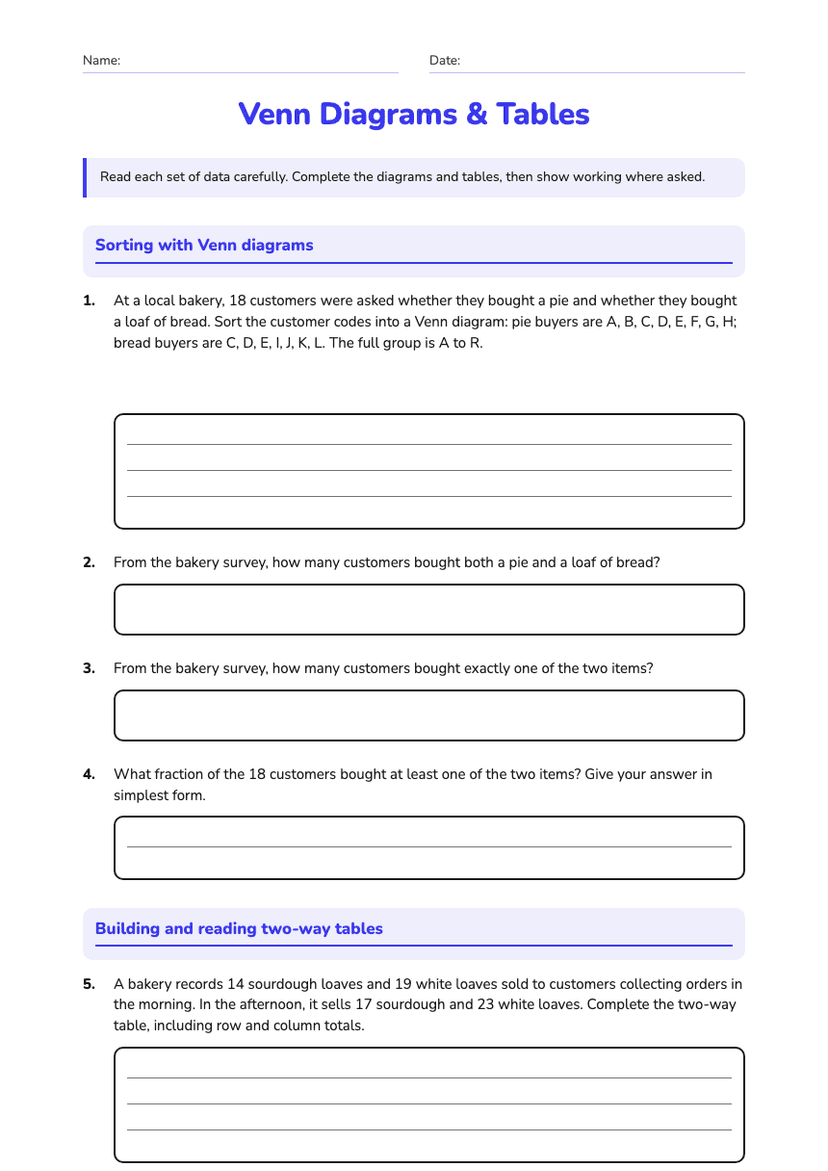
24. Venn Diagram: In a class of 28 students, 15 like science, 12 like art, and 5 like both. Use a Venn diagram to find the probability that a randomly chosen student likes:
a) Only science = _____________
b) Science or art = _____________
c) Neither science nor art = _____________
25. A weather app says the probability of rain on Saturday is 60% and on Sunday is 45%. Assuming these are independent events, find:
a) P(rain on both days) = _____________
b) P(no rain on either day) = _____________
c) P(rain on at least one day) = _____________
26. Relative Frequency: A Year 8 class recorded the colours of 80 cars passing their school: Red = 24, White = 20, Blue = 16, Silver = 12, Other = 8.
a) Complete the relative frequency table:
Red: _______ White: _______ Blue: _______ Silver: _______ Other: _______
b) Based on this data, if 200 more cars pass, how many would you expect to be white? _____________
c) What is the experimental probability that the next car is NOT red? _____________
27. Conditional Probability (Introduction): In a group of 40 students, 25 study French and 18 study Japanese. 8 study both. A student who studies French is chosen at random. What is the probability they also study Japanese?
28. A school raffle sells 500 tickets. Lachlan buys 8 tickets and his friend Zoe buys 12 tickets.
a) P(Lachlan wins first prize) = _____________
b) P(Zoe wins first prize) = _____________
c) P(neither Lachlan nor Zoe wins) = _____________
d) P(Lachlan OR Zoe wins) = _____________
29. Listing Outcomes: Three coins (20c, 10c, 5c) are tossed at the same time. List ALL possible outcomes in the sample space and find:
Sample space: _______________________________________________
a) P(all three heads) = _____________
b) P(at least two tails) = _____________
c) P(exactly one head) = _____________
30. Mixed Problem: A game uses a spinner with 4 equal sections (Red, Blue, Green, Yellow) and a bag with 3 balls (numbered 1, 2, 3). A player wins if they spin Red AND draw ball number 1. Find P(win) and express your answer as a fraction, decimal, and percentage.
Fraction: _____________ Decimal: _____________ Percentage: _____________
🧩 Part 3: Problem Solving (Questions 31–40)
Show full working. Marks are awarded for method as well as the correct answer.
31. Real-World Context: A factory produces light bulbs. Quality control tests show that 3 out of every 200 bulbs are defective. If a shop orders 1,500 bulbs, how many would you expect to be defective? Show your working.
32. Probability from Geometry: A square dartboard has a side length of 80 cm. A circular target is drawn in the centre with a radius of 20 cm. Assuming a dart lands randomly on the board, what is the probability it lands inside the circle? (Use π ≈ 3.14, round to 3 decimal places)
33. Dependent Events — Extended: A drawer contains 4 black socks, 3 grey socks, and 2 white socks. Two socks are drawn without replacement. Find the probability that:
a) Both socks are black = _____________
b) One sock is black and one is white = _____________
c) Neither sock is grey = _____________
34. Probability and Fractions: In a class, 2/5 of students walk to school, 1/4 ride a bike, and the rest catch public transport. If a student is chosen at random:
a) What fraction catch public transport? _____________
b) P(student walks OR rides a bike) = _____________
c) If there are 40 students, how many would you expect to catch public transport? _____________
35. Compound Events — Table Method: Two spinners are used: Spinner A has sections {1, 2, 3} and Spinner B has sections {A, B, C, D}. Both are spun once.
a) How many outcomes are possible? _____________
b) List all outcomes containing the number 2: _________________________________
c) P(spinning 3 AND spinning B) = _____________
d) P(spinning an odd number AND spinning a vowel) = _____________
36. Interpreting Data: A Year 8 class kept track of whether students completed homework over 10 school days. The results: Complete = 7 days, Incomplete = 3 days. Based on this data:
a) What is the experimental probability of homework being complete? _____________
b) Using this probability, how many of the next 30 school days would you expect homework to be complete? _____________
c) Is experimental probability always equal to theoretical probability? Explain.
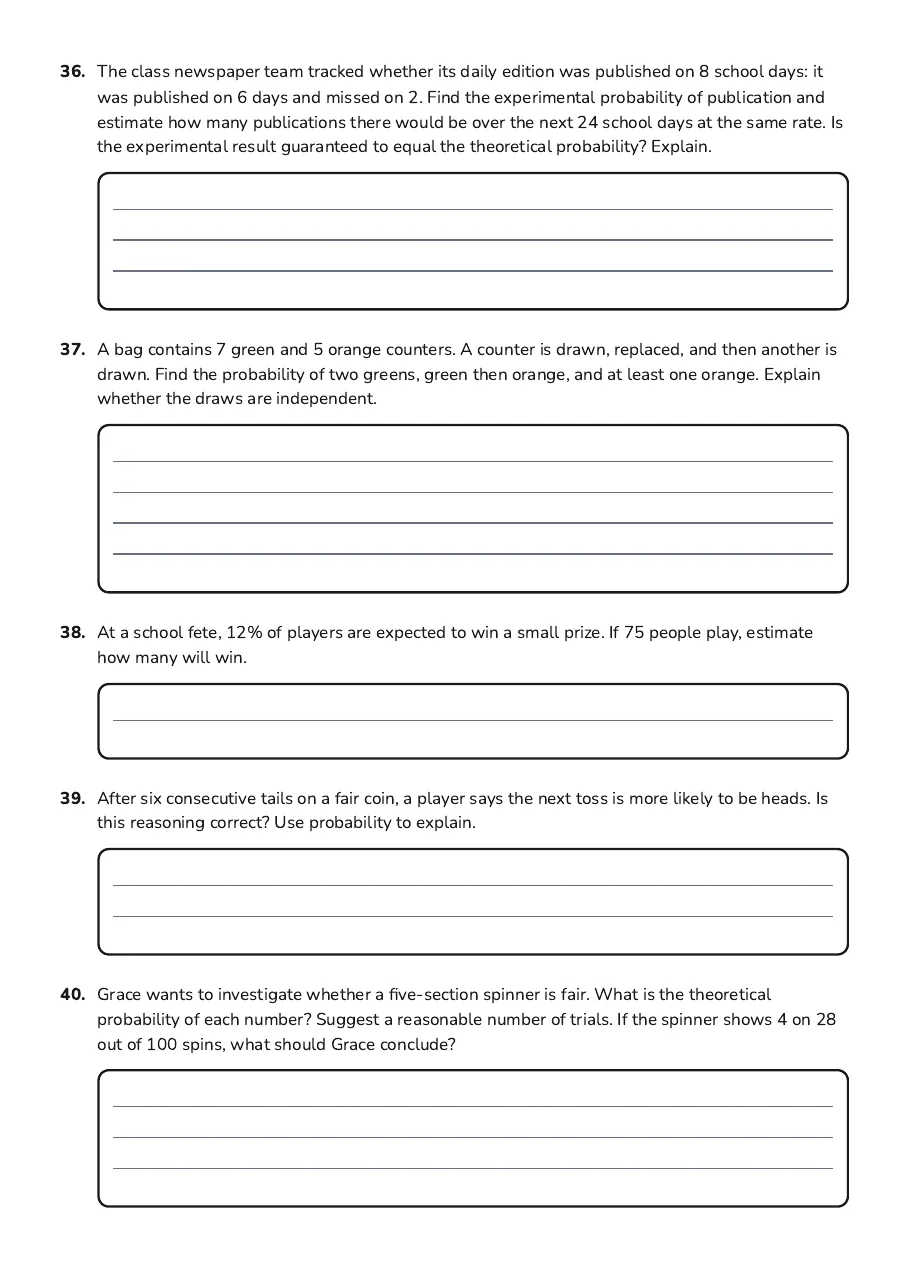
37. Multi-Step Problem: A bag has 5 green and 4 orange counters. Two counters are drawn WITH replacement. Find:
a) P(both green) = _____________
b) P(first green, second orange) = _____________
c) P(at least one orange) = _____________
d) Compare your answers from (a) and (b). Are these events independent? Explain.
38. Probability and Percentages: At a school fete, the probability of winning a prize on a ring-toss game is 15%. If 60 students play the game, approximately how many students would you expect to win a prize? Show your working.
39. Reasoning and Justification: Ethan says: "I've flipped a coin 5 times and got tails every time. The next flip MUST be heads because it's 'due'." Is Ethan correct? Explain your reasoning using probability concepts.
40. Design a Probability Experiment: You want to test whether a spinner with 5 equal sections (numbered 1–5) is fair.
a) What is the theoretical probability of spinning each number? _____________
b) How many trials would you conduct to make the experiment reliable? _____________
c) If you spun the spinner 100 times and got the number 3 exactly 30 times, what would you conclude?
⭐ Extension Activities for Advanced Learners (Questions 41–50)
These questions involve higher-order thinking and are designed for students working above year level. Challenge yourself!
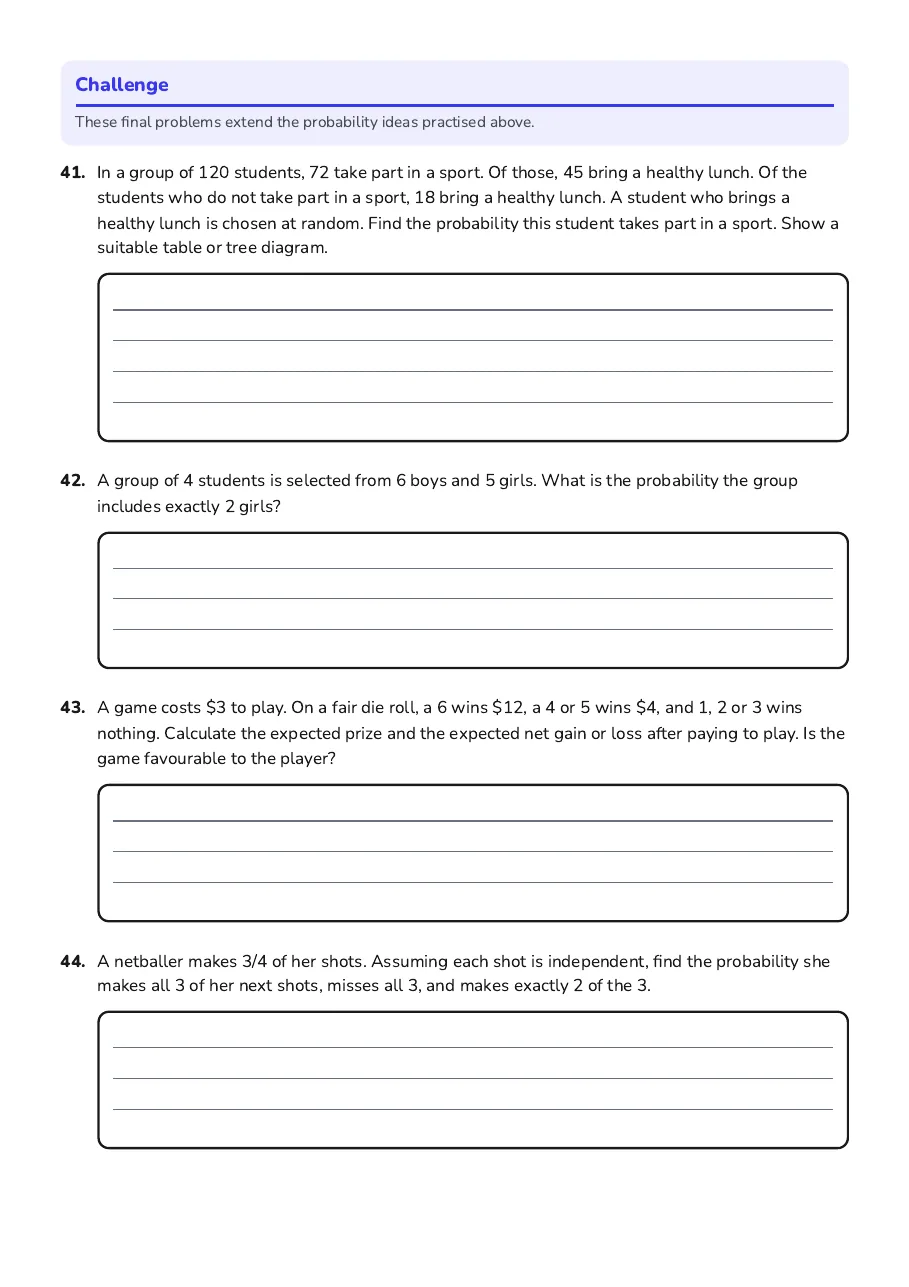
41. Conditional Probability: In a group of 100 students, 60 play sport. Of those who play sport, 40 also eat a healthy lunch. Of those who don't play sport, 15 eat a healthy lunch. A student is chosen at random and found to eat a healthy lunch. What is the probability they also play sport? (Show a tree diagram or table to support your answer.)
42. Probability with Combinations: A committee of 3 students is chosen from a group of 5 boys and 4 girls. What is the probability the committee contains exactly 2 girls? (Hint: Use combinations — C(n,r) = n! ÷ r!(n-r)!)
43. Expected Value: A game costs $2 to play. You roll a die: if you roll a 6, you win $10; if you roll a 4 or 5, you win $3; otherwise you win nothing. Calculate the expected value of this game. Is it worth playing? Justify your answer.
44. Binomial-Style Thinking: A basketball player has a free-throw success rate of 70%. If she takes 4 free-throws in a game, find the probability she makes:
a) All 4