Igneous Rock Properties
A free science worksheet ready for your classroom. Open in Kuraplan to grab the print-ready PDF, customize it for your students, or generate a fresh version in seconds.

Igneous Rock Properties
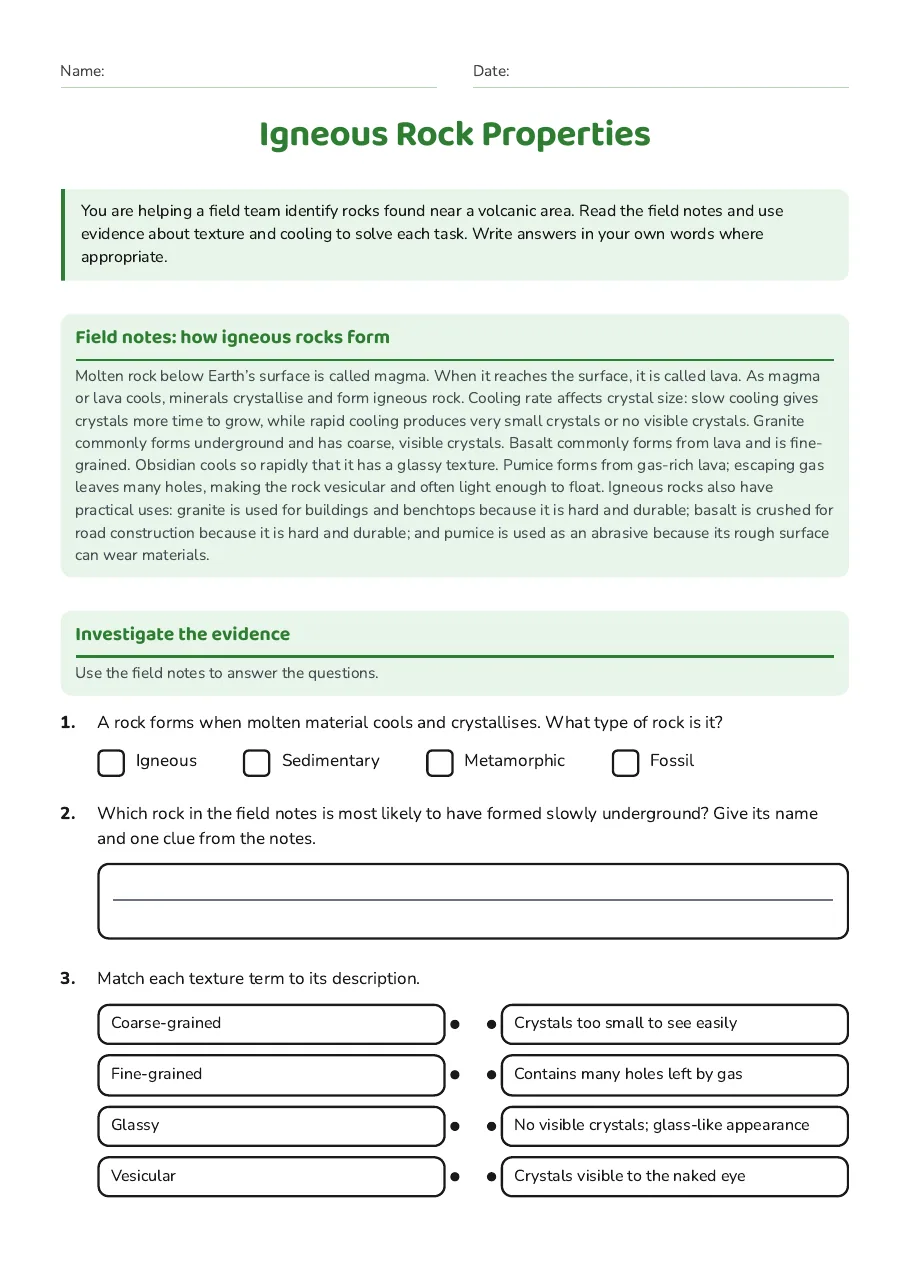
Field notes: how igneous rocks form
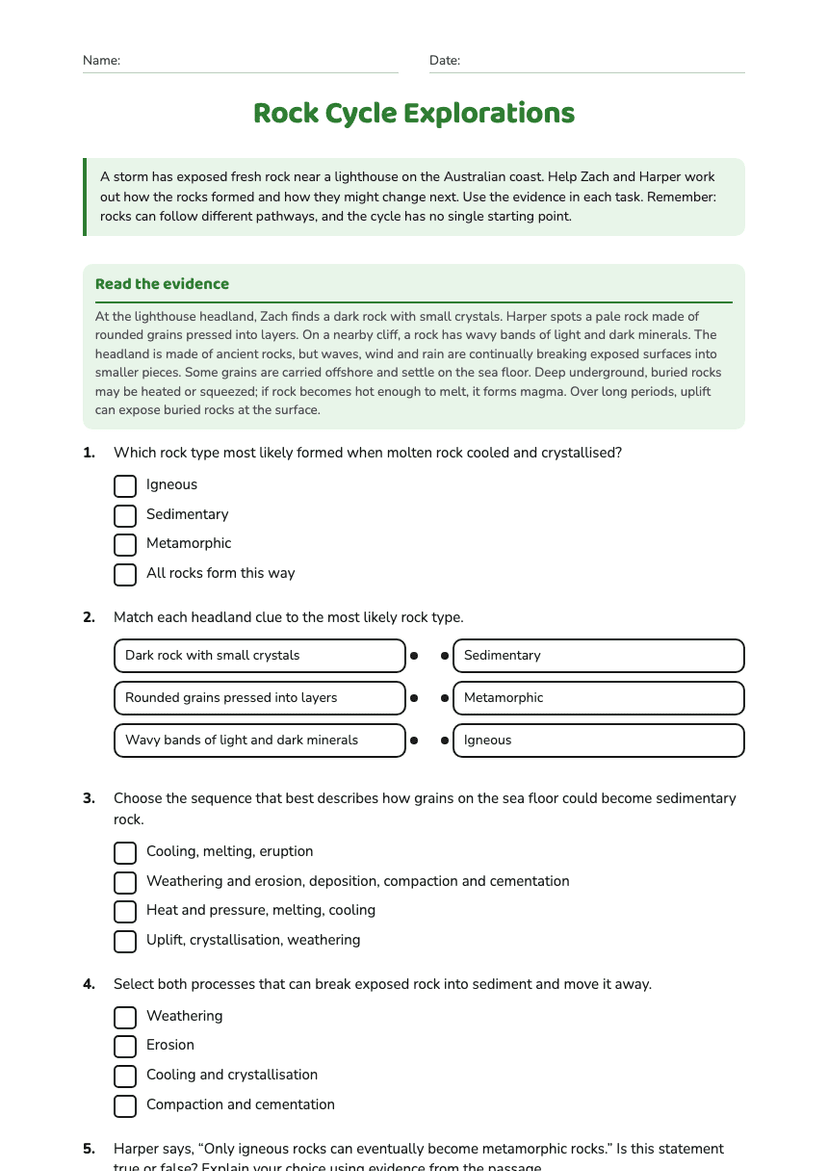
Molten rock below Earth’s surface is called magma. When it reaches the surface, it is called lava. As magma or lava cools, minerals crystallise and form igneous rock. Cooling rate affects crystal size: slow cooling gives crystals more time to grow, while rapid cooling produces very small crystals or no visible crystals. Granite commonly forms underground and has coarse, visible crystals. Basalt commonly forms from lava and is fine-grained. Obsidian cools so rapidly that it has a glassy texture. Pumice forms from gas-rich lava; escaping gas leaves many holes, making the rock vesicular and often light enough to float. Igneous rocks also have practical uses: granite is used for buildings and benchtops because it is hard and durable; basalt is crushed for road construction because it is hard and durable; and pumice is used as an abrasive because its rough surface can wear materials.
Investigate the evidence
Use the field notes to answer the questions.
- Igneous
- Sedimentary
- Metamorphic
- Fossil
- Coarse-grained
- Fine-grained
- Glassy
- Vesicular
- Crystals too small to see easily
- Contains many holes left by gas
- No visible crystals; glass-like appearance
- Crystals visible to the naked eye
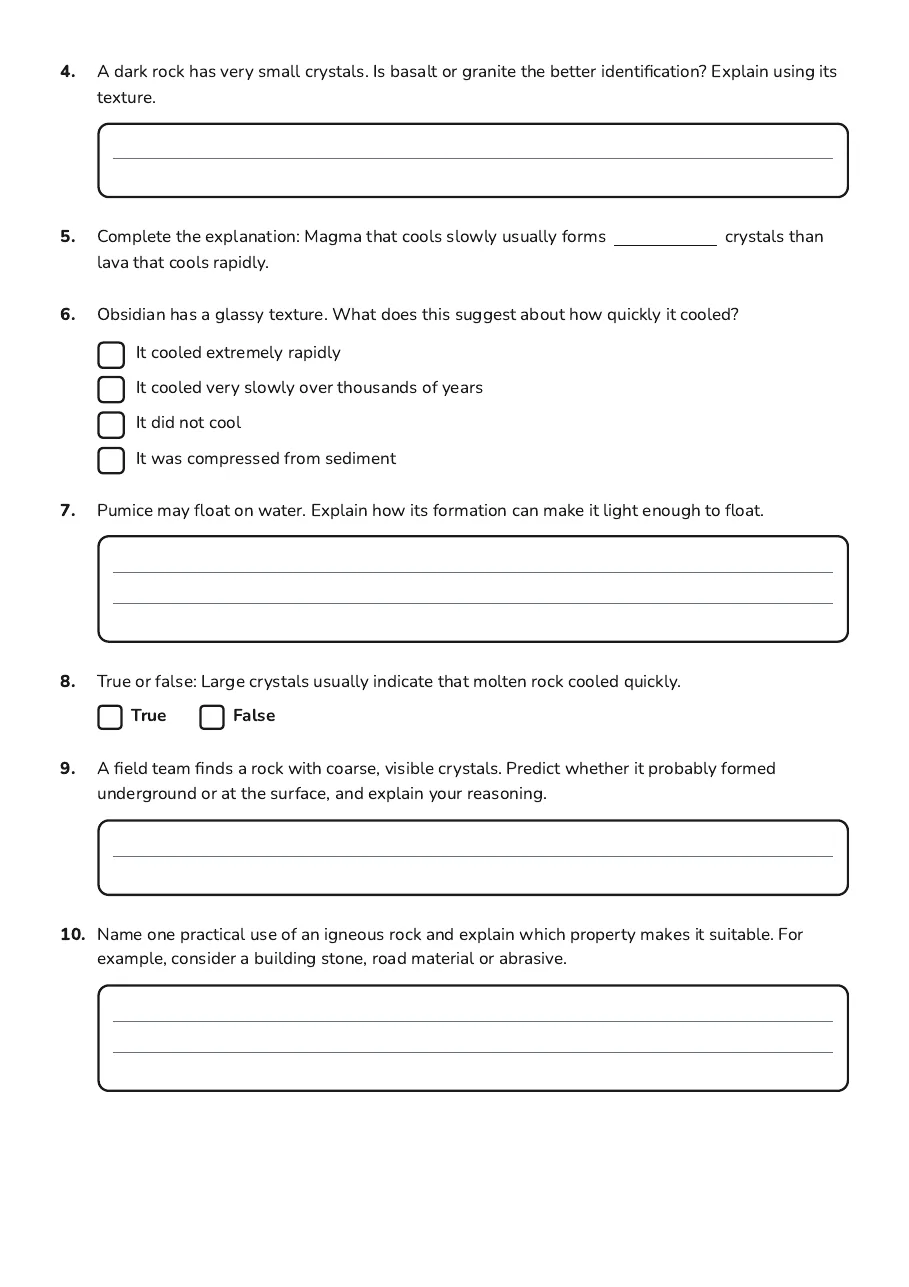
- It cooled extremely rapidly
- It cooled very slowly over thousands of years
- It did not cool
- It was compressed from sediment
2 printable pages
Page 1
Page 2
About This Worksheet
Free in Kuraplan
Sign up free, grab the PDF, and customize it for your class.
Print-Ready
Formatted for standard paper. Clean layout, easy to read.
AI-Generated
Created with Kuraplan's AI, designed for real classroom use.
For Teachers & Parents
Use in classrooms, for homework, tutoring, or homeschool.
Need a custom version of this worksheet?
Kuraplan's AI generates custom worksheets in seconds — differentiated for every learner, aligned to your curriculum.
Generate Custom Worksheets — Free