ScienceFreePrintable

Iodine Number Calculations

A free science worksheet ready for your classroom. Open in Kuraplan to grab the print-ready PDF, customize it for your students, or generate a fresh version in seconds.
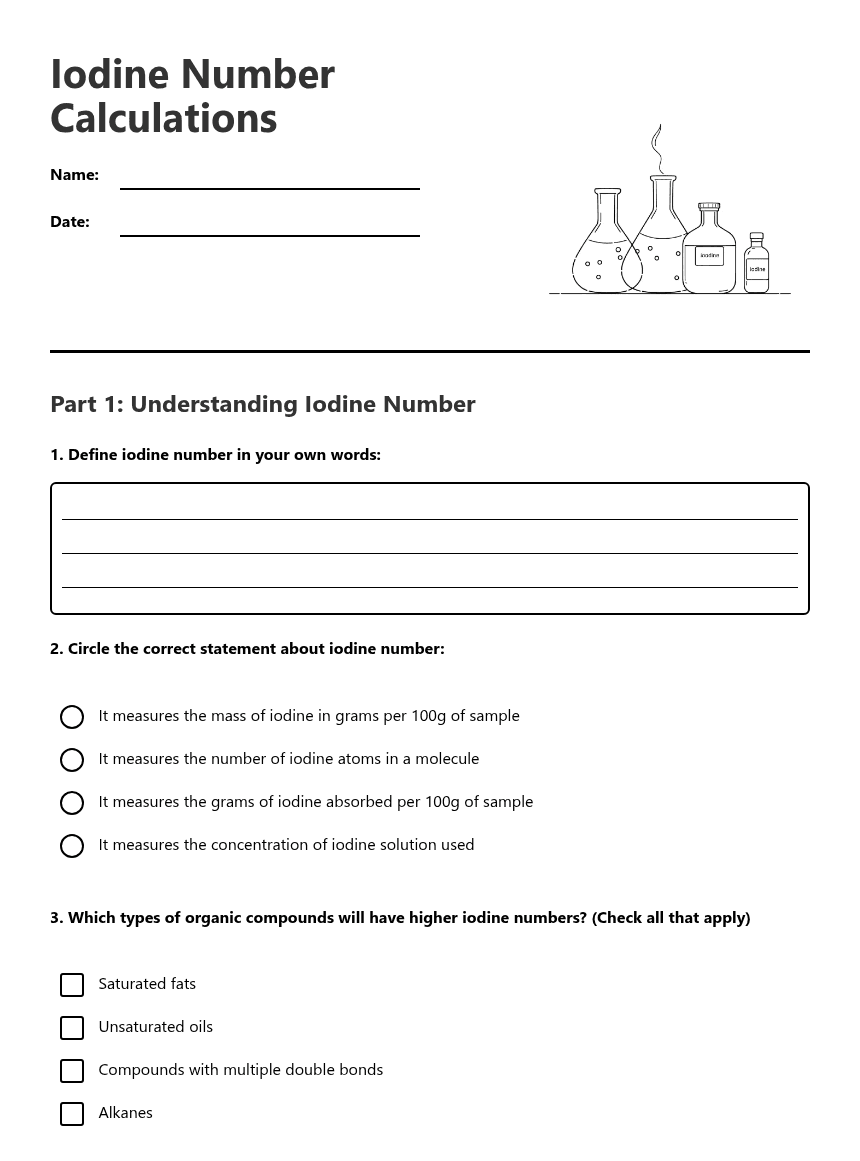
Iodine Number Calculations worksheet preview
Iodine Number Calculations

Iodine Number Calculations

Chemical structure showing iodine addition to double bonds

Part 1: Understanding Iodine Number

1. Define iodine number in your own words:
2. Circle the correct statement about iodine number:

It measures the mass of iodine in grams per 100g of sample

It measures the number of iodine atoms in a molecule

It measures the grams of iodine absorbed per 100g of sample

It measures the concentration of iodine solution used

3. Which types of organic compounds will have higher iodine numbers? (Check all that apply)

Saturated fats

Unsaturated oils

Compounds with multiple double bonds

Alkanes

Part 2: Chemical Reactions and Mechanisms

4. Draw the reaction mechanism showing iodine addition to a double bond:
5. Complete the following equation for iodine addition:

R-CH=CH-R' + I₂ → ___________________

6. Explain why the brown colour of iodine solution disappears when it reacts with unsaturated compounds:

Part 3: Iodine Number Calculations

7. A 2.50g sample of olive oil required 15.2 mL of 0.100 M sodium thiosulfate to titrate the excess iodine. If the blank titration used 25.0 mL of the same thiosulfate solution, calculate the iodine number.

Given information:

• Sample mass = _______ g

• Volume of Na₂S₂O₃ for sample = _______ mL

• Volume of Na₂S₂O₃ for blank = _______ mL

• Molarity of Na₂S₂O₃ = _______ M

8. Calculate the moles of iodine absorbed by the sample:

Volume of Na₂S₂O₃ used by iodine = _______ mL

Moles of Na₂S₂O₃ = _______ mol

Moles of I₂ absorbed = _______ mol (Remember: 2Na₂S₂O₃ ≡ I₂)

9. Calculate the mass of iodine absorbed and the iodine number:

Mass of I₂ absorbed = _______ g (Molar mass of I₂ = 253.8 g/mol)

Iodine number = _______ g I₂ per 100g sample

Part 4: Data Analysis and Interpretation

10. Match the following oils/fats with their typical iodine number ranges:
1. Coconut oil
2. Olive oil
3. Sunflower oil
4. Butter
A. 120-145
B. 75-95
C. 6-12
D. 25-40
11. A student obtained the following results for three different oil samples:

Sample A: Iodine number = 8

Sample B: Iodine number = 85

Sample C: Iodine number = 130

Rank these samples from most saturated to most unsaturated: _______, _______, _______

12. Explain why Sample C would likely be liquid at room temperature while Sample A would be solid:

Part 5: Applications and Critical Thinking

13. List three practical applications of iodine number testing in industry:
14. What factors could affect the accuracy of iodine number determination? (Check all that apply)

Temperature during the reaction

Presence of impurities in the sample

Reaction time allowed

Concentration of iodine solution

Age of the oil sample

15. A food manufacturer claims their cooking oil has "optimal unsaturation for health". The iodine number is 95. Evaluate this claim considering both nutritional and chemical perspectives:
16. Design an experiment to compare the iodine numbers of fresh olive oil versus olive oil that has been stored for 2 years. What would you expect to find and why?

About This Worksheet

Free in Kuraplan

Sign up free, grab the PDF, and customize it for your class.

Print-Ready

Formatted for standard paper. Clean layout, easy to read.

AI-Generated

Created with Kuraplan's AI, designed for real classroom use.

For Teachers & Parents

Use in classrooms, for homework, tutoring, or homeschool.

Need a custom version of this worksheet?

Kuraplan's AI generates custom worksheets in seconds — differentiated for every learner, aligned to your curriculum.

Generate Custom Worksheets — Free
No credit card Curriculum-aligned Under 60 seconds