Measuring Forces Worksheet
A free science worksheet ready for your classroom. Open in Kuraplan to grab the print-ready PDF, customize it for your students, or generate a fresh version in seconds.
Measuring Forces: Direction and Size
🔵 Part 1: Understanding Forces
A force is a push or pull that can change an object's speed, direction, or shape. Forces have both a size (measured in Newtons, N) and a direction.
① The _________________ of the force ② The _________________ of the force
✏️ Part 2: Drawing and Describing Forces
Draw force arrows on the diagrams below. Use a longer arrow for a bigger force and label each arrow with the force name and an estimated size in Newtons.
🅐 A gentle breeze pushing a leaf 🅑 A strong wind pushing a tree
a) Lifting a glass of water: __________ N
b) Pushing a car out of a ditch: __________ N
c) Picking up a pencil: __________ N
d) Lifting a school bag: __________ N
🌟 Part 3: Thinking Deeper
📋 Answer Guide (Teacher Reference)
Q1: Newtons (N)
Q2: Kicking a football ✓ | Pressing a button ✓ | Pushing a shopping trolley ✓
Q3: ① Direction ② Size (magnitude)
Q4: The force is larger / stronger
Q5: Two equal-length arrows — one pointing down (gravity/weight) and one pointing up (normal force)
Q6: One arrow pointing to the right, relatively long to represent 40 N
Q7: 🅑 Strong wind — the force is greater because it can move a much larger, heavier object
Q8: a) 10 N | b) 500 N | c) 1 N | d) 100 N (accept reasonable estimates with justification)
Q9: The rope moves to the right because Student B applies a greater force (80 N > 60 N). The net force is 20 N to the right.
Q10: Accept answers that mention: knowing only the size doesn't tell us where the force is going; knowing only the direction doesn't tell us how strong it is — you need both to fully describe and predict what will happen to an object.
About This Worksheet
Free in Kuraplan
Sign up free, grab the PDF, and customize it for your class.
Print-Ready
Formatted for standard paper. Clean layout, easy to read.
AI-Generated
Created with Kuraplan's AI, designed for real classroom use.
For Teachers & Parents
Use in classrooms, for homework, tutoring, or homeschool.
Need a custom version of this worksheet?
Kuraplan's AI generates custom worksheets in seconds — differentiated for every learner, aligned to your curriculum.
Generate Custom Worksheets — FreeMore Science Worksheets
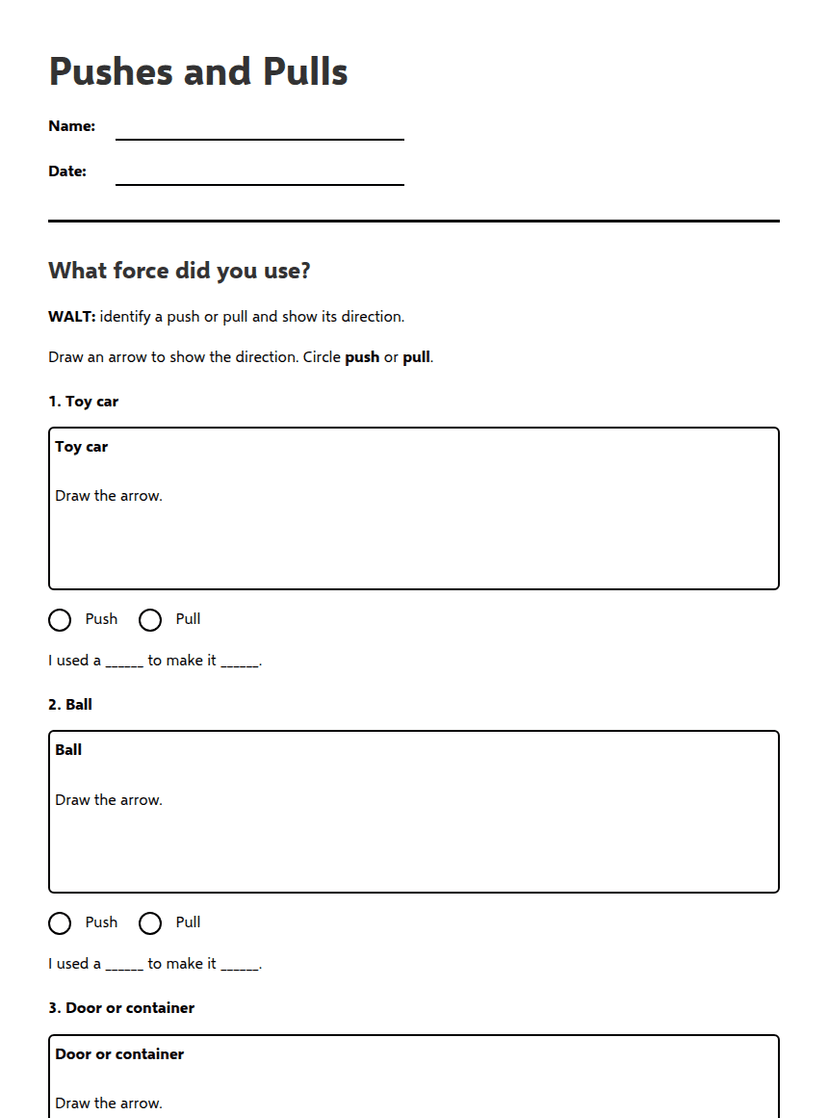
Pushes and Pulls Worksheet
Free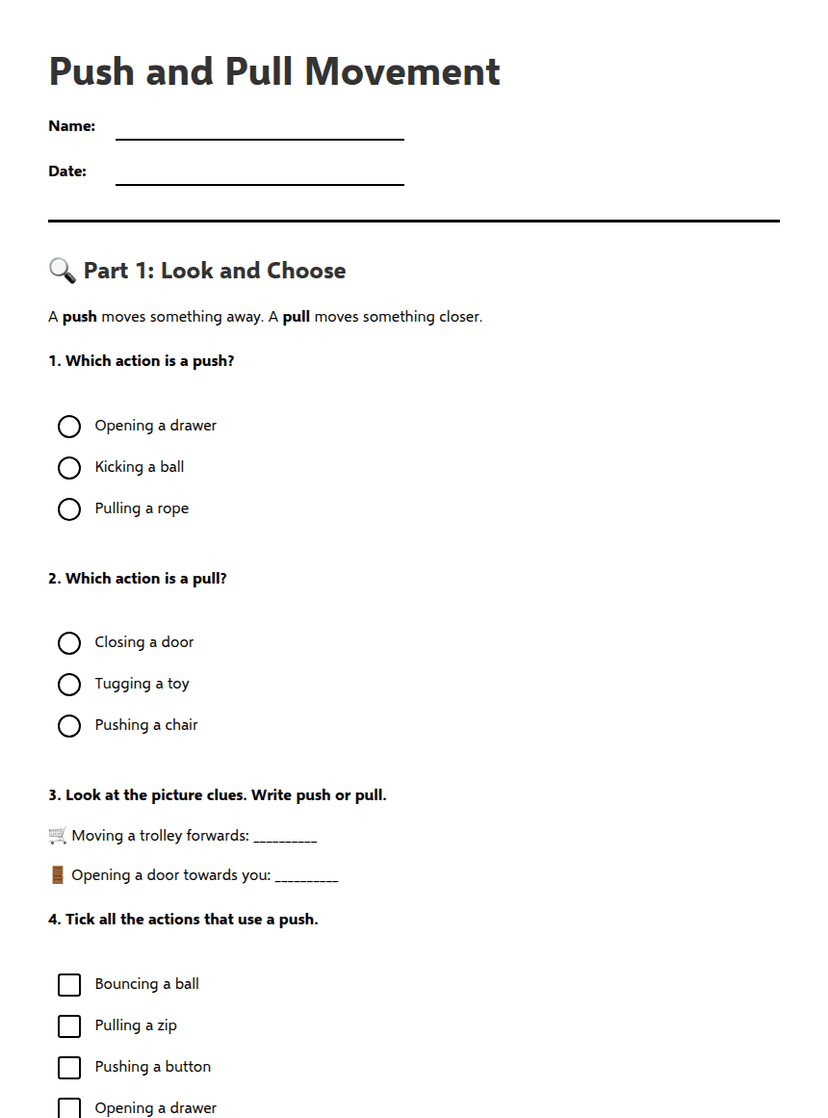
Push and Pull Movement
Free
Push and Pull Movement
Free
Car Physics: Crashes & Traction
Free
Bridge Challenge Logbook
Free
Bridge Challenge Assessment Rubric
Free
Force Diagram Practice Year 7
Free