Plant Life Energy Worksheet
A free science worksheet ready for your classroom. Open in Kuraplan to grab the print-ready PDF, customize it for your students, or generate a fresh version in seconds.
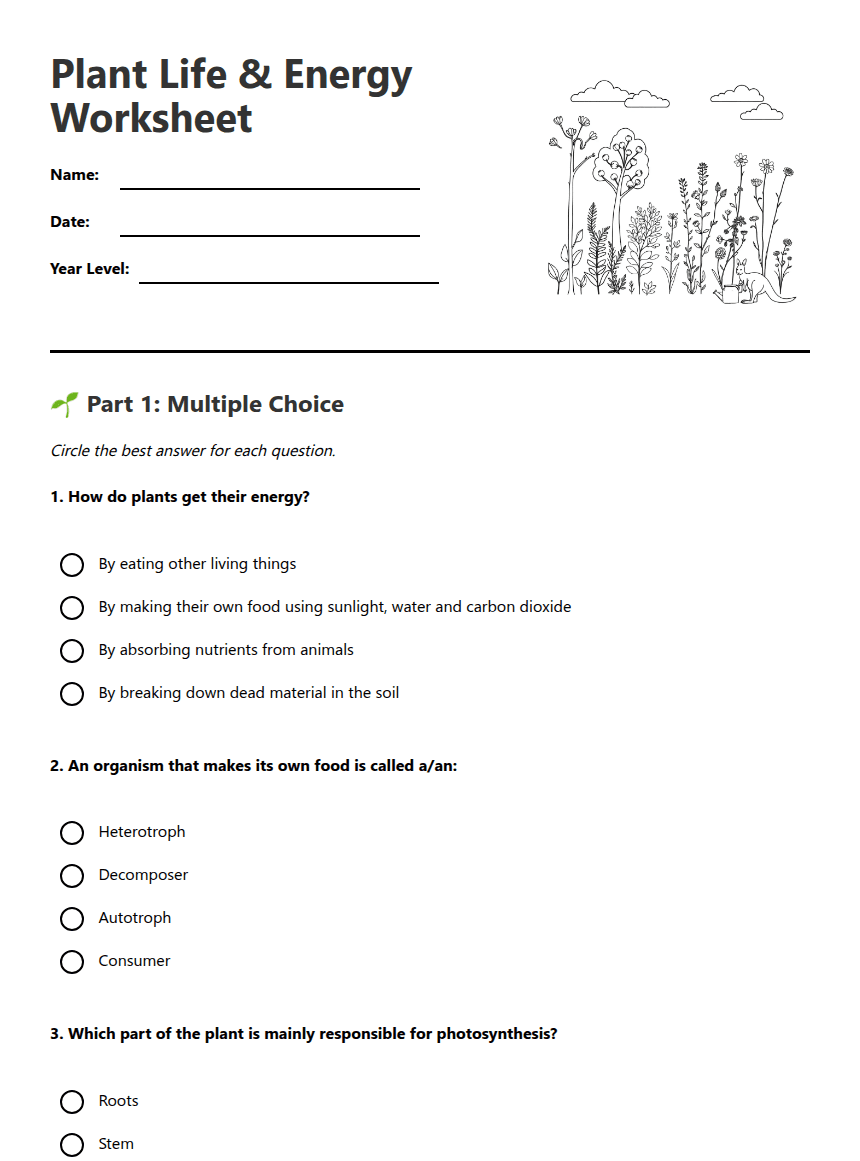
Plant Life & Energy Worksheet
🌱 Part 1: Multiple Choice
Circle the best answer for each question.
✏️ Part 2: Fill in the Blanks & Short Answer
Use the words below to complete the sentences, then answer the questions.
Word Bank: oxygen | carbon dioxide | chlorophyll | roots | sunlight | water
Plants use _____________, _____________, and _____________ to make glucose. They release _____________ as a by-product.
Roots:
Stem:
Leaves:
🌿 Part 3: Label the Diagram
Draw a simple plant in the box below and label these four parts: roots, stem, leaves, stomata. Add an arrow showing where sunlight enters and where gases are exchanged.
📋 Teacher Answer Guide
(Remove this section before printing for students.)
Q1: ✅ By making their own food using sunlight, water and carbon dioxide (photosynthesis)
Q2: ✅ Autotroph (auto = self, troph = feeding)
Q3: ✅ Leaves (contain chlorophyll in chloroplasts)
Q4: ✅ Small pores on leaves that allow gas exchange
Q5: ✅ A rabbit (heterotrophs must consume other organisms for energy)
Q6 Fill in the blanks: sunlight / water / carbon dioxide → release oxygen
Full sentence: Plants use sunlight, water, and carbon dioxide to make glucose. They release oxygen as a by-product.
Q7 Plant structures:
• Roots: Absorb water and minerals from the soil; anchor the plant
• Stem: Supports the plant; transports water and nutrients between roots and leaves
• Leaves: Main site of photosynthesis; capture sunlight and exchange gases through stomata
Q8 Stomata closing in heat: Accept answers that include — plants close stomata to prevent water loss (transpiration). If it's very hot, the plant could dry out and wilt. Closing stomata conserves water even though it also slows down photosynthesis.
Q9 Cactus adaptations (any two):
• Thick, waxy skin to reduce water loss
• Stores water in its thick stem
• Spines instead of leaves (reduces surface area for water loss)
• Shallow but wide roots to capture rain quickly
• Stomata that only open at night
Q10 Disagree: Plants are autotrophs — they make their own energy through photosynthesis using sunlight. Animals are heterotrophs — they must eat plants or other animals to get energy. Both need energy to survive, but they obtain it in completely different ways.
Q11 Diagram: Look for correct labelling of roots (below ground), stem (vertical support), leaves (broad flat structures), and stomata (small dots/pores on leaf surface). Arrows should show sunlight hitting the leaf and gas exchange (CO₂ in, O₂ out) at the stomata.
About This Worksheet
Free in Kuraplan
Sign up free, grab the PDF, and customize it for your class.
Print-Ready
Formatted for standard paper. Clean layout, easy to read.
AI-Generated
Created with Kuraplan's AI, designed for real classroom use.
For Teachers & Parents
Use in classrooms, for homework, tutoring, or homeschool.
Need a custom version of this worksheet?
Kuraplan's AI generates custom worksheets in seconds — differentiated for every learner, aligned to your curriculum.
Generate Custom Worksheets — Free