Organic Chemistry Flashcards
A free science worksheet ready for your classroom. Open in Kuraplan to grab the print-ready PDF, customize it for your students, or generate a fresh version in seconds.

Organic Chemistry Flashcards
Year 11 Science — Cut out each card and fold along the centre line
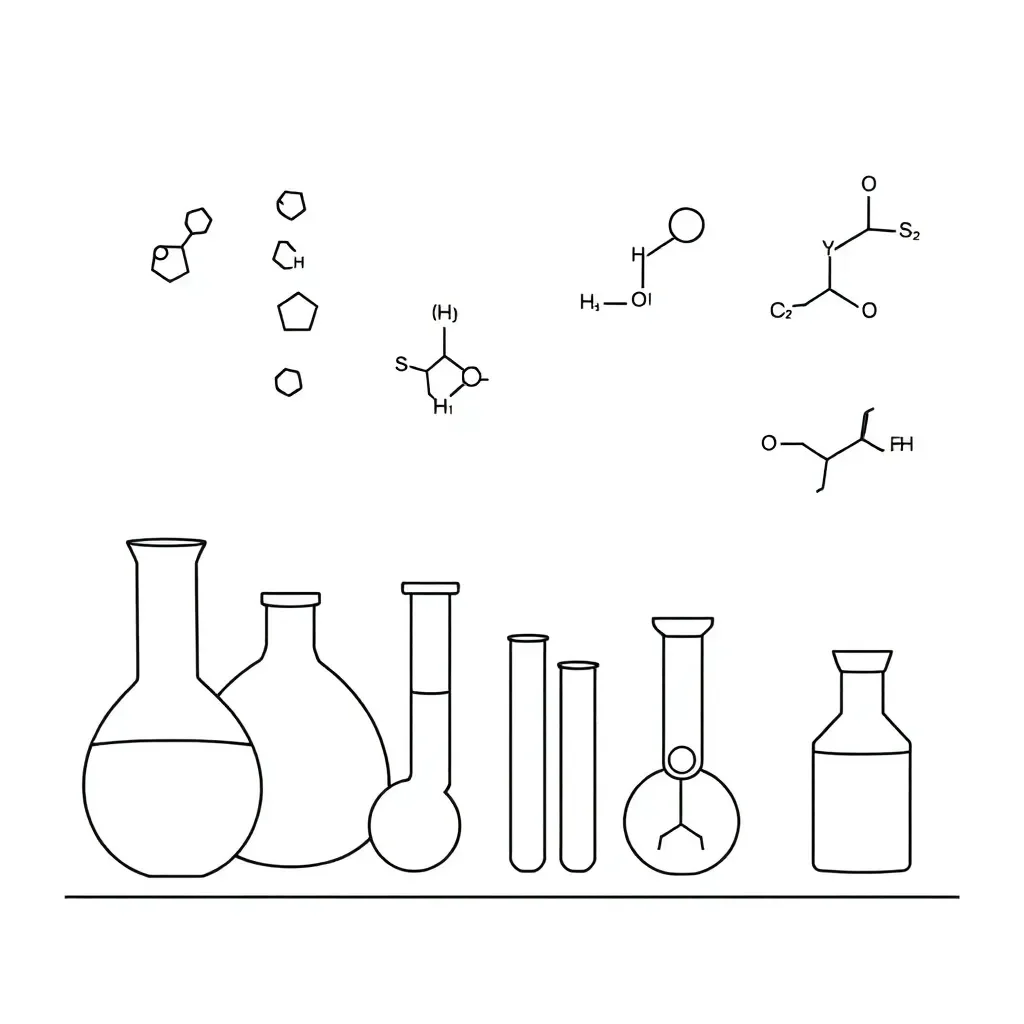
🔬 Hydrocarbons & Nomenclature (Cards 1–5)
Instructions: Study the term/question on the left, then check your answer on the right. Use these as revision flashcards.
✅ Answer: A saturated hydrocarbon containing only carbon–carbon single bonds (C–C). General formula: CnH2n+2. Examples: methane (CH₄), ethane (C₂H₆), propane (C₃H₈).
✅ Answer: An unsaturated hydrocarbon containing at least one carbon–carbon double bond (C=C). General formula: CnH2n. Examples: ethene (C₂H₄), propene (C₃H₆).
✅ Answer: An unsaturated hydrocarbon containing at least one carbon–carbon triple bond (C≡C). General formula: CnH2n−2. Example: ethyne (C₂H₂), also known as acetylene.
✅ Answer: Butane — a straight-chain alkane with 4 carbon atoms. The prefix "but-" = 4 carbons; "-ane" = single bonds only.
✅ Answer: They indicate the number of carbon atoms in the longest chain: meth- = 1C, eth- = 2C, prop- = 3C, but- = 4C. (Continued: pent- = 5C, hex- = 6C)
⚗️ Functional Groups (Cards 6–10)
✅ Answer: A specific atom or group of atoms within a molecule responsible for the molecule's characteristic chemical reactions. Examples include –OH (hydroxyl), –COOH (carboxyl), and –NH₂ (amino).
✅ Answer: An organic compound containing a hydroxyl functional group (–OH) bonded to a carbon atom. Named with the suffix "-ol". Example: ethanol (CH₃CH₂OH). Used as solvents and fuels.
✅ Answer: An organic compound containing the carboxyl group (–COOH). Named with the suffix "-oic acid". Example: ethanoic acid (CH₃COOH), commonly known as acetic acid (found in vinegar).
✅ Answer: An ester contains the functional group –COO–. It is formed by a condensation reaction between a carboxylic acid and an alcohol, releasing water. Esters are often sweet-smelling and used in fragrances and flavourings.
✅ Answer: This is a ketone, containing the carbonyl group (C=O) bonded to two carbon atoms. The compound shown is propanone (acetone), a common solvent.
🔄 Isomerism & Reaction Types (Cards 11–15)
✅ Answer: Structural isomers are compounds with the same molecular formula but different structural arrangements of atoms. Example: butane (CH₃CH₂CH₂CH₃) and 2-methylpropane (CH₃CH(CH₃)CH₃) — both are C₄H₁₀.
✅ Answer: A reaction where one atom or group of atoms in a molecule is replaced by another. Common in alkanes. Example: CH₄ + Cl₂ → CH₃Cl + HCl (halogenation of methane in UV light).
✅ Answer: A reaction where atoms are added across a double or triple bond, converting an unsaturated compound to a saturated one. Example: CH₂=CH₂ + H₂ → CH₃–CH₃ (hydrogenation of ethene). Typical of alkenes and alkynes.
✅ Answer: A reaction where two molecules join together with the loss of a small molecule, usually water (H₂O). Example: formation of esters from alcohols and carboxylic acids. Also occurs in the formation of proteins and carbohydrates in biology.
✅ Answer: Complete combustion (excess oxygen): produces CO₂ and H₂O only. Example: CH₄ + 2O₂ → CO₂ + 2H₂O. Incomplete combustion (limited oxygen): produces CO, soot (C), and H₂O — dangerous as CO is toxic.
📝 Self-Assessment
About This Worksheet
Free in Kuraplan
Sign up free, grab the PDF, and customize it for your class.
Print-Ready
Formatted for standard paper. Clean layout, easy to read.
AI-Generated
Created with Kuraplan's AI, designed for real classroom use.
For Teachers & Parents
Use in classrooms, for homework, tutoring, or homeschool.
Need a custom version of this worksheet?
Kuraplan's AI generates custom worksheets in seconds — differentiated for every learner, aligned to your curriculum.
Generate Custom Worksheets — FreeMore Science Worksheets
Atomic Theory Research Worksheet
Free
Physical and Chemical Changes
Free
Physical and Chemical Changes
Free
Year 7 Chemistry Worksheet
Free
Concentration in Solutions Worksheet
Free
Combustion and Conservation of Mass
Free
Collision Theory and Reaction Rates
Free